

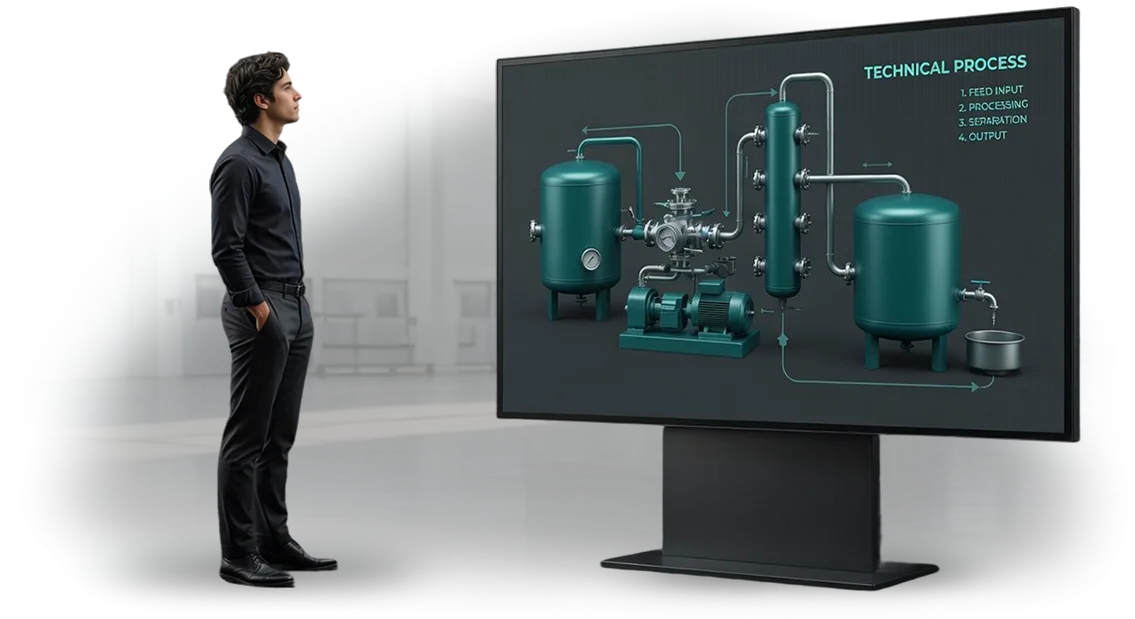
Scientific Research Centers: Staff Mistakes Cost Dearly
Every incorrect action when working with expensive equipment in a scientific research center results in more than just downtime — it means hours of downtime, repair costs, and missed experiment deadlines.
The price of a new employee's mistake can be measured in the cost of components and the loss of unique results that took months to accumulate. A manager understands: it is not enough to hand out a manual and hope that the staff will figure it out on their own.
This is felt especially acutely in laboratories where different specialists — from engineers to lab technicians — work on the same instrument. Each of them arrives with their own level of training, yet the requirements for operational precision are equally high.
After a failed equipment start-up, the entire project stalls, research is postponed, and the center's reporting and reputation with clients and partners come under threat.
Traditional training in the form of text manuals and general presentations does not solve the problem: within a week the information is forgotten, and a mentor cannot be next to every employee.
At the same time, staff turnover in the scientific environment is the norm, and every new person again goes through a long trial-and-error adaptation process. This is exactly where systemic equipment-handling errors arise — the very ones that repeat year after year.
We eliminate this risk with corporate video instructions built from accurate CAD drawings of your equipment. Instead of abstract diagrams, the employee sees every component and the sequence of operations in detail, eliminating ambiguity.
Staff training at a research institute becomes fast and visual, and does not depend on whether a mentor is available — the video material is accessible whenever a prompt is needed.
This approach reduces the number of errors when working with expensive equipment, shortens the time required to bring an employee up to speed, and protects the scientific center from unplanned expenses.
For you, this means control over the training process and confidence that even a complex instrument will remain intact and the research schedule unbroken.
Benefits of Video Instructions: Fewer Mistakes, Faster Learning
In scientific research centers, the cost of an error is especially high: incorrectly configured equipment can ruin an experiment and lead to budget losses.
Text manuals and static diagrams force employees to spend time on interpretation, and the knowledge quickly becomes outdated.
The video instructions we create replace multi-page documents with visual training. Each video is built on a 3D model of your equipment created from CAD drawings — this guarantees accuracy and full compliance with the actual machinery.
Fast Training and a Unified Standard
Employees stop reading and start watching: complex operations are shown step by step, with emphasis on key details. Training time is reduced severalfold, and the result does not depend on individual blueprint-reading skills.
A single video sets the reference sequence of actions for everyone. New employees get up to speed faster, and managers receive a standard against which work performance can be assessed.
Fewer Breakdowns and Greater Engagement
Video instructions prevent typical mistakes: the operator sees exactly how to hold the tool, where to press, and what to check. This reduces the risk of damage to expensive equipment and decreases the number of emergency situations.
Short, dynamic videos hold attention better than text. Employees review them before work and share them with colleagues, and updating materials takes hours instead of weeks — simply record a new video or modify a segment.
Formats of Training Video Instructions: Choosing the Right Fit for Your Task
The same equipment requires different training formats: one for initial onboarding, another for quick retraining, and yet another for rare operations. A scientific center employee will not rewatch an hour-long instruction to recall a single step.
Therefore, we select the format for the specific task: from full-length video to microlearning, from 3D animation to interactive training simulations.
| Format | For whom / what task | What it gives the client |
|---|---|---|
| Full-length video | New employees, full workflow with the equipment | A unified standard: the employee acts correctly from day one, fewer questions for mentors |
| 3D animation | Complex equipment, internal mechanisms, rare breakdowns | Clear understanding of what happens inside the housing — without opening it or taking risks; up to 90% faster comprehension |
| Interactive video | Knowledge checks, practicing actions, work authorizations | The employee does not just watch but makes decisions — mistakes are eliminated before real work |
| Microlearning | Experienced staff, on-the-spot prompts, review | A 1–2 minute video: quickly find the needed step and return to work |
We make the format choice at the brief stage: we analyze the operation, the audience, and how often the instruction is consulted.
For a scientific center where every minute of equipment operation is valuable, the speed of getting into a task is crucial — so we often combine 3D animation with short interactive prompts.
The main criterion is not a "pretty picture" but how quickly an employee will absorb and apply the skill. Tell us who will be trained and how often — we will offer a format that covers the task without unnecessary production costs.
How We Create Video Instructions: From Brief to Finished Video
For a video instruction to truly accelerate onboarding and reduce the number of errors, it must be born from a precise understanding of your center's workflows.
That is why we start every project with a brief: we find out which operations are the hardest to explain, where employees most often make mistakes, and what format suits a particular team.
From there, the work turns into a clear sequence of stages, at each of which you see the intermediate result and have time to make corrections. Here is how we build the creation of a training video.
-
Brief and task analysis. We record the training goals, audience, and the most problematic operations. We determine how many videos are needed and what their runtime will be.
-
Studying the equipment and drawings. We gather documentation and materials about your equipment. We examine the structure of the components so that the instruction is technically accurate and clear.
-
Script development. We write out the shots, voiceover text, and emphases. We align the narrative logic with you so that the video answers a newcomer's real questions.
-
3D modeling from drawings. We create accurate models of your equipment. This allows us to show internal mechanisms and the sequence of operations even where filming is impossible or dangerous.
-
Creating animations and filming. We bring mechanisms to life, add cutaways, and highlight key details. If necessary, we supplement the video with real footage from your facility.
-
Editing the training video. We assemble the video: cuts, text, graphics, voiceover. We verify that every step is understandable without additional explanations.
-
Approval and delivery of materials. We send a draft version, receive comments, and make corrections. We deliver the final files in formats compatible with your training system.
Thanks to this workflow, you receive a video instruction that an employee understands from the first viewing and that immediately becomes a working tool. We manage the project from brief to final file — all you have to do is approve the key milestones.
What Is Included in the Delivery: A Complete Package for a Quick Start
We have structured the delivery package so that your scientific center can launch training immediately after receiving the materials. You receive not just video files but a complete working tool: from the script to usage rights. Below is everything included in the delivery.
- Final videos — ready-made video instructions in the required formats: for LMS, the corporate portal, and in-person sessions. Optimal resolution, clean sound, subtitles if needed.
- Video source files — project files and all media assets (graphics, 3D models, animation). You will be able to make edits with your own team or order an update from us without reshooting.
- Scripts and shot-by-shot storyboards — approved texts and descriptions of each shot. This is the basis for approval, as well as the foundation for the text version of the instruction and knowledge checks.
- Methodological materials — recommendations for mentors and instructors: how to integrate the video into the training process, what tasks to give after viewing, and what new employees should pay attention to.
- Update guide — a simple procedure: how to replace an outdated segment, add a new component, or change the sequence of operations. Updates will not require a complete rebuild of the video.
- Video rights — full rights to use the materials within your center. No restrictions on duplication, the number of employees, or timeframes.
The entire package is handed over with an acceptance certificate within the agreed timeframe.
You receive a single package of documents and files that is easy to store, pass between departments, and use for training new employees — even if several years have passed since the video was created.
Case Study: How We Cut Employee Training Time in Half
When a scientific center needs to train dozens of new employees to work with complex equipment, standard instructions and mentoring do not save the day. Each operator spent about two weeks studying the regulations, and the first weeks of work were still accompanied by mistakes.
We proposed replacing text descriptions with 3D video instructions assembled from CAD drawings — so that a person sees each component and each movement instead of guessing from pictures.
The client was a research institute. Together with their engineers, we analyzed typical operations, prepared scripts, and modeled the equipment in 3D.
The videos show not only the sequence of actions but also typical mistakes: a swapped connector, incorrect force, a missed step. The employee sees the consequences — and understands why it must be done exactly this way.
The implementation results were noticeable within the first month. The time to bring a new employee up to speed was reduced from 14 days to 7 — exactly half. The number of errors when working with the equipment dropped by 30%.
This means fewer defects, less downtime, and faster progress to full independent work. The department head summed it up: "We used to train people for months and still had to redo things. Now a new employee watches the instruction, repeats it — and makes a minimum of mistakes."
For us, this project confirmed a simple fact: 3D video instructions work where traditional materials fail to deliver the needed speed and accuracy.
If you have a similar task — training personnel to work with equipment, preparing for certification, or reducing adaptation time — we are ready to deliver the same result. Take a look at how we structure our work and order a pilot project on one of your processes.
Video Instructions for Scientific Centers: What to Consider?
Scientific equipment means expensive instruments, complex regulations, and a high cost of error.
Therefore, a video instruction for a research center is not just a video but a precise guide that eliminates misinterpretation: the employee must understand the sequence of actions from the first viewing and avoid causing damage.
The main thing to pay attention to is detail. The components of scientific equipment are often small, and the connections are non-standard — they cannot be shown with ordinary filming.
We build a 3D model from your CAD drawings: any component can be rotated, a cross-section shown, a desired part magnified, and assembly demonstrated in ways impossible with a real object.
As a result, the employee sees every step clearly rather than "by eye", which sharply reduces the number of errors during work.
The second point — the relevance of instructions. Equipment is modernized, protocols change, standards are updated. If a video is outdated, it does more harm than good.
To avoid this, we make video instructions modular: you replace only the changed block instead of reshooting everything from scratch. This saves the budget and ensures that employees always train on up-to-date materials.
Integration with the corporate training system is also important. You need the video to be available in the same place where certification takes place, and viewing results to be recorded automatically.
We create videos that integrate easily into your learning platform: you can link them to tests, track each employee's progress, and see who has truly mastered the material.
Finally, remember that training in the scientific environment is an ongoing process: new employees, retraining, scheduled knowledge checks. We build in a structure that scales to these tasks.
As a result, you get not a one-off video but a system of video instructions that accelerates onboarding, reduces the risk of costly mistakes, and maintains the stable operation of the center.
Frequently Asked Questions and Concerns About Implementing Video Instructions
Implementing video instructions raises questions for any research center manager: will the timelines drag on, will materials need to be redone after regulation changes, will the team need to be expanded. We answer the main concerns — briefly and to the point, without technical details.
How long does it take to develop a video instruction?
Timelines depend on the complexity of the equipment and the number of scenes. We set a calendar plan with intermediate milestones so that you can see progress. The work typically takes two to four weeks, and the research process is not interrupted in the meantime.
How is the project cost calculated?
The cost is calculated after the brief — it is affected by the volume of 3D models and the number of video lessons. Before the start, you receive a transparent estimate that does not change after approval. No hidden payments or "as-we-go" surcharges.
What happens when the procedure changes? Do we have to reshoot everything?
No, the materials are built on a modular principle. If the sequence of operations changes, we replace only the affected segment rather than the entire series. This saves time and money, and an update takes only a few days.
Will this approach work for our specific equipment?
Yes, we create 3D models from your drawings, so the video will feature your specific instrument rather than an abstract diagram. Accuracy is confirmed at the approval stage, and the final video undergoes review together with your specialists.
We don't have a technical specialist to support the project.
That is not a problem: our team handles the entire technical side — from model construction to final editing. You work with a personal manager, and no new hires are needed for implementation.
Contact Us: Let's Discuss Your Project and Prepare a Plan
Scientific research centers spend weeks bringing new employees up to speed on working with equipment. Paper instructions are overloaded with technical details, and live trainings take time away from experienced specialists.
A video instruction with 3D visualization solves this problem: the employee sees every component, every movement, every sequence of actions — and quickly absorbs the material.
We create training videos modeled from your CAD drawings, so the image fully matches the real equipment. This format reduces the number of errors during work and accelerates an employee's path to full productivity. But the most important part — you can easily update the instructions when processes change.
To receive a project plan, simply contact us. Leave a request — within one business day we will get in touch, clarify the task, suggest a suitable format, and show examples of our work in the scientific field. This places you under no obligation, but it gives you a clear understanding of the next steps.
What you get after reaching out:
- A personal plan for creating video instructions with stages and timelines.
- An analysis of your CAD drawings and a visualization proposal.
- Selection of the optimal format: 3D model, animation, interactivity, voiceover.
- Estimated budget and timelines before the work starts.
- Demonstration of case studies for scientific centers.
- Support at all stages — from script to final version.
- The ability to make adjustments after launch.
Order video instructions right now: call us or leave a request on our website. We will discuss the task, show our portfolio, and prepare a preliminary plan so that you can make your decision with full clarity.
We have been helping companies train employees visually and effectively for more than ten years, and your center could become the next success story.