

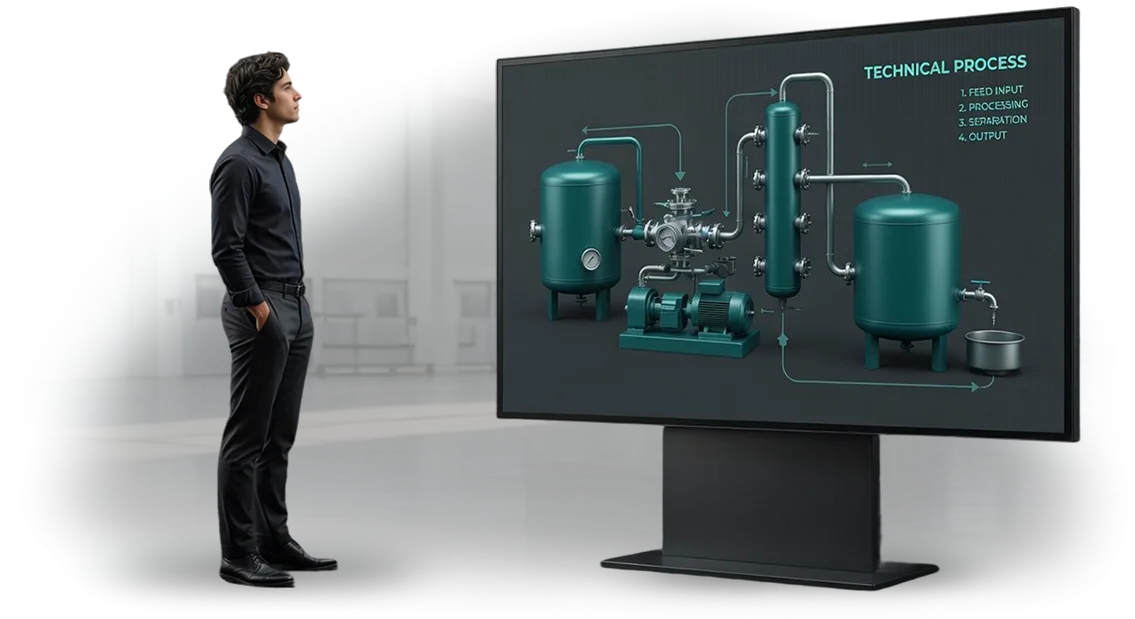
Employee Errors in Telecommunications Manufacturing: Lost Profit
Every employee mistake on a telecommunications production line is not just a failure — it is a direct loss of profit.
While a new operator masters complex equipment through text instructions and verbal explanations, the line runs slower, defects appear, and the share of scrap and rework grows.
Meanwhile, staff training is most often organized as "passing experience from senior to junior": the process drags on for weeks, and knowledge still remains fragmented.
Training errors lead to employees acting hesitantly, skipping critical steps, and disrupting the sequence of operations.
In telecommunications manufacturing, this is especially costly: every inaccuracy in assembling or configuring equipment results in repeated checks, missed deadlines, and additional expenses. A manager sees the drop in output but does not always understand exactly where money is being lost.
The main cause is the lack of a unified visual standard that an employee can use at any moment. Texts, diagrams, and photos do not give a complete picture of the process, and live consultations with a mentor cannot be repeated indefinitely.
As a result, training takes too long, and its quality depends on a specific person rather than on the system.
We solve this problem by creating video instructions based on 3D equipment models built from your CAD drawings. The employee sees the exact sequence of actions with the correct parts and assemblies, so they learn faster and make fewer mistakes.
This reduces losses, accelerates newcomers' path to full productivity, and makes training predictable across all shifts.
What Video Instructions Will Bring to Your Manufacturing
Every production facility faces the same pain: newcomers take a long time to get up to speed, and experienced employees make mistakes due to different approaches to work.
In telecommunications manufacturing, this is especially critical — complex equipment, serial operations, and a high cost of defects. Video instructions turn the experience of the best employees into a clear standard that is equally understandable to everyone.
We create video instructions based on your real processes, with 3D equipment models, so that the employee sees each step. Here is what you get after implementation:
-
Fewer errors. The employee checks every action against the reference and does not rely on memory. The number of defective operations drops by a third.
-
Faster onboarding for newcomers. Instead of a week of theory — a few viewings and the first operations under supervision. A trainee starts delivering value sooner.
-
A unified standard. Everyone works by the same methodology, without "this is how I was taught." Quality becomes predictable.
-
Mentors save time. Basic questions are handled by video, and the mentor steps in for complex cases. Mentors get more done.
-
Rapid adaptation to new models. For new equipment, updating the video is enough — no need to gather the whole shop floor for a briefing.
-
Output stability. When everyone acts in the same correct way, every batch is produced according to the technology. This reduces claims and strengthens customer trust.
Go through this list: if at least three points "hurt" — video instructions will pay for themselves within the first months. Request a commercial proposal — we will show you the cost calculation for your production area.
Video Instruction Formats for Telecommunications Manufacturing
Videos of a single length and level of detail do not cover all production tasks. A newcomer needs an overview, an experienced employee needs a breakdown of a non-standard situation, and a master needs the sequence of operations.
If you choose the wrong format, employees lose time or miss important details. That is why we have divided formats to match different tasks and skill levels.
Options for telecommunications manufacturing are below.
| Format | For whom | What it gives the client |
|---|---|---|
| Short 3D video up to 1 minute | New employees, adjacent departments | Quick introduction to equipment, fewer errors on first contact |
| Detailed video instruction with breakdown of assemblies and mechanisms | Technical staff, repair services | Clear understanding of the equipment, less time for diagnostics and repairs |
| Modular video course with tests | For systematic training and certification | Standardized knowledge, control of material comprehension |
| Animated sequence of operations | Line operators, assemblers | Minimum errors in assembly and configuration, fast entry into rhythm |
We create any of these formats using 3D animation built from CAD drawings. This allows us to show equipment from any angle, in cross-section, and in motion — things that cannot be captured on camera. The employee sees the object they work with even if the equipment has not yet been delivered.
We will select a format for your task: from a one-off video to a full course. Tell us which operation causes the most errors — we will offer a solution.
How We Build Work on Your Video Instructions
Developing video instructions is a process where nothing should be lost: from the first brief to the final video. That is why we have structured our work so that you always know what stage the project is at and can influence the result without unnecessary coordination.
We assign a project manager who is responsible for deadlines and communication. They collect requirements, translate them into the language of 3D graphics, and regularly send you interim versions. You see how the video takes shape and make edits in time.
Here is how the work is structured:
- Brief and task analysis. You tell us about employees, equipment, and problem areas in operations. We study CAD drawings and process charts to understand exactly what needs to be shown.
- Plan, estimate, and timeline. We fix the stages, approval checkpoints, and delivery dates. You get a clear schedule, not a vague "it will be ready soon."
- Script and storyboard. Based on real operations, we create a script and show what each frame will look like. This is the easiest stage to adjust the emphasis.
- 3D modeling and texturing. Based on your drawings, we create accurate equipment models — this guarantees that the employee sees in the video exactly what they work with on the shop floor.
- Interim approval. You receive a draft version, leave comments, and we make edits. Usually one or two cycles are enough, because all details have already been approved.
- Launch and handover. We prepare the final video in the required formats, add subtitles, and upload it to your learning management system. We check that the video runs on all employee devices.
- Support after launch. If questions arise or the instruction needs updating, we quickly make changes. You are not left alone with the material.
This workflow allows us to launch video instructions in three to four weeks and get a product that truly works in training.
What Is Included in Preparing Video Instructions for Manufacturing
Preparing video instructions for manufacturing is not a single video but a comprehensive project. We assemble a complete package: from three-dimensional equipment models to instructional documents and usage rights.
As a result, you get a ready-made training system that integrates into the work of a shop floor or department without unnecessary hassle.
Here is what is included in the result:
- Scope of work. We model equipment according to your CAD drawings, create realistic textures, and animate assemblies and mechanisms. The videos show the exact sequence of operations — assembly, disassembly, maintenance, setup — with voiceover and subtitles.
- Project deliverables. Finished video instructions in formats for desktop computers, tablets, and smartphones. Employees can watch them on the shop floor, in the office, or remotely — on any device, without special software.
- Documentation. We provide instructional materials, text versions of instructions, operating manuals, and checklists for knowledge control. Everything stays with you and is used for certification and onboarding.
- Rights. You receive full rights to all content. You can use the materials inside the company, rework them for your tasks, and expand them without approval from us.
- Guarantees. We support the project after delivery: we make edits free of charge during the warranty period if the design changes or new operations appear.
- Support. We stay in touch, help integrate video instructions into training, answer employee questions, and quickly update materials when needed.
This approach addresses the main pain of manufacturing — scattered instructions that gather dust in folders and go unused. Instead, you get a unified training standard that is clear to both a newcomer and an experienced worker.
And documentation and guarantees remove risks: you know exactly what you received and can rely on the result.
Case Study: Reducing Training Time and Decreasing Errors
We approached the production director of one telecommunications plant with a non-standard task: the enterprise produced complex equipment, but training new employees took up to three weeks.
Experienced mentors were distracted from their own work, and newcomers still made mistakes when assembling components — each such mistake meant line downtime and rework.
About the case
We developed a series of corporate video instructions based on three-dimensional equipment models created from the client's CAD drawings.
Instead of flat diagrams and text regulations, the employee received a visual aid: every operation can be viewed from any angle, the assembly sequence can be understood, and typical mistakes can be seen before they happen on a real machine.
The instructions were divided into modules by difficulty level: from basic assembly to setup and diagnostics. This made it possible to use the videos both for initial training of newcomers and for advanced training of existing workers.
Results for the client in the first months
The adaptation time for a new employee decreased by almost a third. The number of assembly errors dropped by 40% already in the first quarter — confirmed by internal quality audits at every site.
Mentors stopped spending time re-explaining the same operations, and shop floor managers got a control tool: every worker is trained according to a unified standard without loss of quality.
The project paid for itself through reduced scrap and downtime, and the experience was so successful that the client expanded the format to other production lines and included video instructions in their permanent onboarding program. A year later, the enterprise ordered an update of the library for new equipment models.
This case is a clear example of how well-designed training video changes production economics. If you have a similar situation — long onboarding or frequent employee errors — our team is ready to calculate what effect this format would bring to your enterprise.
How to Choose the Right Video Instruction Format for Your Task?
Choosing a video instruction format for telecommunications manufacturing starts not with "how to shoot it beautifully" but with the question "what should employees learn to do." One site only needs a short animation with an assembly breakdown; another needs full 3D modeling with texturing from drawings.
We help you find your bearings: we determine what level of detail your staff actually needs so they can understand the equipment faster and make fewer mistakes.
Each format solves its own task. Full 3D modeling suits complex assemblies, repairs, and maintenance — it shows every assembly from the needed angle. Short animated schemes work when you need to explain the sequence of operations or safety rules.
And video with real equipment works best when training on already installed systems. We choose a combination rather than a single format.
An individual approach is the foundation of our offering. We do not sell template shooting but analyze the task: who watches the instruction, how often, and at what stage of work. This lets us cut the unnecessary and avoid overpaying for excessive detail.
If employees only need the sequence of actions — we keep it concise. If understanding the internal structure of equipment is required — we add detailed 3D cross-sections.
The budget also factors into the solution selection. We honestly show what the cost consists of: video length, modeling complexity, number of scenes. And we offer options — for example, a short version first for a quick training launch, with the detailed one completed afterward. That way you get a working result from the start, not endless approvals.
There is no need to guess — call us, and after a couple of clarifying questions we will select the right format. You will get a video instruction that matches your task and budget, not just a "video for show."
Frequently Asked Questions About Developing Video Instructions
Before ordering the development of training videos, many have the same questions: how long it will take, what the price consists of, and how suitable the result will be for real employee work.
Below are answers to the most common concerns — they will help you plan the project in advance and avoid surprises.
How long does it take to develop one video instruction?
Usually two to four weeks, depending on the complexity of the equipment and the number of scenes. We start with a brief and drawings, then create the 3D model, visualization, and editing.
You see interim versions at every stage — this allows you to make edits along the way and deliver the video exactly on time.
How is the project cost calculated?
The cost depends on the scope of work: the number of equipment assemblies, the level of instruction detail, and the presentation format. We do not count hours — after the brief we fix the estimate and do not change it during the process unless the task changes. You know the budget in advance and receive all files that can be used in training.
What guarantees that the result will suit employees?
We sign a contract that specifies the scope of work, deadlines, and the final result. Before delivery we show a draft version, and you confirm each step.
If employees find something unclear after test training, we refine the video until it is completely clear — this is already included in the work.
What should be known about preparing source data?
For accurate reproduction of equipment, CAD drawings in any common format are sufficient. If there are no drawings, we can create the model from photographs and your comments.
We take on the entire technical part — you only need to assign a specialist who will confirm the correctness of the actions in the instruction.
If you still have doubts about timelines, budget, or format — let us discuss the details in a short consultation and prepare a preliminary cost calculation for your task.Order Video Instructions for Employee Training Now
Starting is easy: just leave a request on the website or call us. This takes a couple of minutes, and in return you will get a clear plan for creating video instructions.
We work with telecommunications enterprises and know how to turn a complex CAD drawing into a clear guide for an employee. Your team will master new operations faster, and experienced workers will get a convenient everyday reference.
The first step is a consultation. We will discuss your tasks, show examples, and suggest the optimal format. If you have working drawings or ready-made scripts, we will use them as a basis; if not, we will help develop a script from scratch. This is not binding: you will learn the possibilities and make an informed decision.
After the consultation, you will receive a project assessment: timelines, scope, and cost. We prepare preliminary calculations and do not push services — the decision is yours. Here is what you get immediately after reaching out:
- A consultation with a training video expert.
- An assessment of your project within one business day.
- Recommendations on the structure and script of your future instruction.
- Examples of our work in 3D modeling of manufacturing equipment.
- A clear commercial proposal with a fixed price and no surprises.
- A guarantee on the result: edits until full approval.
This approach saves your time and money: you do not risk blind prepayment. You know exactly what you are paying for and when you will receive the finished videos. To get started, fill out the form on the website — we will contact you at a convenient time.
From there, the process is transparent: we sign the contract, fix the timelines, create 3D models and animation, and approve interim versions. The entire cycle takes from 10 days — you see the result at every stage and can make edits.