

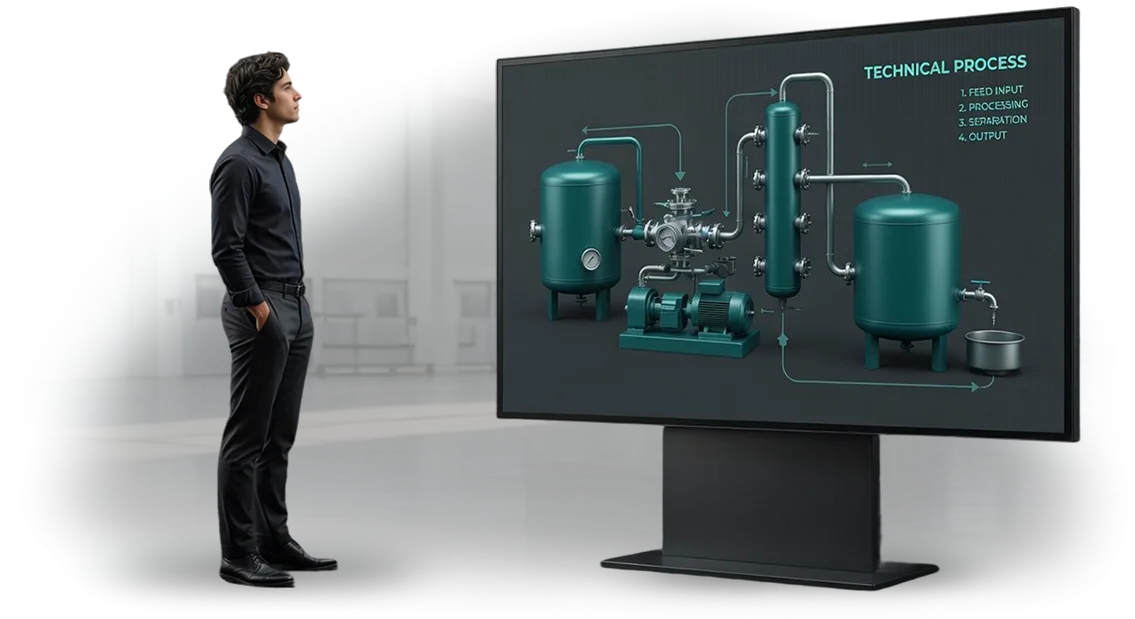
Logistics and Warehouse Automation: Training Without Stopping Operations
Logistics mistakes cost businesses more than it seems at first glance. An incorrectly assembled shipment, a missed barcode, an improper pallet — these mean shipment delays, returns, and damaged partner relationships.
At the same time, classic training for new hires relies on personal guidance: experienced employees get distracted from their own tasks, knowledge is passed on selectively, and every mistake quietly increases business losses.
Video instructions solve the problem without stopping operations. A training video shows the full cycle of operations from receiving to shipping, with demonstrations of equipment exploded views and the correct sequence of actions.
The employee sees not only "what to do" but also "why this way is safer and more reliable." The algorithm is remembered faster than text, and the instruction can be opened at any moment if a question arises.
For logistics and warehouse automation, this format is especially convenient when implementing new equipment and changing regulations.
There's no need to stop a shift for training: employees complete training when it suits them, and the manager sees the result in a reduced number of incorrect operations.
We develop 3D video instructions tailored to your processes and equipment: we capture standards, turn them into visual scenarios, and deliver a package for regular use.
This way, employee training stops being a source of downtime and becomes a tool for stable warehouse operations.
What You Get from Video Instructions for Employees
Fast onboarding of new employees and error reduction are key challenges for warehouses and logistics complexes. Regular text instructions don't cut it: a newcomer wastes time, makes mistakes, and the mentor gets distracted from their own work.
Video instructions from our team solve this problem by giving employees a visual and unified standard for performing operations.
Here is what you get:
- Onboarding speed — a new employee watches a 3D video instruction with an equipment exploded view and immediately understands how the assembly is structured and in what order to put it together. Time to full proficiency is reduced dramatically.
- Error reduction — the video shows every step without skipping, so the employee follows a single algorithm. The number of defects and rework decreases, while safety improves.
- Unified training standard — all instructions are produced in the same style and contain up-to-date regulations. No more relying on mentors' "personal experience" and word-of-mouth retellings.
- Less load on experienced employees — the mentor doesn't explain the same thing ten times: the video handles the routine, while specialists focus on complex tasks.
- Available at any time — instructions can be reviewed from any device; when regulations change, you only need to update one video instead of reprinting manuals.
- Visibility for complex operations — the exploded view shows the internal structure of mechanisms, which is especially valuable for repair and maintenance of warehouse equipment.
With such video instructions, you get a predictable result: faster onboarding, fewer errors, and stable work quality across all facilities.
Video Instruction Formats for Warehouse Automation Tasks
Warehouse automation requires employees to quickly master new processes, but a one-size-fits-all instruction doesn't work here.
An operator needs to understand the operating principle of a mechanism, a setup technician needs the structure of assemblies, an engineer needs the logic of how parts interact.
Every hour of downtime or personnel error is direct loss, so the training format must precisely match the task.
We select the option to fit a specific employee role. Three main formats cover most scenarios in a modern warehouse with automated lines.
| Format | For whom | What it gives the client |
|---|---|---|
| 3D animation of mechanism operation | Operators, pickers, warehouse staff | Quick understanding of equipment operating principles without studying blueprints. The employee sees the entire process as a whole and remembers the correct sequence of actions. |
| Exploded views and design breakdowns | Setup technicians, maintenance staff, engineers | A clear view of the mechanism's structure: what parts it consists of and how they interact. Helps localize faults faster and reduce line downtime. |
| Interactive videos with action choices | All employee categories during knowledge checks | Engaging training: the worker makes decisions inside the video and immediately sees the consequences. Higher material retention, lower risk of errors in real work. |
This division doesn't overload the employee with unnecessary information — everyone receives material in the format that leads most quickly to correct actions.
As a result, the business gets a shorter time to full proficiency, fewer operational errors, and stable operation of warehouse equipment without unscheduled stops. We adapt any format to your regulations and specific setups.
How a Video Instruction Project Works
We've structured the process so that you see results at every step and don't waste time on technical details. Instead of a "black box," you get a transparent schedule with checkpoints: from the initial brief to the launch of the finished video instruction.
Over 10 years, this algorithm has been refined across hundreds of projects, so timelines and quality are predictable. We work remotely — all approvals happen online, with no need to gather a team in a conference room.
- Brief and immersion — you describe the task, audience, and current challenges; we clarify the details so that the instruction hits the mark and solves employees' real problems.
- Plan and timeline — we lock in stages, dates, and formats; you receive a clear schedule and budget with no hidden surcharges.
- Script and storyboard — we show the logic and visuals; you approve them before production starts, so there's no "wrong" video.
- Video production — we create animation, 3D demonstrations, and voiceover, sending intermediate versions for your review.
- Draft approval — we review together and make edits; usually two or three iterations are enough for you to be fully satisfied.
- Launch and support — we deliver the files, help you deploy them, and quickly update the instruction when changes occur.
This approach gives you the most important thing — control and a predictable result. You're not buying a "pig in a poke"; at every stage you see how the solution comes together.
An average project takes two to four weeks, and repeat orders come from the majority of clients — the best indicator of quality.
What's Included in Delivery: A Complete Package for the Training Department
The training department gets not just videos, but a ready-made system for launch and control. The delivery package includes materials that can be used immediately — from the first viewing to knowledge checks.
Everything is assembled into a single set so you don't have to figure anything out on your own or hire contractors for related tasks.
- Video files in all required formats. Ready-made videos for the learning management system, for showing at briefings, and for smartphone access. Employees complete training at a convenient time, and you can see that the video was viewed.
- Scripts for each video. A step-by-step description of shots with voiceover text. If a process changes, you can easily figure out what to reshoot or hand the script off to production without a new storyboard.
- Methodology guide for the training department. Recommendations on how to integrate the videos into your program: when to show them, how to reinforce the material, what questions to ask for verification. Saves weeks of instructor preparation time.
- Access to the video instruction library. A database of ready-made scenarios and best practices for warehouse and logistics processes. You can use them as a foundation and adapt them to your regulations.
- Employee cheat sheets. Short cards with key steps for workstations. Video plus a quick reference gives double reinforcement of the material.
- Launch support. We help connect the videos to your system and answer questions during the first weeks. That's usually enough for the department to train a pilot group without our help.
This package covers the full cycle: you get not a "raw file" but a tool that immediately works to increase employee onboarding speed and reduce error rates.
Case Study: How We Reduced the Adaptation Period by 40%
New warehouse employees typically take 2–3 weeks to adapt when trained using text regulations. Texts don't help them understand exactly how to detach an assembly or in what sequence to assemble a gripper — the employee remembers the wrong order and makes errors during picking.
The logistics operator we worked with faced two problems: the adaptation period stretched to a month and a half, and the error rate in order assembly reached 8%.
During the season, when 60–100 temporary employees were hired, this caused direct losses: returns, assortment mix-ups, wasted team time.
We replaced flat cheat sheets with 3D video instructions. Each operation is shown with an exploded view of the assembly: the employee sees which parts to remove, in what order to connect them, and what the correct result looks like. This eliminates the gap between "as written" and "as done."
Results for the logistics operator after 2 months:
- Adaptation period reduced by 40% — from 10 days to 6 for new employees;
- Picking errors decreased by 25% — fewer returns and claims from retailers;
- Load on mentors dropped threefold — they answer complex questions instead of repeating the same thing.
How it looked in practice:
- We built 3D models of the 20 most common operations at the client's warehouse — from dismantling a box gripper to setting up weight control.
- We broke each operation into 6–10 steps: preparation, disassembly, inspection, assembly, checking, securing.
- We recorded videos with subtitles and text support so the instruction could be reviewed on a tablet right at the station.
- We developed a knowledge-check scenario: the newcomer watches the video, performs the operation, and gets a sign-off from the mentor.
- We integrated access into warehouse tablets and mobile phones — the instruction is always at hand, even in storage areas without a stationary computer.
The client — a regional logistics operator with a distribution center of 300 employees — ordered an expansion of the library to cover new operations after implementation.
Instructions are updated when equipment changes rather than rewritten from scratch, so employees always work with the current version of the process.
Implementation took 3 weeks: one week for filming and modeling, one week for editing and subtitles, one week for integration and testing across two shifts. Already in the first month of the new training scheme, the client saw the first 15% reduction in errors.
How to Choose the Right Video Instruction Format?
The first question isn't "which format is trendier" but "what problem are we solving." If employees confuse the assembly order or make errors during picking — you need a clear step-by-step demonstration.
If you're training people to work on new equipment — interactive content with pauses and emphasis works better. The format is chosen based on a specific business outcome: reducing errors, speed to standard performance, lowering the load on mentors.
The second criterion is the complexity and update frequency of operations. For stable processes, classic video with an instructor is sufficient.
For multi-assembly mechanisms, 3D videos with exploded views are more effective: they show the internal structure and sequence without live filming.
If instructions will change frequently, choose modular production: short blocks are easier to replace than reshooting an entire film.
The third is the audience. New hires in high-turnover environments get up to speed faster with minute-long videos, while experienced employees only review complex assemblies. Consider how many people will train simultaneously and whether they have access to tablets or terminals. This determines both video length and the number of versions for different groups.
Finally, consider how you will verify results. If you need confirmed skill demonstration — add interactive inserts with questions and practical tasks. If the goal is simply to inform, a full-screen video with navigation is enough.
At the start, we recommend running a pilot on 3–5 operations: compare speed and quality before and after, and it becomes clear which format to scale.
The right choice is a balance between clarity, production speed, and ease of maintenance. We help select the format based on an analysis of your operations: you get not just a video, but a training framework that pays for itself in the first month of use.
Common Doubts: Addressing Pre-Order Concerns
Before ordering corporate video instructions, clients often hesitate: won't the videos become outdated, is it easy to update them, what guarantees do we provide. That's normal — you're investing budget and time, so you want confidence in the result. We've decided to address these concerns openly.
Below are honest answers to the three most common questions. If anything remains unclear after reading them, ask directly: the engineer who will manage your project is available.
What if the video becomes outdated?
Warehouse processes change regularly: regulations are updated, new equipment arrives, workflows change. We account for this at the development stage — instructions are built on a modular principle, with each operation becoming a separate short block.
If one detail changes, you replace only that module rather than reshooting the entire video line. The budget isn't spent on re-filming, and employees always work with current instructions.
Is it difficult to update instructions?
An update takes a few business days. You send new input — we make changes to the digital model and deliver the finished video. You don't need to hire an editor, learn software, or pause staff training: you simply approve the result and publish it for the team.
What guarantees do you provide?
We work officially under a contract: we fix the technical specification, timeline, and cost. You accept the project in stages, see intermediate versions, and control the process from the very start. After launch, we provide free support for the first weeks of instruction use.
If you find a discrepancy with the approved scenario, we'll fix it at our own expense — this is also written into the contract.
Next Steps: Application, Consultation, and Training Launch
Warehouse or logistics hub development often comes down to one thing: how to quickly train new employees without losing operational quality. We close this question in a few steps — from application to a working video instruction system.
Here's what happens after you submit an application:
- Application. You describe your task — the area, position, number of employees, problem spots in training.
- Consultation. Our specialist clarifies details, answers questions, and advises which video instruction formats fit your warehouse best.
- Cost calculation. We prepare a transparent estimate within one business day — no hidden fees or surcharges at the end of the project.
- Examples and samples. We show real training videos for logistics and warehouse automation so you can see the result before work begins.
- Launch plan. We lock in stages, timelines, and responsible people, and agree on the schedule for creating 3D instructions and filming.
- Training launch. You receive a complete video instruction package integrated into your learning management system and start the flow of trainees right away.
No "we'll call you in a week." After your application, we follow a set procedure: consultation, estimate, examples, plan, and launch.
Our team works remotely across the entire country, so it doesn't matter where your warehouse is located — material preparation proceeds without delays.
Submit your application today — by tomorrow you'll know the project cost and see what your instructions will look like. All that's left is to launch the training and watch new employees reach their performance targets faster.