

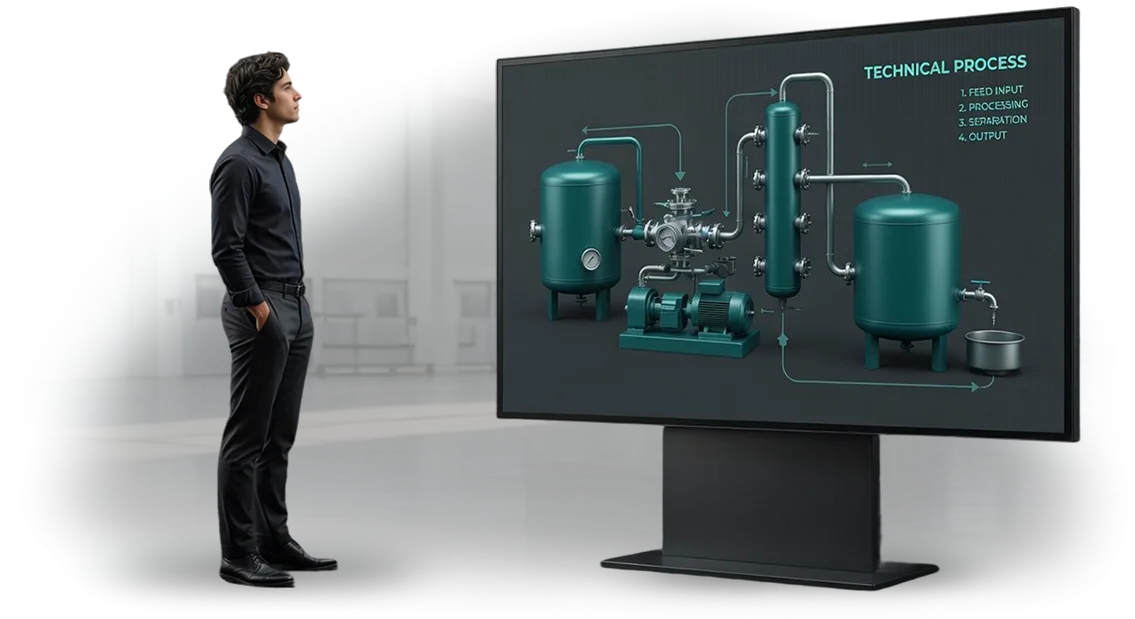
Why personnel training in mechanical engineering is often ineffective
In mechanical engineering, personnel training is often built around text-based regulations and personal demonstrations by a mentor.
But when the equipment is complex and operations require a precise sequence of actions, such training is not enough: a new employee remembers only part of the algorithm, and an experienced mentor cannot always explain every nuance.
As a result, mistakes repeat, and the cost of each one is not just lost time — it's production rejects.
The consequences of ineffective training hit production metrics directly. Damaged parts, idle machines, rework, and missed deadlines all add up to significant financial losses that are often written off as the human factor.
But the root of the problem lies earlier: the employee never received a clear, visual instruction they could follow without guessing or asking for clarification.
This is especially noticeable in mechanical engineering: assembly of units, equipment setup, quality control — every operation has critically important stages, and if an employee skips one, they create a defect.
At the same time, passing on experience through text is almost impossible — what's needed is visualization showing the mechanism's structure and the correct order of actions.
This is exactly where traditional training methods stop working, and the enterprise pays for it every month.
The solution is video instructions with 3D demonstrations that show the process the way an experienced specialist sees it: from the overall view of the machine to the detailed sequence of operations.
Such training shortens the time to full productivity, reduces the number of errors, and makes knowledge standard for all employees, regardless of experience. We help close this gap — we create instructions that actually work on the production floor.
What you get from implementing video instructions
Implementing video instructions is not a replacement for paper checklists — it's a system that directly affects the speed and quality of every employee's work.
Instead of long explanations and scattered regulations, you get a single standard that both new hires and the current team train against. Here's what changes after launching corporate videos.
- 2–3× faster training. An employee watches a short video and immediately repeats the actions on the equipment. No need to wait for a mentor or search for the right section in a paper manual.
- Fewer production errors. The video shows the correct sequence of operations without any "personal interpretation" of the process. The risk of rejects and rework drops, and safety on the floor improves.
- One standard for all shops and shifts. A video instruction looks the same in every city and on every line. Managers no longer have to check how employees understood the task — everyone works from the same scheme.
- Rapid onboarding of new employees. A person trains at their own pace and reaches planned productivity faster. Experienced specialists are freed from endlessly repeating the same thing.
- Corporate videos keep working. Updating a regulation takes days, not weeks: just reshoot one video instead of distributing new documents across all departments.
Every video instruction we create at our teamis tested on the client's actual production floor and adapted to specific operations. So you don't get a "presentation with a narrator" but a working tool that employees use every day.
Start with one or two complex processes — and within a couple of weeks compare how long it takes to bring a new employee up to speed and how the number of errors has changed.
Video instruction formats for different mechanical engineering tasks
In mechanical engineering, the same task — training an employee — can be solved in different ways. A new worker needs a clear walkthrough from scratch, a maintenance crew needs a detailed breakdown of the unit, and a safety briefing needs a short, concise video. A universal video does not exist: the format must match the goal and the audience.
That is why we choose the type of video for each specific situation. Below are the main formats our clients use in mechanical engineering.
| Video instruction format | When to use | What it gives the client |
|---|---|---|
| 3D animation with exploded view | Training from scratch, repair, unit assembly | Shows the internal structure of the mechanism, speeds up understanding, reduces errors |
| Training video with real equipment | Hands-on instruction at the workstation | The employee sees real actions and repeats them faster on the job |
| Safety video | Briefings before work authorization, regular reminders | Simple, memorable material, fewer violations and injuries |
| Short video cheat sheets | Quick reminders for rare operations | No need to reread the manual — fast access to the needed action |
At our team we develop video instructions tailored to the client's tasks: from 3D animations with exploded views to short videos for briefings.
With 10+ years of experience in industry, we have accumulated the expertise to create training videos that employees watch to the end and apply in practice.
Stages of turnkey video instruction development
How we structure the work
For a video instruction to actually reduce training time and lower the risk of errors, the development process must be transparent. We work in clear stages: you control the progress, approve key milestones, and receive the finished video exactly on schedule.
- Brief and task analysis — we pin down the target audience, complex equipment assemblies, and typical employee mistakes. Based on this, we determine which operations to show with live-action footage and which through a clear 3D exploded view.
- Script and structure — we turn the technical instruction into a short training script: sequence of steps, emphasis points, pauses for commentary. You receive a text version of the future video and can make edits before production starts.
- Script approval — we show how the narrative will develop, where cutaways and demonstrations of internal mechanisms will appear. This is a key control point: this is where the wording and training logic get approved.
- 3D visualization and video production — we create exploded-view animations, assemblies, and assembly/disassembly sequences. In parallel, we prepare video fragments with real equipment so the instruction is as close as possible to the actual work process.
- Interim review — you watch the draft version and give feedback. We make corrections, fine-tune the pacing, voiceover, and emphasis for comfortable viewing.
- Final video production — we assemble all materials into a single video: sound, captions, and pop-up hints. After final approval, you receive files in the formats you need — for an LMS, internal portal, or training classroom.
- Launch and support — we hand over the finished video instructions together with implementation recommendations. If procedures need to be updated after machine modernization or a regulation adjusted, you can order a revision without rebuilding the entire video.
This workflow eliminates misunderstandings: every decision is documented in writing or in correspondence, and all development stages take a predictable amount of time.
As a result, you get video instructions that are actually used in training — employees reach full productivity faster and break equipment less often.
What's included in corporate video instruction delivery
You don't just get finished videos — you get a fully packaged product ready for training implementation. The delivery includes all materials your team needs to use the video instructions right away, without additional work or involving another contractor.
Here's what's in the package:
- Script and storyboard — detailed documents showing exactly which operations are demonstrated and in what order. These form the basis for approving the training logic and for future updates.
- Finished video instructions — final videos for each operation with voiceover narration and text subtitles. Formats are adapted for viewing on work computers, tablets, and through an LMS.
- Exploded views and 3D animations — separate files with disassembled machine and mechanism assemblies. These help employees see the internal structure and understand how to properly maintain equipment.
- Source video materials — raw files and projects that remain in your possession. This is your asset: you can make edits, re-record the voiceover, or re-assemble videos without coming back to us.
- Implementation guide — a short instruction on how to quickly upload videos to your learning management system and assign them to employees.
- Methodological recommendations — advice on using video instructions in onboarding, for work authorization, and during recertification.
With this package, the question "what exactly do we get" is settled. The employee sees clear videos with unit breakdowns, and you get full control over the training process.
The source files let you update instructions when regulations change without ordering everything from scratch.
Case study: how we cut training time for a machine-building plant
A new operator at a machine-building plant takes up to two weeks to learn how to assemble a unit: part of the knowledge comes from paper instructions, and part is "passed from hand to hand" by mentors.
During this time, experienced employees are pulled away from their own work, and the newcomer still makes mistakes on their first shifts.
We encountered this in a project for the Volzhsky Machine-Building Plant — and closed the task with 3D video instructions featuring exploded views.
What we did
Instead of text regulations and verbal explanations, we recorded training videos where every unit is shown disassembled: you can see the order in which parts are attached, where effort is required, and where the inspection points are.
The employee trains at their own pace, and at a difficult step they can pause the video and repeat the operation on the real equipment.
We also built in knowledge checks — after each series of lessons, the operator answers short questions and receives confirmation that the material has been absorbed.
The result for the plant
The time for a newcomer to start working independently was cut in half — from two weeks to seven days. The number of errors in the first shifts dropped by about a third, and mentors freed up more than two hundred hours per month and returned to their core tasks.
The plant ordered a second block of video instructions for a neighboring shop within a quarter — for us, that is the main indicator that the format works and pays for itself.
How to choose the right video instruction format for your mechanical engineering production?
There is no universal video instruction format for mechanical engineering — the choice depends on the task you are solving.
One production line needs to quickly train new operators, another needs to capture the experience of assembling a complex unit, and a third needs to systematize equipment maintenance regulations.
So the first step is to define what exactly the employee must be able to do after watching the video and what level of depth they need.
If you're dealing with complex mechanisms where it's important to show the internal structure, the relative position of parts, and the disassembly sequence, the best choice is 3D animation with exploded views.
This format compresses time: the entire process is visible at a glance, each operation is logically connected to the previous one, and the employee builds a complete mental picture.
Live-action filming loses out here — it cannot always show elements hidden from the eye and requires many takes to achieve a quality result.
Another important criterion is the experience level of the audience. A new employee with no background needs a detailed step-by-step instruction with an emphasis on safety and basic techniques.
An experienced master only needs a short video capturing changes to a regulation or a non-standard operation. Mixing these scenarios in one video is not a good idea — the employee will either get tired of unnecessary detail or miss the knowledge they need.
The optimal approach is to split the material into modules that can be combined for different personnel categories.
Finally, consider how often the product design or assembly technology changes. If updates happen regularly, prefer a format that is easy to modify: you can reuse the finished 3D model and update only the changed fragment. This saves a noticeable amount of time and budget in the long run.
Together with our clients in mechanical engineering, we first analyze these requirements and only then propose a format — so you get video material that actually works on your production floor, not just a "pretty video."
Frequently asked questions about video instruction development
Before ordering video instructions, every manager asks the same questions: how long will it take, what will it cost realistically, and how will it fit into the current training process.
Here are the answers to the main ones, so you can make a decision based on facts rather than guesswork.
How long does it take to develop one video instruction?
The timeline depends on the complexity of the script and the scope of the operations shown. For a typical assembly or maintenance instruction, we budget two to four weeks — from brief to finished video.
We fix the schedule at the start of the project and stick to it: each stage has control points where you see intermediate results.
How much does creating corporate video instructions cost?
Cost is calculated individually — it depends on the number of videos, the complexity of the 3D scenes, whether voiceover is needed, and whether translation is required. We always prepare a transparent cost estimate before the start, with all work and stages itemized. No hidden fees or unjustified extras — only what your production actually needs.
What guarantees do we have that the result will suit us?
Before filming and 3D modeling begin, we approve the script and structure of each instruction. At interim review sessions you see draft versions and make corrections — this rules out the situation where the finished video does not match expectations.
We record the requirements in the technical specification, and you personally accept the final product.
Is it difficult to adapt the video instructions to our training system?
We produce videos in universal formats that easily upload to any learning management system or video hosting platform. If needed, we adapt the video to your corporate style: logos, color scheme, intros, subtitles.
Implementation does not require any special knowledge from your staff — just regular access to the training portal.
If you still have questions about timelines, budget, or integration — just write to us. We'll explain how we'll structure the work for your specific task and show examples of similar projects.Order video instruction development and speed up training
Training new employees in mechanical engineering production often takes weeks: mentors are pulled away from their own work, and mistakes at the start turn into downtime and rejects.
Video instructions with 3D exploded views solve this problem — they show the structure of units and the sequence of operations visually, without long explanations.
Order the development of such video instructions, and personnel training will become faster and the results more stable.
To get a proposal for your task, you don't need to write a complex technical specification. Simply leave a request — we'll guide you through every step and prepare a solution tailored to your manufacturing process.
What's included in the ordering process:
- You submit a request on the website — a manager will contact you within one business day for a consultation.
- We discuss which operations and assemblies need to be shown and under what conditions your employees will be training.
- We prepare a cost estimate and timeline for your manufacturing process — clear and with no hidden fees.
- We approve the video instruction script: exploded-view breakdown, assembly order, inspection points, and voiceover.
- We develop the 3D animation and editing, adding text hints and emphasis on important details.
- We deliver the finished video instructions in the formats you need — for the learning management system, tablets, or viewing on the shop floor.
You can order video instruction development in just a couple of minutes: fill out the form and we'll immediately offer a solution. Leave a request to get a consultation, a commercial proposal, and examples of our work for mechanical engineering.
Translate the above into English. Preserve structure exactly.