

How to Train Employees Without Risks and Downtime in the Oil and Gas Industry
Employee errors at oil and gas enterprises cost more than it seems. Formal staff training based on instructions and presentations does not build lasting skills: in a real emergency, an employee acts hesitantly or relies on memory that fails them.
The result — accidents, injuries, regulatory fines and unplanned downtime that weigh on the business budget.
In the oil and gas industry, the price of every mistake is especially high: complex equipment, hazardous substances, strict safety requirements. When an employee encounters a task for the first time already on site, correcting the consequences takes money and time.
At the same time, classic training methods provide no visual clarity — it is impossible to show the internal structure of a unit without disassembling it, and impossible to practice actions in a dangerous situation without real risk.
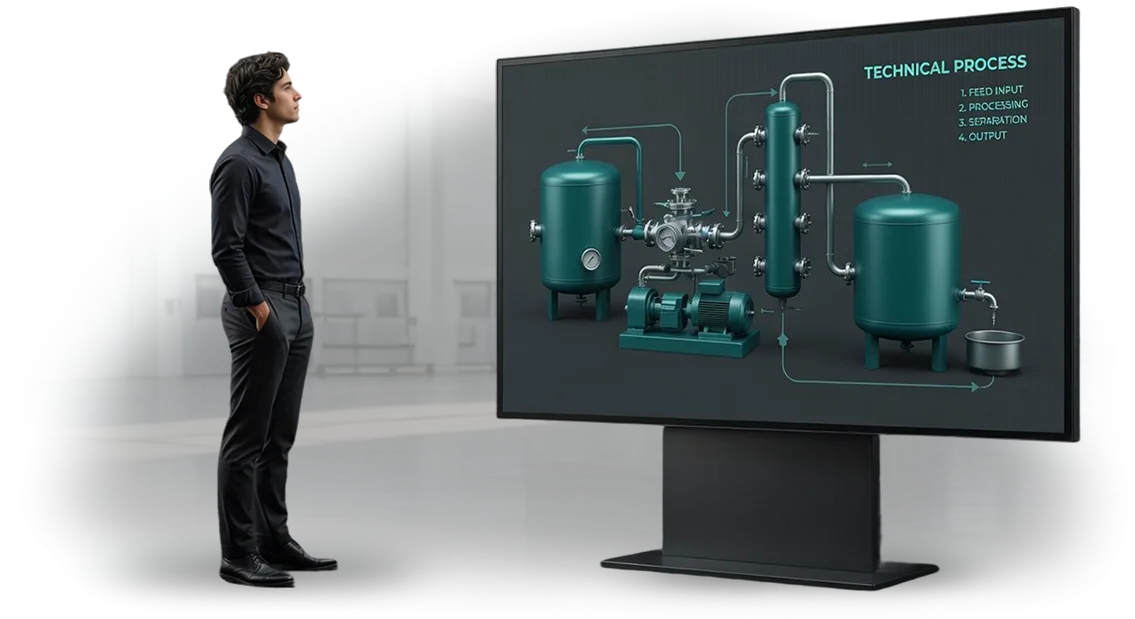
A modern solution is training 3D video instructions that reproduce the structure and operation of equipment in detail. The employee sees an exploded view of components, the sequence of operations, typical mistakes — all without stopping production and without risk to people.
Such staff training can be completed right at the workplace, at a convenient pace, and the result is easy to verify.
We have been developing video instructions for industrial companies for over 10 years.
Our experience shows: after implementing visual 3D materials, the number of employee errors decreases several times over, and safety at facilities ceases to be a matter of guesswork.
For oil and gas enterprises, this means fewer accidents, less downtime and a predictable training budget.
5 Benefits of Implementing 3D Video Instructions for Your Production
Ordinary on-the-job training takes weeks and requires the involvement of experienced mentors. A new employee remembers only part of the instructions, and errors when working with equipment are costly — from component failure to workshop shutdown.
That is why oil and gas enterprises are switching to 3D video instructions: they show the structure of mechanisms in cross-section, not in words.
The first benefit is training speed. Instead of reading hundreds of pages of regulations, an employee sees in a few minutes how a unit is disassembled and assembled, and how dismantling is performed.
The second is fewer errors: exploded views and animation eliminate the ambiguity of text descriptions, which minimizes the human factor in repair and maintenance.
The third benefit is safety. Hazard zones and correct actions in emergency situations shown visually are remembered better than paper instructions. This reduces the risk of injuries and accidents, cutting unplanned downtime.
The fourth is simple onboarding: experienced specialists do not need to be pulled away for lectures — employees study 3D materials independently, and mentors only supervise skills.
The fifth benefit is training cost savings. You reduce expenses on business trips, printing manuals and renting training rooms, while the video materials remain relevant for years. When regulations change, it is enough to update one model rather than reissue all documentation. The implementation pays for itself after the first two or three uses.
Video Instruction Formats for Different Training Tasks
In companies with expensive equipment and high safety requirements, there is no universal training format.
A beginner needs to quickly understand the basic sequence of operations, an experienced employee needs to be shown a rare emergency situation, and for certification it is necessary to verify understanding of the entire scheme.
Different video formats solve different tasks: from short animations to detailed 3D models with full component disassembly. We tailor the format to a specific training goal and budget so that the employee gets exactly the knowledge required for safe work.
Which formats are chosen for training
| Video format | For whom and for what task | What it gives the customer |
|---|---|---|
| Short 2D animation | For initial familiarization with the process, induction briefing | Quick explanation of basic steps, attention retention, low entry threshold |
| 3D animation with exploded view | For studying the structure of complex equipment | Shows internal parts and operating principle without disassembling a real object, reduces time spent on practice |
| Interactive video with action choice | For practicing algorithms in emergency situations | The employee makes decisions and sees the consequences, reinforcing safe response skills |
| Detailed 3D model with assembly | For final certification and knowledge verification | Full control over understanding of the entire operation chain, assessment of readiness for independent work |
This approach to presenting material reduces induction briefing time by 30–40% and noticeably decreases the number of errors when working with equipment.
Employees memorize the sequence of operations faster, and the risk of the human factor decreases — this is visible after the first training cycles.
How We Create Video Instructions: 7 Steps from Brief to Delivery
For a video instruction to genuinely reduce errors and time-to-competency, the process must be transparent. We structured production into seven stages — with fixed deadlines and approval checkpoints. You always know what is happening with the project and when you will receive the finished material.
- Brief and task analysis. We immerse ourselves in the specifics of your production: we study the equipment, regulations and audience. We define the training goals and efficiency criteria.
- Script and storyboard. A technical writer and director turn the regulation into a clear visual sequence. We describe each frame and exploded view, approving the logic before animation starts.
- Concept approval. You receive the script, storyboard and a style sample. We make edits before production launch — this saves time and budget.
- 3D modeling and animation. We create precise models of components and exploded views. They show the internal structure and assembly order without risk to real equipment.
- Voiceover and editing. A professional narrator records the instruction, and the editor places emphasis on key actions. We add subtitles and text hints.
- Quality control and corrections. We check the video for compliance with the regulation and details. You receive intermediate versions and make final edits.
- Delivery and support. We hand over final files and source materials in the required formats. If necessary, we adapt the video for a distance learning system and update the instructions.
What Is Included in a Video Instruction Development Project
Developing video instructions for the oil and gas industry is not just recording a clip. The delivery package includes materials that account for staff training requirements, work at hazardous facilities and internal regulations.
After signing the acceptance certificate, you immediately get everything needed to launch training without additional expenses.
- Project source files: all graphic elements, 3D models and editing projects remain with you. Make edits without returning to the contractor.
- Finished videos for all formats: for distance learning systems, for in-person classroom sessions and for tablets on the production site.
- Methodological materials for instructors: lesson script, control questions, analysis of typical errors and safety reminders.
- Adaptation guide: a step-by-step procedure for replacing a component in an exploded view or making changes to a regulation without a full reshoot.
- Update schedule: response times to requests, prioritization of changes, procedure for replacing old versions in the training system.
- Accompanying documentation: file inventory, instructions for uploading to the LMS, recommendations for storage and backup.
Each delivery item is recorded in the acceptance certificate, and your team receives a short usage guide. We do not abandon the project after launch: we help adapt the videos to new standards and answer questions from the employees responsible for training.
Case Study: 3D Video Instructions for the Oil and Gas Industry Cut Training Time in Half
Working with an oil and gas operator, we encountered a typical industry pain point: training employees on complex equipment took weeks, and paper instructions did not provide the needed visual clarity. Mistakes at the start were costly — mentors' time, resources and nerves were all drained.
We developed a series of 3D video instructions with exploded views of the main components, where every maintenance step is shown in motion.
Specialists at EnergoSib (name changed) gained the ability to study the regulations at a convenient pace, without being constantly tied to a mentor.
Project numbers
- Operator time-to-competency was cut in half — from four weeks to two.
- The number of errors at the first certification attempt dropped by 40%.
- The client ordered additional videos for three new facilities.
This result was possible because the employee sees the internal structure of the unit in motion rather than on a static diagram. Comprehension comes faster, and the mentor no longer needs to repeat the same thing several times — the video takes over the routine.
Customer feedback
«Previously, preparing a new operator took a month, and we could not guarantee an equal level of knowledge. With video instructions, beginners show consistent results within two weeks. We plan to roll out this format across all sites.»
This case confirms: 3D instructions pay for themselves within the first quarter thanks to accelerated training and reduced load on experienced personnel. If your goal is to prepare employees faster without losing quality, this format will work for you too.
How to Choose the Right Video Instruction Format for Your Task?
A universal video instruction that suits all employees does not exist: an operator, a machine driver and a repair crew solve different tasks. The main criterion for choosing a format is equipment complexity and the cost of error. If the operation is simple and repeated daily, a regular video with narrator commentary is enough.
If an employee needs to understand the internal structure of a unit, or understand the disassembly or repair sequence, a 3D video instruction with an exploded view is essential: it shows components that are hidden in real equipment.
The second step is assessing the team's skill level. For beginners, short videos with a step-by-step algorithm and no excessive detail are better; for experienced specialists, extended materials with analysis of emergency situations are preferable.
This way you do not overload some employees and give enough information to others, and the training process itself becomes predictable.
Consider the scale too: if there are many facilities and they are remote from each other, and staff constantly changes, a video instruction replaces a mentor's in-person demonstration.
It conveys the standard equally everywhere, does not depend on the human factor and works at every facility without additional costs. For the oil and gas industry, this is doubly important: a uniform standard for performing operations is a safety matter.
Our recommendation is not to try to cover all equipment at once.
Start with a pilot site: choose one complex component or the most critical operation, make a detailed 3D instruction for it, evaluate how employees absorb the material, and only then roll the solution out to other sites.
We will help you select the format and level of detail for each type of equipment: our expertise in the oil and gas industry allows you not to waste budget on experiments. Tell us about your task — and we will offer the optimal solution after the first consultation.
Frequent Questions and Doubts When Ordering Video Instructions
Doubts when ordering video instructions are normal: it is important to understand what the project costs, when it will be ready and what happens with revisions. For the oil and gas industry, we structure our work so the client has no surprises.
What do video instructions for the oil and gas industry cost?
The cost is calculated after audit and depends on the number of scenes, runtime and the need for 3D exploded views. After the calculation, we fix the price in the contract — it does not change during the work. You know the budget in advance and plan training without risks.
What are the production timelines?
A typical project takes two to four weeks. At the start, we agree on a schedule; if necessary, we deliver in stages — first the key instructions, then the rest. This allows training to start faster if deadlines are tight.
What happens if revisions are needed?
Revisions are built into the contract: you send comments, we make corrections and return an updated version. The number of rounds is sufficient to accurately reflect your enterprise's regulations and the comments of occupational safety specialists.
Can the videos be used in a corporate training system?
Yes. We prepare videos in formats compatible with learning management systems (LMS) and help with uploading. You can assign instructions to employees and track who has completed the material — this is convenient for control and reporting.
Get a Demo Version of a 3D Video Instruction for Your Equipment
Every minute of training downtime costs money, and employee safety tolerates no compromises. That is why we suggest seeing the result first — a demo version of a 3D video instruction for your specific equipment — and only then making a decision.
With the demo, you will receive a sample of what training for your employees will look like: with a realistic exploded view, voiceover and a step-by-step scenario.
This is not an abstract video but a prototype created for your specifics — so you can immediately assess the benefit for your team.
- Accurate cost and timeline calculation for your equipment unit — no hidden work.
- Consultation from an engineer and methodologist: we will advise which components to show in detail.
- Adaptation to your regulations: the instruction will fit into your existing training system.
- Scenario approval before production — make edits immediately, without rework.
- Example structure for your product passport and occupational safety requirements.
- A clear format for employees — even a beginner will quickly understand the unit's structure.
Leave a request, and within one business day we will send the demo version, calculate the estimate and propose an implementation plan. You risk nothing — you simply see how our video instructions reduce time-to-competency and lower the risk of errors in production.