

Why Does the Food and Beverage Industry Need Video Instructions?
Outdated training methods — text instructions, lectures, or "learn from a senior colleague's experience" — no longer work in the food and beverage industry.
An employee sees a multi-page document with requirements and regulations, but in a real situation acts from memory rather than by the rules. The result is staff errors: recipes, sanitary standards, sanitation procedures, and safety protocols are violated.
The cost of such errors is defective products, complaints from supervisory authorities, and threats to consumer health.
Add to this constant staff turnover. New employees arrive without experience and expect to be quickly brought up to speed, but instead drown in the volume of information. Mentors are forced to repeat the same thing over and over, distracted from their own tasks.
Each new hire means several weeks of adaptation, reduced productivity, and the risk of repeating the same mistakes. Training becomes an expensive, lengthy process that does not produce predictable results.
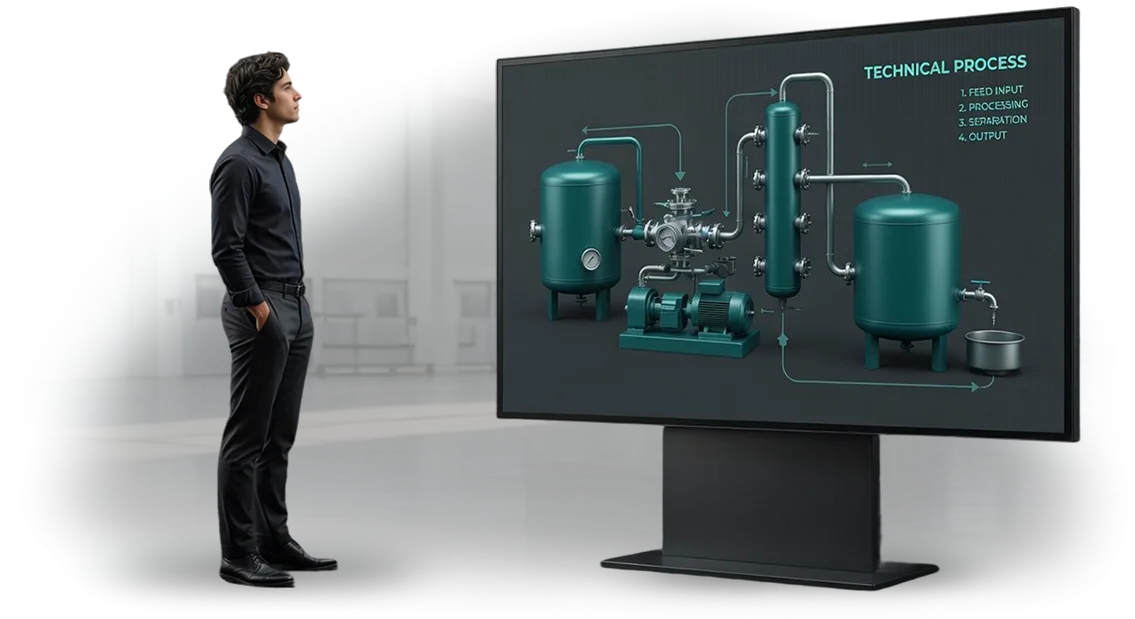
That is why the food and beverage industry needs visual materials instead of tedious regulations. Video instructions in exploded-view format show how equipment is designed, what components it consists of, and what happens inside at every moment of operation.
The employee sees the action algorithm — how to prepare the line, start the cycle, perform cleaning, or disassemble a unit — and understands the process logic rather than merely memorizing points.
Such professional training shortens the time to full competence, makes work across different shifts equally correct, and reduces dependence on "experienced veterans."
A video instruction works as a standard that cannot be misread. It can be placed on a tablet in the workshop, played before a shift, or used when investigating an incident. The employee gets not an abstract text but a ready-made model of correct actions.
For the business, this means fewer defects, stable product quality, and smooth inspections by regulatory authorities — training ceases to be a problem and becomes part of the system.
What Will Implementing 3D Training Give Manufacturers
Manufacturers of food and beverage products face the same daily challenge: train employees to work on equipment quickly, safely, and without loss of quality. Classic briefings take days, and knowledge is still partially lost.
3D video instructions change this process: complex components and sequences of operations are shown visually, so training happens three to four times faster.
The worker sees not a flat diagram but a three-dimensional model that can be examined from all sides — understanding comes from the first viewing rather than after repeated attempts.
It is precisely this visual nature that ensures high material retention. Exploded views let you literally look inside the equipment, understand how parts interact, where errors may occur, and why it is important to follow the sequence of actions.
This format engages visual memory, and even weeks later the employee will recall the correct sequence. This reduces the number of operational errors and cuts the time mentors spend on repeated explanations.
Safety is another key advantage. In the food industry, work involves hot surfaces, rotating mechanisms, and chemical reagents. 3D instructions make it possible to show risks and correct working methods in advance without exposing a new employee to danger.
They learn from clear examples rather than their own mistakes. As a result, injuries and incidents on the production floor decrease, which directly affects the stability of the entire line.
Implementing such video instructions noticeably saves company resources. There is no need to maintain a staff of trainers forced to conduct the same training repeatedly.
A single employee in the training department creates a video, and it can be used for an unlimited number of new workers on any shift. Moreover, updating material takes minimal time — just reshoot one element rather than repeating the entire process from scratch.
In the end, the company gets standardized training without loss of quality and with a predictable outcome.
Video Instruction Options for Staff Training
For the food and beverage industry, staff training is not only about transferring knowledge but also about complying with regulations, safety protocols, and quality standards.
Video instructions handle this task more clearly than text documents and allow employees to learn at their own pace — from any device, right in the workshop, or remotely.
To make training effective, it is important to choose the right format for the specific audience.
We use various types of training videos: from short introductory videos for newcomers to detailed modules with knowledge checks for experienced personnel and video regulations for enterprises with special requirements.
| Format | For Whom | What It Gives the Client |
|---|---|---|
| Introductory training videos | New employees | Quick immersion in processes, fewer errors from the first days on the job |
| Detailed video instructions | Experienced personnel | A single standard for performing operations, stable product quality |
| Modules with testing | All employee categories | Verification of material comprehension and clearance for independent work |
| 3D videos with equipment breakdown | Technical staff and maintenance services | Clear visualization of line construction and operating principles, safe maintenance |
| Video regulations | Enterprises with special requirements | Compliance with industry standards, confident passage of audits |
The formats are easy to combine: one shift needs an introductory course, another needs an analysis of emergency situations.
We assemble a program for your shift schedule, staff qualification levels, and production specifics so that online training runs without stopping production lines.
Stages of Developing 3D Video Instructions
We structure the development process so that you control every stage and know exactly what you will get in the end. Instead of long, vague approvals — clear milestones from brief to launch.
At every step, you see the intermediate result and can make edits before resources are spent on the final render.
- Brief and production audit — we study your technological operations, regulations, equipment, and typical employee errors. We determine which scenarios need to be shown first so the video addresses real needs.
- Script and storyboard — we develop the instruction text and frame-by-frame plan: what happens on screen, which actions are demonstrated, and where an exploded view is needed. We send the document to your technologists — they verify the correctness of each step.
- Script approval — we lock in the approved version: timing, narrative logic, and emphasis on critically important operations. All edits are made at this stage, so the animation does not have to be redone.
- Creating 3D models, virtual filming, and animation — we build digital copies of your equipment and production processes. We clearly show sequences of actions, disassembly and assembly of components, and proper handling of product or packaging.
- Voiceover and interface — we record the narrator's text, add subtitles, hints, and control elements. The employee can pause the video, return to a difficult moment, and quickly find the right section.
- Intermediate review — you receive a draft version of the video, leave comments, we make corrections and approve the final video. After that, we launch the render in high quality.
- Launch and delivery — we export the finished file in the required formats, help you place it in your training system, and provide source materials. If needed, we add an accompanying guide for administrators.
This sequence guarantees that the video instruction matches your regulations exactly and does not require reshoots after launch. You get a predictable timeline and a result that is easy to integrate into new-hire training programs or use for upskilling existing employees.
What Is Included in the Video Instruction Delivery Package
For the food and beverage industry, the training standard solves a lot: fewer errors on the line, faster adaptation for newcomers, and readiness for inspections.
That is why we deliver not scattered videos but a complete delivery package — everything needed to launch training as early as next week.
- Scripts and instruction texts. The approved scripts that the video lessons were based on. An internal expert or technical specialist can always double-check every step.
- Video lessons in a ready format. Final videos with voiceover and graphics. You receive files in a format suitable for your learning management system or internal portal.
- Employee access. We set up video lesson distribution through your learning management system or integrate the package with your CRM — the employee trains in a familiar interface, and you see the progress of each participant.
- Administrator guide. A step-by-step manual: how to add video instructions to the system, assign groups of employees, and track results.
- Update checklist. If recipes, equipment, or regulations change, you can quickly replace the relevant step without reshooting everything from scratch.
- Evaluation forms and tests. Knowledge checks after viewing — ready-made questions for each video lesson. This covers competency confirmation during internal audits.
The entire package is handed over with an acceptance certificate and accompanied by a short video overview: you immediately see what you received and how to use it.
This approach reduces training launch time and guarantees that the first video courses go live within a few working days.
Case Study: How We Reduced Production Errors
For one juice and nectar plant — let's call it SokCo — the bottling line was running with interruptions: changeover took up to two hours, and every operator error led to a batch being rejected.
Text instructions and photos did not help: employees read them differently, and newcomers were afraid to touch the equipment.
We proposed replacing flat descriptions with three-dimensional video instructions. The operator sees not a chart on paper but an exploded view of the line: how a unit is unscrewed, in what order parts are removed, and where the seal goes.
The video can be paused, stepped back, and a difficult moment reviewed again — so it can be repeated without mistakes.
The result was noticeable within the first month. Changeover time was cut in half, assembly errors by a third, and products rejected due to incorrect installation practically disappeared.
New employees were no longer assigned to a separate workshop "for backup": after two hours of training and a couple of repeated video viewings, they started working shifts on their own.
Effect on Production
The key is not just an individual instruction but how it works in the standard process.
Operators watch the video before their shift, the team leader tracks completions in the system, and the production manager sees where employees most often make mistakes and adds video breakdowns of exactly those operations.
Two months later, the plant ordered the same instructions for two more lines and the finished goods warehouse.
Reducing production errors is not theory — it is a measurable result. If you also have an area where "everything is clear on paper but breaks in practice," let's break down one operation and show how a video instruction covers it.
Frequently Asked Questions About Creating Video Instructions
Creating corporate video instructions often raises questions before the project even starts — that is normal. We have gathered answers to the most common ones so you can quickly assess the prospects and make a decision without doubt.
How long does it take to create a video instruction?
Timelines depend on script complexity and the number of scenes: usually two to four weeks. At the start, we set a calendar plan and stick to it. If you need it urgently, we will discuss accelerating by simplifying certain stages.
Will we need a technical specialist to participate in the project?
Yes, but only at the information-gathering stage: one or two calls with someone who knows your equipment and regulations are enough. All the rest — modeling, scripting, editing — we take on ourselves. You do not spend time on technical details; you simply review the result.
Can you adapt the video to our equipment and processes?
Of course. We specialize in the food and beverage industry, so we understand the specifics of lines, packaging, and sanitation requirements. We build your actual regulations into the script rather than an abstract scheme. The final video integrates easily into your existing employee training system.
What happens to the video if the equipment or process changes?
You receive the source materials and documentation, so the video can be updated or extended. Additionally, we offer post-production support: we return to the project after a few months and make edits reflecting your new reality. This is cheaper than ordering a video from scratch.
We answer every question individually and always give guarantees on timelines and content. If you still have doubts — ask us directly, we will show examples of similar projects and propose a solution for your task.Order Video Instruction Development for Your Enterprise
Developing video instructions is an investment in production reliability. When every employee sees the sequence of actions on screen, there are fewer errors, newcomers adapt faster, and inspections go more smoothly.
To achieve this result, you do not need to wait months — we accompany the project from the first call to integration into your training system.
Leave a consultation request — we will discuss your tasks, show examples, and prepare a cost estimate for your scale. Whether you need a pilot area or full coverage of all workshops, we will propose a clear plan and timeline.
What you get as part of the order:
- Review of current instructions and scenarios together with your technologists.
- Cost and timeline estimate without hidden fees.
- Video instructions in the format you need: for PCs, tablets, and smartphones.
- Restricted access: materials are available only to your employees.
- Training for system administrators and transfer of rights.
- Support during implementation and instruction updates after regulatory changes.
We have been working with food and beverage enterprises for over 10 years, so we account for hygiene requirements, safety, and shift schedule specifics.
The video can be embedded in your learning management system or used as a standalone course — we will show you how to do it without unnecessary costs.
Call us or leave a request — we will calculate the cost and propose launching a pilot area within the coming weeks.
We start with a consultation: you will receive an implementation plan and understand how video instructions will reduce training time and lower the risk of errors.
How to Choose Video Instructions for Industry?
Choosing video instructions for industry begins not with the format but with the specifics of your enterprise. In the food and beverage sector, sanitation regulations, specific bottling, packaging, and sterilization lines matter.
These conditions determine which type of video will help an employee master an operation faster — from a simple narrated slideshow to a full 3D equipment model with component breakdown.
Before choosing, answer two questions: what equipment do you use and how complex are the operations? If we are talking about multi-step line setup or unit disassembly, three-dimensional diagrams that show the internal structure of the mechanism work better.
For routine cleaning and sanitation procedures, short instructions focused on the sequence of actions are enough. Therefore, there is no single "best" format — there is a format suited to your specifics.
Video instructions should be selected for each category of operations: safety, equipment startup, scheduled parts replacement, quality control. Each group gets its own presentation — from detailed 3D animation to a clear demonstration on a real line.
Focus on what the employee must do in the first days to reach normal speed and avoid defects. That is the criterion for choosing correctly.
A good approach is to start with an audit of current instructions and typical employee errors. We analyze your regulations, equipment specifics, and staff skill levels, then select formats that close specific gaps.
Not the other way around — we do not "implement video because it is trendy" but solve the problem through the right format. This reduces training time and lowers the risk of accidents, which is especially important on production lines running continuously.
As a result, you get a set of video instructions where each video addresses a real task: some for initial training, others for quick requalification, and still others for strict safety regulations.
This approach pays off through reduced defects and downtime, and employees begin working independently faster. The key is not to look for a universal solution but to choose the format that fits your production specifics — then the effect will be measurable.