

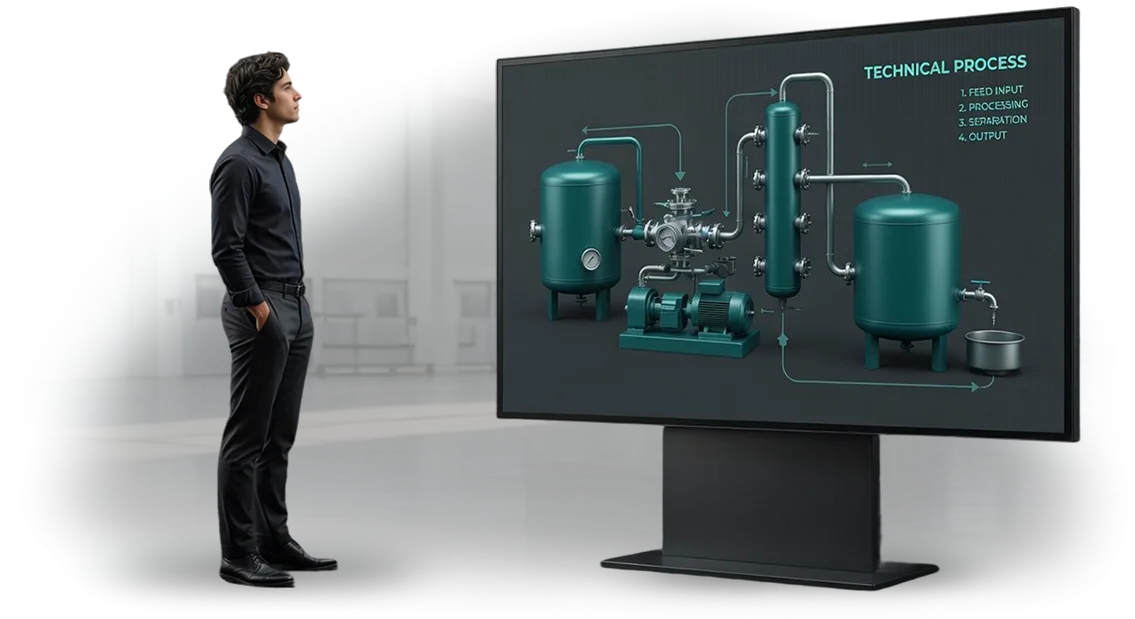
Why Does the Printing Industry Need Video Instructions?
In printing, the cost of an error is especially high: modern printing and post-press equipment requires precise setup and careful handling.
Paper regulations and instructions work poorly — they are rarely read, and even when they are read, each employee interprets the actions in their own way. As a result, the knowledge of mentors remains a personal asset rather than a company resource.
Mistakes made while working on equipment lead to downtime, rejects, damage to components, and missed order deadlines. Every such case means direct losses and a damaged reputation.
Staff training becomes a headache for managers: you need to bring newcomers up to speed quickly without losing quality or stopping production.
Video instructions for employees solve this problem. Instead of an abstract description, the worker sees the real process: how to set modes, change printing formes, and find service points.
And a 3D demonstration of exploded views helps them understand the internal structure of the equipment — even what is hidden behind the casing — and act correctly during setup and repair.
This approach turns staff training into a clear, repeatable process: a new employee can review the video before a shift, refer to it in a difficult situation, and reach the required pace of work faster. The company gets a unified standard of actions instead of a random set of habits.
The printing industry needs such video instructions to reduce dependence on the human factor, speed up onboarding, and cut the number of failures.
We develop videos for your specific equipment and technological processes, adapting the presentation to the skill level of your audience. Leave a request — we will show you examples, calculate timelines, and help you build a training system that actually works.
What Replacing Paper Regulations with Visual Videos Gives You
Anyone who has worked with paper regulations in the printing industry knows: instructions of 20–30 pages gather dust on shelves or in files that are only reopened after an incident. Text is skimmed diagonally, and each operator remembers key operations differently.
This is where mistakes come from: the wrong sequence of actions, incorrect settings, unnecessary changeovers, and ruined print runs.
Visual videos solve this problem at the root. The employee sees the real process — from machine preparation to final control — exactly as it should happen.
And a 3D demonstration with exploded views helps them understand the internal structure of components: what connects to what, how adjustments are made, and what to pay attention to. This builds the correct mental model, and the number of errors drops noticeably.
Onboarding for new employees also goes faster. Instead of weeks spent shadowing a mentor, a newcomer masters operations through short videos at their own pace, returning to difficult moments as many times as needed.
This reduces the workload on experienced technologists and shortens the time it takes for a new operator to start working at full speed.
It is also important that videos set uniform standards.
Every employee — in any shift and any workshop — is trained using the same visual program rather than “the version a senior colleague understood.” Quality becomes more predictable, it is easier to monitor compliance with technology, and training scales easily when production expands.
The bottom line is simple: replacing paper regulations with visual videos delivers concrete business results — less waste, faster ramp-up to full productivity, and stable work standards.
This works for experienced staff, newcomers, and the entire printing industry, where the cost of a mistake is high.
Formats of 3D Video Instructions for the Printing Industry
In printing, every minute of downtime on a press line means an unfinished run and delayed deadlines. An employee must quickly master the equipment, but without risking damage to components and without pulling experienced mentors away from their work.
3D video instructions solve this problem: they show the internal structure of the machinery, the sequence of operations, and typical mistakes visually, at any pace and as many times as needed.
For each training scenario, we choose the right video format — from a general introduction to the line to a detailed repair guide with exploded views. This covers the needs of different employee groups without overpaying for excessive detail where it is not needed.
| Format | Target audience | What it gives the client |
|---|---|---|
| Overview video | New employees, trainees | Rapid immersion in the technological process and an understanding of the entire line without reading multi-page instructions. |
| Step-by-step instruction | Operators, setup technicians | A clear action algorithm for changeovers, consumable replacement, or standard cleaning — fewer mistakes and less waste. |
| Exploded-view breakdown | Engineers, service teams | Detailed component structure and the disassembly/assembly sequence — safe repair training without the risk of damaging expensive equipment. |
Before starting video production, we analyze which operations cause the most questions and where errors occur most often. These scenarios become the basis for the 3D animation and text explanations.
As a result, you get training material that genuinely reduces the load on mentors and accelerates a newcomer’s path to independent work.
How Training Video Development Works for Your Team
Developing a training video does not take time away from your team and requires no technical knowledge. We run the project along a transparent path — from the brief to finished videos that can be used in training right away. Below are the stages every video instruction goes through.
-
Brief and process audit. We study your real operations, typical mistakes made by newcomers, and complex equipment components. We record which skills the video instructions must cover and which formats are most convenient for your employees.
-
Video script. Based on the brief, we write a script — in plain language, with an emphasis on practice. We take the specifics of printing production into account so that the instruction is understandable on the first viewing even for a new employee.
-
Visualization and layout approval. We show a storyboard or 3D mockup of the future video before production begins. You see how every frame will look, make edits, and avoid overpaying for rework at the final stage.
-
Production and editing. We create the video: shooting or animation, voiceover, subtitles. We work with professional equipment and proven tools so the result looks equally good on screens of any size.
-
Final review. We send you a draft version, and you collect feedback from technologists, instructors, and safety officers. We make corrections based on the comments and approve the final version.
-
Implementation and handover. We deliver the source files and finished videos in a convenient format. We help integrate the videos into your training system and give recommendations on how to use the instructions for fast onboarding and error reduction.
What Is Included in the Video Instruction Delivery Package
You get not just separate videos, but a complete package that can be used in employee training right away. Everything needed for launch and ongoing maintenance is already included in the project — you won’t have to figure anything out or order anything extra.
Here is what is included in the delivery package:
-
Ready-made video instructions — all episodes in formats suitable for your learning management system, internal portal, or video hosting. Employees can watch them from any device without additional setup.
-
Project source files — all scenes, graphics, and texts in an editable form. If changes are needed, they can be made quickly — by your team or with our help, without starting from scratch.
-
A guide to updating video instructions — step-by-step instructions on how to replace an outdated video or add a new episode. Updates take hours, not weeks, and do not require hiring a contractor.
-
Library access — all videos created for you are stored in a structured catalog. You can find the right instruction at any time, check the version’s relevance, or give access to colleagues.
-
Supporting documentation — scripts, texts, and recommendations for using each instruction. This helps integrate the videos into your training program and evaluate their effectiveness.
-
Implementation support — we help connect the video instructions to your training system, answer employees’ questions, and adjust materials during the warranty period.
All of this is included in the project cost — with no hidden fees or additional options. You get not just files, but a working tool that is easy to keep up to date. That is why clients come back to us for new instructions and recommend us to their colleagues.
Case Study: How We Reduced Commissioning Time with a 3D Instruction
One of our projects was for a printing facility where launching a new line took up to two weeks. Experienced setup technicians could do it in three or four days, while newcomers often made mistakes when adjusting components. This led to downtime and missed order deadlines.
We proposed replacing text regulations with a 3D video instruction using exploded views. Instead of flat drawings, the employee sees how a component is actually disassembled and assembled, where the fasteners are, and how gaps are set. Training becomes visual and no longer depends on the mentor’s memory.
What changed
In two months, we prepared instructions for five key operations at the client’s facility — let’s call it PolygraphStandard. Newcomers were able to start independent work in a week instead of two or three, and the number of setup errors fell by about 60%.
The main business metric was reduced commissioning time. The average time to bring a line into operation dropped from nine working days to five.
For a printing house, that means an additional three or four days of production output per month — and therefore meeting contracts without penalties and stable revenue.
Value for the client
After the first result, the client switched other areas to video as well — maintenance of printing rollers and replacement of plate cylinders. Six months later, they ordered six more instructions.
The chief engineer admitted: the video instruction became the first document newcomers actually open rather than hide in a drawer.
Do the math yourself: if every minute of downtime costs money, and setup takes half the time, the development pays for itself in the very first month of use.
How to Choose the Right Video Instruction Format?
The main question when choosing a format is not “what is trendier” but what problem you are solving.
In the printing industry, employee training usually comes down to two scenarios: introducing a newcomer to the equipment or teaching them to perform a complex operation without errors.
The answer determines whether you need an overview video or a detailed breakdown with three-dimensional diagrams.
An overview video is suitable for a first introduction to the machine, learning the overall structure, and safety rules.
This format gives the employee a complete picture: where the control panel is, which components are responsible for what, and in what sequence the process is launched.
It is a quick way to bring a newcomer up to speed in 5–7 minutes and build a basic understanding that is later reinforced through practice.
A detailed breakdown is needed where a mistake is costly: replacing a plate cylinder, adjusting the inking unit, or clearing a paper jam. Here an overview won’t help — the employee needs step-by-step instructions with the internal structure of the component.
That is exactly why we use exploded views: three-dimensional animation shows the order in which parts should be removed, how to install them correctly, and what to pay attention to. This reduces the risk of breakdowns and shortens equipment downtime.
So how do you decide? If you have high staff turnover and need to quickly train dozens of people in general work rules, start with an overview video. If you want to reduce the number of rejects and emergency stops, make detailed breakdowns of key operations.
In practice, the best result comes from a combination: a short overview for context and detailed instructions for the most critical actions.
We will help you choose the optimal format for your task, the skill level of your employees, and the specifics of your particular machines. Just describe which operations cause difficulties — and we will propose a video structure that closes exactly those gaps. No unnecessary detail: only what really speeds up training and reduces production costs.
Frequently Asked Questions about Implementing Video Instructions
Clients often worry that implementing video instructions will become an extra burden on the team: whether they will have to change processes, redo videos every time regulations change, or send us piles of documents.
We answer these questions — so you can understand in advance how the work goes and what benefits it brings.
Is it difficult to integrate video instructions into current training?
No, we adapt the videos to your business processes, not the other way around. You don’t need to rebuild your training system: you only need to replace text regulations or verbal explanations with short videos that employees can review at any time. Implementation takes several days and does not require stopping production.
What happens when equipment or regulations change?
The videos don’t become outdated — they get updated. We store the source materials and scripts, so when processes change, we adjust only the necessary fragment: we reshoot one operation or make changes to the 3D diagram.
An update takes from a few days to a week, and you always receive the current version of the instruction.
What source data do we need to provide to get started?
A minimal set: technical documentation, a description of operations, and access to the equipment for filming, or drawings if we use 3D models. After that, we prepare the script, storyboard, and shooting plan ourselves, coordinate them with you, and only then start production. You won’t have to understand the nuances of editing or animation.
Will we have to redo the videos if the result isn’t suitable?
We work in iterations: first we approve the script and storyboard, then we show a rough cut. All edits are made before the final version, so you get a video that truly solves the training task.
If adjustments are still needed after release, they also fit into the update process without a single missed deadline.
This approach removes the main risks: you are not left alone with an unfamiliar technology — instead, you get a tool that quickly pays for itself by reducing training time and lowering operator errors.Order Video Instruction Development for Your Production Facility
Printing production means complex machines, dozens of operations, and a high cost of error. When a new employee learns “on the fly” or from 40-page instructions, downtime, rejects, and rework are inevitable.
A video instruction removes this burden: the operator sees every step with their own eyes and reaches a working rhythm faster.
Ordering a video instruction means getting a ready-made training tool that works without your involvement. We handle the entire video development process from script to edit: we study your process, shoot close-ups of components, add explanations and checkpoints. The result is clear material for newcomers and a reference for the experienced shift.
Immediately after your inquiry, you receive:
- A task analysis and timeline estimate — within one business day.
- A clear commercial proposal with no hidden conditions.
- A script for the future video — you see the structure before filming begins.
- Format recommendations: from a short video for initial training to a full course.
- Examples of our work for the printing industry, so you can gauge the quality.
Then we launch production: we approve the shooting plan, come to your site with professional equipment, and edit the video with text, graphics, and highlights on important operations.
Employee training becomes systematic: you update materials when technology changes and don’t waste time on repeated explanations.
Leave a request to develop a video — through the form or by phone. We’ll call you back, clarify the details, and propose a solution for your task. Printing cannot wait for an employee to learn on their own — make training fast and predictable.