

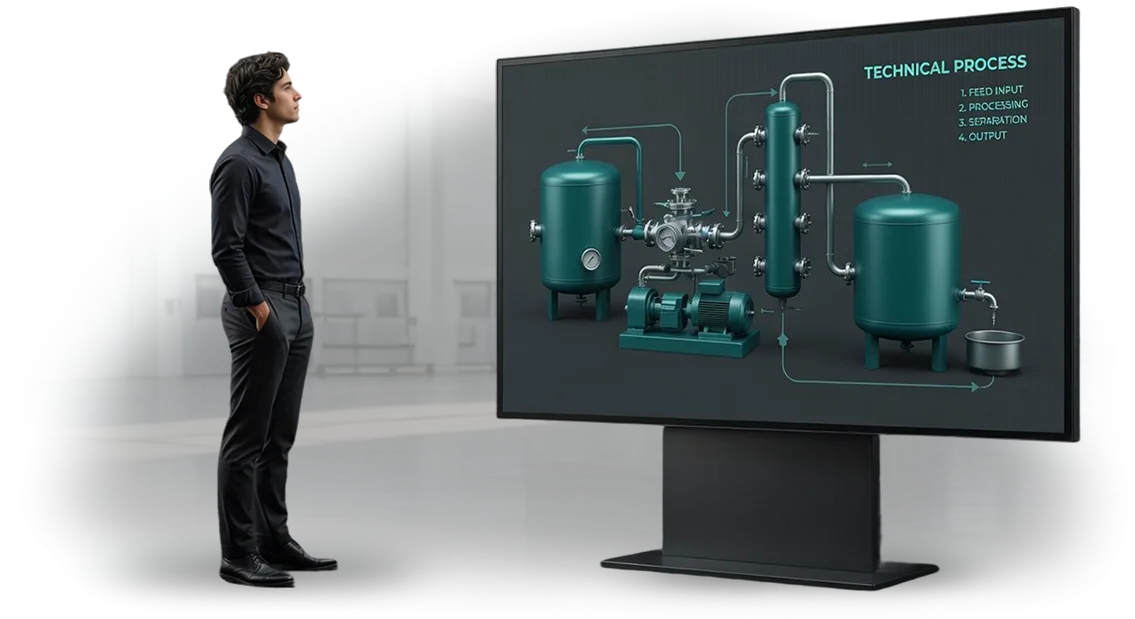
Costly Mistakes in the Production of Lifting and Transport Equipment
Staff errors in the production of lifting and transport equipment cost more than it seems at first glance.
Incorrect assembly sequence, maintenance schedule violations, or improper handling of a mechanism are not just defects and missed deadlines — they are also a risk of workplace injuries. Each such case stops the line, triggers investigations, and undermines customer trust.
Most often, the cause is not employee inattention but ineffective staff training. Everyone reads text regulations and drawings in their own way, trainers waste time repeating the same things, and newcomers still make typical mistakes.
Video instructions close this gap: they show every component and every step visually, without ambiguity or guesswork.
3D instructions with exploded-view demonstrations are especially valuable. An employee sees the internal structure of a mechanism, understands how parts interact, and remembers the correct sequence of actions.
This reduces the number of employee errors, accelerates new workers' transition to independent work, and reduces the load on experienced trainers.
We develop such video instructions for your enterprise's specific needs — based on your regulations and real operations. The videos can be easily integrated into your training system and used for workforce preparation.
The result: fewer defects, stable assembly quality, and peace of mind regarding people's safety on the production floor.
What 3D Video Instructions Give Your Production
A new employee needs weeks to master a complex component in the production of lifting and transport equipment: first theory, then observing a trainer, then the first independent operations with mistakes.
3D video instructions change this process: the mechanics are broken down to the smallest screw, every step is shown visually, and the trainee sees the correct sequence before approaching the machine. Training speeds up many times over, which means the new team member starts adding value faster.
Defects in production most often mean that an employee understood the process in their own way. A video instruction sets a single standard: everyone studies the same scenario with the same checkpoints and quality criteria. This reduces the number of reworks and downtimes, which cost more than any materials.
Workplace safety is especially important when handling lifting equipment: a mistake carries risks to human life. A 3D instruction shows danger zones and correct grips before real work begins, so the worker arrives at the site already understanding what is allowed and what is not. This builds a culture of safety without moralizing.
Standardization also helps both during team expansion and staff turnover. Knowledge is captured in video — training does not depend on a trainer's mood or availability.
Even under high production load, onboarding does not stop: the instruction is available for review and verification at any time.
The bottom line: 3D video instructions work as a systematic tool. They accelerate training, reduce defects and risks, increase production predictability, and pay off with every new employee and every prevented error.
Video Instruction Formats for Equipment and Shop Floor Tasks
In the production of lifting and transport equipment, every employee error results in downtime, defects, or a safety threat.
That is why a universal video instruction is a compromise that suits neither a newcomer nor an experienced adjuster: one needs the basics explained, the other needs the subtleties of repair.
We break training down into formats, each addressing its own business objective. Below is a comparison table to help you assess which materials your shop floor needs.
| Format | Target audience | What it gives the client |
|---|---|---|
| Basic video instructions | New employees, operators, personnel undergoing briefing | Fast integration into work: reducing adaptation time from a week to 2–3 days |
| 3D breakdowns with exploded views | Repair services, engineers, assembly training | Clear view of component structure without disassembling equipment; fewer errors during maintenance |
| Interactive simulators (VR) | Specialists in rare or hazardous operations | Practicing actions without equipment downtime and without risk to personnel |
What matters is not which format is used by itself, but how it addresses a specific task. Basic videos are enough for initial briefing, 3D breakdowns are needed for scheduled maintenance, and interactive scenarios are needed for training on assembling complex components.
We select formats for your equipment and employee skill levels and package them into a unified training system. As a result, you get predictable growth in team qualifications and a reduction in losses associated with the human factor.
Stages of Creating a Video Instruction: From Brief to Implementation
A clear process is half the success of a project. We have structured our work so that you see results at every stage and control the budget, rather than waiting for "surprises" at the end.
- Brief and task audit. We identify which operations employees perform most often and where they make mistakes. We determine which machines, components, or regulations need an instruction first.
- Script and step breakdown. We break the work operation down into clear steps, describing actions, safety highlights, and typical errors. You receive a text script for approval — edits are made before production begins.
- 3D modeling and visualization. We create an accurate digital copy of your equipment and show the structure of components and mechanisms in exploded views. The employee sees what is inside and how it is arranged — this accelerates understanding many times over compared to flat drawings.
- Video production and voiceover. We assemble the video with narration, captions, and highlighting of key areas. We emphasize the points where breakdowns or safety violations most often occur.
- Approval and revisions. We show a draft version and make edits based on feedback from your technologists and line managers. We bring it to full compliance with your regulations.
- Launch and implementation. We deliver the final files in the required formats and, if necessary, upload them to your distance learning system. We provide recommendations on how to integrate the instruction into the onboarding program and knowledge assessment.
At every stage, you receive a concrete artifact: script, preview, draft, final video. This approach eliminates last-mile rework and allows training to be launched within 2–4 weeks after the project starts.
What Is Included in the Video Instruction Delivery
When you order video instruction development, you receive not just videos but a complete kit for employee training. Everything needed to launch the program right away: from scripts to materials for your learning management system (LMS).
- Ready-made videos in multiple resolutions — for screen, tablet, and smartphone. Employees learn wherever convenient: on the shop floor, in the training room, or remotely.
- Scripts and text instructions — use them as manuals for briefings, exams, and knowledge checks for new employees.
- Documentation for each video — lesson descriptions, regulations, and implementation recommendations. The entire foundation for the training department at hand.
- LMS integration — upload courses to your system, assign training, and track who has completed the material and who has not.
- Updates and revisions — when regulations change or new equipment models are released, we refine the videos so instructions never become outdated.
- Rights to the materials — full rights to use the videos within the company, without restrictions on the number of employees or branches.
- Additional production formats — cheat sheets and QR codes linking to videos, placed at the machine so an employee can open the needed step within a minute.
This kit covers the entire cycle: from initial briefing to knowledge control. You receive not separate files but a working training system that can be implemented and scaled to any number of employees and sites.
Case Study: How We Reduced Downtime and Staff Errors
Downtime in the production of lifting and transport equipment means lost revenue and missed deadlines.
When a new employee joins the line without experience working with complex components, assembly errors turn into costly reworks, and senior staff are constantly distracted from their own tasks by mentoring.
We solved this problem for a machine-building enterprise that produces crane mechanisms. Instead of text regulations and flat drawings that newcomers typically study for weeks, we created a series of 3D video instructions with exploded views of components.
Each part is shown with the correct installation sequence, and complex assembly operations are broken down step by step — from receiving components to securing the finished assembly.
The implementation results speak for themselves: the number of assembly errors dropped by half within the first months of operation. The time to bring a new employee up to speed decreased by 40% — instead of six weeks of adaptation, three to four are now enough.
Fewer defects mean lower costs for materials and components, as well as a reduced load on experienced trainers, who returned to their direct responsibilities.
The economic effect exceeded expectations. The plant reduced costs for reworking defective assemblies and simultaneously increased productivity on the assembly lines. The production manager noted:
We doubted whether video formats would take hold on the shop floor, but employees themselves ask for access to instructions on tablets.
Newcomers work more confidently, and team leaders are no longer "walking reference books." Faster achievement of target metrics is something we had not even factored into our calculations.
Today we are scaling this approach to other production areas — from hydraulics maintenance to commissioning.
If time losses and errors on your production floor are eating into your profits, send us a typical technological operation for analysis: we will show you what it would look like as interactive training.
How to Choose the Right Format for Your Task?
To choose the right format, start not with budget but with the task: what exactly should the employee learn after watching, and how will they apply it on the job. If you need to teach a basic sequence of actions, a short 2D video with emphasis on key points is enough.
But when it comes to complex equipment where the internal structure of components and their interaction matter, flat images are not enough: a video instruction with a 3D exploded view will allow for an error-free understanding of the assembly, disassembly, or maintenance principle.
The main criterion is the complexity of the object and the skill level of the employees. For a new employee without experience, you need the most visual demonstration possible with a mechanism cutaway and labeled components, so they can match parts on screen with real equipment.
For an experienced team, a focused video showing only the changed operations is sufficient. Therefore, the first step is a task audit: describe who will watch the instruction, which typical errors need to be eliminated, and how often employees will refer to the video.
As for budget: it is secondary to format, not the other way around. A short "cheap" video that does not answer a mechanic's real questions will almost certainly require rework — and that means additional time and stress.
A properly selected format pays for itself because employees make fewer mistakes, ramp up faster, and break equipment less often.
When defining the task, describe not scenes but the outcome: "after watching, the employee should be able to replace a component without a supervisor's help." From there, we will propose the appropriate video type — whether it is animation with a transparent housing, a step-by-step 3D breakdown, or a combined video with live footage.
This way, you get exactly what your production line needs, without overpaying for unnecessary detail.
If you are unsure about the choice — send us a short description of the task: what equipment, who the audience is, what operations are involved. We will quickly advise on format and budget so you can make an informed decision.
Frequently Asked Questions About Video Instruction Development
Before ordering video instructions for the production of lifting and transport equipment, managers tend to ask the same questions: cost, timelines, safety, the possibility of updates, and ease of implementation. Here are the key answers.
How much does video instruction development cost?
The cost depends on the complexity of the script, the number of components, and the demonstration format. After the brief, we lock in the estimate and do not change it along the way — you get an exact budget before work begins. All additional revisions are discussed in advance, so the final amount is always transparent.
What are the production timelines?
A typical project takes 3–4 weeks: from reviewing technical documentation to the final render. If you need to make it in time for a scheduled certification or the launch of a new line, we can accelerate the work without sacrificing quality. We set checkpoints in the contract so you can see progress.
Are such instructions safe?
Video instructions are built on the official documentation from the equipment manufacturer. We verify every step with technologists and documentation, which eliminates errors in the sequence of operations.
This reduces the risk of injuries and helps with incident reviews — you have a clear reference sequence of actions.
How do we update instructions when equipment is modified?
We use a block-based video structure. If a component changes or a new operation is added, we reshoot only that block rather than the entire video. Updating takes much less time and does not require a full new budget.
Is it difficult to integrate such videos into training?
No. We deliver ready-made files in the required formats along with an accompanying guide. Your training department or IT specialist simply uploads the videos to an internal portal, a distance learning system, or a shared folder. Employees get access from any device — computer, tablet, or smartphone.
If you still have questions about the script, presentation, or format — leave a request, and we will suggest the optimal solution for your task.Order Video Instruction Development for Your Production
Safety in the production of lifting and transport equipment begins with clear instructions. Even an experienced operator makes mistakes when regulations are overloaded with text and paper drawings.
Ordering video instruction development means turning rules into a visual scenario where every component, every movement, and every risk zone is visible.
Tell us about your task during a consultation — and we will prepare a commercial proposal with a cost calculated after audit for your specific equipment model. Video instructions are created around your regulations, employee skill levels, and production specifics. You receive a ready-made training tool, not an abstract video.
By ordering development from us, you get:
- Video instructions that follow the logic of working on your specific equipment.
- Clear 3D exploded views for disassembly, assembly, and maintenance of components without risk to machinery.
- Employee training right at the workstation, without time away from the shift.
- Reduced injuries and errors thanks to visual demonstration of safe practices.
- A unified training standard for all shifts and sites.
- Support during implementation and instruction updates when regulations change.
Leave a request for a consultation — we will answer your questions, show examples, and calculate timelines. After discussing the details, you will receive a commercial proposal with a fixed budget and can launch the project right away.