

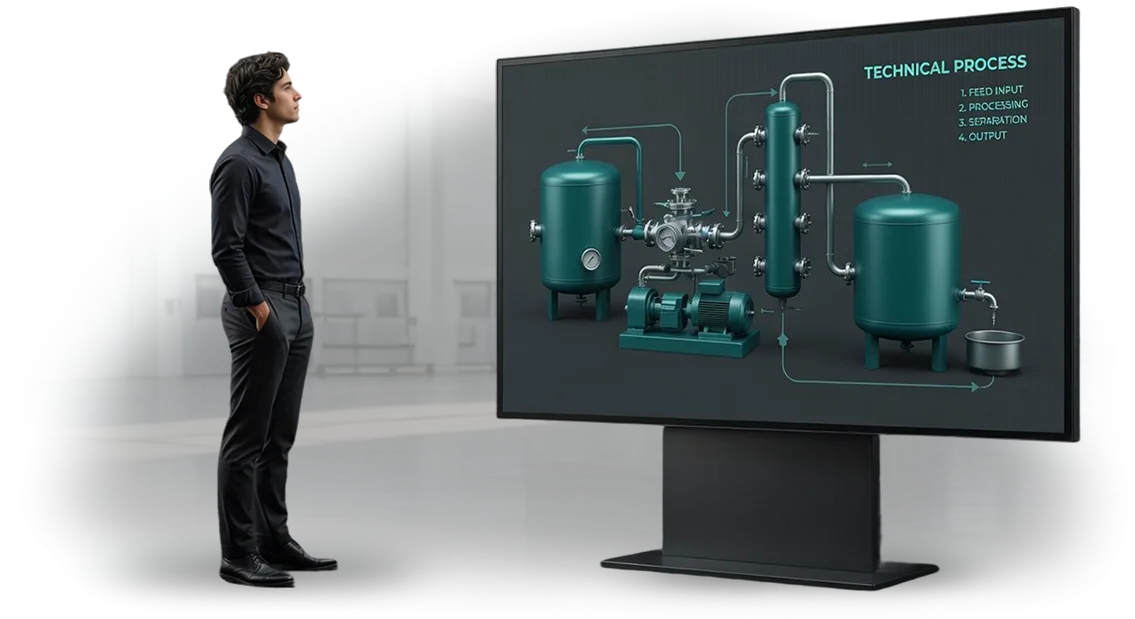
No Clear Instructions for Robotics and Industrial Automation
Robotics and industrial automation are complex equipment where every operation affects the result. Standard instructions are often voluminous manuals with drawings and terminology that a new employee can hardly understand.
The consequence: long onboarding, errors in setup and operation, line downtime, and additional repair costs.
The problem is especially acute in staff training: mentor engineers are overloaded, and staff turnover forces repeating the same material over and over.
Even an experienced employee can forget the sequence of operations or confuse components when dealing with a non-standard situation. As a result, the enterprise loses time, money, and reputation in the eyes of customers.
Video instructions work much more effectively in this regard: they show every step visually and allow you to pause at the right moment and return to a complex fragment. But simply filming real equipment does not always reveal the internal structure of mechanisms.
For an employee to truly understand the operating principle, 3D models and exploded views are needed — they make hidden processes and components visible.
We help close this need: we develop corporate video instructions for robotics and industrial automation that reduce training time, lower the number of errors, and increase employee confidence.
Even a beginner will quickly understand the sequence of actions, and a manager will get a working personnel training system without dependence on mentors' personal experience.
What benefits do video instructions bring to manufacturing?
Manufacturing loses money on every downtime caused by an operator error or the long adaptation of a new employee. Text instructions and diagrams do not give the full picture — a person has to mentally assemble components, and that takes time and creates risk.
Video instructions with 3D demonstrations solve this problem: the employee sees the exact sequence of actions and repeats it without guesswork.
Speed of on-the-job training
New employees get up to speed faster when they see the real process rather than read about it. A 3D video instruction shows how to service a robotic line, replace components, or configure automation — from the first viewing, the person understands the algorithm. Training takes hours instead of days, and the mentor does not waste time repeating the same thing.
Visual clarity that drawings cannot provide
An exploded 3D view shows the internal structure of a mechanism: where each part is, how it is attached, and what happens to it during operation.
This is especially important in robotics and industrial automation, where an error in the assembly sequence leads to the breakdown of expensive equipment. Video lets you examine each component from the needed angle, freeze a frame, or slow down a complex moment.
Fewer errors and less downtime
When every employee works according to a unified video benchmark, the number of errors drops. The instruction eliminates "personal interpretation" — the operator repeats a proven sequence rather than recalling how they were taught.
The result: fewer unplanned stops, tooling breaks down less often, and scheduled tasks are completed faster.
A single standard for the entire shift
Video instructions ensure consistent training quality across all sites — it does not depend on the mentor's experience or the shop floor workload. Updating a regulation takes minutes: record a new clip or replace a fragment — and the whole shift works to the current version. This reduces retraining costs and makes the process predictable.
We shoot such video instructions with professional equipment, so every detail is clearly visible, and sound and text aid comprehension. The client receives a ready-made package that can be immediately used in a distance learning system.
Formats of training videos for robotics
The same robot or automation line is mastered differently by different employees: an engineer needs the logic of disassembly, an operator needs the startup sequence, a beginner needs the big picture without the risk of breaking equipment.
That is why we do not make "one video for all cases" but instead select a format for the specific task and employee level.
The table below shows the main types of training videos we develop for enterprises with robotics and industrial automation.
| Video format | For whom | What it gives the client |
|---|---|---|
| 3D instruction with exploded view | Engineers, service departments | Clearly shows the disassembly and assembly order of components. Reduces repair time and the number of errors — the employee sees how the mechanism is built before picking up a tool |
| Step-by-step video instruction for working with a robot or machine | Operators, new employees | Fast path to independent work. A clear sequence of actions prevents abnormal situations, and a new employee can be put on shift within a few days |
| Video regulation on safety procedures | All shop-floor personnel | Communicates the rules without dry instructions. Reduces the risk of injuries and violations, helps pass internal checks and audits |
| Short video cheat sheets for routine operations | Experienced employees, supervisors | Allow quick knowledge refresh during changeovers or non-standard situations. Reduce the flow of questions to technical specialists and cut downtime |
Each format is shot with professional equipment using 3D graphics, so the client gets a stable picture and accurate detail even for complex industrial units.
If needed, we combine formats into a single training program: from a short cheat sheet to a full course with knowledge testing.
We help you choose the optimal format for your equipment fleet and staff skill level at the briefing stage. You will get exactly the video that solves the rapid training task without overpaying for unnecessary options.
Stages of creating your video instruction
To ensure the video instruction actually works and integrates into your processes rather than becoming "a presentation on the shelf," we have built a transparent workflow.
You participate at all key stages — from idea to launch — so the risk of getting the wrong result is eliminated from the very start.
-
Briefing and task analysis. We study the equipment, typical work scenarios, and staff skill levels. We set goals: reduce assembly time, lower errors, accelerate onboarding of new specialists.
-
Script and storyboard. We prepare a text description of each frame: what the employee sees, which component is demonstrated, how the commentary is voiced. You make edits before rendering begins — this saves budget and time.
-
3D modeling and animation. We create an exploded view of the mechanism: parts separate, and we show the assembly and disassembly sequence. Intermediate versions look like draft videos so you can see the progress and provide feedback.
-
Voiceover, subtitles, and accents. We add the narrator's voice, text hints, and visual markers for dangerous actions. The instruction becomes understandable even to a beginner in the first week on the job.
-
Final version approval. You receive the complete video and test it on real equipment or in the training process. We make edits to animation, text, or voiceover — up to two iterations per contract.
-
Launch and integration. We deliver files in the formats you need: for corporate training portals, training classrooms, or the training department. We help package the instruction into a QR code for quick access from a tablet.
-
Support and updates. If the model or regulation changes, you come back to us for an update — the source files stay with you, and edits are made in a targeted way.
The entire process is fixed in the contract: deadlines, number of revisions, and scope of work are clear from day one. You always know which stage the project is at and when it will be ready.
What you get as part of the project
When we deliver the project, you receive not just videos but a complete package for employee training. Everything is assembled so you can launch training immediately: without additional shooting, without additional orders, and without internal approvals.
The final product includes:
- 3D-format training video instructions with breakdowns of components and mechanisms — the employee sees the internal structure even if the equipment is already installed or in operation.
- Turnkey editing: scenes are arranged in training logic, accents are placed, and excess material is cut. You get ready-to-use files that can be uploaded directly to the learning system.
- Subtitles and voiceover broken down by steps: the material is clear to beginners and to those working in a noisy shop.
- Access to finished videos through a private channel or learning platform — you can issue them to employees in portions and track views.
- Files in different formats: for computer, tablet, and phone, so training can happen at a convenient time.
- Methodological recommendations: a short document on how to integrate video instructions into the onboarding and certification program.
Every item is a result that saves mentor time and accelerates a beginner's path to full productivity. After delivering the package, you receive support: if you need to adjust a scene or add a step, we will make the changes quickly.
Real case study: staff training without stopping production
Task: train staff without stopping the conveyor
A plant assembling industrial robots approached us: new equipment required skills that some employees did not have, and no one could stop the line for a week of training — every hour of downtime meant lost revenue.
Off-site training sessions did not provide the needed coverage: instructors managed to train one shift in two weeks, and after a month, part of the knowledge "faded" due to lack of practice.
We proposed a solution that addressed both tasks: a series of video instructions with exploded views of mechanisms. Employees studied the structure of components on screen and saw the disassembly and assembly order without the risk of breaking expensive equipment. Training took place right at workstations — during breaks, before shifts, at a comfortable pace.
What changed on the production floor
Within two months, all 120 employees across two shifts had used the video instructions. The time for a new specialist to start working independently fell by 40% — instead of a month of mentoring, two weeks were enough.
The number of errors in equipment maintenance halved, and most importantly — production did not stop for a single hour.
We should also note the effect for the occupational safety department: the instructions became the basis for knowledge testing and analyzing abnormal situations.
The production manager at TechnoProm, at the pilot version demonstration, asked to re-shoot the videos to their own visual standard so the videos would feel like "native" plant material rather than third-party content.
Why the client returned a quarter later
Three months later, the plant ordered a second block of videos — this time for the repair crew and interns. In plain terms: on-the-job training that requires no external instructors and does not let the production plan slip. This is what measurable training looks like: speed, safety, and preserved production rhythm.
How to choose a format for your task?
A universal "best" instruction does not exist — the right one depends on which task it solves. If an employee needs to quickly recall the sequence of operations at a machine, a short video focused on steps will work.
If a complex component must be disassembled and reassembled, you need 3D animation with an exploded view where every element and its place are visible.
The criterion is simple: the higher the cost of an error and the more complex the equipment, the more detailed the video should be.
Base your choice on three questions: who will watch (a new employee or an experienced specialist), under what conditions (at the machine in a noisy shop or in a training classroom), and what should happen after viewing (independent assembly, safe maintenance, fast diagnostics).
If the answers involve practice on real equipment, choose a video with difficulty levels and the ability to pause. If you need to scale the expertise of narrow specialists, make a series of modular videos that are easy to update when equipment is modified.
We help clients decide on the format before shooting starts: we analyze typical errors, usage scenarios, and the audience's skill level. Based on that, we propose the optimal structure — from 60-second operation cards to full courses with 3D breakdowns.
This way you get not just "a video" but a tool that actually reduces defect rates and speeds up onboarding.
The key is not to chase trendy formats but to test the video on a focus group of future viewers. Spending one day on testing will save months of rework and ensure a high level of material retention. As a result, the format will work for you — not you for the format.
Frequently asked questions about creating video instructions
Clients ordering video instructions for robotics and industrial automation most often worry about one thing: whether it is safe for the equipment, understandable to employees, and durable. We answer typical questions honestly and to the point.
Is filming safe for operating equipment? Will we damage it?
Yes, it is safe. We do not disassemble a running line and do not risk the production cycle. Instead, we create a professional 3D visualization with exploded views: the employee sees the mechanism's structure and the sequence of actions without touching a single real component. Your equipment remains in its original state, and the personnel gets a clear instruction.
How do you guarantee that employees will actually understand the material?
Clarity is tested not with words but with a focus group of your employees. We show a draft version of the instruction, observe where questions arise, and refine the block until it is fully clear.
As a result, you get training that reduces the number of errors in maintenance and repair, and new employees begin working independently faster.
What happens if the production process changes or the equipment is upgraded?
The video instruction is built modularly: each action is a separate short block. If the algorithm changes or a new operation appears, we update only the needed module, not the entire series of lessons.
This saves the budget and keeps the training system always relevant for your robotics and industrial automation.
How long does creating training videos take, and what are the deadlines?
The timeline depends on the number of operations and the complexity of the mechanisms. At the initial briefing, we record the list of actions, approve the script, and set a delivery date.
All deadlines are fixed in the contract — you can plan the onboarding of new employees and confidently launch training exactly on time.
Order video instructions for your production
Do you want new employees to get up to speed in days rather than months?
That is exactly why we create video instructions with 3D demonstrations of components and mechanisms: the technique is clear from the first viewing, and the risk of errors during assembly or setup drops noticeably.
We have made instructions for companies with dozens of machines and robotic lines, so we understand real production tasks. Leave a request — and we will propose a solution for your specific site, not an abstract "corporate course."
After your inquiry, you will receive:
- an analysis of your operations and an instruction script that addresses exactly your bottlenecks;
- a proposal on formats: from short videos to a complete package for each piece of equipment;
- a timeline calculated for your schedule — without stopping production;
- a test fragment on your operation so you can assess the style and level of detail;
- ready materials in the formats you need, including 3D exploded views for complex mechanisms;
- training for your team: how to upload, update, and supplement instructions on your own;
- support after launch, if refinement or a new script is needed.
Ordering development is simple: call us or leave a request for a consultation — we will discuss your tasks, show examples, and propose a solution. Within a few days, you will receive the first ready fragment and see how convenient it is for your employees.
Write to us today — we will help turn instructions into a working tool that saves mentor time, accelerates training, and improves the quality of work on the line.