

Problems of woodworking: how video instructions save budget
Any woodworking production loses money on three things: employee errors, material damage, and downtime. Even an experienced machine operator sometimes misreads a drawing or confuses the order of operations — and the result is a spoiled workpiece and a stopped line.
A separate risk is occupational safety. Working with circular saws, routers, and thickness planers requires precise movements. When training is reduced to a quick hands-on briefing or reading dry regulations, new employees learn by trial and error.
The price of such a mistake is not only a spoiled part, but also an injury, fines, and a loss of reputation for the employer.
A familiar picture: training one newcomer takes weeks, during which a mentor accompanies him and is distracted from his own work. Productivity drops, rejects grow, and experienced specialists burn out.
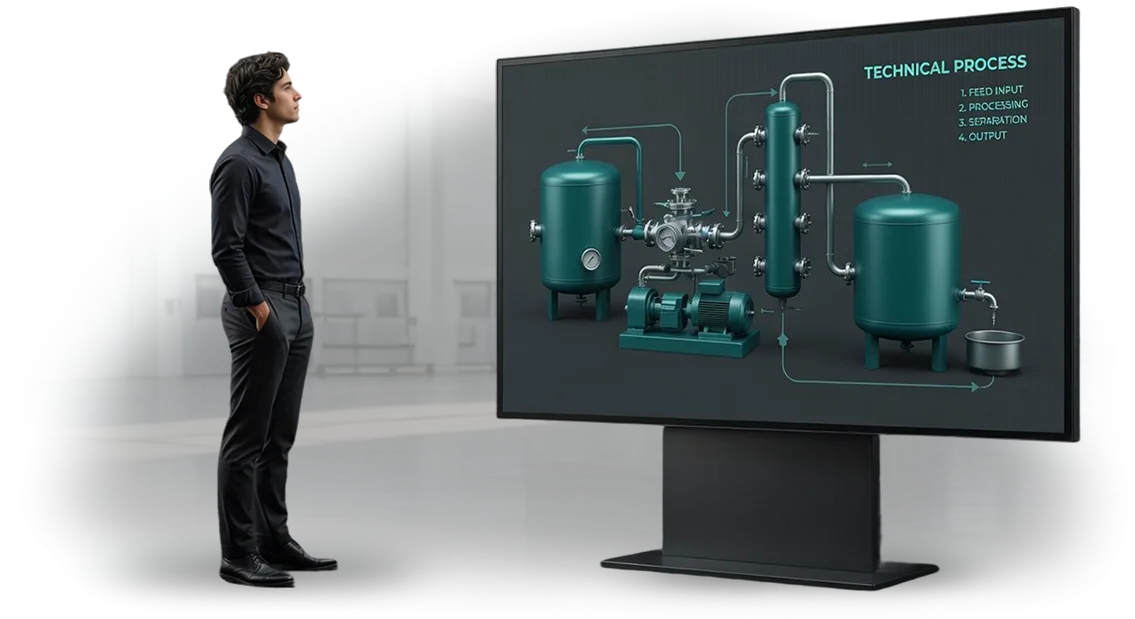
We solve this problem with visual 3D video instructions. Instead of abstract instructions, the employee sees an accurate exploded view of the assembly and the correct sequence of actions. Every step is in plain sight, including clamping force, feed angle, and quality checkpoints.
Such training reduces onboarding time, reduces the number of staff errors, and helps comply with safety regulations. The video instruction can be reviewed at any time — on a workshop screen or from a smartphone, without stopping work or distracting the mentor.
As a result, you get a predictable outcome: less reject material, less downtime, lower material consumption. And employees get a clear training system that does not depend on the human factor or instructor fatigue.
What a video instruction system gives a business
A video instruction system for employees is not just a set of videos, but a working tool that builds unified work standards across all areas.
When every specialist sees a reference execution of an operation, there is no need to rely on "senior experience" and personal interpretations of technology. The result is predictable quality and fewer rejects.
For HR and line managers, such a library accelerates employee onboarding many times over. Instead of weeks of observation and trial, a new person receives a structured course: watch, repeat, reinforce.
This is especially important in woodworking, where complex operations with cutters, machines, and materials require a precise sequence of actions — a visual demonstration eliminates questions before the first time they go on the line.
The quality department gets a transparent basis for control. If there is a recorded standard for each operation, it is easier to assess whether an employee's actual work matches the accepted standard.
Video instructions help point out deviations with clear reasoning and quickly correct skills — without disputes and subjective judgments.
The key benefit for production is learning without interrupting work. The employee does not need to travel to trainings or sit in a classroom: the instruction opens on a tablet or computer in the workshop at the right moment.
This way you do not lose output volumes and systematically improve staff competence right at the workplace.
Taken together, this benefits the entire business: less time for onboarding, stable quality regardless of the shift, and mentoring does not suffer when experienced specialists leave. Video instructions become a knowledge base that stays in the company even if the team changes.
Formats of 3D video instructions for employee training
Employees absorb information differently, and the cost of a mistake in woodworking production is high. Therefore, for training we use three key formats — from quick familiarization to deep skill practice. The format is selected according to the specific task and the staff's skill level.
| Format | For whom | What it provides |
|---|---|---|
| 2D video instructions | New employees, mass training | Quick introduction to basic operations and safety standards. Short videos are convenient to use as a cheat sheet |
| 3D animation with exploded view | Technical staff, maintenance services | A clear understanding of the internal structure of machines and assemblies. You can see how parts connect and in what order to correctly disassemble and assemble the mechanism |
| Interactive scenarios | Experienced employees, certification | Practicing actions in emergency situations without risk to equipment. The employee makes decisions, and the system immediately shows the consequences |
3D animation with an exploded view is the hallmark of our woodworking direction. It shows the machine in section: the employee sees what is hidden under the housing, why each part is important, and what will happen if operations are performed in the wrong sequence. This reduces training time and prevents breakdowns caused by the human factor.
Interactive scenarios turn training into practice. The employee goes through the scenario in a safe environment, mistakes are reviewed immediately, and the manager sees an objective readiness level for each employee.
This format is convenient for certification and advanced training — it gives a measurable result, not just formal attendance at a lecture.
Stages of creating corporate video training
Developing video instructions for woodworking is a well-structured process with clear stages. You control the project progress and receive videos that can be used immediately in employee training. The process includes seven steps:
- Brief and task analysis. You describe the specifics of your production, complex operations, and typical employee errors. We record the goals, target audience, and quality criteria.
- Script. We write the script: what happens in the frame, the narrator's text, and where to place emphasis. You see the structure of the future video before filming and can make changes.
- Storyboard. We agree on the visual plan: how we will show machine assemblies, tools, and exploded views. This eliminates expensive rework at the production stage.
- Production. We shoot the material and create 3D animations, including exploded views for woodworking. We use professional equipment and proven tools — the quality is consistent.
- Rough cut and approval. We show an intermediate version, collect feedback, and make changes. You know exactly what you will get in the final version.
- Final editing and adaptation. We prepare the video in the required formats: for a training portal, messengers, and in-person trainings. We add subtitles on request.
- Launch and support. We help integrate video instructions into the training program, answer employee questions, and update videos when necessary to reflect changes in processes.
At each stage you receive a clear result: a document, a plan, or a video version. That is why the development of video instructions proceeds without unnecessary delays or drawn-out approvals.
What is included in the video project delivery
The delivery includes not just a set of files, but a complete solution for integrated training. You receive final videos, source files, and training materials — everything you need to launch a training program without engaging a contractor.
- Final videos in three formats: a full version for group sessions, a shortened version for self-study repetition, and a smartphone version — the employee watches when and where it is convenient.
- Training materials for the mentor: a detailed lesson script, comprehension questions, and a skills assessment checklist after viewing.
- Source files of the 3D project and video editing: when a machine, tool, or technology changes, you can quickly make edits without ordering a video from scratch.
- Instructions for uploading to the learning management system: how to place the video, grant employees access, and view viewing statistics.
- Employee memo: a short text with key operations and a sequence of actions — convenient to keep on hand in the workshop.
- Videos of different difficulty levels: from a full breakdown for a beginner to short fragments with only complex assemblies for experienced workers.
- Training recommendations for integrated training: how to integrate the video into existing courses, what assignments to give before and after viewing, and how to evaluate the result.
Such a set covers the full cycle: video delivery provides material for a fast start, training materials help mentors conduct classes, and source files remove the dependence on a contractor.
You get not a one-time service, but a knowledge base that saves time on every new employee and accelerates the transition to a working rhythm.
Case study: how video instructions reduced rejects and injuries
In woodworking production, rejects and injuries often occur not because of employee inattention, but because of ambiguous instructions. A newcomer reads text memos, looks at flat drawings — and assembles the unit in the wrong sequence. The result: material overuse, line downtime, and health risks.
We encountered this at a furniture factory that produces cabinet furniture. The client asked us to reduce the share of rejects during the assembly of complex units and lower the number of minor injuries among operators.
Instead of ordinary PDF memos, our team developed a series of 3D video instructions with an exploded-view effect: every fastener and part is shown disassembled, and the sequence of actions is demonstrated clearly.
The worker sees not an abstract diagram, but a precise model of his machine or unit. He does not need to decipher a drawing — he just needs to repeat the movement shown on the screen.
This is especially important for operations where a mistake in the first seconds leads to damage to the workpiece or tool jamming.
Two months after implementation, the factory recorded a 30% reduction in rejects, and injuries halved. In addition, the onboarding of new employees accelerated: instead of two weeks of mentoring, it took three days of working with the video instruction and a test assignment.
This training case shows: investments in 3D instructions pay off through material savings and reduced downtime. If your production has similar losses, we are ready to analyze one unit and show the effect before scaling.
Answering questions about implementing video instructions
Implementing video instructions in woodworking production raises questions — most often about budget, timelines, and compatibility with existing regulations. Below we have gathered answers to what concerns clients before starting a project.
How much does development cost?
The cost depends on the number of instructions and the complexity of the exploded views. After an audit of your equipment, we give a fixed price without hidden surcharges. The video pays for itself through faster training of new employees and reduced errors during assembly.
What are the implementation timelines?
A typical project takes 2–4 weeks. We show the first demo a few days after the start — you see the style and format before final delivery. We work in parallel with production without stopping processes.
Is it difficult to adapt the video to our regulations?
We take your instructions and process charts as a basis. We convert text steps into clear 3D scenes while preserving the sequence of operations. When a regulation changes, the video is updated quickly — edits are made to the model, not reshoot.
What equipment is needed for playback?
An ordinary computer, tablet, or screen in the workshop is enough — no special equipment is needed. We provide files in a universal format for any device and, if necessary, adapt them to a corporate portal or learning management system.
Order corporate video training for employees
High-quality employee training is not an expense but an investment in the speed and accuracy of work. But for video instructions to truly be beneficial, they must be clear, visual, and integrated into your processes.
That is why we start cooperation not with a contract, but with a conversation: we listen to how your production is organized, where errors occur, and which format is more convenient for your operators.
After contacting us, you will receive a concrete action plan, not general words.
We will assess the scope of the task, suggest a suitable format — from short videos to detailed 3D breakdowns with exploded views — and calculate the cost so that it is clear to you what you are paying for.
What you will get after your request
- A consultation: we will review your task and advise how to present the material more effectively.
- A project assessment: we will send an approximate structure of video instructions for your operations.
- Cost and timeline calculation — without hidden surcharges or "surprises" along the way.
- Examples of our woodworking work so you can see the level of execution.
- Recommendations on format: for machines, hand tools, or entire work areas.
- Adaptation to your standards: taking into account regulations and the rules accepted in your production.
- Support at all stages — from script approval to the final version.
Leave a request on the website — we will call you back at a convenient time, answer your questions, and prepare a proposal for your task. Employee training can start as early as this month: one email or phone call is enough.
How to choose the video instruction format for woodworking?
Choosing the format of a video instruction for woodworking is not a question of "what is trendier", but a question of "what solves your problem".
There is no universal solution: for one machine a simple 2D video is enough, but for complex multi-assembly equipment 2D will only confuse the employee.
The main principle is that the format should shorten the path from viewing to correct action: fewer errors, less training time, fewer spoiled materials.
A flat 2D video is the foundation. It is suitable for quick instructions on setup, tooling changes, and daily maintenance. If the operation is linear and does not require understanding the internal structure of the unit, 2D is a fast and budget-friendly solution.
But as soon as you deal with a mechanism where it is important to see how dozens of parts interact, a flat image forces the employee to fill in the gaps. That is where room for errors appears.
When the task is more complex, the 3D format with exploded views comes to the rescue. In woodworking, these are primarily machines with cutting heads, feed units, and dust removal systems.
A three-dimensional instruction with separated parts shows what is attached where, in what order to disassemble and assemble, and where the risk of jamming lies. The employee sees the mechanism from the inside without opening it — and learns 30–40% faster. Plus, such videos are equally understandable for a beginner and an experienced master.
Interactive instructions are the next level. This is not a passive "watch and repeat", but a simulator: the employee chooses the steps himself, answers test questions, and gets hints when he makes a mistake.
This format is justified for dangerous operations where the cost of an error is high — for example, when working with milling or sawing units. Interactivity makes it possible to test knowledge before a person approaches the machine and takes some of the load off the mentor.
We choose the format based on your tasks, not by "selling the most expensive one". If 2D is enough, we honestly say so.
If you need 3D for complex assemblies or interactivity for certification, we put together a combination: one large video for everyone plus short interactive modules for critical operations.
As a result, you get instructions that really work on the shop floor — saving mentors' time, reducing injuries, and protecting equipment.