

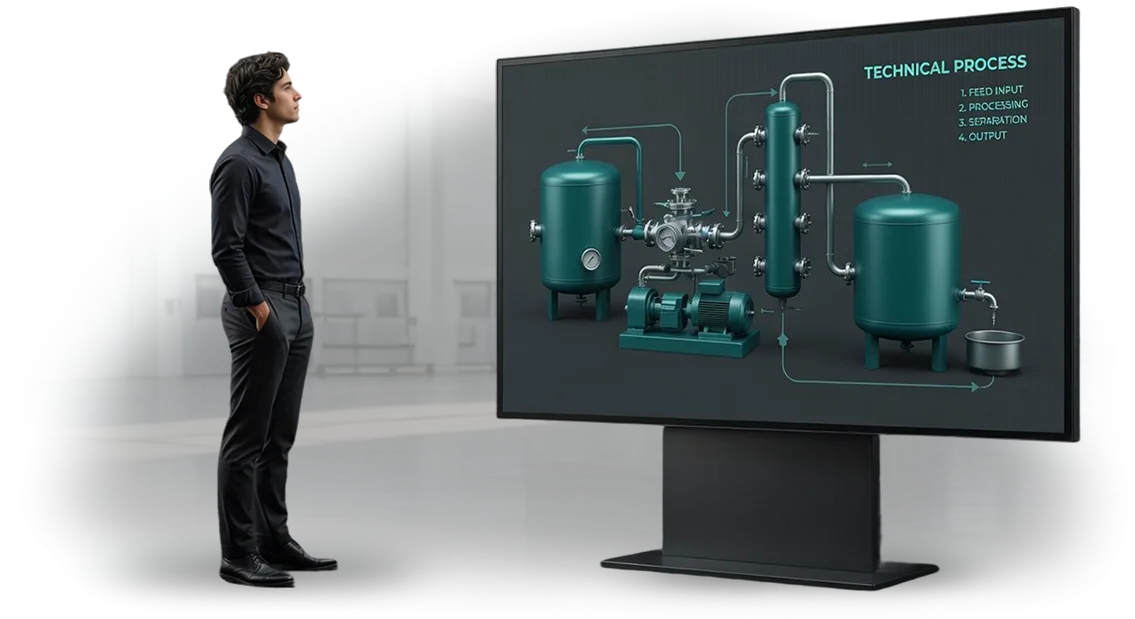
Without 3D Instructions for Filtration Equipment, You Lose Orders
Without visual 3D video instructions, your filtration equipment only sells itself halfway. The buyer sees the housing, the connections, and the filter elements, but doesn’t understand how the system works inside, how to maintain it, or why it’s worth the money.
Instead of a confident “we’ll take it,” you get dozens of clarifying questions, drawn-out approvals, and decisions in favor of a competitor who seems easier to understand.
The same thing happens inside your company. New employees struggle to learn installation, cartridge replacement, and routine maintenance from text instructions and flat drawings.
Training drags on for weeks, errors on site undermine client trust, and “experienced” specialists constantly have to stop what they’re doing to help out. In the end, you lose not only time but also orders — because service becomes part of the product you offer.
This is exactly where 3D video instructions with exploded-view demonstrations come in. A step-by-step breakdown and reassembly of filtration equipment in three dimensions shows every part and every assembly, making the maintenance process transparent and predictable.
The buyer sees how easy it is to replace the filter element, and the employee gets a clear procedure they can review at any time.
For business, this means higher conversion and better customer retention: fewer doubts at the selection stage, faster onboarding for new employees, and consistent service quality that doesn’t depend on “golden hands.” The video works for you around the clock — on your website, in commercial proposals, and in internal training — saving resources for your sales and support teams.
We create exactly these kinds of instructions: professional 3D visualization, clear assembly logic, and a finished product that’s easy to integrate into your sales and training processes.
A short brief — and you get a tool that pays for itself through faster deals and fewer staff errors.
What You Get from Professional Video Instructions
Professional video instructions solve three business tasks at once: they speed up staff training, reduce operating costs, and increase brand trust.
Instead of thick manuals and long internships, an employee gets a visual scenario: how to correctly disassemble, flush, replace the filter element, and reassemble the equipment without mistakes.
This is especially important for filtration systems, where every part affects service life and operational safety.
The main effect is cost reduction. A new employee begins working independently more quickly, and experienced staff make fewer mistakes during maintenance. The company spends less on retraining and fixing the consequences of improper operation.
Video instructions function as an always-available reference: employees can return to them at any time without interrupting a mentor or stopping production.
The second result is brand recognition. High-quality videos with three-dimensional diagrams and exploded-view visualization show clients and partners your level of expertise.
Such materials set your company apart from competitors; they get shared and cited in tenders and negotiations. They build your image even when the video isn’t watched in full — a professional presentation and level of detail are enough.
The third effect is a unified service standard. When all employees are trained with the same program, service quality no longer depends on the experience of a particular technician. This is especially important for companies with distributed teams and dealer centers.
Clients receive equally competent support in any region, which means higher loyalty and more repeat orders.
In the end, video instructions are not an expense item but an investment that pays off through reduced downtime, fewer warranty claims, and a stronger reputation. You get a ready-made tool that works for training, sales, and after-sales support alike.
A set of videos created once delivers value for years, and when you update your product line, the materials can easily be supplemented with new scenarios.
3D Video Instruction Formats for Your Business
Each business task gets its own video format: some need a short video for an exhibition, others need a full instruction for staff training. We’ve prepared three types of video content that we adapt to your goal and distribution channels.
Choosing a Format for Your Task
| Format | For Whom | What It Gives the Client |
|---|---|---|
| Short video (up to 1 minute) | Marketing and exhibitions | Quickly engages the audience, increases interest and reach |
| Training video (2–5 minutes) | Operators and new employees | Clear setup steps, fewer mistakes, and faster onboarding |
| Full instruction (10+ minutes) | Service engineers | Detailed 3D breakdown of the device for maintenance and repair |
A short video builds brand awareness, while a full instruction sets the quality standard: all employees are trained in the same way.
3D animation with an exploded view shows the internal structure of filtration equipment without opening the housing. A future specialist sees how assemblies connect and where replaceable elements are located — training is faster, and the risk of errors is lower.
We will select the right format before you start: we’ll discuss your audience, goal, and distribution platform. You’ll receive a video that solves a specific task — training, sales, or a procedure.
How We Create a Video Instruction: Step-by-Step Process
We designed the process so that you understand at every stage what is happening and what you’ll get in the end. You don’t need to understand production details — just define the task, and we’ll handle the rest.
-
Brief and task audit. We discuss which equipment operations need to be shown, who will watch the instruction, and under what conditions. The result is a clear technical specification approved by you.
-
Script development. We break the process down into short on-screen steps: from unpacking to maintaining the filter. We indicate which assemblies and parts should be highlighted so that employees don’t miss anything important.
-
Preparing clear visualization. We create an animated model of your equipment — from an overview to an exploded view showing the internal structure. You can see right away what the video will look like and make changes before the final render.
-
Reviewing the interim version. We show a draft version with timing and voice-over text. You check whether everything matches your procedures, and we adjust the details without losing time.
-
Video production. We assemble the video: animation, voice-over, subtitles, and highlights of key components. The result is a finished file in the formats and resolutions you need.
-
Instruction rollout. We deliver the video and help you place it in your learning management system, corporate portal, or employees’ mobile devices. We give recommendations on how to integrate the video into the onboarding process and improve viewing rates.
-
Post-publication support. If the equipment design or procedure changes, we update the scenes quickly. You’re never left with an outdated instruction.
Each stage is recorded in a short report so you can see the work status and know what you’re getting. This approach lets us release a video instruction in two to three weeks and be confident that it solves the training task for your specific employees.
What’s Included in the Delivery: a Complete Package for Your Project
You get not just a video file, but a complete package for implementing training. Everything is packaged so you can immediately place the materials in your learning management system (LMS), on tablets, and in shared chats without any extra work.
- Ready-made video in the formats you need — for LMS platforms, mobile devices, and video hosting. Just upload the file and assign it to employees.
- Professional video editing — a logical structure, highlights on key operations, and pauses for reflection. An employee watches and immediately understands the sequence of actions.
- Clean audio and voice-over — each step is explained without noise or background sounds. This speeds up learning and reduces the number of mistakes when working with filtration equipment.
- Subtitles for all videos — convenient for those who work in a noisy shop or don’t use headphones. The material is absorbed in any conditions.
- A guide to using the materials — how to upload the video to the LMS, grant access, and track views. Implementation takes no more than an hour.
- Project source files — if needed, you can make edits with your own specialists or order updates from us.
- A test assignment and checklist — to verify employees’ knowledge after viewing. You can see who has absorbed the material and who needs to review the instruction again.
This package covers the entire cycle: from first viewing to results control. You won’t have to figure anything out or finish anything — everything is ready to use.
Case Study: 3D Instructions for a Filter Manufacturer Increased Conversion
A manufacturer of filtration equipment for water treatment systems came to us with a problem: it was taking too long to bring new installers and service engineers up to speed.
While a new hire waded through paper instructions and old drawings, project deadlines slipped, and clients received service that wasn’t up to standard.
We suggested replacing part of the training with a series of short 3D video instructions featuring exploded views.
On screen, they could clearly see how a filter assembly comes apart, in what order cartridges are removed, where the seals are located, and how to correctly reassemble the system.
Our team produced videos for three key equipment models, tying each step to the common mistakes that trainees used to make.
The results speak for themselves. The time it took a new employee to begin independent work dropped by about a third, and the number of errors during assembly and maintenance fell by half.
The service manager noted that repeat callouts due to poor installation almost disappeared, which meant higher customer loyalty.
The most important part is that the effect wasn’t limited to training. We adapted the same 3D videos for the sales department: showing buyers how the filtration equipment works significantly boosted conversion on the website and in presentations. The client has already ordered a second series of video instructions for new models.
How to Choose the Right Video Instruction Format for Your Task?
Let’s start with the main point: there is no universal “ideal” video instruction. The format is determined by the task — whether you are teaching an employee to accept a new line, carry out routine maintenance, or fix a malfunction.
It’s the purpose of the video that will tell you whether you need a full sequence of actions, a short reminder video, or a detailed breakdown of the device.
For filtration equipment, 3D video instructions with exploded views are particularly effective. When an employee sees the internal structure of an assembly — filter elements, valves, seals — it’s easier to understand the logic of assembly and disassembly.
This format reduces errors when replacing consumables and making repairs, which in turn reduces equipment downtime.
When choosing a format, ask yourself three questions. Who will watch the video — a new employee, an experienced mechanic, or an operator? What result do you want — for the person to repeat the operation or understand the working principle?
Under what conditions will they watch the instruction — on a tablet next to the machine or during a course in a training room? The answers immediately narrow down the suitable formats.
If the goal is fast onboarding of new employees, modular videos of up to two minutes with a focus on key steps work best. If you need to improve the skills of service engineers, choose extended 3D breakdowns with pauses and highlights on critical components. For regular knowledge checks, short videos with control points are suitable.
Our advice: don’t choose a format in advance based on trends or budget. Start with the goal of the video instruction, and we’ll help you select the optimal format — from simple 2D diagrams to detailed 3D exploded views.
At the start of the project, we analyze your task and propose a video structure that will exactly meet your employees’ needs and your business goals.
Answers to Common Questions About 3D Video Instructions
We understand that before ordering a 3D video instruction for employee training, questions come up about timelines, cost, and technical requirements. We’ve collected the most common ones and prepared honest answers — so you can make a decision without extra calls and approvals.
Every project is unique, but there are typical scenarios we’ve already implemented for filtration equipment manufacturers. Based on that experience, we answer the main concerns — so you’ll understand faster what exactly you’ll receive.
How long does video series development take?
On average, creating one 3D instruction takes 2–4 weeks. The timeframe depends on the complexity of the equipment and the number of assemblies that need to be shown in section.
We set the delivery date in the contract and stick to it — this lets you plan employee training in advance.
Is the instruction difficult for employees to use?
No, the video is intuitive. The 3D model shows the sequence of operations close up, and the on-screen comments and hints are designed for an ordinary employee without technical training. Learning goes faster than with paper procedures.
How much does development cost?
The cost depends on the complexity of the 3D model, the level of detail, and the length of the video. After the brief, we prepare a transparent estimate that includes all stages — from creating the model to final editing and voice-over. No hidden payments or forced options.
Will the video work for our filtration equipment?
We work from your drawings, technical documentation, or 3D scans. So the exploded view exactly matches the real assemblies and parts that your employees use. If the equipment is modernized, we update the video quickly — this is cheaper than creating a video from scratch.
If you didn’t find an answer to your question, just write to us — we’ll tell you about the timelines, cost, and possibilities of 3D instructions for your task.Order a 3D Video Instruction for Your Filtration Equipment
Employees remember only what they see with their own eyes. Text procedures and paper diagrams don’t provide a full understanding of how filtration equipment is built and how to properly maintain it.
That leads to installation errors, incorrect operation, downtime, and unnecessary costs from retraining.
A 3D video instruction with exploded-view demonstrations solves this problem once and for all. Employees see the equipment’s internal structure, understand how components are removed and installed, and remember the sequence of actions.
Such a video shortens training time several times over and minimizes the risk of failures caused by staff error.
Order a video instruction from our team— and get a finished video that works for your safety and efficiency.
What you get when you work with us:
- a consultation on the format and content of your future video;
- an accurate project cost calculation after audit, with no hidden fees;
- a turnkey 3D instruction: from script to final editing;
- adaptation of the video to your corporate style and training program;
- fast production times without sacrificing quality;
- support on any questions after project delivery.
Leave a request on the website — we’ll contact you within one business day, answer your questions, propose the best solution for your filtration equipment, and prepare an individual calculation.
Start with a short consultation — there’s no obligation, but it will save you weeks of searching and approvals.