

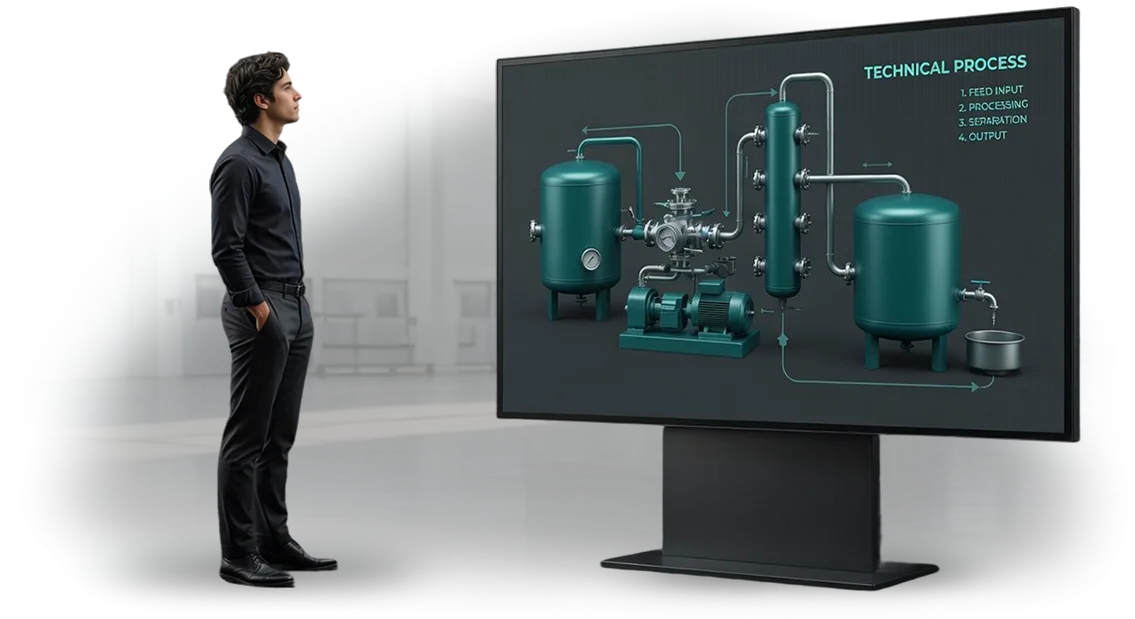
Errors When Operating Laboratory Equipment: How to Avoid Them
Even a minor mistake when working with laboratory equipment results in costly downtime, ruined reagents, or equipment failure. An employee who learned "by trial and error" remembers not the procedure but their own imprecise actions — and passes them on to newcomers.
As a result, research reproducibility declines, and every incident means missed deadlines and unplanned expenses.
A familiar situation: text instructions sit in folders, but nobody opens them in a real situation. Training is delivered by a "senior employee" who shows everything their own way. And when that person goes on vacation or leaves, the process grinds to a halt.
The company loses time, money, and control — yet the problem is not the people, but the lack of a visual standard that works without the mentor's personal involvement.
A high-quality video instruction removes this pain. The employee sees every step: how to prepare the instrument, connect modules, load a sample, and respond to an abnormal situation.
A 3D exploded view shows the equipment's construction from the inside — the person understands the operating logic rather than simply memorizing a sequence of buttons.
This shortens a newcomer's onboarding from weeks to a couple of days and reduces the number of errors several times over.
We create video instructions that integrate into the real workflow: available on a tablet next to the instrument, in the corporate knowledge base, and on mobile devices.
The lab manager stops being a "walking instruction" — instead, well-tuned video materials that are up-to-date for every employee do the job.
And when the equipment stops being a mystery, the number of incidents decreases, fewer consumables are wasted, and planned targets stop being missed due to the human factor.
What a 3D Video Instruction Gives to Employees and Business
Training on laboratory equipment usually takes weeks. Newcomers are afraid of making mistakes, experienced employees spend time on repeated explanations, and every inaccuracy risks breaking an expensive instrument or producing unreliable results. The benefits of video instructions are obvious — they address several business tasks at once.
Error Reduction
A 3D video instruction with an exploded view clearly shows how the instrument is built and how to perform each step correctly.
The employee sees not a flat picture but a three-dimensional model with parts broken down — this rules out misinterpretation and noticeably reduces the number of errors on the job.
Faster Training
Instead of multi-page procedures — short videos that can be rewatched at any moment. A new employee masters the procedures several times faster, and an experienced one refreshes knowledge without stepping away from work. Onboarding ceases to be a headache for the manager.
Procedure Standardization
A video instruction is a single source of truth for everyone. Regardless of experience and tenure, everyone follows the same scenario. This is especially important for laboratories that require accuracy and reproducibility of results.
Training Cost Savings
A created instruction works indefinitely: for hiring, for equipment updates, and for quality control. You reduce mentors' time and lower the cost of repeat training — the solution pays for itself after the first use.
The company our team develops 3D video instructions on professional equipment, taking into account the specifics of your laboratory complex.
We take on the entire process — from procedure analysis to final editing — so that you get a tool that truly works in everyday operations.
Video Instruction Formats: From a Simple Video to Exploded Views
When it comes to training employees to work with laboratory equipment, the video instruction format directly affects how quickly material is absorbed and how often errors occur.
There is no one-size-fits-all solution: for simple procedures, a short video is enough, while complex assemblies require a 3D model with disassembly.
Understanding the differences between formats helps you choose an option that pays off faster and delivers measurable results in personnel training.
A basic video is shot on real equipment — it is fast and budget-friendly, but it does not show the internal construction and hidden assemblies.
3D animation reproduces the instrument as a whole and can demonstrate the mechanism in cross-section and in motion, but developing it requires more time and resources.
An exploded view is a 3D animation where the equipment is broken down into its component parts: the employee sees the order of each part and how the elements connect to one another.
Interactive video supplements the visuals with step-by-step transitions, questions, and checkpoints — this format is convenient for self-assessment and practicing action sequences without the risk of breaking a real instrument.
| Format | Best suited for | What it gives the customer |
|---|---|---|
| Basic video | Briefing on simple operations | Quick launch, minimum budget |
| 3D animation | Showing the design and operating principles | Visual clarity without disassembling a real instrument |
| Exploded view | Disassembly, assembly, part replacement | Understanding the order and compatibility of components |
| Interactive video | Training with knowledge checks | Verification of each step, fewer errors |
However attractive a format may seem, the decisive factor is how well it matches the training task. For mass briefing, simple videos are enough, while for engineers and technical specialists, an exploded view with detail and interactive hints works better.
In complex cases, formats are combined: a short video gives the overall picture, while an interactive 3D diagram reinforces each action. We help you choose the optimal option and implement it for your specific equipment, budget, and skill level of your employees.
Stages of Developing a Video Instruction for Your Equipment
We have structured the process so that you see the result at every stage and can influence the final product. Instead of lengthy approvals — clear checkpoints: from the first brief to a finished instruction that employees will start using within a few weeks.
-
Brief and equipment audit. We capture the tasks: which operations to show, who will watch the instruction, and on which devices. We study the documentation and specifics of your laboratory equipment — this allows us to build accurate details into the scenario.
-
Scenario and storyboard. We describe each step: what happens on screen, which assemblies to show in close-up, and where an exploded view is needed. You receive a written scenario and a visual plan — it is easy to check the logic before production starts.
-
Scenario approval. We discuss edits and verify the sequence of operations and terminology with your company's experts. We lock in the approved version — this protects against rework at the final stage.
-
3D animation development. We create models of the assemblies and animations of disassembly and reassembly. We add labels, arrows, and highlighting of important parts — the employee sees the internal construction in a way they would not see during real work.
-
Quality control. We check compliance with the scenario, correctness of movements, and readability of labels. We provide a test version for review and make edits — in the end, you receive an instruction without technical errors.
-
Deployment and handover. We package the video in the required formats and help place it in the distance learning system or on the internal portal. We provide source files — you will be able to update the instructions when equipment changes.
We have used this workflow at our team in more than 50 projects for industrial and laboratory companies. You always understand what is happening at each stage and know the deadlines in advance — no surprises and no hidden tasks.
What's Included in the Delivery of a Video Instruction for Laboratory Equipment
You receive not just a video, but a complete delivery package that can be used immediately and updated without a new purchase. All materials are handed over after final payment, along with a description of the contents and instructions.
The delivery package includes:
- Final video files — the video in several formats and resolutions so it can be shown on any device: from a laptop to a screen in a training room.
- Project source files — all working files from which the 3D scene and animation were assembled. If the procedure changes or new equipment appears, you can make edits with your own team or order targeted refinements without reshooting.
- Scenario and instruction text — the approved voiceover text and a step-by-step editing scenario. You always see exactly what is shown to the employee and in what order.
- Operation documentation — a guide for the administrator: how to open files, where to store them, and how to upload the video to the internal portal or distance learning system.
- Subtitles and captions — a text version with time synchronization. Useful for those who watch without sound and for adapting to other languages.
- Implementation guide — a short list of actions: who to send the video to, how to integrate it into the training program, and how to check comprehension of the material.
This composition protects your investment: the video becomes a working tool that lives together with the laboratory. You can share the video between departments, update it when changes occur, and you will not depend on us after the project is completed.
Case Study: How We Cut Training Time by 40%
For the company BioLab, which supplies laboratory equipment to research centers, training new employees was a bottleneck. Each operator spent up to two weeks mastering the procedures: first theory, then work with a mentor, then the first independent shifts under supervision.
At the same time, experienced employees were constantly distracted from their own tasks to train newcomers — productivity dropped, and mistakes at the initial stage were costly.
We proposed replacing part of the live briefings with a cycle of 3D video instructions featuring exploded views.
Instead of abstract drawings and long texts, the employee sees the exact sequence: how to disassemble an assembly, replace a consumable, put it back together, and verify it works.
The video can be paused, you can go back to a difficult step and watch it in slow motion — this works better than a paper instruction.
We measured the results two months after launch. Training time for new employees decreased by 40% — instead of two weeks, they reached independent work in eight to nine days.
Errors during initial maintenance dropped almost threefold, and mentors were able to return to their core tasks. The head of training noted that newcomers get into the rhythm faster and ask fewer clarifying questions.
The video instruction cycle is now used as a mandatory stage of onboarding, and the company has ordered similar materials for three more equipment lines.
For the business, this means a predictable speed of bringing an employee to full capacity and fewer losses from mistakes at the start.
How to Choose a Video Instruction Format for Your Budget?
The choice of video instruction format depends on two factors: the complexity of the laboratory equipment and the budget.
For simple instruments where all operations are visible from the outside, regular filming with explanations is enough — it is fast, inexpensive, and easy to update when procedures change.
A different matter is complex multi-assembly equipment: analyzers, microscopes, systems with internal components. It is important for the employee to understand the construction, not just the sequence of actions.
Here, 3D video instructions with exploded views help: they show how the assemblies are arranged and what happens when replacing consumables and during calibration. This format pays for itself through fewer errors and faster training.
This is especially noticeable with expensive laboratory equipment, where every employee error risks downtime and repairs.
If the budget is limited, choose a combined format: real footage for general actions and 3D fragments for complex assemblies. This provides the necessary visual clarity without overpaying for full animation.
We help you choose the optimal option — we analyze the equipment, typical operations, and the skill level of employees. This approach is already used in our projects and delivers results without unnecessary costs.
The main thing is to find a balance between cost and benefit. A properly chosen format works both as an instruction and as an element of the training system, reducing the load on mentors.
Tell us about your task — we will propose a solution that fits your budget and the specifics of your laboratory.
Frequently Asked Questions About Video Instruction Development
We have collected answers to common concerns: guarantees, timelines, updates, and compatibility with training systems. If your question is not here, write to us — we will advise you.
What guarantees do you provide?
We lock the result into the contract: you receive exactly the agreed technical specification. Revision stages are included — we keep refining the video until it is convenient for your employees.
How long does development take?
Usually two to four weeks, depending on complexity. We give the exact timeline after clarifying the task and lock it into the contract — we meet the agreed dates.
What happens if the equipment is updated?
You send us the new data, and we make changes to the video while keeping the style. Updates are done under a separate procedure — usually faster and cheaper than shooting from scratch.
Will the video work with our training system?
We deliver it in a universal format supported by any corporate portal. If desired, we add subtitles, chapters, and versions for different devices.
What does support include?
We help with uploading and setup and answer employees' questions. If you have a support contract — priority queue and regular instruction updates.
Order a Video Instruction for Equipment: Start with a Brief
Ordering a video instruction for industrial equipment means taking the load off mentors and reducing the time it takes for a new employee to start working independently.
So that you can assess the timeline and budget without unnecessary approvals, we have made the process transparent and fast: you submit a request for a consultation, we clarify the task, and prepare a cost estimate.
The brief is the foundation of the project, and we help you fill it in during a consultation. You are not left alone with a form: our expert asks the right questions, captures the training goals and scenario, and then proposes the structure of the future instruction.
After contacting us, you receive:
- A personal consultation on the video instruction format for your equipment and the skill level of your employees.
- A list of questions for the brief — so nothing is missed and key requirements are agreed on right away.
- A preliminary cost and timeline estimate with no hidden work: you know what you are paying for.
- Recommendations on video length and style: short clips for quick operations or detailed breakdowns for complex assemblies.
- Examples of our work for similar tasks — you see the quality before we start.
- A plan of stages and checkpoints: brief, preparation, filming/3D modeling, editing, approval.
After the brief, you receive a fixed commercial proposal and a contract, and we reserve time in the production schedule. This way, the client always knows when the draft will be ready and when the final version will be.
Leave a request for a consultation — together we will break down the task and prepare a brief that will save time at all subsequent stages. This is not binding, but it gives you an accurate estimate for your project.