

Why do employees make mistakes when installing server equipment?
A mistake during server equipment installation isn't just a human factor. It's hours of downtime when sales can't see requests, logistics don't get routes, and accounting freezes before reporting.
Each such stoppage costs the business more than it seems at first glance: deadlines slip, clients are lost, and the workload grows for those who have to fix someone else's mistake.
Why do experienced employees make mistakes with operations that seem routine? The answer is simple — they work from old instructions. Forty-page textual manuals, static connection diagrams, and verbal "quick explainer" walkthroughs don't give the full picture.
When a specialist faces a complex server unit and only has a couple of PDF pictures in memory, the risk of mixing up the order of operations or connecting a component incorrectly multiplies.
Add stress, deadlines, and server-room noise — and an expensive unit is down due to one awkward move.
Traditional corporate training doesn't save the situation either: lectures without practice are forgotten within a week, and hands-on training on real equipment isn't always available to everyone.
In the end, knowledge stays with two or three veterans, while the rest learn by trial and error — a method that costs the company real money.
3D video instructions with exploded view demonstrations close this gap.
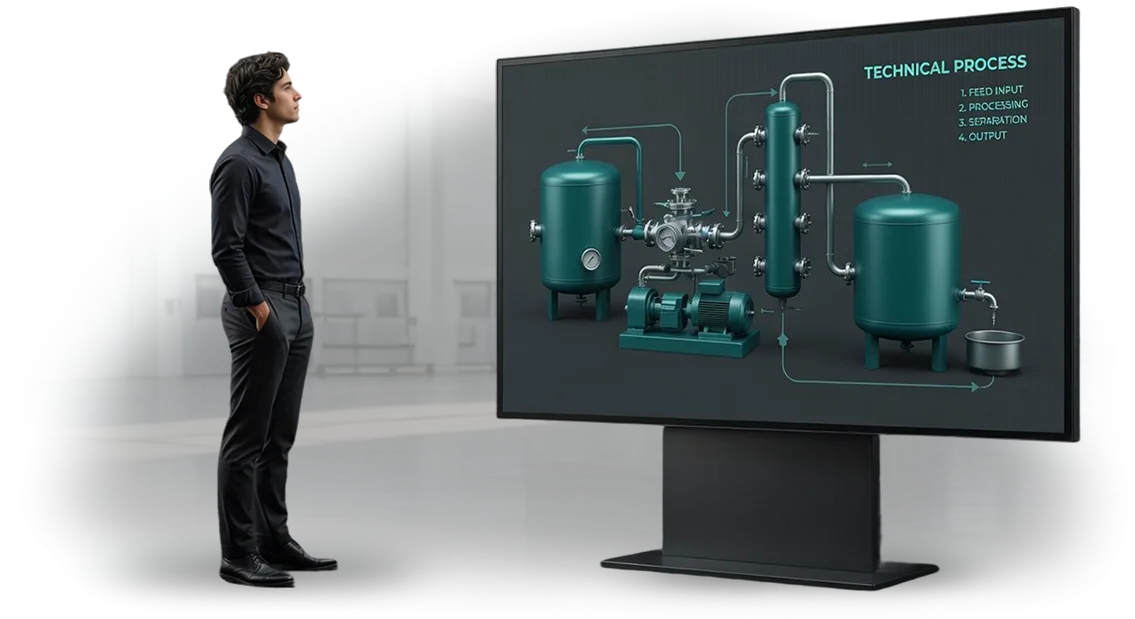
Instead of abstract text and flat pictures, an employee sees a 3D model of the server equipment: every installation step, every component, and the exact sequence of actions — clear and with no room for misinterpretation.
Errors in server equipment work become a thing of the past because a person understands not just "what to do," but also "how it works inside." Training becomes short, clear, and equally effective for both beginners and experienced engineers.
What you get: faster training, fewer errors, and skill growth
Fast onboarding without stopping production
A new employee no longer needs to sit next to an experienced engineer for weeks, memorizing the structure of server equipment. Instead, they get a visual 3D instruction that shows every detail and the sequence of actions.
Training takes hours, not days, and after just a couple of shifts a person is ready to work independently.
For the business, this means less chaos when hiring and expanding the team. You're not dependent on whether a mentor has free time — the instruction is always at hand and can be reviewed at any moment.
Fewer errors and less equipment downtime
Incorrect disassembly or assembly of a server is a risk of breakage, missed deadlines, and extra repair costs. An exploded 3D view shows exactly how a component is built and in what order the parts connect. An employee sees the final result before picking up a tool and acts with confidence.
Training errors no longer carry over into real work. Fewer emergency stops mean more stable service and less pressure on the people who usually fix others' mistakes.
Skill growth without expensive training
Video instructions turn scattered knowledge into a single knowledge base. You can train an entire shift to the same high standard — regardless of who conducts the onboarding. The experience of the best specialists becomes the standard for everyone.
Employees get a clear development path: from basic operations to complex repairs and configuration. This increases the value of the team and reduces turnover because people see that the company invests in their growth.
Transparent training tracking and ready-made materials
You always know which employees have completed the instruction and how well they've absorbed the material. This simplifies certification and helps quickly identify those who need extra attention. And once the process is set up, it keeps working on its own.
We build training around your real tasks. You don't get abstract videos but instructions that can be used tomorrow for onboarding, cross-training, and professional development.
3D video instruction formats: from short clips to a complete course
Different tasks need different 3D instruction formats. Some teams need to quickly bring a newcomer up to speed; others need to retrain an entire crew before a server room upgrade.
That's why we've developed a line of formats: from short videos to a complete course with certification.
What they all share is clear 3D graphics with exploded views of server equipment, allowing an employee to see the device from the inside and understand the logic of the operation rather than just memorizing actions.
| Format | For whom | What it gives the client |
|---|---|---|
| Short video, 1–2 minutes | New employees, standard component replacement operations | Reduces the number of errors in the first month on the job |
| Training module, 5–7 minutes | Technical staff, complex configuration and diagnostics | Accelerates time to independent work and reduces downtime |
| Series of 5–10 modules | Training centers, regular staff hiring | A single training standard without mentor involvement |
| Full course with knowledge check | Department heads, HR | Employee certification and transparent reporting on results |
You can start with one video and later expand it into a full course — the content structure is designed so modules come together into a single system.
We handle every stage: operations analysis, scriptwriting, creating 3D models of server equipment, editing, and adapting the content to your training system.
This is true turnkey development: you get a complete set of 3D instruction formats that immediately works to cut downtime and reduce accident rates.
How we create video instructions: from brief to implementation
We don't start with editing, and we don't draw 3D scenes until we understand the task. The process is designed so you can see results at every stage and influence them — and so employees ultimately get an instruction that genuinely reduces errors when servicing server equipment.
-
Brief and task audit. We meet with you and your technologists, capture the operations that need to be explained, and identify the points where employees most often make mistakes.
We determine which server equipment components and parts will be shown in detail — at the end, you receive a document with the goals of the future training.
-
Training video script. We lay out the structure: sequence of shots, close-ups, moments for exploded views, narrator text, and subtitles. You get a script for approval rather than a finished video with unclear emphasis — this eliminates surprises at later stages.
-
Approval and revisions. We make changes based on your comments and approve the layout of the future video and the logic of how operations are shown.
This is where the technical department's requirements (accuracy of actions) meet management's expectations (clarity and learning speed).
-
Building 3D models and animation. Using your drawings, we create an exact replica of the equipment, show the breakdown into components, and demonstrate the correct sequence of actions.
Exploded views let you see parts that can't be shown on a real server but are critical for repair and maintenance.
-
Editing and voiceover. We assemble the video with a narrator, text prompts, and checkpoints. At this stage it's already visible where an employee's gaze might drift — we place emphasis on key operations in advance and add pauses for reviewing the material.
-
Training launch and material handover. We deliver the final videos in the formats you need and help load them into your learning management system or internal portal.
We provide recommendations for tracking completion: who watched, how much time they spent, and where questions arise.
This workflow avoids unnecessary iterations and delivers a video instruction that integrates into training immediately rather than needing rework after the first few launches. You control the process at every step and approve only what your employees actually need.
What's included in the delivery: finished videos, source files, and guidelines
You get not just finished videos, but a complete package for working with training content for years to come. Everything we create is handed over in an organized form — from final videos to the materials you can use to grow the instruction library with your own team.
- Finished videos — a series of short instructions on assembling and disassembling server equipment with exploded view demonstrations. Each video covers a specific employee task and is formatted for the corporate portal or LMS.
- Source files for all videos — the project files from which the videos were assembled. When procedures change, you don't order a new shoot — you just edit the existing elements.
- Scripts and frame-by-frame storyboards — texts describing each action. This is a ready-made methodological base for knowledge control: it's easy to build tests and checklists for employee assessment from it.
- Instruction update procedure — a clear guide on how and when to make changes to videos so the content matches current equipment versions. You'll update videos using a defined algorithm, without pain or chaos.
- Rights to modify and use — you can freely adapt videos to new training formats: cutting them into short courses, changing subtitles or voiceover. No restrictions on use inside the company.
- Catalog of all elements — a structured file list with descriptions of what's stored where and which block does what. Any new member of your L&D team will understand the system within half an hour.
Case study: how we improved server equipment installation accuracy
For a major systems integrator that installs server racks at customer sites, mistakes made by new engineers were expensive: modules installed in the wrong slots, incorrect cable routing, lost fasteners.
Training was built on paper manuals and verbal tips from experienced colleagues, so the first installations took twice as long and required constant supervision.
We developed a series of 3D video instructions with exploded equipment views for the company. On a tablet screen, an employee can see what parts a server is made of, how they connect, and in what order they're installed.
The video can be paused, and the employee can return to a tricky component and check their work against the reference assembly right on site.
The results confirmed the value of this format. Two months after launch, the number of errors during server equipment installation dropped by 70%. Onboarding for new engineers sped up by 40%: trainees reached independent work in six days instead of ten.
They also noted a reduced load on mentors — they no longer need to stand over a newcomer's shoulder. The video instructions became part of the standard procedure, and the company ordered another set of videos for adjacent areas.
A repeat order is the clearest proof that the format pays for itself and solves real business problems.
What if we have unique processes and special video requirements?
Unique processes aren't an obstacle; they're a standard working situation for us. Over 10+ years, we've filmed instructions for non-standard machines, rare server equipment configurations, and closed internal procedures.
So we don't ask you to "fit" your task into typical templates — instead, we adapt our approach to your reality.
Adaptation begins at the brief stage. We study your equipment, procedures, and typical employee mistakes, then build a script so that the frames show your specific components, ports, and sequences.
If needed, we show processes that can't be stopped for filming using 3D models and exploded views, while retaining detail accuracy.
Individual requirements apply not only to the visuals but also to the narrative logic. We account for the skill level of your employees, corporate style, and even the devices on which the videos will be watched — from a large screen to a phone on the workshop floor. The finished video easily integrates into your learning management system or internal portal.
As a result, you don't get "one video for everyone," but a precise training tool. Employees remember operation sequences faster, make fewer mistakes, and less frequently stop work to ask clarifying questions.
And you keep control over the content: you approve the script, frames, and texts before final editing.
Describe a non-standard task — we'll send a shooting plan and preliminary solutions for your case. Usually one call is enough to understand how best to present the process and which angles you need. We handle the technical side, and you get a video that truly works in your unique conditions.
Answers to common questions about creating training videos
Clients ordering training video instructions most often ask the same questions: will we meet deadlines, what happens if the equipment changes, and who is responsible for the accuracy of the 3D models.
We'll answer point by point — without technical jargon, only about what affects your business process.
How long does it take to create a video instruction?
The timeline depends on the complexity of the equipment and the number of scenes. After the brief, we fix an exact schedule in the contract and stick to it — you get the finished video by the time training launches, with no "next week" slippage.
What if the server equipment is updated or the configuration changes?
Changes are made to the 3D model, not by reshooting from scratch. That's why updating a video takes days, not weeks. You can order a correction separately — and before long, your employees are studying the updated scheme.
How do you explain the complex structure of server racks and components?
We use exploded views and step-by-step animation: first we show the overall view, then we break the component into parts and reassemble it. This way, an employee sees the logic of installation and connection, even if they've never worked with this hardware before.
What guarantees that the 3D model accurately matches the real equipment?
We work from your drawings, specifications, and photos. Each model is checked for conformity, and the final visualization comes with a guarantee: if you find an error in how a component is displayed, we'll fix it for free within the agreed scope of revisions.
Will new employees without a technical background understand the video?
Each video moves from simple to complex: first the interface and basic actions, then detailed connection diagrams. An employee can pause, return to a difficult fragment, or rewatch the instruction — at any time and from any device.
These are the typical concerns we hear during discussions. If you still have questions — ask us directly, and we'll find a solution for your task.Order video instructions and get a training package
Video instruction development starts with one simple step: leave a request, and we'll prepare a proposal for your task.
Within 1–2 business days, you'll receive a brief, an accurate timeline estimate, and a project plan: which scripts will be part of the training, how long production will take, and how we'll approve the results.
No abstract promises — just a clear work plan and a fixed estimate before we start. You know in advance what you'll get and when, and your employees get a clear tool for fast onboarding.
What you get immediately after reaching out:
- A completed brief tailored to your tasks — we define the training goals and audience.
- Timeline and cost estimate — we provide the figures before work begins.
- Project plan with stages and milestones — you see the workflow from script to final video.
- Production calendar — you understand when to notify the IT department about testing.
- Approval of key stages — you approve the script and graphics before final rendering.
- Technical specification for your team — a clear procedure for deployment into your LMS or corporate portal.
The process is designed so you don't have to dive into production details. We handle the script, filming, editing, and adaptation for different screen formats — from laptop to projector in a training room.
We are accountable for results at every stage, and you receive final videos in source formats for future use without quality loss.
Leave a request — and within a couple of days, you'll have a project plan with clear timelines and costs. Tell us which employees need training, and we'll propose a solution that fits your work schedule.