

Employees Don't Understand Video Surveillance Systems: How to Fix It?
Video surveillance systems are becoming more complex: cameras, controllers, switches, network configuration. Employees without sufficient experience easily get confused by connection diagrams and make installation errors — as a result, equipment works incorrectly or fails. The company loses time and money on repeat visits, downtime, and explanations to the client.
Ordinary text instructions and static pictures don't help: the sequence of actions gets lost, and important details remain out of view.
Filming real devices doesn't always save the day either — it's hard to show internal connectors, hidden elements, and the exact order of connection. As a result, knowledge doesn't stick, and installation errors repeat again and again.
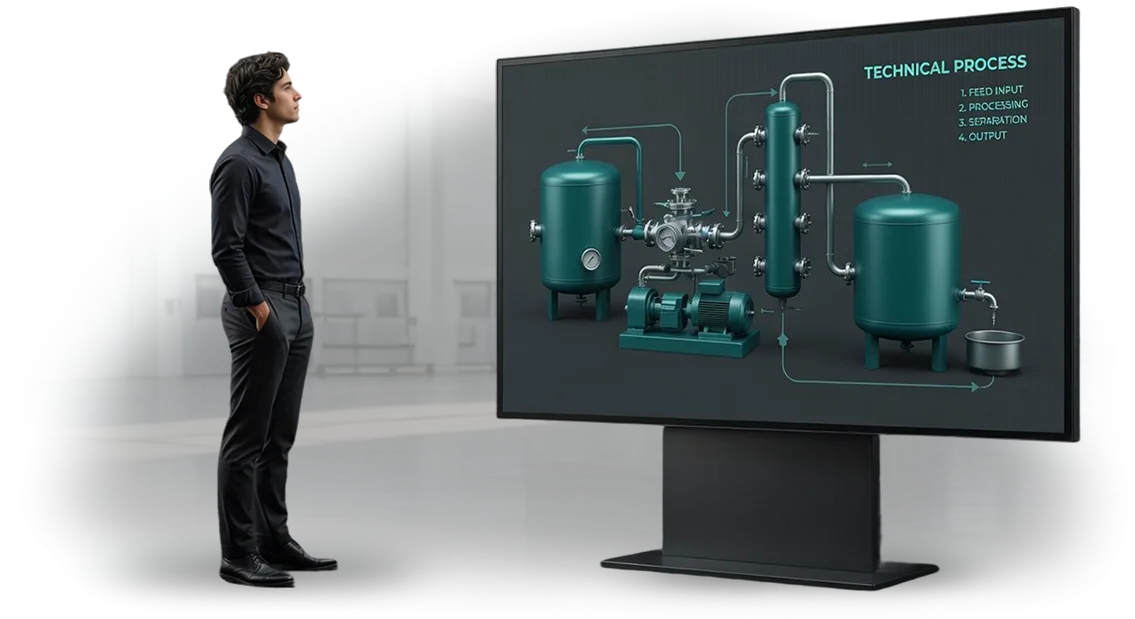
That's why employee training should be built on clear 3D video instructions with exploded-view demonstrations.
When a person sees the system broken down — all the parts, cables, connections — they understand the logic of how video surveillance works, rather than just memorizing actions.
This helps avoid typical mistakes, get up to speed faster, and work confidently with specific equipment.
Such training pays off immediately: less downtime, higher quality of installation and maintenance, client peace of mind, and your company's reputation. We develop video instructions for your specific system — taking into account your equipment and connection layout. As a result, employees stop being afraid of complex technology and do the job right the first time.
What a 3D Video Instruction Gives Your Employees
Ordinary text instructions and flat diagrams don't give an employee a complete picture of how a video surveillance system is built. An installer spends hours studying documentation and still makes mistakes during connection and configuration.
A 3D video instruction with an exploded view solves this problem: the employee sees the equipment in detail, understands the assembly sequence, and easily repeats the actions without any risk of mixing something up.
For the training department, this is a ready-made onboarding tool that works without an instructor. New employees get up to speed faster, while experienced ones refresh their knowledge without leaving work.
For technical staff — a clear reference guide that reduces the number of mistakes during installation and maintenance. For management — process standardization: every specialist follows one proven scheme, so service quality becomes predictable.
We build 3D models based on your documentation and use professional equipment for filming, so the instruction matches the actual products precisely. Every unit is shown exactly as it looks in reality — from mounts to cable connections.
This is critical for video surveillance systems, where an installation error leads to blind spots or equipment failure.
The results are confirmed by clients. For example, in the video surveillance integration company Safe City, after implementing a 3D instruction, installer training time was cut in half, and the number of installation errors fell by a third.
The technical director notes: “We sent the video to all branches and now we're confident that every specialist works equally correctly.”
Formats of 3D Video Instructions for Video Surveillance Systems
For video surveillance systems, both installation and further service maintenance are equally important. But training employees for these tasks with the same video isn't effective — each audience has its own skill level and work scenarios.
The right video instruction format saves training time and reduces the number of errors on site. We develop videos for a specific task: from a full course for a beginner to a short reference guide for an experienced engineer.
Main Formats
Here are typical usage scenarios for 3D video instructions in working with video surveillance systems:
| Format | Target Audience | What It Gives the Client |
|---|---|---|
| Full video instruction on camera installation | Installers, contractors, new employees | A single installation standard, fewer errors and rework on site |
| Modular video on configuration and connection | Field engineers, technical support | Quick access to the needed step, reduced downtime |
| 3D instruction with device disassembly | Service engineers, repair departments | Clear view of the camera and its components, faster diagnostics |
| Short maintenance reference guide | Technical staff, duty shifts | Quick review of key steps, fewer emergency situations |
| Video course for remote training | New employees in branches | Consistent knowledge level without leaving work |
Each format addresses its own task: somewhere depth and sequence matter, somewhere speed of access to a specific step, and somewhere the visualization of the internal structure. We select the right option for your situation and help integrate it into the training process.
How We Create Training Video Instructions: 6 Steps
We know that a manager needs to understand what they are paying for and when they will get the result. That's why the process is divided into six clear stages — you always know where the project stands and what comes next.
At our team, this scheme has been proven across dozens of corporate projects, so deadlines and quality are predictable.
- Brief and task immersion. We study your specifics: which operations need to be shown, who will watch the video, and under what conditions. The output is an agreed technical specification and work plan.
- Script and storyboard. We write down the video logic and show key frames before production begins. You approve the concept rather than receiving a “surprise” at the final stage.
- Creating 3D models and exploded views. We break the video surveillance system into component parts so the employee can see the device from the inside and understand the sequence of assembly or maintenance.
- Video production. We create animation, voiceover, subtitles, and emphasis on important details. The video turns out clear and short — no fluff.
- Intermediate review. You watch the draft and leave comments. We record them and make changes quickly because the script was approved in advance.
- Launch and delivery. We provide final files in the required formats, a brief usage guide, and source files if needed. Employees can start training immediately.
What Is Included in the Delivery of a 3D Video Instruction
A finished 3D video instruction for video surveillance systems is not just a video — it's a complete package where everything is thought through, from script to application methods.
You get a working tool that can be given to employees right away and built into the training process.
The delivery includes:
- Script and frame-by-frame plan — an agreed video structure with texts and a description of each scene. You see the logic before animation and make changes without redoing everything.
- 3D animation with an exploded view — the video surveillance system is broken down into component parts, clearly demonstrating the order of assembly, connection, and maintenance.
- Professional voiceover — recorded by a narrator or your own expert, with subtitles. The employee absorbs the material both audibly and visually, missing nothing.
- Graphic hints and highlights — arrows, callouts, and text explanations that keep attention on the main points and prevent misinterpretation.
- Editing and final processing — tuned pacing, transitions, color correction. The video is ready for publication in your corporate training system, on a portal, or in a classroom.
- Methodological support — recommendations for implementation: knowledge tests, checklists for skill practice, and a reference guide for the instructor.
This package covers the entire task: employees learn procedures faster, make fewer mistakes, and you don't have to explain the same things manually. Just grant access — the instruction takes care of the rest.
Case Study: Accelerating Camera Installation Training for an Integrator
An integrator that installs and maintains video surveillance systems ran into the problem of new installer training taking too much time.
Every camera model had to be explained in person on site: how to remove the housing, attach the bracket, route the cable, and adjust the viewing angle. Mistakes at this stage led to repeat visits and dissatisfied clients.
We suggested replacing paper instructions and verbal briefings with a series of 3D video instructions with exploded views. In such videos, the camera is broken down into its components right on screen, and the installer sees every step of assembly and connection.
Within a month and a half, we created training videos for the five most popular models the company works with. Filming and animation were done on professional equipment to ensure the picture was sharp and realistic.
The videos were kept short so they could be reviewed right on site from a tablet or smartphone. In each video, we also highlighted typical mistakes: incorrect gasket placement, insufficient tightening torque, and the wrong wiring sequence.
Implementing the video materials changed the training process. The service department manager no longer spends time going out with every newcomer — they just grant access to the videos and briefly answer questions.
Installers arrive on site already understanding how a particular camera is built and make fewer mistakes. This is especially important for companies where the workforce is growing quickly and people need to be deployed to sites in a short time.
The results were measurable: new employee training time dropped from two weeks to three days, installation errors decreased by almost a third, and repeat visits to fix defects nearly disappeared.
As a result, the company saved on overhead costs and improved customer service — clients call installers back far less often.
The head of the integrator company Safe City summed it up: “Before, we could only dream of this training pace. An employee arrives on site already prepared, understands the camera design, and works confidently.
Time to full productivity has multiplied, and installation quality has only improved. We've already ordered the next block of videos — this time for the group of service engineers.”
How to Choose the Right 3D Video Instruction Format for Your Task
To choose a format, look at three things: the task, the audience, and the budget. There is no one-size-fits-all solution — for mass training, a short video is enough, while a service team needs a detailed 3D instruction with an exploded view.
A mistake at the start leads to overspending: the video either doesn't provide the necessary depth or turns out more complex than the situation requires.
For video surveillance systems, detail matters especially: 3D video with an exploded view shows the camera structure and mounting components. An employee quickly understands what the system consists of and how to properly carry out installation. This reduces training time and lowers the number of errors.
| Format | When to Choose | What It Gives |
|---|---|---|
| Short video | Mass training | Quick start, wide reach |
| Step-by-step video | New employees | Clear sequence, fewer mistakes |
| 3D instruction with exploded view | Service team, installation | Understanding of the device, accurate repairs |
| Full course | Certification | Knowledge and results control |
If the budget is limited, start with one video for a typical scenario — for example, basic camera configuration. When you see the result, expand the lineup. If the task is to train several departments and verify knowledge, choose a full course.
The main rule: the format follows the task, not the other way around. A properly chosen instruction pays off through training speed and error reduction. We'll help you select the right option for your audience and budget.
Frequently Asked Questions About Developing Video Instructions
Before starting a project, every client wants to understand what they will get for their money and what happens if something goes wrong.
Developing video instructions for video surveillance systems is an investment in staff training, so we address the main concerns and formalize the agreements.
What does the quality guarantee include?
We guarantee the result: we show intermediate versions of the video at every stage and make changes until full approval. If you find an inaccuracy in the described actions after delivery, we will fix it free of charge. The terms are set out in the contract, and risks are minimized.
How is the cost calculated?
The cost depends on the number of scenes, the complexity of the equipment, and the instruction format. We calculate it before the start and set it in the estimate: the price doesn't change during the process. You pay for a finished result — a clear video instruction, not for hours of work.
What is the preparation time?
A typical project takes two to four weeks: from defining the task to the finished video. The exact schedule depends on the number of scenarios and revisions, but we provide deadlines at the start and stick to them.
How do we update instructions after changes?
The modular structure allows individual scenes to be replaced without reshooting the entire video. When equipment or an interface changes, we adjust the needed fragment and update the instruction. This is faster and cheaper than creating a video from scratch.
Order a 3D Video Instruction for Your Employees
Leave a request for a 3D video instruction for video surveillance systems — the next day you'll receive a preliminary cost estimate and a work plan. We handle all stages: from equipment breakdown to final editing and delivery of the finished file.
You don't need to dive into the technical side — you just get a result that makes employee training several times faster.
Here's what working with us looks like:
- Request and consultation — you describe the task, we clarify the details and propose a solution.
- Cost estimate and commercial proposal — we set the price and deadlines with no hidden charges.
- Brief and script — we agree on the instruction structure and select components for the exploded views.
- 3D animation production — we create the video with exploded views and the correct sequence of actions.
- Review and delivery — we show intermediate versions, make changes, and hand over the finished file.
In the end, after ordering, you get a ready-made training tool: employees master camera work faster, make fewer configuration errors, and newcomers reach a competent level in just days.
Leave a request — we'll call back within an hour, clarify the details, and prepare a cost estimate. We work under a contract, set deadlines, and guarantee the result. This is entirely non-binding: you make the decision after the consultation.