

Why Employee Training Is Becoming a Challenge for Airlines
Staff errors in an airline cost more than in any other industry: every inaccuracy in a procedure can cost time, money, reputation, and safety.
At the same time, classic training approaches — paper manuals, long presentations, "learning from senior colleagues" — no longer keep up with the modern volume of knowledge.
The problem is compounded by staff turnover: a new employee must reach working proficiency in weeks, not months. Experienced specialists spend time re-explaining basic things instead of focusing on their own tasks.
And scattered instructions from different sources create a situation where everyone acts "their own way" — making quality control practically impossible.
A manager faces a vicious circle: it is impossible to verify how exactly an employee absorbed the material, how they would behave in an abnormal situation, or whether their actions comply with the approved regulations. It is difficult to identify weak points before a mistake occurs on a real site.
We solve this problem with video instructions that clearly demonstrate every process — from pre-flight inspection to passenger interaction.
Instead of abstract text, the employee sees the ideal action sequence and repeats it step by step, while you get a unified standard and a tool for monitoring their comprehension.
What Benefits a Company Gets from High-Quality Video Instructions
Airlines spend weeks on initial training, and the result often depends on a live instructor. Video instructions remove this dependency: every employee receives the same program, equally understandable and equally measurable.
The business benefit is predictable staff qualification and fewer downtimes due to lack of readiness to work.
Training Speed Without Losing Quality
A course based on video instructions is mastered 2–3 times faster than text regulations or lectures. The employee watches the material at a comfortable pace, reviews difficult moments, and goes on the line with an already formed action sequence. The company brings new people up to speed faster and responds to process changes more quickly.
Comprehension of Material, Not Rote Memorization
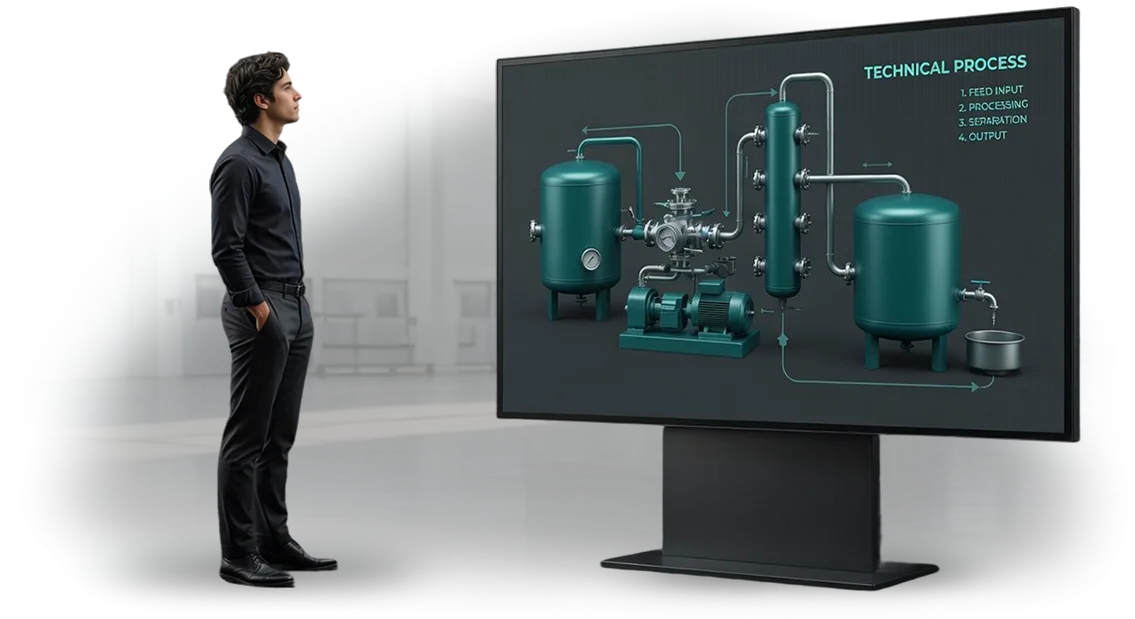
Dynamic animation shows the entire technological process — from system startup to scheduled shutdown. The employee sees the sequence of operations in a real context, so they remember not individual items but the logic of the work.
This is especially important for aviation services, where a mistake in the sequence of actions is critical.
Unified Standards for All Departments
Video instructions eliminate discrepancies between shifts and branches. Every employee — in Moscow or in a remote airport — is trained according to the same reference standard.
Training quality control becomes simpler: it is enough to check how the employee applies the unified standard, rather than find out which version of the instruction they memorized.
Reduced Risks and Errors
Visual materials make procedures transparent and therefore reduce the number of violations and incidents. Fewer errors mean lower costs for correcting consequences, insurance risks, and reputational losses. For an airline, this is not saving on training but an investment in safety and flight stability.
Video Instruction Formats: What to Choose for Airlines
For an airline, a training video is not just a clip but a tool for quality and safety control. The carrier's reputation and accident-free operation depend on how accurately an employee understands a procedure.
Therefore, choosing a format is a choice between production speed, level of detail, and implementation cost.
Below is a comparison of the three main formats we use in projects for airlines. Each solves its own task: from quickly bringing a newcomer up to speed to a detailed breakdown of a complex technological process.
| Format | For Whom | What It Gives the Client |
|---|---|---|
| Animation | For mass training when you need to show the principle of a system or a process that cannot be captured with a camera | A clear diagram of any component or algorithm. Allows removing unnecessary details, leaving only the essence. Easy to update — replaced a block and the video is relevant again |
| Live Footage | For instructions on working with specific equipment, maintenance, and actions in abnormal situations | Maximum employee trust: they see real workplaces and familiar aircraft. Accurate representation of tactile actions: how to grip a tool, where to press. The best choice for building muscle memory |
| Screencast | For digital systems: completing flight documentation, working with electronic checklists, software interfaces | Step-by-step breakdown of on-screen actions. The video shows clicks and form completion, eliminating errors "due to inattention." Inexpensive and fast to produce, easy to update when the interface changes |
Most often, airlines combine formats: basic theory is delivered through animation, practical skills through live footage, and work with software through screencasts. This covers all types of perception and fits the budget without losing quality.
We will select the right combination for your task — just describe the situation, and we will handle the rest.
Stages of Video Instruction Development: From Brief to Implementation
Developing video instructions for aviation personnel requires precision at every step. We have built a transparent process from brief to implementation so that you control the result and receive the material exactly on time. Here is how it works:
- Brief and process immersion. We start with interviews with your subject matter experts: we study regulations, typical errors, and training requirements. This allows us to set the right priorities from the start.
- Script approval. We turn the collected material into a clear step-by-step script with text and logic. You approve it before production begins — this saves time and budget.
- Storyboard and visual concept. We create frame sketches and define the graphic style: animation, diagrams, accents. You see what the instruction will look like before it is rendered.
- Video production. We produce animation, voiceover, and editing. We use professional equipment and a refined process to achieve consistent picture and sound.
- Checkpoint: review and revisions. We hand over an interim video for you to gather feedback from instructors and employees. We make corrections until final approval.
- Integration into training. We deliver final files in all required formats and help integrate the video into your learning management system or internal portal.
- Support and updates. Regulations change — we make timely edits or recreate individual scenes. You are never left alone with outdated materials.
This sequence eliminates ambiguity during approvals and helps adapt the video to the real tasks of employees. As a result, you get up-to-date training material that is easy to update when regulations change.
What Is Included in the Video Instruction Delivery Package
The delivery package is a ready-made training tool for employees, not just a set of files. We provide a complete package of materials that your team can work with immediately after handover: from script to final videos.
- Script and storyboard — the approved text and frame-by-frame plan of all scenes. This is the basis for approvals and, in the future, the foundation for quick updates without reshooting.
- Final videos in multiple formats — for the training portal, in-person classes, and tablets. Employees complete training on any device without losing quality or loading speed.
- Source materials (originals) — all working project files. You are not dependent on us for future edits: you can update the video with your own team or hand it to another contractor.
- Instructions for using the package — a short document on how to launch the video in training, where to upload files, and how to divide the material by employee roles.
- Cover letter and acceptance certificate — they document the package contents and usage rights. This resolves any questions during material handover, internal audits, and inspections.
For airlines, where regulations and procedures change regularly, this approach is especially important. With source files and the script, you can quickly make changes to instructions — without a long reshooting cycle and unnecessary approvals.
Case Study: How We Created Video Instructions for a Major Airline
A major airline approached us with a challenging task: they needed to train hundreds of employees to operate complex ground equipment. Paper instructions lacked visual clarity, and errors in flight preparation resulted in delays and financial losses.
We proposed replacing static materials with a series of training video instructions based on 3D animation of technological processes. The videos showed not only the correct actions but also typical mistakes — so staff could quickly understand what to pay attention to.
The results were immediate. Two months after implementation, the time to bring a new employee up to speed was reduced by a third, and the number of violations in scheduled maintenance decreased almost twofold.
The video instructions are now used in offices, workshops, and distance learning — the material is easy to review from any device.
"Previously, preparing a specialist took months, and the new videos made the process clear and fast. Training has become unified across all sites — that matters when it comes to flight safety," said the head of the training department of a major airline.
Based on the project results, the client not only expanded the instruction library but also asked us to create materials for adjacent departments. We continue to support the project today: adding new scenarios and adapting videos to updated regulations.
Answers to Frequently Asked Questions About Video Instruction Development
Before ordering corporate video instructions, almost every client asks the same common questions: how implementation will go, what it costs, what the timelines are, and how easily the videos can be integrated with the existing training system. We answer briefly — in terms of how it affects your day-to-day operations.
Is it difficult to integrate video instructions into the current training process?
No. We make implementation part of the project: we agree on the format, packaging, and delivery method for the videos. Your employees simply open the video — no work interruptions or restructuring of regulations.
What does the cost of CGI animation development depend on?
The cost is made up of the script volume, the number of technological operations, and the video length. After the brief, we lock in the price and do not change it during the process, and you receive a cost estimate with clear stages.
What are the implementation timelines?
A typical project takes from two weeks to two months — depending on the complexity of the animation. You do not have to wait for months: we approve intermediate versions to launch training as quickly as possible.
How does integration with the existing training system work?
We integrate the videos into the learning management system or internal portal: upload them, configure access, and track completion. Videos can be linked to specific training programs, and you can get analytics for each employee.
This section will help resolve key concerns before you even start. If you still have questions — let's discuss the details on a short call.Order Video Instruction Development for Your Company
Discuss your task at the brief — and you will already receive a plan, timelines, and a preliminary cost estimate at this stage. We do not charge for "we'll see later": specifics appear after the first conversation, not after a week of correspondence.
After that, we handle everything ourselves: from script to final render. You do not need to understand production — just check the text for your domain knowledge and approve the key frames. Time savings on approvals — up to 50% compared with the standard approach.
What you get immediately after reaching out:
- Priority cost calculation within one business day — without a detailed brief or immersion into your processes.
- An individual production plan: how many videos, in what timeframes, with what level of detail, depending on training goals.
- A dedicated manager and producer — two people who run the project from brief to delivery, not a "call-center manager."
- Work under a contract with a fixed cost estimate — the price does not change during the process, even if we find a more complex technical solution.
- Revisions at all stages except the final render — you watch the video instruction grow and can intervene before rework becomes expensive.
- A result guarantee: if after delivery you find an inaccuracy in the technology or script that is our fault — we fix it at no additional charge.
Book a consultation right now and get a cost estimate within one day. We want you to know the budget before work starts, not after.
How to Choose a Video Instruction Format for a Specific Task?
The question of format choice arises when you need to train employees on a complex process. There is no universal answer — the decision depends on the specifics of the operation and the training goals.
For some, a short video with live footage is enough, while processes invisible to the eye require CGI animation.
The main criterion is what exactly the employee needs to learn. If the goal is to show a sequence of actions on real equipment, live footage will work.
If you need to explain internal structure, the physics of a process, or rare emergency situations, 3D modeling is more effective — it allows you to look inside and show every detail without risk to people or equipment.
The second criterion is training goals: initial familiarization, skill practice, or knowledge assessment. For initial training, a dynamic overview video is better; for practice, detailed instructions with pauses and repetitions.
We help define these goals at the start and choose a format that delivers results, not just a "pretty picture."
The specifics of the aviation industry also matter: high responsibility, regulations, and the need for uniformity.
Here CGI animation is especially valuable — it eliminates the human factor in demonstrations, shows processes identically for all employees, and is easy to update when regulations change. This reduces the risk of errors and accelerates onboarding.
To avoid a wrong choice, a short consultation is enough. We analyze your task, audience, and expected result, propose the optimal format, and justify the decision. You will receive a clear plan, not abstract options. Contact us — let's discuss your specific situation.