

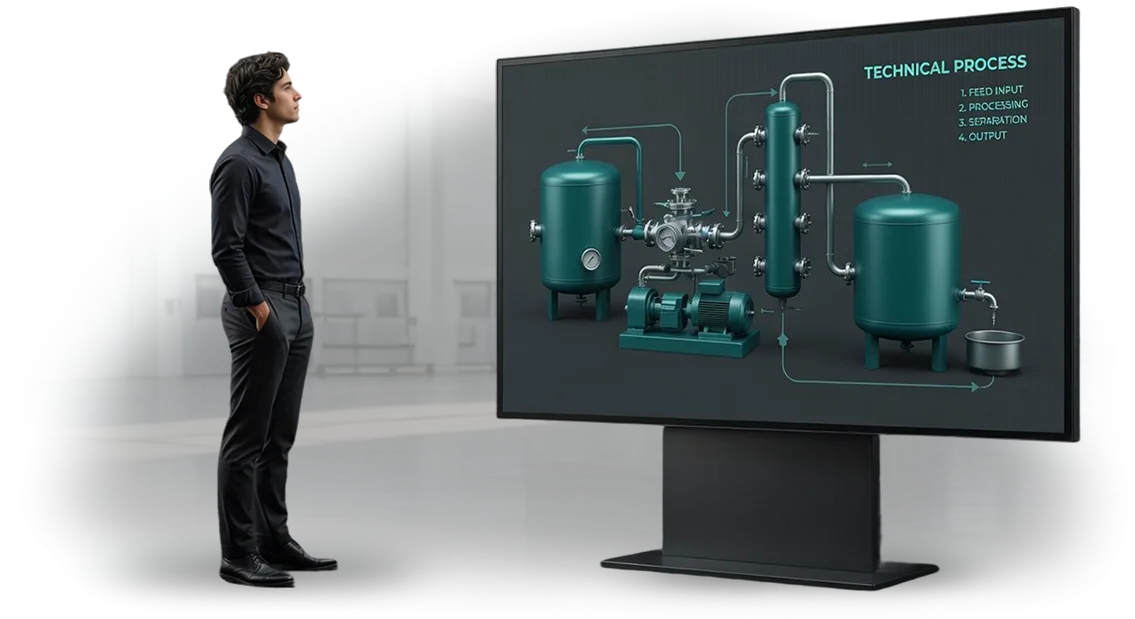
Why Video Instructions Are Critical for Aviation Manufacturing
In aviation manufacturing, the cost of an error is measured not in money but in human safety and the company's reputation. Every technological process — assembly of a unit, part inspection, system maintenance — requires flawless adherence to procedures.
Traditional text instructions are often overloaded with terminology and don't provide the full picture, especially for new employees.
The human factor is the main source of risk in complex manufacturing. One specialist reads the instructions carefully, another skips a detail, a third misinterprets a drawing. This leads to defects, equipment readjustment and, in the worst case, incidents. That is why personnel training in aviation manufacturing requires visual, unified standards.
Video instructions solve this problem: they show the entire process, capture the correct sequence of actions and visually highlight critical moments. This format is absorbed faster, and the likelihood of error drops significantly.
Leading aviation companies, such as Airbus, have long used video for training and quality control — which confirms the effectiveness of this approach.
For aviation manufacturing, video instructions are not just a convenience but a production necessity. They preserve the expertise of experienced mentors, replicate it across all shifts and sites, and allow training to be updated quickly when regulations change. As a result, the company achieves consistent quality and reduces the burden on supervisors.
We create video instructions that address this need: we immerse ourselves in the real conditions of your production, work through every step in detail and deliver a complete package for training employees at any skill level.
What 3D Animation of Technological Processes Gives to Production
Aviation manufacturing is a field where the human factor and misunderstanding of technology are especially costly. When a process is explained with words or static diagrams, each employee builds their own mental picture — with distortions and gaps.
3D animation removes this problem: it shows every stage of the technological process accurately, clearly and uniformly for the entire team. That is why we at our team build training around animated production scenes rather than abstract slides.
Speed of Training
A new employee or a worker moving to another operation gets into the rhythm faster when they see a ready-made reference rather than reading an instruction.
Based on our projects, the time required to master a complex process is reduced several times over — instead of weeks and months, it takes days. This directly affects equipment downtime and how quickly a person starts delivering results.
A Unified Standard Without Misinterpretation
The same process shown in 3D looks identical to a newcomer and to a master with twenty years of experience. The "instruction in one's own words" that causes deviations on the production floor disappears.
All employees assemble and inspect operations against a single reference image — this reduces the number of errors and cuts losses from defects.
Fewer Errors in Complex Operations
Technological processes in aviation manufacturing often include dozens of steps where every detail matters. Animation highlights critical points: gaps, tightening sequence, correct part positioning.
A person remembers the motion through eyes and hands rather than from memory, so they make fewer mistakes. And you get consistent quality at every workstation.
Visibility for Instructors and Audits
3D animation also works well as a foundation for mentors: you can pause, repeat a difficult moment, show a part in cross-section. The same video helps with internal audits and employee qualification verification — you always have an up-to-date visual standard of the process. And it is easy to update when the technology changes, without rewriting the entire training base.
In short: the benefits are speed, a unified standard, fewer defects and a clear knowledge base. In the next block, we will show how work on such projects is structured.
Training Video Formats for Aviation Manufacturing Tasks
Each training video format solves its own task — from quickly bringing a newcomer up to speed to practicing rare emergency scenarios.
It is important to match the video type to the specific production area; otherwise, even high-quality material will not deliver the expected result.
Below is a breakdown of typical formats for aviation manufacturing companies. This is a practical cheat sheet: what to choose, for whom, and what result production will get.
| Video format | Who it is for | What it gives the client |
|---|---|---|
| Interactive video instruction with action choices | New employees in assembly shops | The employee goes through the scenario themselves, makes mistakes and sees the consequences — without risk to equipment or deadlines. Faster time to full productivity, fewer errors. |
| Animation of unit disassembly and assembly | Engineers, maintenance services | A clear look at the mechanism's "inner workings" without opening a real unit. Training on maintenance procedures without stopping production. |
| Short video for introductory briefing | Entire shop personnel, including adjacent teams | A unified standard of knowledge on safety and basic operations. No difference in interpretation of requirements between shifts and areas. |
| Video analyzing an abnormal situation | Quality control service, operators | Practicing actions in case of deviations from the norm: what to do, who to inform, how to document it. Less scrap and downtime caused by personnel. |
| Certification video with knowledge check | All employee categories | Automatic recording of results and retaking the test if the score is low. A transparent picture of personnel readiness for the shop manager. |
This approach pays off through reduced defects and faster onboarding. If you are not sure which format fits your operation, we will send examples tailored to your task.
We cover the entire cycle: from script to a finished video that integrates into your training system and delivers results.
How We Develop Video Instructions for Aviation Manufacturing: Stages and Timelines
For aviation manufacturing, training video instructions are not just videos — they are part of the safety and quality system. We have structured the process so that at every stage you can see what is happening and influence the outcome. No black boxes: just a clear plan, clear timelines and a person responsible for each step.
-
Brief and immersion in the task. We collect your technical specification, regulations, existing materials and production specifics.
We clarify who will watch the video, which operations need to be shown and what result you expect — all subsequent development stages depend on this.
-
Script and storyboard approval. We turn the recorded sequence of actions into a script text and a step-by-step visual plan.
At this stage, you see how each frame will look and can make edits before shooting or modeling starts — this is cheaper and faster than redoing a finished video.
-
Video material development. We create animation or footage according to the approved script.
For technological processes, we use professional equipment and refined tools — this guarantees a stable picture, accuracy of details and a consistent style for an entire series of instructions.
-
Interim review and corrections. We show you a draft version. You check compliance with regulations, readability of details and ease of comprehension. We make edits until you confirm the material is ready for use.
-
Final version and implementation. We deliver the finished videos in the format you need — for an LMS system, internal portal or in-person sessions. We advise on how to integrate the material into your training program and adapt it for different employee groups.
-
Support and course development. If regulations change or new operations appear, we quickly update the videos. You get not a one-time file but a working tool that lives alongside your production.
How long the entire process takes depends on the complexity of the operations and the number of revisions. Usually the cycle from brief to final video takes 3–4 weeks. We fix the exact timeline in the contract after the initial script approval.
Delivery Package: What You Get with the Video Course
You receive not just a finished video but a complete training package for your employees. All materials are transferred together with usage rights and remain at your disposal indefinitely — this is a tool that works for the company for years, not a one-time shoot.
The delivery package includes:
- Course video files in formats suitable for a corporate portal, e-learning system and offline presentations. No additional processing is required — upload and run.
- Text scripts and storyboards for all videos. If a technological regulation or equipment changes, you can quickly update the instruction without reshooting from scratch.
- Methodological recommendations for mentors or instructors: how to structure a session, what questions to ask for knowledge checks, how to integrate the video into your existing training program.
- Handout materials for employees — reference cards, checklists, tests. Everything needed to reinforce the material and quickly verify comprehension.
- Source versions of videos and graphics — you are not dependent on the contractor and can hand off edits to your team or another vendor at any time.
- Rights to use the video course — a perpetual license to show to employees, host on internal systems and distribute within the company. No limits on the number of views or branches.
All transferred materials are documented in the acceptance certificate, and usage rights are documented in the contract. If an error is found in the video, we will fix it free of charge within the agreed timeframe.
You get a ready-made training tool that can be launched immediately after signing the acceptance certificate.
Case Study: 3D Animation of Unit Assembly for Aviation Manufacturing
Traditional training with drawings and text instructions did not provide the needed speed: a complex unit required understanding of spatial sequencing, and errors at early stages led to defects.
Newcomers needed up to a month to reach full productivity, and every mistake resulted in downtime and rework.
We proposed replacing static materials with a training 3D animation of the technological process for the aviation plant AviaProm.
The video instruction showed the unit assembly in cross-section, highlighting each part, control points and typical errors — employees could rewatch the video on a tablet right at their workstation.
The results exceeded expectations: training time for new employees dropped by nearly 40%, and assembly errors fell by a third. The average time to reach full productivity decreased from a month to two weeks, and mentors no longer spent time re-explaining the same operations.
After the first video, the client ordered animations for two more critical units, plus an English-language version for training international partners.
Today this format has become the standard for introductory training on the production floor — we continue expanding the video instruction library together with the plant.
Frequently Asked Questions About Video Instruction Development
Every video instruction project starts with practical questions: will we meet the deadlines, will the cost stay within budget, how quickly can a video be updated when technology changes, will the material be clear to employees.
These concerns are understandable — the quality of instruction affects onboarding speed and workplace safety.
We work with aviation manufacturing companies and understand their requirements: precision of details, compliance with regulations, relevance of data.
That is why we fix timelines, cost and the update format already at the brief stage — so you get a predictable result without surprises.
How long does video instruction development take?
The timeline depends on process complexity and the number of scenes. Standard assembly operations take 2–4 weeks; multi-stage technological chains with detailed CGI animation require a bit more.
We provide the exact timeline after analyzing your regulation and immediately fix it in the contract.
How is the cost calculated?
The cost is based on video duration, the number of animated scenes, the complexity of equipment models and whether voiceover is needed. We prepare a transparent estimate before work begins — no hidden line items.
For aviation, we account for higher detailing requirements, but the final price is fixed in advance.
What happens when the technological process changes?
Production technologies evolve, and that is normal. We keep the source files of all projects, so updating an instruction does not require reshooting from scratch. You only pay for the revisions, and you receive the new video within a few days.
Is this video convenient for employees?
Yes, we produce instructions in a format that is easy to integrate into an e-learning system or show at workstations. Short videos with highlighted key operations are clear to both newcomers and experienced specialists. We adapt the language and pace to your audience.
Order Training Video Development for Your Production
Standard on-the-job training means weeks of adaptation and costly mistakes by newcomers. Training video compresses that path: an employee sees the entire process, remembers the sequence and makes fewer errors.
We create such instructions for aviation manufacturing companies — from unit assembly to working with measuring and control instruments.
Every project starts with a consultation. You describe the task — we propose the format, script and shooting plan. After approval, we fix the timeline and cost so you understand the result before work begins.
What you get after placing an order:
- A detailed analysis of your process together with technologists — we identify what to show first.
- A training video script adapted to your employees' skill level.
- Professional filming or 3D animation of complex operations — every stage is visible from the right angle.
- Finished videos in formats for your e-learning system and internal portals.
- Recommendations for integrating the video into your introductory briefing program and assessing material comprehension.
- Post-launch support: we will update the video if regulations or equipment change.
Ordering a video is simple: call us or leave a request on the website. We will respond within one business day, calculate the cost and offer a suitable option.
Start with a consultation — in just a few weeks, your employees will be working from a clear visual instruction, and you will get consistent training quality without disrupting shifts.
How to Choose the Video Instruction Format for Your Aviation Enterprise's Specifics?
Choosing a video instruction format for an aviation enterprise is not a matter of taste — it is a matter of how accurately an employee will understand and remember the sequence of actions.
In aviation manufacturing, the cost of error is high: safety, assembly quality and production schedules all suffer.
So before filming anything, it is important to determine what exactly needs to be shown — a real workstation, a complex technological process or interaction with small parts.
For most tasks, a combination of formats is optimal rather than a single one. Live footage featuring your own masters conveys the real context and familiar work techniques well.
But when it comes to internal mechanisms, hidden units or actions that cannot be captured with a camera, CGI animation comes to the rescue: it simplifies the complex and makes visible what is usually hidden.
This approach creates an instruction that reduces errors among new employees and speeds up their path to independent work.
What else should you consider when choosing? How often regulations are updated, the size of the workforce and ease of comprehension.
If the process changes rarely and the audience is hundreds of specialists across different sites, a universal format with voiceover and subtitles is the better choice.
If it is a high-precision operation where every detail matters, the focus should be on animation with magnification of key elements and slow narration.
Choosing the right format is not a compromise with the budget — it is a way to get maximum benefit from every minute of an employee's attention.
We help clients get their bearings at the start: we study your technological processes, identify the most complex and hazardous areas, and then propose a format that addresses your specific tasks.
This could be a fully animated instruction, live footage with graphic overlays or a hybrid solution — the option is selected to match your production specifics and budget.
In the end, you get not just a video but a working tool that easily integrates into your training system and genuinely reduces personnel onboarding time.