

Why gaps in staff training hinder production automation
Production automation is not only new machines, robots, and software. It is first and foremost people who have to work in a new way.
When employees do not understand why processes are changing and have no clear instructions, even the most modern shop floor turns into a source of errors and downtime.
Gaps in staff training are the quiet reason why the introduction of automation fails to deliver the promised return.
Text-based regulations and dry memos overwhelm a newcomer and irritate an experienced worker. You have to read, memorize, keep asking your mentor again — and even then there are those who keep doing things the old way.
As a result, the number of errors grows, the speed of work drops, and employees begin to resist any changes: “we worked fine before.”
Training video instructions close this gap. In 5–7 minutes a person sees the whole process in its entirety — from switching on the equipment to checking the result — and can repeat it step by step.
This format is clear to employees of any age and experience, does not require rereading, and remains available at any moment — on a tablet, a phone, or on a screen at the workplace.
The company wins on all fronts at once: a newcomer gets into the working rhythm faster, experienced staff stop wasting time on endless prompting, and product quality stops depending on the operator's fatigue or mood.
That is exactly why our team develops corporate training video instructions that help production automation “get on track” without slipping and without unlearned lessons.
What training video instructions will give your team
In automated manufacturing, the cost of an error is line downtime and defects. Text-based regulations are rarely read, and experienced employees explain things informally, on the fly. Video instructions turn corporate training into a single standard that everyone understands.
For managers — fast results without monitoring every step
Instead of explaining machine setup to an operator twice, give them a link to the video. The employee can rewatch it at a convenient time, and you can see who has completed the training. Less downtime — higher output.
For HR — faster onboarding and lower turnover
New hires get up to speed faster: they don't need to follow a mentor for a week. Short visual materials cover 80% of typical questions, so onboarding new employees takes a day or two instead of a month. People work with more confidence and quit less often in the first months.
For employees — clear material instead of reading regulations
The video shows the sequence of actions from the workplace, and the animation of mechanisms makes the process transparent. A person sees how to do it correctly and repeats it without fear of making a mistake.
The materials are available on a tablet or phone — you can check the required step right at the machine.
We create training videos: we bring technological processes to life in 3D so that every frame matches your equipment. Record once — use for years. We integrate the videos into a learning system, such as iSpring, and employees learn without leaving their shift. This pays off through reduced defects and downtime from day one.
Video Instruction Formats for Different Production Automation Tasks
There is no universal video instruction. The same equipment can be explained in different ways: a short overview for a newcomer, a detailed animation of problematic components for an experienced shift.
If the format does not match the task, employees either rewatch the video ten times or act by guesswork. That is why we select the format for a specific stage of the production process.
| Format | When to use | What it gives the client |
|---|---|---|
| Short overview (2–3 minutes) | Onboarding, introduction to a new area | Quickly gets an employee onto a shift without long mentoring |
| Step-by-step instruction with voiceover | Standard operations, repetitive actions | Fewer errors, a unified execution method |
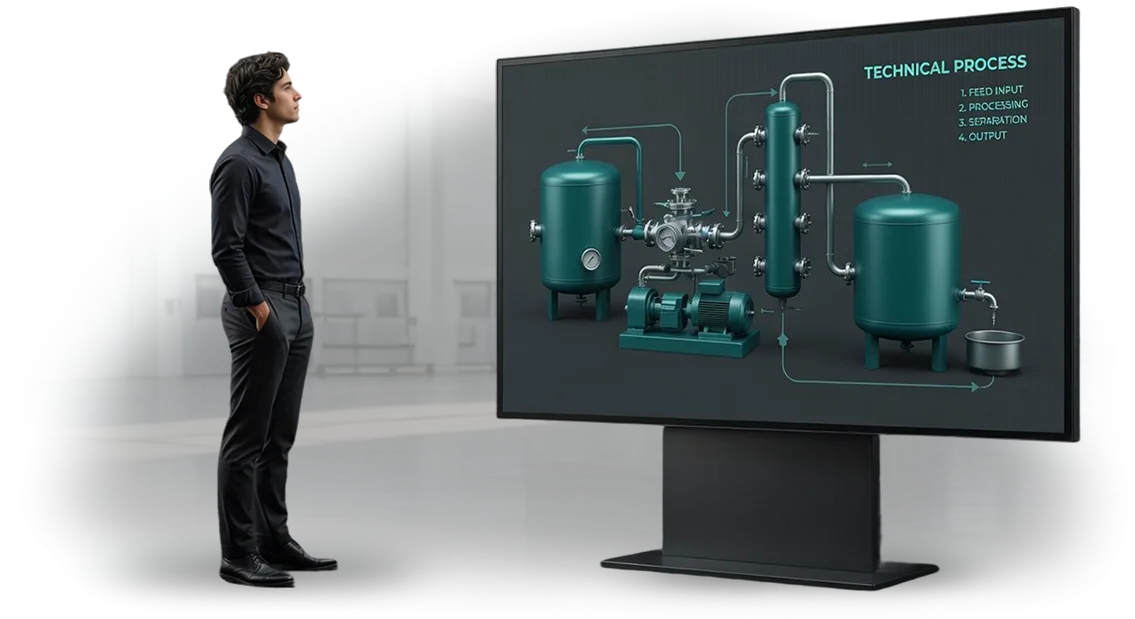
| Animation of the technological process | Hidden processes: movement of raw materials, valve operation, pressure changes | Understanding the physics of the process, fewer accidents and downtime |
| Interactive video | Knowledge testing, practicing emergency situations | The employee chooses actions independently and sees the consequences |
But even the best list of formats does not guarantee a result if the choice is made at random. To get exactly what your production needs, follow a simple checklist.
First, determine the main task: rapid onboarding of newcomers, advanced training, or analysis of a complex technological unit. Then fix the audience — different levels of training require different depths of presentation.
After that, describe the scene: what exactly the employee should see and what action to repeat. And only then choose the format — we will advise which of the listed ones will give the maximum effect.
For each scenario, we prepare a storyboard and a test fragment before filming or animation begins. This allows aligning the approach in one cycle and not redoing the finished material for new expectations.
How video instructions are created: from task setting to launch
A clear process guarantees that you do not get “just a video,” but a tool for staff training. We have broken the work into short stages of video instruction development; at each stage we record the result and approve it with you — no surprises and no budget loss.
- Task setting and audit. We record which employees need training, which operations to show, and what result is expected. We collect information on site or from your regulations — this is the foundation of the future video.
- Scenario approval. We turn the production process into a clear visual sequence: order of actions, emphasis, duration. You approve the scenario before filming begins — this protects against rework.
- Preparation for filming. We select the location, set up the equipment, and rehearse shots with a real operator or at a real site. This way the video will look natural, and employees will trust the instruction.
- Filming and video creation. We film all key steps, add explanatory captions, graphics, and voice-over. We edit the material so that every stage is obvious even to a newcomer.
- Revisions and final approval. You review the draft, we make adjustments to the text, emphasis, and timing. We bring the video to a state in which it can be embedded into the training program.
- Training launch. We deliver the finished files in the required formats and help place them in the distance learning system or on the internal portal. Employees get access, and you get confidence that the instruction actually works.
What is included in the training video instruction package
You receive not an introductory video, but a ready-made training system that integrates into your processes and covers the need for rapid employee preparation.
Below is the full contents of the package so that you know exactly what you will receive and how it will work for your production automation.
- Package of video instructions. A series of videos on all key technological operations, presented in a unified style and with a runtime convenient for perception. The videos are divided into logical modules — an employee goes through them sequentially or selectively, depending on the position.
- Script and storyboard. For each video, you receive a detailed script with a frame-by-frame plan. Before production starts, you approve what will be shown in each frame, in what order, and with what emphasis. This eliminates rework at the final stage.
- Editing and voice-over. All videos undergo professional editing: voice-over narration (or subtitles), music design, emphasis on important units and mechanisms. You receive finished files in formats suitable for your distance learning system, as well as for showing on shop-floor monitors.
- Integration into training. We prepare a launch kit: recommendations on how to upload videos to your LMS or assign courses to trainees, how to track views and check mastery of the material. Implementation instructions reduce the time for adapting new employees and lower the load on mentors.
- Source files and unlimited revisions. All source project files remain with you. Within the agreed scope, we make revisions without limiting the number of iterations — you are not dependent on external contractors if you decide to update the instruction.
- Device adaptation. The videos are optimized for viewing on computers, tablets, and smartphones. An employee can open the instruction directly at the workplace, via a QR code on the equipment or in a mobile app.
Such a package covers the entire cycle: from script to launch. You receive not only files but also clear usage guidelines — the system does the training itself, and all that remains for you is to monitor the result and the speed of completion.
Case study: how video instructions accelerated the launch of new equipment
Launching a new line is always stressful for production: expensive equipment sits idle while operators figure out the procedures, and the first shifts work by trial and error. The result is defects, downtime, and the technical director’s nerves. Here’s how we solved this task for one of our customers.
A large machine-building enterprise needed to launch an automated line within 3 weeks. It was impossible to train 40 operators in that time using mentors: no one read text instructions, and in-person training would take months. We developed a series of short video instructions that showed each stage of work on real equipment.
Project results
| Metric | Before | After |
|---|---|---|
| Time for an operator to work independently | 5-7 days | 2 days |
| Equipment setup errors | 10-12 per shift | 2-3 |
| Mentor workload | 100% of the time | 30% |
| Line launch speed | 6 weeks | 3 weeks |
Video instructions made it possible to launch the equipment exactly on schedule: operators studied the material at a comfortable pace and reviewed challenging points before each shift.
The number of errors decreased fourfold, and mentors focused on quality control instead of repeating basic actions.
Client review
“The video instructions paid for themselves before the end of the month: launch without downtime, staff work confidently, and defects have decreased severalfold. Now we plan to move all production training to this format.” — Technical Director of a machine-building enterprise
This case is an example of how a well-produced video instruction turns training from a cost item into a cost-saving tool. You get a predictable launch, motivated employees, and results that are visible in numbers already in the first month.
How to choose a suitable video instruction format for your task?
There is no universal video instruction: the format is determined by the specific task, audience, and budget.
Companies often look for “the one” solution, although in practice the same video rarely covers both initial onboarding of newcomers and upskilling of experienced employees.
Therefore, it is better to start not from trendy formats but from the result you want to achieve: quick onboarding, fewer errors, or a clear demonstration of a complex process.
You should start with an analysis of specific requirements. If a technological process includes a non-standard task — for example, working with unique equipment or rare emergency situations — you need detailed step-by-step animation with emphasis on critical points.
If the process changes frequently, it is better to choose a modular structure: individual short videos are easier to update than reshooting an entire film.
For production automation, precision of details is especially important, so the format must allow showing mechanisms from the inside, without excessive artistry.
A separate issue is adaptation to employees. The level of training, age, and experience with video instructions strongly affect perception. Some people understand diagrams and 3D cutaways faster, while others need a narrator’s voice and slow-motion replays.
We clarify in advance who will watch the videos and adjust the pace, vocabulary, and visuals to the real audience. This removes the risk of creating beautiful but useless content that employees simply will not finish watching.
The budget for a video instruction also determines the format, but not as rigidly as it may seem. Even with limited resources, you can choose an effective solution: for example, combine filming of real equipment with CGI inserts for hidden mechanisms.
This hybrid approach is often less expensive than full animation and still provides the necessary clarity. And for complex technological processes where every detail matters, full 3D visualization pays off through reduced defects and faster training.
We always help you navigate the formats before work starts: we analyze the task, show examples for your type of production, and propose the optimal option, not the “most expensive” one.
As a result, you get an instruction that employees actually use, not just a file in an archive. Just describe your non-standard task — and we will advise which format will cover it with a minimal budget and maximum benefit.
Frequently asked questions about developing video instructions for employees
Before ordering training video instructions, every client has the same questions: how long development will take, who will receive the rights to the video, what the budget consists of, and what will happen when the process changes. We address typical concerns — without technical details or hidden conditions.
How long does it take to develop a video instruction?
The timeline depends on the complexity of the production process and the level of animation detail. On average, one instruction takes from two to four weeks.
We fix the deadlines in the contract and show intermediate versions in stages — you see the result at every step, not only at the end.
Who owns the rights to the video? All rights to the finished video transfer to you. You can use the video in your own training, on the internal portal, in presentations, and at meetings with partners — without restrictions on the number of views or the number of employees.
What does the cost of development consist of? The price is formed by the scope of the script, the length of the video, the level of animation detail, and the number of revisions.
We approve the estimate before the start and fix it in the contract — the final cost does not change during the work. You know the exact cost in advance and control the budget.
Will we be able to update the instructions after changes in technological processes? Yes. Your instruction is not a static file but a working tool. We provide the source materials and can promptly make edits to the existing video under a separate rate. Updating a finished video is many times faster and cheaper than developing from scratch.
Do we need to involve employees in filming and pull them away from their work? No. We work based on your regulations, instructions, and production schemas.
Employees continue to perform their tasks, while the animation shows the process in full — without filming, stopping the shop floor, or unnecessary approvals.
If you have doubts about any point, just ask us directly. We will tell you how the work will be structured in your specific case and prepare a commercial proposal in which everything is set out transparently before signing the contract.
Discuss the task and get a plan of video instructions for your process
Every production process is unique: your equipment line, regulations, and employee training level are your own. Ready-made template videos do not stick — they either fail to answer operators' real questions or do not account for the specifics of production automation.
That is why we start with a discussion of the task and a consultation, and only then propose a plan that will genuinely simplify training.
A request for video instructions is a starting point, not a formality. We study your technological process, identify the most common mistakes and critical operations, and only after that determine the composition of the videos.
At the end, you receive not an abstract catalog but a clear route: which instructions we will shoot, for which positions, in what scope, and within what timeframe.
What our work with you looks like:
- Request for video instructions — you fill out a short form or write directly to us, describe your process and the task you want to solve.
- Training consultation — we analyze how instruction currently takes place, where employees most often make mistakes, and which formats are convenient for them.
- Work plan — we record the list of video instructions, scripts for each video, approval stages, and deadlines.
- Cost calculation — we determine the exact pricing for your scope after the plan, without hidden additional charges or unexpected “surprises” midway through the project.
- Creation of video instructions — we shoot or animate the videos and coordinate each stage with your team so the result is exactly what is needed.
- Handover of materials — we deliver the finished videos in convenient formats and help embed them into a distance learning system or internal portal.
As a result, you get a transparent process and a clear understanding of how training in production will change.
No “ongoing work” — only a concrete plan, implementation, and a result that is visible in the speed of onboarding employees into their roles and the reduction in the number of errors.
Submit a request for video instructions — we will contact you within one business day, ask the right questions, and prepare a plan for your project so you can assess the scope of work and budget.