

Video instructions for automotive manufacturing: why personnel aren't learning
Personnel in the automotive industry learn on the assembly line, where the cost of a mistake is defective parts, line downtime, or people's safety.
But most video instructions today are static presentations or phone footage that misses the main points: the sequence of movements, the effort involved, and quality control.
An employee simply skims through such material—and goes to the work station without confidence, which means with a risk of errors.
The consequences are visible in the shop floor numbers: onboarding time for new hires grows, the number of rework returns increases, and trainers spend hours repeating the same explanations.
The problem is not discipline, but that people don't get a clear visual example of the correct action. Text and diagrams don't create muscle memory, and boring videos fail to hold even a motivated employee's attention.
We close this gap with training videos built around the real work process. Instead of abstract theory—a precise sequence of actions with emphasis on the key control points that can't be seen in ordinary footage.
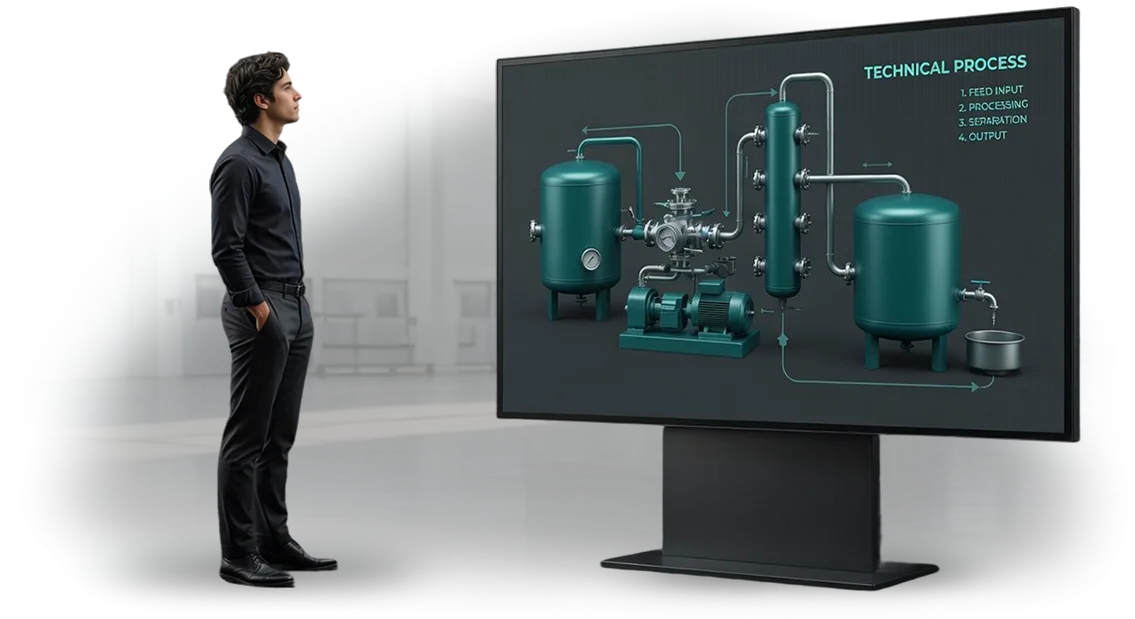
We use professional CGI animation of technological processes: the employee sees the mechanism from the inside and remembers the correct algorithm, rather than memorizing an instruction manual.
The result for the automaker is predictable operation quality, faster onboarding to production rhythm, and reduced trainer workload. Personnel don't just "familiarize themselves" with the material—they actually absorb it and apply it on the job.
This is how video instructions stop being a formality and become a tool that pays off through reduced defects and faster adaptation.
What results do training videos bring to a factory
Every manufacturer faces the same challenge: how to quickly and effectively train employees on complex operations. Training videos for an automotive plant turn scattered knowledge into clear algorithms that work regardless of a particular trainer's experience.
A new hire no longer waits for a specialist to become free—they open the instruction and immediately see the correct sequence of actions, tools, and control parameters. Onboarding time is cut dramatically, and productivity reaches planned levels earlier. This is especially important on the assembly line, where every hour of downtime is expensive.
Benefit: faster time-to-competency
Employees master operations faster, and the shop floor manager gets a predictable result: people begin working independently within just a few shifts. There's no need to spend resources on long-term supervision—just show the video and answer clarifying questions.
Benefit: reduced defects
Most defects are caused not by carelessness but by violating the sequence of operations. The video fixes the single correct way of performing the job, eliminating "freelancing" and individual interpretations by process engineers.
As a result, the defect rate drops, and materials and rework time are saved. Experienced employees also skip control points less often when they work according to the approved standard.
Benefit: unified work standards
When training is built around videos, all assembly lines operate the same way. This simplifies quality control, moving personnel between stations, and rolling out new regulations.
Just update one video—and all employees receive the updated requirements simultaneously, without extra meetings and lengthy information hand-offs.
Video content formats for different production tasks
On the production floor, every employee faces different tasks: a new hire needs to master the process chain, an operator needs to quickly recall the sequence of actions, and a supervisor needs to check compliance with the standard.
Photos and text instructions don't convey process dynamics, so training videos and process animation solve this problem more effectively. We divide material into content types, each addressing a specific production task.
We select video instruction formats based on the complexity of the operation and the audience. Below are the key options and the business results the client gets.
| Format | Intended for | What it gives the client |
|---|---|---|
| CGI animation of the technological process | Workers at complex stations, process engineers, engineers | Clearly shows hidden mechanisms and assembly sequence — the employee reaches the required quality faster without downtime. |
| Step-by-step video instruction | Line operators, maintenance personnel | A clear action algorithm without reading regulations — fewer errors, higher safety and productivity. |
| Interactive video simulator with knowledge checks | Training department, HR, quality controllers | Allows checking material comprehension and approving employees for work — saves time on skill assessment. |
| Virtual production tour | New employees, contractors, partners | Fast adaptation without on-site risk — the person already knows the zones and routes, meaning fewer injuries and emergency situations. |
No matter what format the material is delivered in, you get a unified visual standard for all work areas. It reduces dependence on verbal transfer of experience, accelerates new hires reaching the required performance standard, and makes knowledge part of the company.
Stages of developing video instructions for automotive manufacturing
So you can see what you're paying for and influence the result at every step, we've built a transparent process. It's been proven across dozens of projects for automakers and dealership networks—from initial drafts to the final launch in your learning management system.
-
Brief and task immersion — we study how the operation works, who will watch the video, and what mistakes need to be prevented. We lock in deadlines and format so you understand the budget and milestones in advance.
-
Script approval — we describe shots, texts, and the instruction logic in plain language. You make edits before production begins, so you don't pay for reworking finished animation.
-
CGI animation and graphics creation — we clearly show every component and action, even those hidden from view. On intermediate versions, you see what the video will look like and adjust details.
-
Voiceover and subtitles — we record clean narrator speech and emphasize key moments. The subtitle version allows the video to be used without sound—convenient in noisy workshops.
-
Testing with real employees — we check how clear the instruction is and make final corrections. This prevents misunderstandings before a full-scale rollout and reduces the number of errors on the job.
-
Launch and support — we deliver the final file in all required formats and help integrate the video into your training system. We stay available for updates when regulations or equipment change.
What's included in the video deliverables
The delivery package is not just video files, but a complete system for employee training. You get everything needed to launch the program—from approved scripts to finished videos that can be immediately uploaded to the LMS or shown on the production floor. Below is the full scope of work and materials.
- Ready-to-use videos in multiple formats — for the LMS, for tablets and smartphones, and for screens on the production floor. Each format is optimized for its channel, so nothing needs to be transcoded or adapted.
- Editable source files — you receive the source materials our specialists worked with. If the technological process or regulations change over time, you can update the videos with your own team or order targeted revisions from us.
- Approved scripts and storyboards — each video is created from an approved script with a frame-by-frame storyboard. You can see the narrative logic and sequence of operations in advance, from assembly of components to quality control.
- Methodological recommendations for trainers — instructions on how to integrate the video into your training program: what questions to ask after viewing, how to check material comprehension, and how to use the videos for certification.
- Unrestricted usage rights — you get full rights to the videos: use them inside the company, for contractor training, in educational centers, and on partner platforms.
- Implementation support — we help upload the videos to your training system, set up employee access, and run a pilot launch on one shift or work area.
This scope of work eliminates "set it and forget it" issues: video instructions become a working tool that's easy to update, scale, and use in daily staff training.
You get not just content, but a ready-made foundation for training new employees and requalifying current ones.
Case study: reducing assembly line errors after video implementation
In automotive manufacturing, every error on the assembly line results not only in defective products, but also in downtime, rework, and reputational risks. Training new employees with just texts and diagrams is slow, and knowledge still gets lost.
We suggested the client replace part of the training with videos shot directly at their production facility.
The client—an automobile plant «Volga Motors»—was experiencing up to 12 errors per month by operators at the brake line installation station. Each such error stopped the line for an average of 40 minutes.
We developed a series of short video instructions showing the correct movements, control points, and typical deficiencies.
Implementation results
Within two months of launching the videos, the number of errors at the station dropped by 37%, and average line stoppage time was cut in half.
Training a new employee went from two weeks to three days—the trainer no longer repeated the same things, and the videos handled the basic part.
In addition, the workload on team leaders decreased: they no longer needed to stop and explain every small detail. The client was so impressed that they ordered video courses for four more line stations.
This approach pays off in the first training cycle. If your factory has similar areas where mistakes are costly, tell us about the challenge, and we'll calculate what effect video instructions can bring specifically for you.
How to choose the right video content format?
Choosing a corporate video format always starts with the questions: what problem are we solving and what result do we want?
This is especially important in automotive manufacturing—employee safety, time-to-competency, and the number of production errors all depend on training quality. There's no universal answer, but there are clear criteria that let you decide in one or two working days.
The first criterion is the complexity of the technological process. If the operation is linear, short, and can be shown on real equipment, classic video recording with instruction is enough.
But if you need to explain a component's design, hidden mechanisms, or the consequences of incorrect actions, you can't do without clear animation.
Modern CGI animation allows you to break the process into layers, show a cross-section of the unit, and focus attention on critical points—this reduces new employees' error rate by 30–40% already in the first weeks on the job.
The second criterion is the frequency of regulatory updates. At automobile plants, instructions change regularly: new models, line modernization, changes in quality standards. Here, video with real footage becomes outdated faster: every change requires a new recording.
An animated video is easier to update—you just change individual scenes instead of reshooting everything. For a company, this is significant time and cost savings in the long run.
The third criterion is the launch budget and audience size. If you need to train dozens or hundreds of employees across different locations, animation pays off through replication: you create the video once and use it for years.
If your audience is small and the process is unique, a short recording with an instructor's voice is faster and cheaper. The optimal solution is a combined format: real video for general context and animated inserts for complex components. This approach provides clarity without requiring a maximum budget.
In practice, we recommend starting with a pilot area: choose one process that's hardest to explain in words, create an animated instruction for it, and measure how training speed and the number of new-hire questions change.
This data will show which format fits your needs, and then you scale the solution to other shops and departments.
Frequently asked questions about ordering video instructions
Before ordering video instructions, clients have similar concerns: will you meet deadlines, what happens if the result isn't satisfactory, how do revisions work. We answer the main questions so that the working conditions are clear before signing the contract.
What is the production timeline for a video instruction?
A standard 3-5 minute video is ready in 2-3 weeks. This time includes the script, filming, editing, and approval. If deadlines are tight, we offer phased delivery: you see completed parts earlier and have time to make revisions.
What happens if the result isn't satisfactory?
We work according to an approved script, so risks are minimal. If there are comments at the delivery stage, we make revisions until you confirm readiness. The contract includes a guarantee: you accept the work after full approval.
How many revisions are included in the cost?
The base price includes two rounds of revisions after editing. That's enough to adjust the text, emphasis, and individual shots. Further iterations are quoted separately—no hidden surprises at payment.
Do we need to provide equipment or personnel?
No, we work with our own professional equipment and arrive with our own team. This ensures consistent picture and sound quality. All we need from you is access to the facility and a contact person for coordination.
Ready to create video instructions for your enterprise?
Employees at an automotive manufacturing enterprise perform dozens of operations every day—from coating application to electrical work and final assembly. Every mistake can cost time, resources, and brand reputation.
Training video instructions solve this problem: they turn a complex regulation into a clear video that an employee watches once and then performs the job without errors.
We make videos turnkey: we study your technological process, write the script, film on the production floor or create 3D animation, edit, and deliver the finished materials to your internal training system.
We work remotely, and if necessary, we visit your site and approve every stage—you don't need to hire a studio, producer, and editor separately.
What you get:
- A unified training standard for all workshops, shifts, and new employees.
- Time savings: videos replace lectures and printed regulations.
- Reduced defects and injuries through clear examples.
- Fast onboarding to working rhythm—days instead of weeks.
- Flexibility: materials work on tablets, computers, and the portal.
- Video updates when the technological process changes.
Leave a request for an estimate—we'll send you the cost and production timeline for video instructions for your enterprise. We'll show examples of automotive projects and propose a solution tailored to your process.
To order a video, write to us via the form or messenger—we'll respond within one business day and find the best format for your task.