

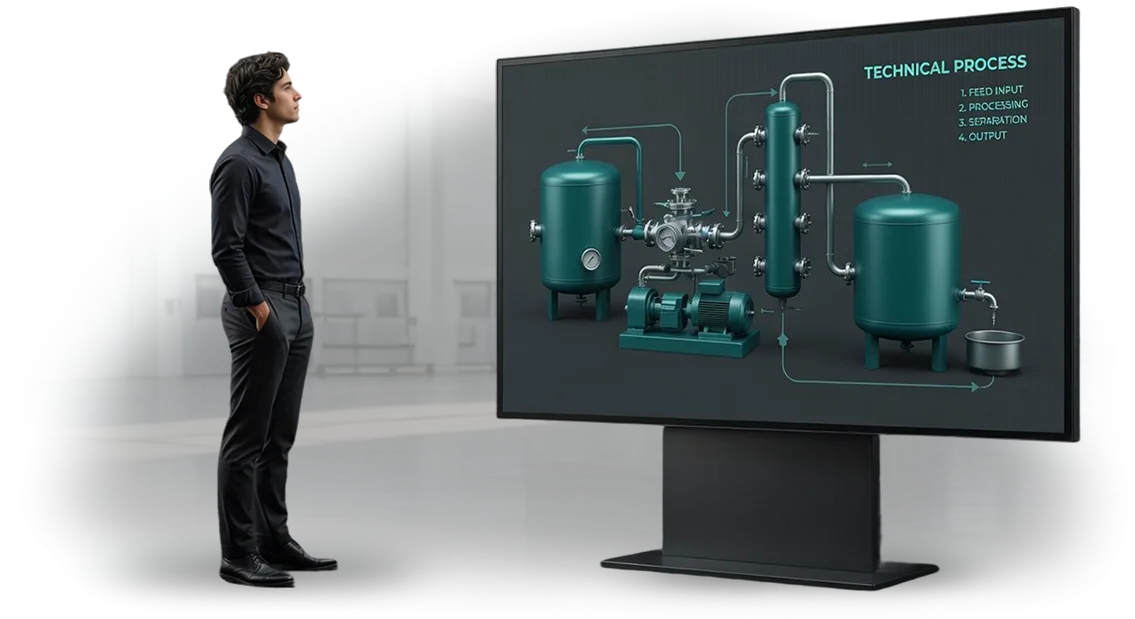
Why Standard Safety Briefings Don't Work for the Energy Industry
Standard safety briefings in the energy industry have long ceased to be reliable protection against mistakes. Employees formally listen to a lecture, sign the logbook — and within a week they forget the key safety rules.
Meanwhile, the complexity of equipment and the responsibility for technological processes in the industry are many times higher than in most other fields.
The cost of carelessness here is not just a workflow disruption, but an accident with serious consequences for people, equipment, and the environment.
Traditional training methods — text, diagrams, verbal explanations — cannot convey the real picture of processes, especially when it comes to actions in emergency situations. An employee must not memorize the instruction, but understand the logic of each step.
As a result, companies face recurring violations, increased accident rates, and injuries. These are direct losses: downtime, fines, legal costs, and loss of reputation as a reliable supplier.
Additionally, time and money must be spent on retraining and incident reviews, which often do not eliminate the root cause — simply an ineffective way of presenting the material.
The solution lies in the presentation format: employees need to see the process as it really is, rather than imagine it from text. Video instructions with CGI animation show technological operations and correct actions in detail that is clear to every operator.
This makes energy industry training practice-oriented and shortens the time needed to absorb the material.
We develop exactly this kind of training video instructions for energy enterprises. Instead of abstract diagrams — realistic visualization of processes that helps employees quickly and accurately master regulations and safe work practices. This is how you reduce accident risks and improve the safety culture in your company.
Three Benefits of Video Instructions: Safety, Speed, and Savings
Let's Talk About the Benefit, Not the Technology
Video instructions are not just a "picture with text," but a working tool that reduces risks, accelerates training, and saves budget. Let's break down three key benefits that matter specifically to the client.
Benefit 1. Employee Safety
Mistakes on the production floor are expensive: injuries, downtime, reputational losses. Video instructions clearly show each step — from equipment startup to actions in an emergency situation.
The employee sees the correct algorithm with their own eyes, rather than reading dry text, so they remember it better.
The number of violations and accidents decreases. Which means less downtime, fewer inspections, and fewer payouts.
Benefit 2. Training Speed
A new employee can be onboarded faster, and an experienced one can be trained on a new operation or updated regulation. The video can be rewatched at a comfortable pace, allowing employees to return to complex fragments and use it at workstations and in distance learning systems.
Instead of three days of lectures and briefings, one day of practice with video is enough. The mentor's time is freed up for other tasks.
Benefit 3. Budget Savings
Developing a video instruction pays for itself through reduced training costs: fewer mentors pulled away from their work, less rental of training facilities, and fewer consumables for repeated trainings. A video created once works for years and serves hundreds of employees.
In addition, the "cost of error" decreases: properly trained personnel are less likely to break equipment, produce defects, or create emergency situations. These are direct savings for the company.
our team — this is exactly the kind of savings we help our energy industry clients achieve. Case studies show that implementing video instructions delivers a tangible effect within the first quarter. Contact us — we'll advise you on how to calculate the benefit for your production site.
Formats of Video Instructions for the Energy Industry: CGI, Live Action, and Animation
The same material can be presented in different ways — and the training outcome changes dramatically. In the energy industry, where every mistake is costly, it's important to choose a format that employees will truly understand and remember.
CGI animation accurately shows the internal structure of equipment and hidden processes, live action captures real personnel actions, and classic animation explains the logic and sequence of steps.
Below is a comparison of the three main formats we use when developing training videos. Based on the task, budget, and audience, you can easily choose the right option.
| Format | For Whom | What It Gives the Client |
|---|---|---|
| CGI animation | Engineers, maintenance personnel, operators | Shows the internal structure of components and mechanisms that cannot be captured with a camera. Allows safely demonstrating emergency scenarios. |
| Live action with employees | New workers, blue-collar roles | Maximum clarity and recognition: personnel see their real workplaces. Easier to perceive, faster to adopt. |
| 2D animation | All categories, especially for distance learning | Simplifies complex diagrams and regulations, makes content easy to grasp. Ideal for mass training without loss of quality. |
Whichever format you choose, it's important that the video doesn't just repeat the instruction, but builds correct actions in a real situation.
That's why we combine formats within a single project: CGI animation shows the physics of the process, live action shows real actions, and 2D animation ties everything together into one coherent story. This approach saves instructors' time and reduces the number of errors on the production floor.
Our team has been developing training video instructions for the energy industry for over 10 years. We know how to present complex material so that employees absorb it the first time and apply it in their work. Contact us — we'll select a format for your task and budget.
Stages of Developing Video Instructions: From Brief to Implementation
Developing video instructions is not creative chaos, but a well-structured process with clear stages and control points.
We support you at every step so that the final video truly solves the training task — it is clear, safe to perceive, and easy to implement into personnel workflow.
-
Brief and Immersion — You tell us about your tasks, the specifics of your employees' work, and requirements for the instruction. We ask clarifying questions, study the regulations and technological processes so that the video matches real conditions.
-
Script Approval — We turn technical information into a structured script: key steps, emphasis on complex points, narrator text or subtitles. You receive a document that is easy to review — even before filming, you can see what will be in the frame.
-
Production Plan — We determine the format: filming with an instructor, animation, or a combination. We build a schedule so as not to miss deadlines or distract your employees from work for too long.
-
Production and Filming — At this stage, we shoot material with professional equipment or assemble animation scenes. Everything that could be dangerous or difficult to show live is modeled to maintain accuracy and clarity.
-
Editing and Final Approval — We combine the footage, add graphics, accents, and pauses for perception. You review a draft version, make edits — and only after your "yes" do we release the video in the required format.
-
Implementation and Support — We help adapt the video for the distance learning system and verify playback on work devices. If needed, we make edits after the pilot launch so that the instruction works as effectively as possible.
This approach reduces the risk of misunderstanding and rework. You always know what stage the project is at and control quality before the video reaches your employees.
What's Included in the Delivery of Video Instructions for the Client
Upon project completion, you receive a complete delivery package — a structured set of materials ready to be handed over to the training department or HR service. No "semi-finished products": each element undergoes internal review and comes with usage instructions.
Here's what's included:
- Approved script and storyboard. The text of each instruction, broken down frame by frame, with explanations for operators and control points.
- Final videos. Ready-made instructions in formats for computer, tablet, and smartphone — with and without subtitles, so that every employee can learn at their own pace.
- Technical documentation. A description of the video structure, timings, file versions, and recommendations for embedding into your distance learning system.
- Source materials and rights. All rights for use and modification transfer to you. You receive the source files so you can update the videos in-house if needed.
- Methodological recommendations. How to integrate video instructions into the training program, what assignments to add, and how to assess material comprehension.
- Launch presentation. A short overview for managers and employees to quickly communicate the value of the new instructions and increase engagement.
The entire package is transferred with closing documents, so you know exactly what you received. This is not just files — it's a ready-made solution that starts working immediately after being placed in your distance learning system.
Case Study: How Video Instructions for the Energy Industry Reduced Accident Rates
Energy is an industry where the cost of human error is measured not in fines, but in people's health and the uninterrupted operation of equipment.
Yet traditional personnel training often remains a formality: nobody reads PDF instructions, and lectures are forgotten within a week.
This is exactly the problem a company operating distribution networks brought to us — after several incidents caused by incorrect employee actions.
our team developed a series of short video instructions for key technological operations: from substation switching to actions in emergency situations. We converted complex regulations into clear videos with a frame-by-frame breakdown of each step.
Importantly, the videos were filmed not in a studio but at the client's real facilities — employees saw familiar equipment and remembered the sequence of actions without losing connection to their everyday environment.
The result was measured six months after launch: personnel-related accident rates fell by 31%, and the time for new hire induction training was cut in half.
Additionally, the company reported increased confidence among operational personnel — twice fewer calls to the dispatcher for guidance when performing routine operations. This allowed senior specialists to be reassigned to complex tasks.
Why Video Works in the Energy Industry
Employees remember not abstract instruction points, but a visual action scenario. Video instructions can be rewatched before a shift, on a tablet right at the facility, and they are equally clear to a newcomer and an experienced worker.
For the client, this is not just "training content," but a tool for reducing risks and protecting people.
Repeat Order and System Development
After the first stage, the company ordered another block — video instructions for the maintenance of transformer substations. Today, the video library is used as a core part of the training program across all regional branches.
This confirms: the results that video delivers pay off not as a one-time effect, but as systemic reliability.
How to Measure the Effectiveness of Video Instructions?
The effectiveness of video instructions is measured not by views, but by changes in an employee's performance. The client cares about three groups of metrics: speed of material mastery, quality of task execution, and the level of workplace safety.
If a newcomer starts an independent shift faster after implementation, and the number of errors during commissioning work drops — the video is working.
We suggest embedding KPIs at the script design stage. To do this, we define control points: time to answer a test after viewing, the share of employees who successfully pass the knowledge check, and the frequency of returning to the instruction in the first months of work.
This data shows which material blocks are clear right away and which are worth reshooting or supplementing with an analysis of common mistakes.
Another metric is the impact on safety. We track the dynamics of incidents and regulation violations in areas where our videos are used. A decrease in citations and accidents is the most visible result confirming the return on training investment.
It's important that the assessment is automatic and doesn't distract employees from their work. That's why we embed short quiz questions directly into the video and compile the statistics into a summary that is convenient for the manager.
This way, you see the progress of each worker and an entire workshop without manual surveys or paper reports.
The main rule is: metrics should be tied to business goals, not to the format. We help you select 3–4 indicators that truly reflect training effectiveness and set up regular monitoring after launch.
This turns video instructions from a one-time project into a manageable tool for improving personnel competence.
Frequently Asked Questions About Video Instructions for the Energy Industry
Before starting a project, energy industry clients most often ask the same things: how much it costs, when it will be ready, and whether video instructions really pay off. We answer the main doubts — briefly and to the point.
How long does it take to create a video instruction?
It depends on the complexity of the technological process and the number of scenes. On average, a project takes three to six weeks: from brief to finished video.
At the start, we fix the deadlines in the contract and meet them — you can plan your training without waiting for delays.
If the process needs to be shown urgently, we can offer an accelerated option by running the scriptwriter and artists in parallel.
Why is a video instruction better than a regular text or PDF one?
An employee perceives video several times faster than text and remembers the sequence of actions better. This is especially important for the energy industry: a mistake when working with equipment can lead to an accident or downtime.
A video instruction shows the process step by step — the risk of incorrectly following a regulation decreases.
Plus, it can be rewatched before a shift and used when onboarding new employees.
Do you work with specific equipment? Can you show our processes?
Yes. We have created instructions for energy facilities with unique technological cycles: from standard operations to complex regulations. All we need is documentation and access to the facility for filming — we take care of the rest. If filming is not possible, we fully model the process in CGI and show it from any angle.
What makes up the cost, and can we fit our budget?
The cost depends on the script volume, the level of detail, and the format — animation or live action with post-production. After the brief, you receive an accurate estimate, and it doesn't change during the process. We work in stages, so you can start with one video and scale up to other processes.
What happens after the project is delivered?
We hand over the source files and final files in the formats you need. If necessary, we adapt the video for different screens: from monitor to tablet or phone. We also update instructions when regulations change — this is cheaper than creating a video from scratch.
Still have questions about your process? Contact us — we'll review your task and propose a solution.Get a Commercial Proposal with an Estimate in 1 Day
We understand how important it is to quickly assess the employee training budget without drowning in technical details. Especially in the energy industry, where instructions must account for industry specifics and safety requirements.
That's why we've prepared a simple path: you submit a request — and the very next day you receive a commercial proposal with a transparent estimate.
We don't just name a price; we break the estimate down by stages: script development, filming or 3D graphics, editing, voiceover, and revisions. You immediately see what you're paying for and can adjust the scope to fit your budget.
This approach saves time on internal approvals and allows you to launch the project without lengthy negotiations.
What you get after reaching out:
- Commercial proposal with an estimate within 1 business day — no waiting and no "we'll think about it": we lock in the cost and timeline right away.
- Clear stages and the result of each stage — you control the process rather than waiting for something unclear.
- Adaptation to your format — in-person training, distance learning, or a blended model: we'll build it around your system.
- Industry-specific considerations — the scripts will factor in regulations, typical scenarios, and the requirements of your industry.
- A single dedicated manager — no "transferring between departments": all questions are resolved in one place.
- Deadlines fixed in the contract — missed deadlines are ruled out because production is in-house, not outsourced.
To receive a commercial proposal, simply submit a request on the website or give us a call. We'll ask a few clarifying questions about your task — number of employees, topics, desired format — and send you a commercial proposal with an estimate within one business day.
No hidden payments and no "fine print": the final cost does not change after signing, unless you make changes to the scope of work. This allows you to plan your training budget in advance and protects you from unexpected expenses.
Fill out the form or contact us in any convenient way — and by tomorrow you'll know the exact cost and timeline for your project. We'll start with a short brief, and we'll take care of the rest.