

Why the Mining Industry Needs Modern Video Instructions
The mining industry is one of the most complex and demanding fields, where the cost of a mistake is measured not in financial terms but in people's health.
Every day, employees work with heavy machinery, explosives, and sophisticated equipment, so staff training here is not a formality but a condition for business survival.
However, traditional training formats—safety briefings, text-based regulations, posters—have long ceased to be effective.
A newcomer arriving at a plant faces an enormous amount of information and in reality has only a few days to get up to speed. Text instructions are skimmed diagonally, and mentors cannot always devote enough time to each person.
As a result, the onboarding of new employees stretches over months, and during this period the risk of errors and workplace injuries grows.
Experienced workers also suffer from outdated approaches. When process technologies change or new equipment is introduced, employees are forced to retrain, and without visual material knowledge becomes distorted—each person interprets the regulations in their own way.
This leads to safety violations on the production floor, operational disruptions, and additional costs to fix the consequences.
Video instructions for employees solve this problem: they show every step in action, eliminate misinterpretation, and allow learning at a convenient pace. This format shortens time-to-competence and makes training uniform for everyone—from recruit to experienced supervisor.
We help mining companies create precisely such materials, which reduce risks and increase operational efficiency.
What Benefits Does 3D Animation Bring to Staff Training?
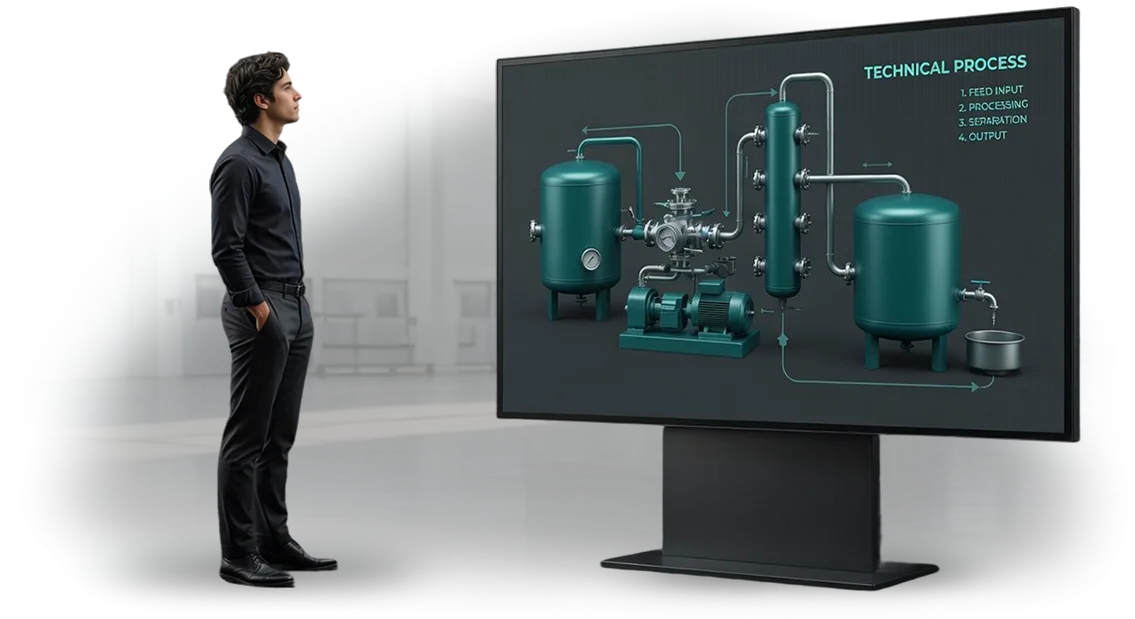
Three-dimensional animation turns a complex technological process into a clear sequence of actions: the employee sees equipment and operations just as in a real workshop, but without risk or interference.
In staff training, this works better than diagrams and text instructions—the material is absorbed faster and stays in memory for a long time.
Faster onboarding is the first benefit a company notices. A newcomer understands the line layout and operation sequence within a few days—steps that previously took weeks to master.
The mentor is freed from repeating the same thing, and the company gets a fully productive employee sooner.
Error reduction is the second, equally important side. In mining, an incorrect action is costly: the risk of equipment breakdown, downtime, or in the worst case, a safety threat.
A three-dimensional breakdown of stages with emphasis on hazard zones forms the correct algorithm even before the employee sets foot on site.
Visual materials continue to serve the company after training: the animation can be reviewed at any time, used as a reference in the system, or included in initial safety inductions. Such content does not become obsolete for years and pays off with every new round of hires.
Our team creates videos with professional 3D graphics tools—the client receives material that accurately matches the real equipment and technological documentation.
Everything is tailored to the specific production task, from frame composition to the pace of information delivery.
Video Instruction Formats for the Mining Industry
A video instruction for the mining industry solves three tasks: it teaches newcomers to work safely, standardizes staff actions, and reduces errors on complex equipment.
There is no single best format—the choice depends on what needs to be shown: equipment structure, operating procedures, or work in a software program.
The table below helps match tasks to formats.
| Format | For Whom | What It Gives the Client |
|---|---|---|
| CGI process animation | Training for work on unique equipment and hazardous areas | Shows the structure and movement of components without stopping production |
| Interactive video | Knowledge testing, training action algorithms | The employee chooses a scenario—errors are highlighted and the skill is reinforced |
| Screencast | Training for software and dispatch systems | Step-by-step interface walkthrough that can be rewatched |
The choice of format depends on the end goal. A CGI video can show processes inaccessible to conventional filming: the internal structure of a crusher or the movement of ore. Interactive video makes the employee make decisions in an emergency. A screencast is indispensable for a precise sequence of actions in software.
We recommend combining formats: a CGI video provides the big picture, an interactive module reinforces it, and a screencast serves as a reference guide at the workplace.
This combination covers the full cycle—from familiarization with the process to independent work without a mentor.
A video instruction must work in field conditions—with poor internet, on a tablet, or in the noise of a workshop. Therefore, we adapt videos for offline viewing and various screens, so the employee gets information exactly when it is needed.
How Video Instructions Are Developed: From Brief to Launch
A clear process is half the success. You see how the project is progressing, where the revisions stand, and when employees will receive the video instruction.
This is especially important for the mining industry: regulations are strict, and simple, visual training directly affects safety.
We have structured our work so you always understand what is happening and can intervene at any moment.
-
Brief and process audit. We study your technological process, current instructions, and regulations. We identify where employees most often make mistakes and which components need to be shown in particular detail.
-
Script and storyboard. We turn the process flow into a clear narrative: we describe each frame, the voiceover text, and the focal points. We approve the script with your process engineers and safety specialists to eliminate inaccuracies.
-
Layout approval. We show key frames of the future animation in static form—you see the style, shots, and details before production begins. We make corrections at this stage so we do not have to redo finished scenes later.
-
CGI animation production. We create realistic 3D models of equipment, special machinery, and employee actions. Each component is shown from the right angle, each step in a logical sequence. This takes up the bulk of the project timeline.
-
Voiceover and editing. We record a professional voiceover, sync it with the animation, add subtitles and emphasis on critical actions. You receive a ready draft for final review.
-
Launch and support. We deliver the video instruction in the formats you need—for LMS, tablets, training rooms. We remain available after launch: we will update the video if regulations change or add new episodes.
The entire process takes from two to six weeks depending on the complexity of the process technology. At each stage you have an approval point—you control the budget and timelines without surprises.
Full Deliverables for Training Video Instructions
Work on the project does not end with delivering the finished video. We provide a complete package of deliverables—everything your team needs to launch training the very next day and continue using the materials without being tied to a contractor.
- Final training videos in multiple formats: for the corporate portal, for on-site briefings on a screen, and for mobile devices of employees working in the field.
- Source project files: all scenes, layers, and source graphic assets, so you can make edits yourself or order updates from us without redevelopment.
- Methodological materials for each video: script, episode breakdown, test questions, and an instructor’s guide—a ready-made lesson plan that does not need to be created from scratch.
- Usage instructions: where to upload the video, how to configure access, and how to embed the materials into your existing employee training and certification program.
- Stills and previews for printed materials: posters, reminders, and short cheat sheets for workstations, so key steps of the process are reinforced even after the briefing.
- Production archive: a complete set of technical documentation and project files in case the course evolves, equipment is replaced, or safety regulations change.
This deliverables package covers the full implementation cycle. You receive not just a video but a ready-to-use training tool that can be adapted, supplemented, and passed on to new employees.
This is especially important in the mining industry: regulations change, new specialists arrive, and your training material must quickly adapt to new requirements—without new tenders or lengthy approvals.
Example: How Video Instructions Accelerate Onboarding
Onboarding at a mining enterprise is a long and costly process. A new employee needs not just to study the regulations but to understand how the production cycle works: from ore receipt to concentrate output.
Without a visual diagram, training stretches over weeks, and early mistakes are too expensive—equipment downtime or a rejected batch.
It was precisely this pain that brought a mining client to us—the company Vostok-Rud.
The enterprise operated with text instructions and rare in-person internships: experienced employees passed on knowledge personally, but each newcomer required time, and some processes remained “in the heads” of mentors.
We developed a series of video instructions with 3D animation of key process flows. Instead of abstract slides, the employee sees the movement of ore along the entire chain—crushing, enrichment, filtration—with emphasis on critical control points.
This format is understandable even for those who have never worked in production: you don’t need to read diagrams; it is enough to see the correct sequence of actions once.
We measured the results a month after launch and recorded them in the report. The average onboarding time for operators dropped from 12 to 4 shifts, and the number of errors during shift handover fell by 35%.
Repeat requests to the instructions almost disappeared—training became self-directed, and mentors stopped being distracted from their own tasks.
The main point the client noted: new employees reach independent work faster, and current staff use the videos as a reference in emergency situations.
We apply the same approach when new equipment is introduced and regulations change—video instructions are easily adapted to new processes and remain relevant for many years.
Answers to Frequently Asked Questions About Developing Video Instructions
Before discussing timelines and estimates, clients want to understand the main thing: what exactly they are spending their budget on and what result they will get.
A video instruction is not a “checkbox video” but a tool that reduces accident rates, accelerates newcomer onboarding, and eliminates scattered paper regulations.
That is why we answer the most frequent questions before the project starts—so you see the full picture and make a decision without hidden surprises.
How long does it take to develop one video instruction?
A standard cycle takes 3 to 6 weeks, depending on the complexity of the process technology and the number of scenes.
A short instruction for working with a specific component is done faster; a full training cycle for a workshop takes longer because it requires more shooting days and editing.
We fix the schedule in the contract and stick to it: missed deadlines disrupt the training program and therefore hit your plans. That is why you receive a calendar plan already at the brief stage and can see the checkpoints.
Why does the cost depend on the format—where is the difference between filming and animation visible?
Each format solves its own task. Filming on real equipment shows the texture of the process and introduces the employee to an actual workshop; CGI animation makes it possible to show the internal structure, invisible mechanisms, or hazardous zones without risk to the operator.
The cost difference reflects the difference in production effort: animation requires more modeling and refinement stages, but it delivers the “cutaway mechanism” effect where a camera is powerless.
At the consultation we select the format for your task, rather than selling the most expensive option.
What guarantees do we have that the video will actually be used by employees?
A video instruction does not work by itself—it works within your training system. We deliver a ready-to-use file in the required formats: from a video hosting version to local files for offline viewing on tablets and in training rooms.
In addition, we transfer usage rights and methodological recommendations: where to embed the video in the training program, what tests to include after viewing, and how to update the visual content when regulations change. This way you get not just a “picture” but a tool that instructors can immediately apply.
If you still have questions about cost, timelines, or the script—write to us, and we will examine your specific case. Based on your process flow, we will prepare a proposal within a couple of working days.Order Video Instruction Development for Your Enterprise
Do you want to order video instructions for employees at a mining enterprise? Leave a request—and we will conduct a consultation and calculate the project cost for your task.
We will analyze your process technology, suggest the optimal format, and show how the video will shorten onboarding time, reduce the risk of errors, and improve safety on the production floor.
The work follows a transparent process:
- Brief: you describe the task, we clarify the details.
- Process analysis: we study the regulations and equipment.
- Script and storyboard: we approve the text and video logic.
- Filming or 3D animation: we create the material.
- Editing and voiceover: we add graphics and explanations.
- Review and revisions: we finalize the result.
- Delivery of final files and employee training.
We coordinate each stage with you so the result exactly matches expectations. After submitting your request, you will receive:
- A consultation on video instruction format.
- A cost and timeline estimate tailored to your process.
- Examples of our work for the mining industry.
- Recommendations for using the video at your enterprise.
- Support at all stages—from brief to launch.
Leave your request—and tomorrow we will discuss how to make your employees’ training simple and safe.
How to Choose a Video Instruction Format for Your Task?
A video instruction format is never an end in itself—it is determined by the specific task: what the employee must absorb, under what conditions they work, and how often the process changes.
There is no universal solution, but there are clear selection criteria that allow you to avoid overpaying for unnecessary complexity and avoid skimping where maximum clarity is needed.
The first criterion is the complexity and hazard of the process. If it is a multi-step operation on equipment where a mistake is costly, the employee needs detailed animation with cutaways of mechanisms and sequential steps.
The second criterion is the audience: experienced specialists respond to short reminders of regulations, while newcomers require full immersion in the context with an emphasis on typical mistakes.
The third is operating conditions: can the real process be filmed, or is it physically inaccessible?
And here the specific requirements of the mining industry come to the fore. Real filming in a mine, at a processing plant, or near crushing equipment is often impossible or involves risk for the crew.
Even if access is available, you will not show in the frame the internal structure of an assembly, the movement of ore inside a pipeline, or the consequences of violating safety procedures.
CGI animation solves this problem: it models the process with the required accuracy while maintaining the safety and clarity that are unattainable with conventional video filming.
Practical advice: before choosing a format, answer three questions. What should the employee do after viewing—remember the sequence, understand the physics of the process, or practice actions in an emergency situation? What is the actual skill level of your audience?
How often is the instruction updated—once a year or quarterly? The answers will immediately narrow the choice: for example, modular videos suit frequently changing regulations, while full CGI animation with focus on details suits complex technological cycles.
We do not sell “one format for all cases”—we select it for your production task, analyzing the scenario, employee working conditions, and safety requirements.
This makes it possible to get an instruction that truly reduces training time and the number of errors, rather than simply looking good in a report.
Start with a brief—and within a few days you will receive a format recommendation with a justification of why it fits your particular enterprise.