

Staff Errors in the Chemical Industry: Why Do They Cost So Much?
Every year, incidents occur in the chemical industry caused by the human factor.
An operator's mistake, an incorrect sequence of actions, neglect of regulations — all of this results not only in line shutdowns but also in risks to human life, the environment, and the plant's reputation.
The cost of such a mistake is measured not in hours of downtime but in lost contracts, the trust of regulatory authorities, and multi-million fines that undermine production economics for years to come.
The situation is aggravated by the fact that staff turnover in the industry remains high, and the transfer of experience from veterans to newcomers is often formal. A newcomer receives an instruction "on paper" but does not see the real consequences of their actions.
This is where the main risk lies: the employee does not realize how their seemingly minor mistake can affect neighboring workshops, product quality, and the safety of the entire enterprise.
Systematic staff training solves this problem. When every step of the technological process is clearly shown and typical errors are analyzed down to the smallest detail, the employee develops the correct behavior model — they act confidently and deliberately.
This is not just professional development; it is the foundation of industrial safety that reduces accident rates and makes production predictable.
We have been developing corporate video instructions for chemical industry enterprises for over 10 years. We analyze real regulations, consult with technologists, and turn dry texts into clear action algorithms.
As a result, the customer receives not "another training for show" but a tool that actually reduces the number of errors and protects the business from costly incidents.
What Does Training Based on 3D Animation of Technological Processes Provide?
In the chemical industry, the cost of a mistake is especially high: an incorrect employee action can lead to production shutdown, product defects, or an accident.
At the same time, traditional training formats — lectures and text instructions — do not provide a full understanding of processes, especially when it comes to hidden reactions or equipment that cannot be stopped for practice.
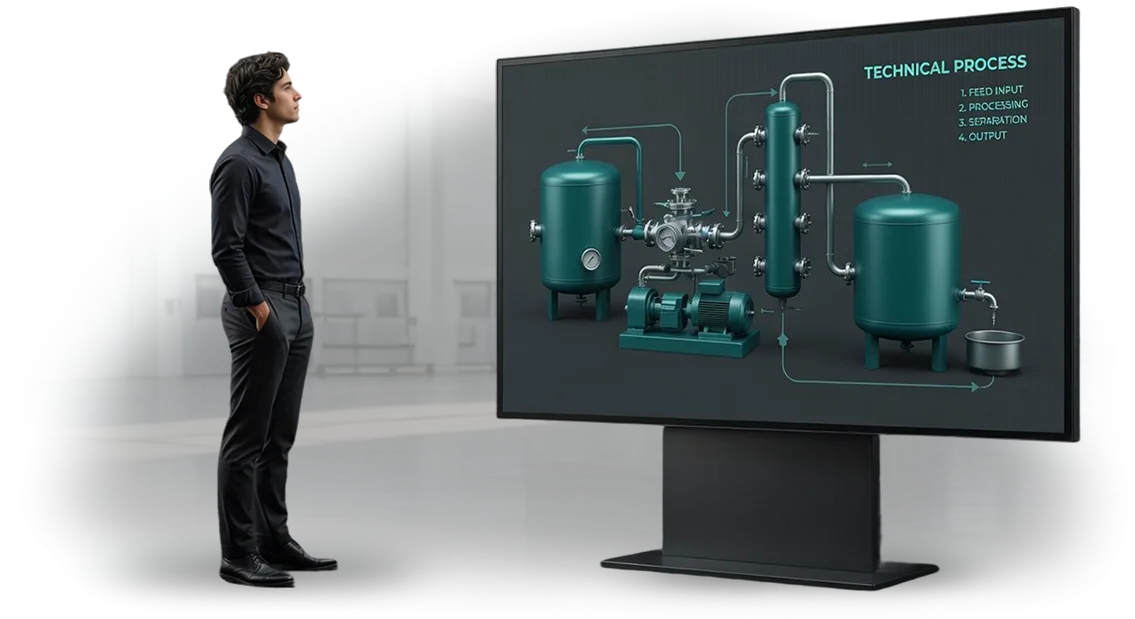
At our team we create training video instructions based on 3D animation that show the technological process visually — from raw material feeding to the finished product output. The employee sees each stage from the inside, in motion, with a precise sequence of actions. This turns abstract regulation points into a clear picture.
Reducing Risks and the Number of Errors
When an employee understands what happens inside a reactor or column, they act consciously rather than mechanically. 3D animation makes it possible to show the consequences of incorrect actions and practice behavior algorithms in emergency situations without real threat. As a result, the number of regulation violations, raw material losses, and injuries decreases.
Accelerating Onboarding and Improving Qualifications
A new employee does not need to spend months observing experienced colleagues — they receive a structured video course and can review it at any time. This reduces the time to full competency and lowers the burden on mentors.
At the same time, current workers master rare and emergency modes that cannot be demonstrated in real conditions, which improves their qualifications without stopping production.
Ready-made video instructions are easy to use for certification and knowledge control. They integrate into the e-learning system, and the manager always sees who has mastered the material and who needs additional attention. In the end, training becomes predictable, and production becomes stable and safe.
Video Course Formats for the Chemical Industry: How to Choose?
There is no universal video instruction for the chemical industry. One employee needs to systematically understand the technological process, another needs to quickly recall actions before a shift.
The cost of a mistake when working with reagents is high, so the format is chosen based on risk and frequency of use, not on trends.
| Format | When to choose | What it provides to the enterprise |
|---|---|---|
| Full video course | Training new employees, retraining, certification. A system is needed, not a set of fragments. | A unified knowledge standard, learning control, less time spent by mentors. |
| Animated videos | Processes that cannot be captured by a camera: chemical reactions, media movement, operation of closed apparatuses. | Clear explanation of complex operations, fewer errors, understandable demonstration of risks. |
| Microlearning | Actions before a shift, emergency situations, repeating regulations without interrupting production. | Quick employee engagement, regular skill reinforcement, less downtime. |
Go through a short checklist:
- There is a risk to health or technology failure — take a full course with knowledge verification.
- The process cannot be shown with regular filming — use animated videos.
- Employees check the instructions every day — microlearning is sufficient.
In the chemical industry, a combination works more reliably: a basic video course for newcomers and short videos at the workplace. Such a system is easier to implement, and when regulations change, it is enough to replace one module.
At the briefing stage, together with you, we will analyze the audience and build the video course structure for the specific task of the enterprise.
How We Create Training Videos: Project Stages
Developing a training video is not just animation. It is a project that changes employee behavior and reduces errors in production. We structure the process of creating a video instruction into 7 stages — so you always control the project progress.
Stages of Work on a Video Instruction
-
Brief and task analysis. We discuss who the video is for and why it is being created. We define training goals — for example, reducing errors or speeding up shift readiness.
-
Script and storyboard. We turn the technological process into a clear visual sequence. We coordinate the script with your technologists — this is the project approval stage where key decisions are recorded.
-
Collecting source materials. We study documentation, film real processes, obtain drawings and samples so that the animation accurately replicates your equipment.
-
Creating 3D models and animation. We visualize each component and movement. You see intermediate versions and refine details before the final edit.
-
Voiceover and editing. We record the narrator's text, synchronize it with the animation, and add subtitles. We check the video on all employee devices.
-
Approval and revisions. We hand over the film for review and make revisions until full approval. Usually two or three iterations are enough.
-
Launch and support. We deliver the files and help integrate the video into the training system. When regulations change, we update the video.
At our team we have been creating training videos for industry for 10 years. We know how to show a complex process simply and clearly so that employees remember the actions.
What Is Included in the Delivery of a Video Instruction
You receive not just a video, but a ready-made tool for employee training. For chemical production, it is especially important that every worker strictly follows regulations — safety and quality depend on it.
Therefore, we put together the delivery package so that it can be implemented without any additional work on your company's side.
The delivery of a video instruction includes:
- Main training video — a series of videos or a single film with CGI animation of technological processes. The video is delivered in formats compatible with your e-learning system and internal portals.
- Methodological materials for the instructor or mentor — a ready-made lesson script, recommendations for analyzing typical errors, and control points so that you can conduct training without preparation.
- Control questions and tests — knowledge verification after viewing. Tests are graded automatically, and you see the results for each employee.
- E-learning system — if you do not have one yet, we install and configure a platform where you can assign courses, track completion, and generate reports for management.
- Project source files — animation scenes, editing files, and working materials. When technology or regulations change, you can quickly make edits together with our team or another contractor.
- Brief implementation guide — a step-by-step plan: how to upload materials, assign training, and for administrators — how to manage permissions and statistics.
- Video instruction passport — a document describing the video composition, runtime, and compliance with your internal standards (if necessary).
We adapt all components to your infrastructure: from simple upload to the HR department to full integration with the corporate training portal.
You end up with a package that keeps working after our launch — you update regulations, change the script, and training always meets current production requirements.
Case Study: Developing Animation for a Production Enterprise
Case Study: Developing Animation for a Production Enterprise
A chemical enterprise approached us as it was launching a new line and faced a typical pain point: training employees on real equipment is expensive and risky.
A trainee's mistake means production downtime and potential defects, and mentors spend hours repeating the same instructions.
We proposed a solution — detailed 3D animation of the technological process. Instead of abstract diagrams and dry regulations, the customer received a clear video where each stage — from raw material feeding to the finished product — is shown in motion.
Such animation can be reviewed at any time, paused, and returned to complex components. As a result, new employees start working faster, and mentors stop being distracted from their own tasks.
How We Worked on the Project
We started by immersing ourselves in the process: we studied the regulations, filmed references on site, and analyzed each operation together with the customer's technologists.
This is a key stage — it is what makes the animation not a "pretty picture" but accurate training material that reflects the real behavior of the equipment.
Next came the creation of 3D models and animation of the movement of flows, valves, and sensors. For the customer, this means training safety: it is possible to show emergency situations and abnormal scenarios that cannot be practiced in live production without risk. The employee sees the consequences of a mistake before it happens in reality.
Project Results
The main result is that we work with the enterprise on an ongoing basis: after the first animation, the customer ordered videos for two more workshops.
Employees memorize the sequence of operations faster, and the number of errors during onboarding has noticeably decreased — regular certification will show exactly how much.
For this project we used professional 3D graphics software — this guarantees the level of detail that makes training truly visual. We continue to support the customer: we update the videos when regulations change and adapt them to new training formats.
If your production needs clear and safe employee training — let's discuss the task at a consultation.
How to Choose the Right Video Instruction Format for Your Task?
There is no universal format that will train both a production operator and a sales manager equally well. If you choose "by eye," it is easy to end up with an expensive video that will not change employee behavior or pay for itself.
So first we answer the question of what task the training faces, and only then do we select the format for it.
The main criterion is the complexity of the process and the knowledge level of the employees. For a simple regulation, a short screencast or slideshow with narration is enough.
But when it comes to rare emergency situations in production or working with hazardous substances, you need the level of detail that only 3D animation of a technological process can provide.
The second criterion is how measurable the result should be. A simple video explains how to perform an action but does not show the internal mechanisms and consequences of an error.
CGI animation simulates chemical reactions and stages of the production cycle, so the employee forms a complete picture. They understand why it is necessary to act strictly according to the instructions, rather than simply memorizing a sequence of actions.
Finally, consider the conditions in which the employee will review the material. If it is training before a shift at a stationary computer, a detail-rich format is suitable.
If the video needs to be quickly updated when regulations change, choose a format that can be easily modified without a full rebuild.
We help you select the right format for your task as early as the briefing stage.
We analyze training requirements, the complexity of technological operations, and the current skill level of the personnel, after which we propose a video that will deliver a measurable result — reducing the number of errors and the time needed to bring a newcomer up to speed.
Choosing a format is not a matter of technical preferences but a matter of achieving your business goals, so it is better to entrust it to those who have already completed dozens of such projects.
Frequently Asked Questions About Developing Corporate Video Instructions
Before ordering training videos, questions remain: the main ones are timelines, revisions, employee reaction, and compatibility with internal systems. This is especially important in the chemical industry, where an error in production is costly. We answer honestly and to the point.
What are the development timelines?
Timelines depend on the number of scripts and the depth of detail. At the briefing, we give an exact date — usually from two weeks to two months. We work in stages: you see intermediate results and understand the project progress. If you need it urgently, we speed things up by bringing in additional specialists.
Are many revisions included in the cost?
The contract includes two revision cycles: after script approval and after the draft edit. This is enough to account for the comments of technologists and occupational safety specialists.
We make revisions within two to three days; all cycles are already included in the cost, and there are no hidden additional charges.
How will employees perceive the video instructions?
Employees more readily accept short videos with analysis of real work situations than voluminous regulations.
At the testing stage, we involve two or three operators and technologists, collect feedback, and adjust the presentation — this way the video becomes part of the team rather than a requirement imposed from above.
Will the videos work with our internal systems?
We deliver videos in universal formats that play in any browser, on laptops and tablets, in e-learning systems, and on corporate portals. An employee opens the video from their workstation without any additional setup. Professional equipment and refined tools ensure equally high-quality images on any screen.
Still have other questions? Call us — in 10 minutes we will give you an idea of timelines and cost, and offer an option for your task.Order the Development of Video Instructions for Your Enterprise
The chemical industry requires precise, flawless actions from every employee: a mistake can cost too much.
Training video instructions with animation of technological processes help personnel master regulations faster, reduce the risk of accidents, and shorten the adaptation time for newcomers.
Leave a request — we will develop a video that will be clear to every worker, regardless of experience and seniority.
After receiving your request, you will get:
- An accurate cost and timeline estimate within one business day — no hidden charges or unexpected additional payments.
- A personal manager who accompanies the project from the first request to the final version.
- A script approved by your technologists and occupational safety specialists — we take all internal instructions into account.
- Clear animation of technological processes that shows every stage of work and safety requirements.
- Ready-made videos in formats for in-person training, distance courses, and mobile access.
- The ability to make revisions after delivery so that the material fully matches your standards.
- A guarantee of project completion within the agreed timeline — this is stated in the contract.
To order a video instruction, fill out the feedback form on the website or write to us in a messenger. We will get back to you promptly, answer your questions, and prepare a cost estimate.
After discussing the details, we will confirm the timeline and start work — and you will receive clear and safe training material for your personnel.