

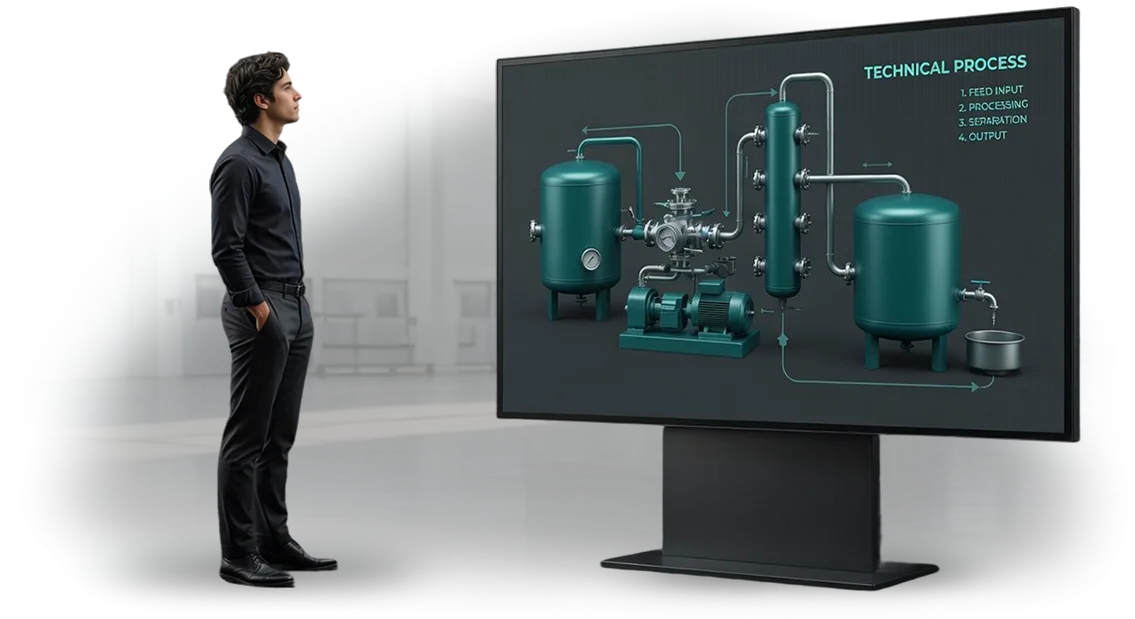
Staff Errors on Refrigeration Production Lines Are Costly
Staff errors in refrigeration production are costly: every line stoppage is loss straight from profit. An incorrectly performed operation leads to product damage, equipment downtime, and missed delivery deadlines.
In the worst case, unskilled actions cause an industrial accident, where the stakes are measured not only in money but also in people’s health.
Many industrial accidents happen not because of equipment wear but because the operator does not follow the procedure. Formal instruction does not stick in memory: a week later, the employee is again working intuitively, repeating the same staff errors.
This is especially dangerous in refrigeration production, where the slightest deviation from technology creates risks for product quality and occupational safety.
Every incident means direct costs for repairs, fines, lost contracts, and reputation with clients. At the same time, most incidents can be prevented at the employee training stage if training is made visual and practical.
That is exactly why we create corporate training video instructions: the employee sees each work stage on real equipment, with correct techniques and an analysis of typical errors.
Instead of reading a memo, a person receives a ready-made action model that can be reviewed as many times as needed. This is how employee training ceases to be a formality and becomes a system protecting your business. You reduce the number of violations, cut downtime, and remove the grounds for emergency situations.
The result is fewer accidents, stable quality, and calm shifts. Video instructions pay for themselves through prevented losses and allow you to manage risks instead of dealing with consequences.
What Your Business Gains from High-Quality Video Training
High-quality video training directly affects the production economy. At a refrigeration enterprise, every incorrect operator action results in defective products, excess energy consumption, or breakdown of expensive equipment.
A video instruction with CGI animation of technological processes shows the employee the ideal sequence of operations — without the risk of ruining the product or shutting down the line. This way, the employee learns from a visual example rather than from his own mistakes.
The first and most noticeable benefit is a reduction in defects. When every worker sees the reference process and repeats it step by step, the percentage of deviations drops.
Animation eliminates the discrepancies that arise with text regulations or verbal instructions: the operator remembers not a general description but an exact picture of actions.
As a result, there are fewer losses at every stage — from raw material acceptance to packaging of finished products.
The second result is uniform work standards. Video training sets the same action model for all shifts, all lines, and all personnel categories. A new employee settles into the position faster, and mentors no longer need to repeat the same thing ten times.
The company gets a reproducible process: no matter which specialist starts a shift, quality remains stable.
Finally, video training improves qualifications without taking employees away from production. An employee can review the instruction at any moment — before a complex operation or after a failure.
This reduces anxiety for beginners and strengthens the confidence of experienced workers. Ultimately, the team’s competence grows, and with it product quality and customer trust.
These benefits work together: fewer defects cut costs, uniform standards simplify management, and higher qualifications increase each employee’s effectiveness.
Once you implement video training, you get a tool that pays off on every shift and continues to work without your involvement.
Formats of Training Video Instructions for Refrigeration Production
3D animation of production processes, live video from real lines, and combined formats — each has its own role in staff training.
The difference is not in the “pretty picture” but in how quickly the employee understands and remembers the operation and whether he can apply the knowledge on the job.
Here are three basic formats we use in training video instructions for factories.
| Format | For whom | What it gives the client |
|---|---|---|
| 3D process animation | New employees, line operators, maintenance personnel | Shows the unit’s structure and internal processes that are not visible to the eye. The employee understands the logic of the work rather than just memorizing actions. |
| Live production video | All personnel, including experienced workers | Captures real operations and procedures. A person sees familiar surroundings and workplace — so the instruction is perceived as a practical guide rather than abstract theory. |
| Combined format | Mixed groups, briefings, certification | Combines real workshop footage and 3D diagrams at key moments. Best holds attention and covers both tasks: showing “what it looks like” and “how it works.” |
For refrigeration production, the combined format is especially effective: 3D animation clearly explains the cooling cycle, refrigerant flow, and compressor operation, while live footage shows real operations on the line — from equipment startup to scheduled maintenance.
How to match a format to a task
- Introductory briefing for beginners — use 3D animation. It reduces the fear of complex equipment and speeds up the transition to independent work.
- Skills development and certification — live video with expert commentary works well. Employees see real errors and correct techniques, which provides an objective basis for knowledge assessment.
- Analysis of emergency situations — combine both formats: a 3D diagram shows the causes of a breakdown or accident, and video shows the correct sequence of actions.
How we shoot
For each project, we visit the site in advance, study the technological processes, and choose the optimal format for a specific task. If the process is hidden inside equipment, we add 3D animation. If the nuances of manual work matter, we enhance it with live footage.
As a result, you get video instructions that employees actually watch and apply at work — not an archive of manuals.
How We Develop Video Instructions: Work Stages
We have built the video instruction development process so that you understand at every stage what is happening and what result you will get.
From the first brief to launching the video into your training system, there are several sequential steps that take into account the specifics of refrigeration production processes and the needs of your employees.
- Video creation brief. We collect information about the technological process, training goals, and audience. Based on this, we determine the format, style, and timeline — without unnecessary approvals in the middle of the project.
- Script approval. A methodologist breaks the process into logical steps, writes the text, and describes the visual sequence. You make edits, and we adjust until it fully matches your procedures.
- Storyboard and style. We show key frames of the future video so you can see the design and understand how the mechanisms will look. This is the easiest stage to adjust details.
- CGI animation development. We create detailed 3D models and animate the technological process. Employees will see how components and systems work without the need to stop production.
- Voiceover and editing. We add a narrator’s voiceover, synchronize it with the script, and insert text hints. The result is a video ready for viewing and training.
- Interim approval. You receive a preview link and leave comments. We make corrections and deliver a final version that matches your personnel training system.
- Launch and support. We provide the finished files and help you place the video in your training system. If the technological process changes, we will promptly update the instruction.
What Is Included in the Delivery of a Video Instruction
We deliver not just a video, but a complete set of working materials. Everything for launching training and reinforcing skills — in one package, from script to final files. You won’t have to redo or adapt anything.
- Video instruction script — a step-by-step description of frames, actions, and explanations. It is approved before shooting and editing, so it eliminates content disagreements.
- Video instruction in multiple formats — versions for viewing on a computer, tablet, and within a distance learning system. Every employee will get access from any device.
- Professional editing — emphasis on key operations, subtitles, and graphic pointers. Even a complex process becomes clear on the first viewing.
- Ready text instruction — a concise procedure based on the video. It is convenient to format as a memo for workstations or an appendix to internal standards.
- Final high-quality file — no watermarks, with the right to use inside the company. The video instruction remains yours forever, with no restrictions on duplication.
- Implementation guide — practical tips on how to integrate the instruction into new employee onboarding, certification, or regular training. This speeds up launch and increases engagement.
Such a package covers the full cycle: the script fixes the content, editing makes the video clear, and the text version remains with employees as a permanent reference. You get a ready-made tool that can be put to work immediately after acceptance.
Implementation Results: Client Case Study
A refrigerated processing plant, “Severny Produkt”, had two problems: high turnover among line employees and long training for newcomers.
Each operator had to be assigned to a mentor for two to three weeks, and even then, errors in temperature setting still caused downtime and spoiled batches. Text regulations did not help — employees interpreted the same points differently.
We built for the plant a series of training video instructions covering all key operations: starting and stopping cold rooms, parameter control, and actions in emergency situations.
The shooting took place on real production, so employees saw familiar equipment and typical errors rather than abstract diagrams. The materials were placed in a corporate knowledge base accessible from tablets and work terminals.
Measurable results
The training results proved measurable within a quarter. The time to bring a new employee up to speed dropped from fourteen days to six days — 40% less. The number of errors when working with refrigeration equipment fell by 30%, and downtime caused by personnel halved. Mentors stopped spending time on repeating the basics and focused on quality control.
The effectiveness of the video instructions was confirmed not only by numbers but also by the client’s decision: after discussing the results, management extended the cooperation and ordered new videos for adjacent areas.
We consider this the main indicator of success — when a client comes back for more, it means the video instruction case paid off. This approach works for any production that needs fast and clear algorithms for personnel.
How to Choose the Right Video Instruction Format?
Choosing a video instruction format comes down to one question: which is more important for your task — ultimate realism or clear visualization of hidden processes. Live footage is good when employees need to see real parts, control panels, and tactile actions.
3D animation wins where the process happens inside equipment, requires a cutaway of the housing, or calls for showing dangerous operations without risk to the operator.
For refrigeration production, this is especially relevant: compressor maintenance, work with refrigerants, and automation setup are often inaccessible to a camera.
That is why a 3D model can slow down a complex assembly, break it into layers, and show each stage from the right angle. The employee sees not a “black box” but a clear diagram with a specific sequence of actions.
Use three criteria: level of detail, speed of updates, and budget. If procedures change frequently, live video is cheaper to reshoot, but each shoot requires organizing filming.
A 3D model can be refined point-by-point without visiting the site, and the same digital twin can be used for training, presentations, and technical documentation.
Also consider the audience: beginners need close-ups and step-by-step hints; experienced workers need a concise instruction focused on emergency situations. Animation allows you to adjust the pacing and embed test questions directly into the video.
Live video is better suited for short one-to-two-minute instructions, while 3D proves itself on complex processes that need to be “spelled out.”
We help you choose a format for your specific situation rather than selling the same template. We prepare cost estimates for different options, show examples, and explain where animation will save budget and where live footage is indispensable. As a result, you get a video that employees actually watch and apply at work.
Frequently Asked Questions About Developing Video Instructions
Business owners and training managers most often ask the same questions: how long will development take, how much will it cost, could technological information leak, and can something be changed after delivery. We answer honestly and to the point — without technical details and fine print.
What are the development timelines for video instructions for production processes?
On average, one video instruction takes from two to four weeks: from brief to finished video. The timeline depends on the complexity of the technological process, the number of scenes, and the need for approvals on your side.
At the start of the project, we create a schedule with clear dates and stick to it — you always know what stage the work is at.
How much does video production for refrigeration production cost?
The cost is calculated for a specific task, not “off the top of our head.” The price is affected by the video duration, the amount of shooting or animation, whether voiceover is needed, and how many rounds of edits are included.
After a short brief, we give you the exact amount and fix it in the contract — no hidden fees and no surprises at the end. You understand what you are paying for before the start.
How is information about technological processes protected?
We understand that for equipment manufacturers and refrigeration production, technology is a competitive advantage. Therefore, we work under a confidentiality agreement and store materials on protected servers. Access to source files and draft versions is available only to your team and those you designate.
Can changes be made after the video instruction is ready?
Yes, we provide for revisions even after the final version. At the start, we agree on the number of edit rounds and fix them in the contract.
If a procedure or equipment changes in a few months, we will supplement the instruction or update a separate block so that the material always remains relevant.
Didn’t find your question? Leave a request, and we will analyze your situation: we will clarify the timeline, cost, and work format for your task — we usually respond within one business day.Order Video Instruction Development for Your Production
Training new employees in production often takes weeks: a mentor is distracted from work, theory diverges from practice, and mistakes are expensive.
A ready-made video instruction solves this problem — the employee gets a clear action algorithm at any moment, without waiting for a senior colleague’s help.
We develop corporate video instructions with CGI animation of technological processes specifically for refrigeration production.
Animation shows components, parts, and the sequence of operations in a way no camera can: without interference, from the right angle, and at the ideal pace. As a result, personnel master procedures faster and make fewer defective products.
What You Get After Contacting Us
- A ready-made set of video instructions for key operations of your production — from equipment preparation to quality control standards.
- A unified training standard — all employees see the same correct sequence of actions regardless of experience and shift.
- Reduced onboarding time — new workers start working independently faster without distracting experienced mentors.
- Fewer errors and injuries — visual videos show safe work techniques and typical dangerous situations.
- Easy knowledge sharing — video can be used in a distance learning system, on a tablet in the workshop, or during personnel certification.
- Updates without reshooting — when a procedure changes, we quickly adjust the video without stopping the process.
Leave a request through the form or call us — we will discuss your tasks, suggest a format for your budget, and give you real timelines. Order video instruction development today and turn employee training into a clear, manageable process that works for your production results.