

Employee errors in HVAC and climate systems ruin reputation
Every installation of climate equipment is an exam for the entire company. An employee who doesn't fully understand the process risks making a mistake the customer will notice immediately: incorrect installation, compromised sealing, inaccurate adjustments.
In the HVAC and climate industry, the cost of such a slip-up is higher than in other fields — here, equipment operates for decades, and any deficiency reminds itself through electricity bills or system failures.
That is exactly when the company's reputation suffers. The client doesn't understand the details, but they see the result: missed deadlines, repeated team visits, equipment returns.
Every such incident erases months of managers' work and agreements on future projects — a private customer will tell the neighbors, and a commercial partner will simply stop renewing the contract.
At our team we solve this problem through employee training. Instead of dry instructions and lectures, we create visual video instructions where each process is shown step by step: from unpacking the equipment to final configuration.
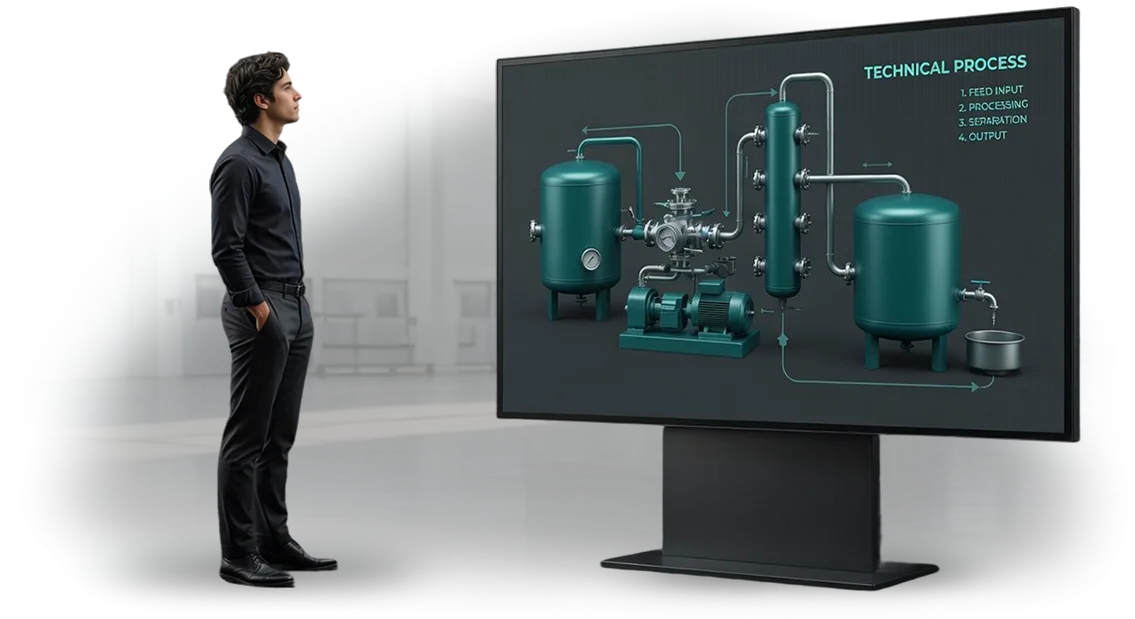
CGI animation allows us to break down complex components and show how they work from the inside — so the technician clearly sees what incorrect action leads to and understands the importance of every step.
This training format gives business predictability. Employees work according to a single standard, make fewer errors during installation and maintenance, and the manager no longer has to act as a “permanent rescuer” on site.
As a result, the company reduces costs for fixing defects, confidently delivers projects on time, and protects what matters most — customer trust.
What a video instruction gives employees: fewer mistakes, more sales
Training staff in HVAC and climate control is a constant challenge: complex equipment, a large amount of information, different skill levels among employees.
Text instructions, presentations, and live lectures take time and don't guarantee that knowledge translates into correct actions. Video instructions close this gap: an employee sees the real process from start to finish and absorbs it much faster.
The main advantage is adaptation speed. New employees reach working level in one to two weeks instead of one to two months, because they don't read abstract descriptions — they watch the exact sequence of operations. This cuts onboarding costs and allows faster involvement of newcomers in client-facing work.
The second important effect is fewer errors. When everyone follows the same standard, the chaos of “personal experience” and improvisation disappears. Staff works by a proven scheme, which minimizes wrong connections, setup errors, and conflicts with customers. The result: fewer warranty claims, fewer reworks, and more satisfied clients.
The third benefit is improved safety. Video clearly demonstrates how to work with equipment and tools safely, reducing the risk of injuries and equipment damage.
When an employee is confident in their actions, they communicate more calmly with customers, answer questions more precisely, and close sales more often. Staff training thus becomes not an expense item, but an investment in revenue growth.
CGI animation formats for HVAC and climate training
To quickly master installation or maintenance of HVAC equipment, an employee needs not abstract diagrams but a clear process: how a component is built, what happens inside the system, how to correctly follow the regulation.
CGI animation solves this better than photos or videos — it shows hidden details, flow movement, and sequence of actions without stopping production or disassembling a real object.
We develop training videos for a specific task: from a short 3D instruction to a full course. Below are the main formats we use in projects for the climate industry.
| Animation format | Suitable for tasks | What it gives the customer |
|---|---|---|
| Assembly and disassembly of a component | Training for installation, maintenance, part replacement | The employee sees the correct sequence of actions before arriving on site, fewer mistakes and reworks |
| System operation “in cross-section” | Learning operating principles: refrigerant circulation, heat exchange, automation | Quick understanding of the design without opening equipment — reduces training time by 2–3 times |
| Step-by-step action algorithm | Commissioning procedures, diagnostics, maintenance | A strict sequence of steps with highlighting of required elements — eliminates skipped operations |
| Safety briefing | Emergency actions, working with pressure and electricity | Visual demonstration of risks and correct responses — reduces injuries and downtime |
Which format is right for you depends on equipment complexity and training goals. For quick onboarding of beginners, one assembly video is enough; for retraining line staff, it is better to create a set of 3–5 animations of different types.
We take on the entire process: analyze the task, choose the format, develop CGI animation in professional software (we work in Blender), and adapt the videos for your LMS or training portal.
On output, you get ready-made training material that pays off by reducing onboarding time and lowering staff errors.
How we create a video instruction: 7 steps from brief to launch
A transparent process is a predictable result. When complex technological processes and several approval parties are involved, chaos in production leads to missed deadlines and wasted budget.
That's why we built our workflow so that you understand what's happening at every stage and keep control over the project.
Here are the 7 steps that every video instruction goes through — from the first brief to the final launch.
- Brief and task analysis. We define the video goals, target audience, complex equipment components, and timelines. We decide which format is needed: full training, a short review of an error, or a module for a distance learning system.
- Material collection and technical analysis. We review your documentation, drawings, and procedures. If something is missing, we fill in the gaps through interviews with your engineers and technologists.
- Script development. We translate technical language into something employees understand. We create a frame-by-frame plan, voiceover text, and key emphasis points, so a beginner understands on the first viewing.
- Script approval. You receive the document for approval. Here we connect with your experts to eliminate errors before drawing and editing begin.
- CGI animation creation. We model the process, cross-sections, and part movement. Animation reveals what's hidden inside the casing — something impossible to show with regular footage.
- Voiceover, editing, and rough cut. We assemble the video, add a narrator voice and graphic hints. You receive a draft for final review.
- Launch and support. We make edits and deliver all source files and final files in required formats. We stay in touch if the video needs to be updated after process changes.
This approach saves your time at every stage. You see the result before it becomes a finished product, and you can adjust the direction without losing budget. In the end, you receive a video instruction that works for employee training immediately after project delivery.
What's included in the delivery: a complete employee training kit
You get not just a video, but a full employee training kit. It includes everything needed to launch training the day after project delivery — without revisions or unnecessary questions.
Here's what's included in the standard package:
- Ready-made video instructions — in several formats: for LMS, for sending via messengers, and for display on shared screens. Every employee can watch the material wherever is convenient.
- Project source files — all scenes and assets remain yours. If you need to change the logo, narrator voice, or certain frames, you can do it yourself or with us without rebuilding the entire project.
- Scripts and voiceover texts — ready for approval, subtitling, and translation into other languages. This speeds up localization if your company has employees in different countries.
- Implementation guide — a step-by-step manual: how to upload videos to the distance learning system, assign the course to relevant departments, and check who completed it.
- Methodological recommendations — how to integrate video instructions into your onboarding, certification, or continuing education program. We'll suggest when to show the video to maximize its value.
- Updates and support — when procedures or equipment change, we update the videos within an agreed timeframe. You always know employees are learning from current instructions.
All deliverables are shared in a structured form with a clear folder system. Detailed instructions for working with each file are included as well.
You receive not a disk with videos, but a system that can scale to new departments and directions without additional development spending.
Case study: how animation reduced installer training time by 40%
For the climate company KlimatPro (name changed), training new installers was a bottleneck. Beginners spent weeks studying paper manuals and drawings, but still mixed up the order of operations on site.
Errors during air conditioner and ventilation installation led to rework, missed deadlines, and extra expenses. Managers realized they needed a tool that would quickly and clearly explain complex processes to any employee.
We suggested replacing part of the text materials with a series of animated video instructions. Instead of static diagrams — clear videos showing step by step how to connect components, lay routes, and configure equipment.
The client selected the key operations that caused the most questions, and wrote the scripts together with us. We then modeled each process in CGI and voiced the instructions.
Animation delivers what paper or photos cannot: a three-dimensional view of the installation unit with the correct sequence of actions. The employee sees the result before picking up a tool. This reduces the fear of complex tasks and speeds up memorization.
Results were assessed two months after launch. The time for a new installer to work independently dropped by 40%, and the number of installation errors was nearly halved. Adaptation became predictable: team leaders no longer had to stop and re-explain basics.
The company was so convinced by the effect that it ordered a second series of videos from us for servicing chillers and fan coils.
The key takeaway: animation is not just a “pretty picture” — it's a working tool that pays off through fewer reworks and faster employee onboarding. For business, that's a direct saving of time, money, and reputation on site.
How to choose the right CGI animation format for training?
Choosing a CGI animation format doesn't start with a “pretty picture” — it starts with the training objective and the skill level of the employees who will work with the equipment.
If the process is simple, for example basic filter service or sensor replacement, a short 3D video with a clear sequence of actions is enough.
For multi-step operations with error risk or complex equipment, an interactive model is needed — one that lets you “look inside” the system and examine each component separately.
The second important factor is how often the instruction is used. If employees learn the process once during onboarding, a linear video works: it sets the correct algorithm and removes the mentor's questions.
If the instruction is needed constantly — for advanced training or procedure reviews — choose modular CGI animation divided into meaningful blocks. Each specialist can then quickly find the required stage without rewatching the whole training session.
Equally important is the complexity of the technology itself. In HVAC and climate control, these processes are often hidden from view: refrigerant flow, compressor operation, air distribution. Animation should not just show parts — it should explain the physics of the process. That way, employees understand why they act in a certain way instead of mechanically memorizing.
This is exactly why at our teamwe start with an audit of your training program: we analyze which operations are critical for safety and quality, and only then propose a specific animation format.
In the end, the choice comes down to three questions: how complex the process is, who will be learning, and how often the instruction is used. Answer them, and you get more than a video — you get a tool that shortens onboarding time and reduces errors during equipment operation.
And we'll help you determine the optimal format and budget at every stage, from a short explanatory video to a complete interactive training system.
Doubts? We answer your questions about video instructions
Every responsible manager asks the same questions before ordering: will the video become outdated in six months, will employees without technical background understand it, how much does it cost, and when will we see results.
This is normal — we review every request before signing the contract, and we've prepared honest answers to frequently asked questions.
Will the video instruction become outdated? What happens when procedures or equipment change?
A video is not made “for ages” — it's part of a working process. If the sequence of actions or equipment model changes, we don't reshoot everything from scratch. We update the animation point by point: replace a component, change the step order, adjust the voiceover. In terms of time, it's days, not months, so employees always work with the current instruction.
Isn't animation of a technological process too difficult for people without engineering education?
Complex climate and HVAC schematics are actually easier to show in motion than to explain with a drawing or text. Animation demonstrates air movement, valve operation, and automation in a way that's clear on the first view.
We structure the script around the employee's task: what to press, in what order, what to pay attention to — without unnecessary theory and complex vocabulary.
How much does it cost and will launch take a lot of time?
The cost is calculated based on the scope of the script and the number of complex scenes, not estimated by eye. You receive an estimate before the start, with no hidden charges for edits within the agreed structure.
Deadlines are also fixed in the contract: a typical 3–4 minute instruction is ready in a couple of weeks, and urgent projects can be accelerated through parallel team work. The investment pays off through reduced onboarding time and fewer mistakes in equipment maintenance.
We understand that for business, video instructions are not decoration but a tool for reducing costs and improving work quality. That's why we answer every question in concrete terms: we send examples of similar projects, show the work stages, and name exact timelines. Still have doubts? Write to us — we'll analyze your specific case and offer a solution tailored to your needs.Order CGI animation for employee training
CGI animation for employee training is visual instructions that are clear even for those encountering the equipment for the first time. Instead of dull texts and diagrams — realistic processes that are easy to remember and reduce errors on the job.
This approach speeds up the adaptation of new specialists and reduces the burden on mentors. Such videos pay off: employees get up to speed faster, ask fewer repeated questions, and the likelihood of breakdowns due to incorrect operation is noticeably reduced.
At our team we've been working remotely for more than 10 years and understand the specifics of HVAC and climate control. We use professional equipment and a streamlined server architecture, so the result is stable at any scale.
Over the years, we've created hundreds of training videos for companies — from small service teams to large manufacturers of climate equipment.
Leave a request — and get a consultation, an accurate price, and timelines for your project. We care about you understanding what you're paying for, so the estimate is always transparent — no hidden payments or unexpected surcharges. After your request:
- we'll analyze the task and suggest the optimal animation format for your goals;
- we'll calculate the budget and timelines within a couple of working days;
- we'll show references from similar projects in your industry;
- we'll propose a work plan — from script to final render;
- we'll give recommendations on integrating the video into your training system;
- we'll fix deadlines and quality guarantees in the contract.
To order a video, just write to us — we'll respond within one working day. We'll discuss details, answer questions, and make an offer that suits you. We'll find a convenient time to talk — we work with clients around the world.