

Personnel Errors in Cosmetics Manufacturing: What Do They Cost?
Production errors at a cosmetics enterprise mean a lost product batch, a broken contract, and a blow to brand reputation. Even a small deviation from the process flow changes the properties of a cream, serum, or toner — and the result usually cannot be fixed after packaging.
It is at these moments that staff training stops being a formality and becomes a matter of business survival.
The financial impact comes from the cost of raw materials, line downtime, employee wages, and the expense of disposing of defective products. If a nonconformity is caught during quality control, the company loses only money.
It is far more dangerous when the consumer notices the problem: then compensation, fines, returns from retail chains, and lost distributors are added to the cost of the losses. The damage quickly exceeds the value of an entire shipment.
Reputational risk is just as serious. In the cosmetics industry, customer trust takes years to build and is destroyed by a single incident.
An incorrect concentration of an active ingredient, a breach of sterility, or a labeling error all become news hooks picked up by media and bloggers. Marketing investments are devalued, and key partners reconsider their cooperation terms.
Most often, such errors occur not because of poor qualifications, but because of ambiguous instructions and the absence of a clear visual standard for the operation.
It is hard for a person to keep all the nuances of a technological process in mind — especially when it varies across different product lines.
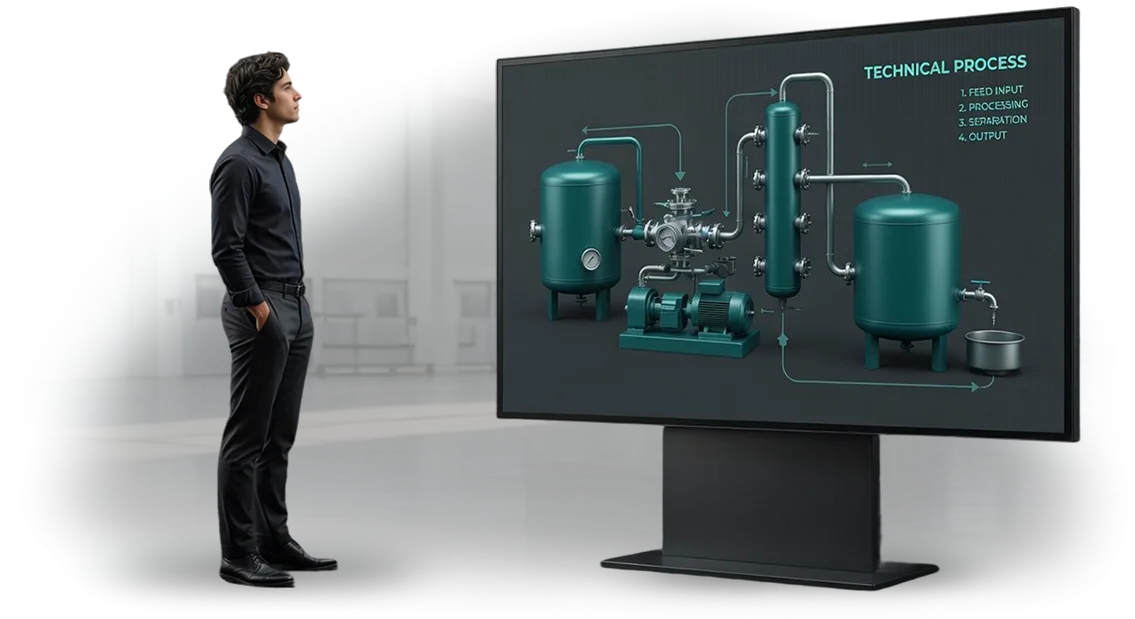
That is why video instructions for employees become a fundamental safeguard: the worker sees every action from start to finish and repeats it with minimal risk of deviation.
Training turns into a clear, repeatable process, and batch quality no longer depends on the experience and attentiveness of a specific shift.
We develop such video instructions with the specifics of cosmetics manufacturing in mind, so that you protect both your profit and your reputation. You won’t have to monitor every employee — just give them a standard that eliminates ambiguity.
What Benefits Does a Business Get from Training Video Instructions
Training new employees often becomes a lengthy process that depends on the mentor’s personal experience and availability. Video instructions remove this dependency: they provide a single standard available to every employee at any time. Here is what a business gains from switching to this format.
- Faster onboarding. New employees reach the working rhythm quicker — the video shows the operation from start to finish without requiring them to wait for a mentor.
- Fewer defects. When the right example is in front of employees, mistakes become rarer. Video conveys nuances that are difficult to describe in text: movements, effort, sequence.
- Process standardization. Everyone works to the same standard, regardless of experience or shift. This is especially important for cosmetics manufacturing: product quality directly depends on adherence to the technology.
- Higher engagement. Short visual videos are easier to digest than multi-page instructions. Employees are more willing to complete training and are less likely to postpone it.
- Self-paced review. At any moment, an employee can rewatch a difficult section without stopping work or distracting colleagues.
Implementing video instructions brings stability and predictability to key operations. The company our team develops such courses for your production tasks, drawing on the experience of your best employees.
Formats of Training Videos for Cosmetics Manufacturing
In cosmetics manufacturing, the operator’s actions determine batch consistency and consumer safety. Errors in dosing, mixing, or sterilization lead to defects and unnecessary expenses.
Therefore, training videos must not only demonstrate the process, but also build a clear algorithm that the employee will follow without reminders.
The format of a video instruction is determined by the specific task: show hidden equipment, teach a manual operation, or check operator readiness. We use three main approaches, each with its own strengths.
| Format | Best suited for | Client benefit |
|---|---|---|
| 3D animation of production lines | Hidden processes, automation, formulations, equipment alignment | Clearly shows the line structure “in cross-section,” reduces the time needed to master complex units |
| Live footage with a technologist | Manual operations, packaging, quality control, documentation work | A realistic model of actions that can be repeated after the instructor, easy to update |
| Interactive diagrams | Teaching action sequences, certification and work authorization | The employee works through steps at their own pace, and the system immediately points out mistakes |
For most areas, a combination of formats is effective: 3D animation shows the line structure, live footage reinforces the correct movements, and an interactive diagram checks comprehension.
This approach reduces the number of errors and accelerates new operators’ transition to independent work.
Our team will help you choose the optimal set of formats for your processes and develop turnkey training videos. We have already completed projects for cosmetics manufacturers and know how to make operator training fast and effective.
Stages of Creating Video Instructions for Company Employees
The process is designed so that you always understand where the project stands, what we need from you, and when the first results will appear.
We have divided the work on video instructions into six stages — from a short brief to deployment in your training system and ongoing maintenance of video relevance. You receive an interim result after each step.
-
Brief and task analysis. We examine the process that needs to be shown to employees and the real difficulties they face. You tell us about procedures and equipment — we propose a format and an animation plan. Result: a technical specification.
-
Script and storyboard. We prepare a frame-by-frame plan and voiceover text. You check the accuracy of the operation descriptions — this eliminates errors before expensive animation begins. Result: an approved script.
-
Draft 3D visualization. We create equipment models and work scenes and show renders of key frames. You see the style of the future video and make changes while they are still inexpensive. Result: agreed key scenes.
-
Final animation and voiceover. We assemble the full video: mechanism movement, voiceover, subtitles, and accents on important operations. We send a draft — we adjust anything that didn’t work the first time. Result: a draft version of the video.
-
Approval and delivery. We make final edits, receive your confirmation, and provide the files in the required formats — for your e-learning system, messengers, and in-person training sessions. Result: the final version.
-
Launch and support. We help connect the video to your training and promptly update scenes when procedures change. For cosmetics manufacturing, this is a guarantee that instructions always match current standards. Result: working videos with ongoing support.
What Is Included in the Complete Video Instruction Package
You receive not just a video, but a full package ready for launching training. All materials are delivered in an approved form — all that remains is to add them to your employee training program.
- Script — the text and logic of every scene are approved before production begins, so the video solves your task right away instead of being redone after editing.
- Storyboard — a visual shot plan shows what the future animation will look like. This is an opportunity to make changes before resources are invested in production.
- Process animation — clearly demonstrates each stage, from raw material preparation to packaging. The employee sees the correct sequence of actions and remembers it faster than from a text instruction.
- Professional voiceover — clear diction, calm pace, and no background noise. You can choose a voice that matches your corporate style or use your own company narrator.
- Subtitles — key steps are duplicated as on-screen text. This is especially important for work in workshops with noisy equipment where audio may be inaudible.
- Final video in the required formats — we prepare files for your e-learning system, internal portal, and standard video hosting. No playback issues on any device.
- Training materials — a quick reference guide for the trainer and test questions for knowledge checks. These help integrate the video into existing training quickly.
The entire package is delivered as a single set, so you can immediately launch training for new employees or use the video for upskilling current staff. No technical routine — you get a ready-made tool that supports process standardization and error reduction.
Case Study: How 3D Animation Reduced Staff Training Time
Cosmetics manufacturing is one of the most regulated industries: even a small operator error on a filling or packaging line can lead to an entire batch being rejected. Training newcomers usually drags on for weeks and requires a mentor who is distracted from their main work.
A major cosmetics manufacturer, BeautyPro, came to us with exactly this challenge — they decided to move their training into a digital format.
What We Did
Instead of text regulations and static diagrams, we developed a series of 3D videos that accurately replicate the process flow, from line startup to sanitation.
The animation shows every equipment component, the correct sequence of actions, and typical mistakes — just as they appear on the real floor, but without the risk of stopping production.
The results were visible within the first month. The time required for a new operator to become fully independent dropped from two weeks to five days. The number of errors when switching product lines fell by more than a third — meaning fewer rejected batches and less downtime. Mentors returned to their own duties instead of explaining the same thing ten times.
Why it worked: 3D animation shows the process “from the inside,” in cross-section, with emphasis on critical points. The employee sees not an abstract diagram, but a complete picture of the production cycle that is remembered as an image.
This is especially important for cosmetics manufacturing, where the sequence of operations directly affects product quality and safety.
The client appreciated the result and, within six months, ordered an expansion of the animation library for adjacent workshops. The repeat contract was the best confirmation that training with 3D graphics delivers measurable business value, not just a nice picture.
How to Choose the Right Video Instruction Format for Your Task?
The right format is determined by three questions: what exactly the employee does, how often it happens, and what budget is allocated for training.
There is no universal answer, but there is a pattern that saves money and time — and it is easy to verify before starting the project.
If the task is to train a fast routine operation, such as labeling or packaging, a short video with live footage or simple animation is enough. A complex process is another matter: preparing an emulsion, sterilizing equipment, quality control.
Here you need an animated instruction that shows stages invisible to the eye: the movement of components, changes in state, and the correct sequence of actions.
This format is exactly what reduces the number of errors and significantly accelerates the onboarding of a new employee.
The format is directly tied to budget, but more expensive does not mean better. The optimal path is a modular approach: split the process into blocks and produce animation only for critical stages, while explaining the rest with diagrams and short text inserts.
This approach gives a working result at a reasonable investment and allows you to gradually expand the instruction library without rebuilding the whole system.
The key benchmark is the cost of an error and the frequency of use. If an incorrect action leads to a rejected batch or a health risk, the animation pays off on the very first training run.
If the operation is simple and remains unchanged for years, one filmed video with narrator explanations is enough. In both cases, it is important that the instruction is short and answers a specific employee question.
We will help you choose the right format for your process and budget: during a consultation, we will analyze your operations, identify the stages where animation will deliver maximum benefit, and propose a solution without unnecessary rework. You will get an instruction that employees actually watch and apply on the job — from day one.
Frequently Asked Questions About Corporate Video Instruction Development
Before launching a project, clients most often ask about timelines, updates, and whether the videos align with real processes.
This is the right approach: training videos determine how quickly a newcomer reaches full productivity and how consistently procedures are followed in cosmetics manufacturing. So we answer the main questions in advance — without fluff or empty promises.
How long does it take to develop a video instruction?
A standard project takes 3–5 weeks, from the brief and a visit to the production site to the final files. You approve the script and visual style at every stage, so the result doesn’t need to be redone.
If you need a tighter timeline, we can discuss an accelerated schedule while maintaining quality and approvals.
What happens if the process changes?
We build the video using a modular structure: we replace only the changed block, not the entire video. For example, if you change the product formulation or add a new step, the update takes a few days. You receive editable source files and support for an agreed period after delivery.
Will the videos work with our e-learning system?
Yes, we provide files in standard formats that can be uploaded to an internal portal or corporate platform. If needed, we add subtitles, voiceover, and break the material into short topic-based modules — this simplifies training and subsequent knowledge checks.
How do you guarantee that the video matches real processes?
Every video is built on your process regulations and interviews with technologists. Before final assembly, you and your technologist review draft scenes — we make changes before the project goes into editing. As a result, you receive an instruction that can be used for training without further revisions.
If your question is not on the list — contact us, and we’ll send you an estimate of timelines and stages tailored to your process.Order the Development of a Training Video for Your Company
Submit a request for a cost estimate and get a ready-made solution for your task. We start with a consultation: we clarify which operations need to be shown and who will watch the video, so we can propose a format that truly reduces training time and the number of errors.
Already at this stage, you will see examples of our work for cosmetics manufacturing and understand what your video will look like.
After you contact us, a personal manager will be assigned to you. They will collect all requirements, finalize the estimate and timeline, and then hand the project over to our team.
You will be spoken to in plain language — no technical details, only timelines, results, and revisions.
What you get by contacting us:
- A consultation on the format and structure of a training video for your employees;
- A cost estimate within one business day — no hidden fees;
- A selection of work examples for the cosmetics industry and similar manufacturers;
- A personal manager who manages the project from brief to final version;
- A clear plan of stages and timelines with every agreement documented;
- Post-delivery support: we account for revisions and help adapt the video for different employee groups.
Fill out the form or message us — we’ll send examples and a preliminary cost estimate. We’ll take it from there: you will get a video that new employees understand on the first viewing, and current employees will use as a clear instruction.