

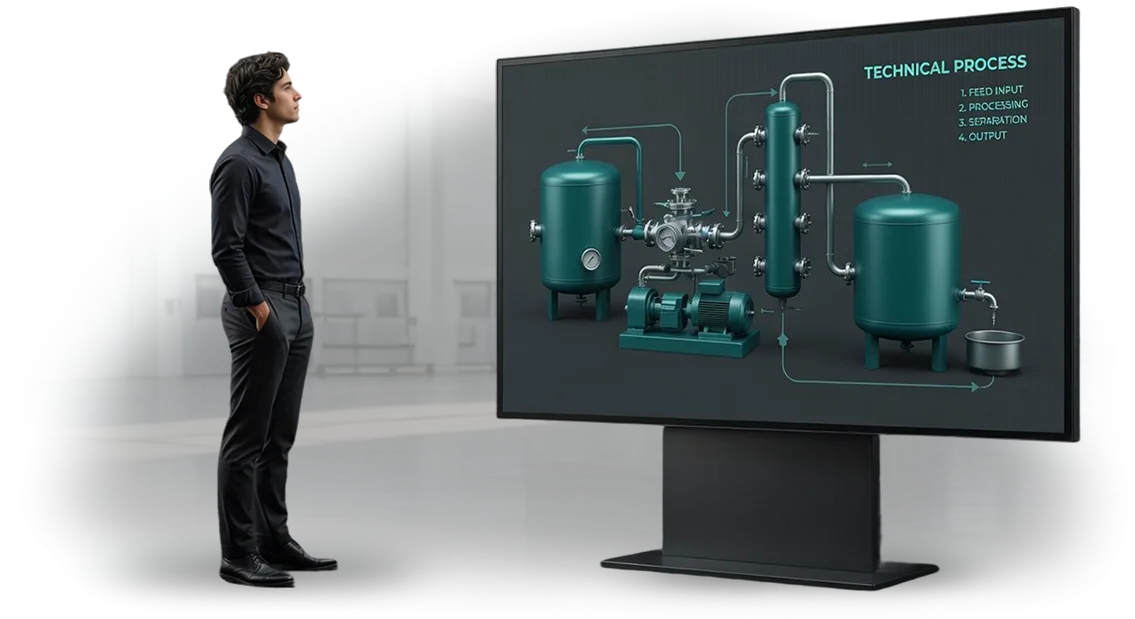
Unclear instructions in mechanical engineering eat up budget and employee time
In the workshop, work follows the instructions — but errors still repeat. An employee reads the procedure, tries to imagine the operation, does not find an answer to their question, and acts at random.
In mechanical engineering, the cost of such uncertainty is high: a defective part, machine downtime, a missed delivery deadline. Ineffective instructions are often the hidden cause of losses blamed on the human factor.
Simply handing an employee a text document or a diagram is not enough.
The training problems in mechanical engineering are familiar to every manager: new hires take a long time to get up to speed, experienced craftsmen are pulled away from work to explain the same things again and again, and misunderstandings lead to rework.
Each such situation costs machine time, employee wages, and the manager's nerves. As a result, more and more budget is spent on training, while production efficiency does not grow.
The solution is training video instructions for employees that show the operation exactly as it is actually performed: sequence, tool, checkpoints, typical error. The employee sees a ready-made algorithm, remembers it faster, and applies it without asking again.
Such employee instructions shorten the onboarding period and reduce the number of errors — which means budget returns to production.
We create corporate training videos that solve this problem. We show the process through the eyes of an experienced operator, capture real operations, and make training visual. We cover this with short videos embedded in your enterprise's training system.
Benefits of video instructions for mechanical engineering: control and quick start
Video instructions for mechanical engineering production are not just a replacement for paper procedures. They are a tool that directly affects how quickly an employee can start a shift, the amount of scrap, and process controllability. Our team see this result daily with our customers.
Faster onboarding for new employees
A newcomer receives a ready-made benchmark: what to do, how to do it, and in what sequence. The video can be rewatched at any time without waiting for a mentor. As a result, the full onboarding period is reduced significantly — the employee starts delivering results sooner.
A single production standard
Paper instructions allow different interpretations, and master craftsmen teach in different ways. A video instruction locks in the single correct sequence of operations used at your enterprise.
This ensures consistent work quality in every shift and simplifies oversight by process engineers and managers.
Fewer errors and less scrap
Errors most often happen because of the wrong sequence of actions or inattention to detail. The video shows all critical points and typical mistakes — the employee sees what not to do and understands the consequences. This directly reduces the cost of scrap and rework.
On-the-job training
Video instructions work right at the workstation: the required segment can be opened at the machine or on a tablet. The employee does not need to travel to a training session — they learn the process in its real context and apply the knowledge immediately.
| Format | Who it is for | What it provides |
|---|---|---|
| Short operation videos | New employees, operators | Quick shift readiness, fewer errors |
| Full process course | Process engineers, area supervisors | Single standard, quality control |
| Typical error breakdowns | All staff | Less scrap, skill reinforcement |
Video instruction formats: from animation to interactive modules
Some operations are easier to show with a diagram, others with a 3D model, and still others by letting the employee "rotate" the assembly themselves.
That is why we do not offer a single universal format; instead, we tailor the presentation to the specific task: teach a newcomer, explain a complex process, or test knowledge retention.
The table below shows the main video instruction formats and the scenarios where each one delivers the greatest effect. It is a guide; in practice, formats can be combined to cover all stages of training, from initial familiarization to skill testing.
| Format | Who it is for | What it gives the client |
|---|---|---|
| 2D animation | New employees, staff without a technical background | A simple explanation of the action sequence, with emphasis on key points and no unnecessary details. Quick onboarding. |
| 3D animation of technological processes | Experienced workers, engineers, maintenance services | A clear view of internal mechanisms, components, and part movement. Reduces the number of errors during setup and maintenance. |
| Interactive modules | Employees who need to practice a skill | The learner chooses the steps themselves and sees the consequences of their decisions. Training in a safe environment before working with real equipment. |
| Combined video instructions | Mixed groups, remote sites | Diagram + 3D scene + test questions in one video. Suitable for both initial training and periodic refresher courses. |
Regardless of the format used, the employee receives a single standard for performing the operation. This reduces dependence on the "personal experience" of mentors and makes work quality predictable across all areas.
Stages of video instruction development: from brief to launch
Video instruction development is a structured process with clear stages and control points, not a "black box." Our team has refined it over dozens of projects for mechanical engineering enterprises: so you know what happens at each step, who is responsible for what, and when you will receive the finished video for employee training.
-
Brief and audit — You tell us about the technological operation, difficult areas, typical mistakes of newcomers, and training requirements. We ask clarifying questions, study drawings and procedures, to remove uncertainty before work even starts.
-
Script development — Based on the brief, we create a script plan: the logic of steps, camera angles, what to show in close-up, where to emphasize safety procedures. You receive a document for approval — no surprises at later stages.
-
Creation of 3D models and animation — Specialists build models of equipment and tooling that replicate the real movement of mechanisms. This is critical for mechanical engineering: if an assembly is shown inaccurately, the employee will carry that error onto the production floor. Already at this stage, you see interim visualizations and can make adjustments.
-
Review and revisions — You review the draft version together with process engineers and mentors, and record your comments. We make changes to the animation and voiceover until the result satisfies everyone responsible for training quality.
-
Voice-over recording, editing, and narration — Once the shots are approved, we record the narrator, assemble the final video with subtitles and emphasis on key operations. We check how the video looks on different devices: from a shop-floor computer to an employee's smartphone.
-
Launch and support — We deliver the finished files to your corporate training system, help with uploading and setting up access for employees. If technology or tooling changes later, we update the material so the instruction does not become outdated.
What is included: a complete package for the training department
When you order training videos for employees, it is important to receive not just videos, but a complete tool for the training department.
We put together a package that can be used right away: upload it to the learning management system, issue it to new hires and existing specialists, track material completion, and test knowledge.
- Ready-made video instructions for your technological operations — from 3 to 10 minutes, with voice-over narration and subtitles. The employee sees every step clearly, with no discrepancies from the procedure and no need to reread long instructions.
- Project source files in editable formats. If the process changes, your specialist or we can quickly make edits and reassemble the video without new shooting or large budgets.
- Methodological materials: scripts, step-by-step cuts, test questions for knowledge checks. The training department receives a ready-made base for exams and certification, not blank pages to develop from scratch.
- LMS-compatible versions — files in common formats that open correctly in your distance learning system. This includes SCORM packages for automatic tracking of views and test results.
- A reference card for the employee — a short version of the video and text summaries of key operations. Convenient to place at workstations where there is no screen or internet.
- Technical description of the package and implementation instructions: what to upload to the LMS, how to grant access, and how to update materials. Your administrator can handle it without the involvement of developers.
- Support for an agreed period: we answer questions about working with the package and, if needed, help with setup and export.
The result is that the training department gets everything "turnkey" and can launch the course within a week, rather than spending time refining materials.
The package contents are fixed in the contract, so you know exactly what you will receive for your money and in what timeframe.
Real case: how a plant reduced training time by 40%
How the implementation case was built
A mechanical engineering plant launched a new line, and there was no one to train the operators: experienced mentors were busy on the production floor, and almost no one read the paper instructions.
A newcomer reached independent work only after two or three months, and one in two made errors during setup.
The implementation case started with a request from PromStan — the need was to speed up employee training.
We created video instructions for the plant using animated diagrams of technological processes and footage of real work: the employee sees every stage and can rewatch a difficult fragment at the machine.
What the measurements showed
Two months after launch, the training time for new employees was reduced by 40%, and the number of errors during equipment setup fell by almost half. Mentors returned to their own tasks — the video instructions covered the typical questions.
"We expected the video to simplify training, but the effect was stronger: training became predictable and independent of the mentor's availability," noted the plant's training department head.
The training time savings made it possible to bring employees up to speed faster, so the plant ordered video instructions for three more workshops. The measurable results of the case paid back the investment and formed the basis for a new training standard.
Answers to frequent questions about video instruction development
Clients from mechanical engineering most often ask about development timelines, animation accuracy, and revisions after delivery.
This is understandable: a video instruction must match the real technological process down to the smallest detail — otherwise, it will not be adapted for training. Let's look at the common questions.
How long does video instruction development take?
It depends on the complexity of the process: a typical operation takes 10-15 business days, a multi-stage assembly up to 30. We specify the timeline in the contract and agree on a calendar plan before the work begins.
How accurately does the animation replicate real equipment?
We work from your drawings and technological process. You approve intermediate versions with your specialists — the animation replicates the real components and movements down to the finest detail.
What if revisions or updates are needed after delivery?
This is a normal situation: procedures change, new tooling appears. We take the videos into maintenance and quickly update individual scenes or adapt the video to a new process.
What quality guarantees do you provide?
We write the guarantees into the contract: the number of iterations, approval stages, and response time to requests. Before delivery, the video goes through internal verification of compliance with your documents.
Can the video be used to train new employees?
Yes, that is a common scenario. The video instruction is uploaded to the learning management system or shown at the workstation: the employee sees all operations from start to final inspection and can return to the recording when needed.
How to order video instructions: take the first step today
Leave a request, and we will start with a short consultation. You tell us how your employees work with equipment or technological processes, and we will propose a video instruction format that reduces training time and lowers the risk of errors. No obligations: first we understand the task, then we show the solution.
We will clarify the details ourselves, choose a script, and calculate the cost. You do not need to understand filming, editing, or animation — just describe your task, and we will handle the rest.
What you get after contacting us
- A personal consultation: we will analyze your situation and suggest which video instructions will produce results in your production specifically.
- A cost and timeline estimate within one business day — no hidden fees or "asterisks."
- A structural proposal: we will break the process into clear videos that employees can master step by step.
- Format recommendations: from expert filming to CGI animation of technological processes — we will choose what is clear to your employees.
- A result guarantee: we will show intermediate versions, incorporate revisions, and deliver a final product that actually works.
- Post-launch support: we will help integrate the video instructions into training and answer your team's questions.
Take the first step today — submit a consultation request. We will contact you, discuss your tasks, and prepare a proposal that saves your specialists' time and gets new employees up to speed faster.
Which video instruction formats suit different tasks?
The choice of video instruction format depends directly on the production task: training an employee to assemble a complex unit is one thing, introducing them to safe machine operation procedures is another.
There is no universal "best" format, so we start by analyzing the specific situation: who will watch the video, on what equipment, what skill level the new hires have, and which errors need to be eliminated first.
Mechanical engineering typically has specific requirements: show hidden mechanisms, cross-sections, the movement of parts inside a housing, the tightening sequence of fasteners, or the adjustment of machining parameters.
Regular filming is often powerless here — you need 3D animation that clearly demonstrates the process without unnecessary angles and interference. This format is ideal for instructions on assembly, disassembly, maintenance, and repair of equipment.
If the task is to teach work with a CNC machine tool interface, a screen recording with voice explanations is more effective.
When you need to quickly update a procedure or communicate a change in the technological process, a short video focusing on key control points is enough.
For a full training course for new employees, it is better to use a modular structure: one topic, one video, each 2-5 minutes long. This approach makes it possible to build a training system where the employee returns to the required fragment before performing the operation.
We help you choose the optimal format for your specific task and budget: we analyze the process, identify difficult points, and propose a solution that delivers results, not just a pretty picture.
Tell us which operation needs to be covered by a video instruction — we will recommend a suitable format and show examples of similar projects so you can make an informed decision.