

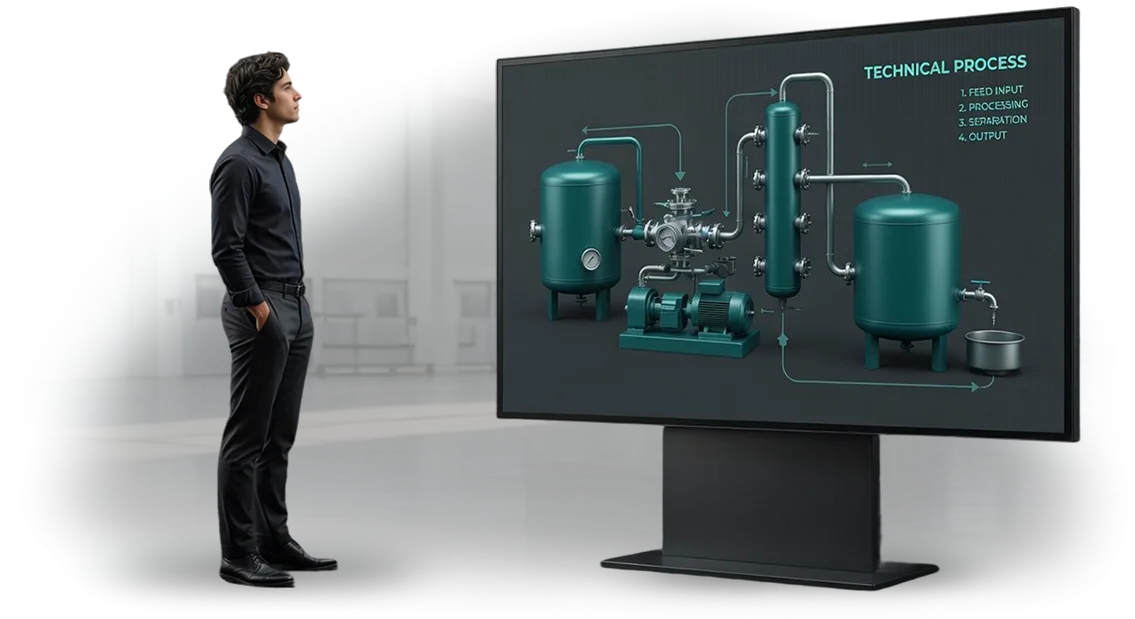
Staff mistakes in metallurgy lead to accidents and downtime
Staff mistakes in metallurgy are one of the main causes of industrial accidents. A single wrong step by an operator, dispatcher, or maintenance worker can halt an entire process line for hours and cause serious production losses.
Moreover, the damage is not limited to money: there are risks to health and life, damage to expensive equipment, insurance payouts, and a blow to the plant’s reputation. One such incident sets the enterprise back weeks in meeting its production plan.
Most incidents happen not because of negligence, but because employees simply have not absorbed the instructions.
Text-based regulations, diagrams, and presentations are hard to read and nearly impossible to keep in mind — especially when the process is complex and requires quick reaction.
A specialist formally completes training, but in an abnormal situation acts randomly, because the “paper” has not prepared them for reality.
As a result, the enterprise pays for downtime, defects, and lengthy investigations. An industrial accident can stop a furnace or rolling mill for a day, disrupt a contract, and trigger inspections by regulatory authorities.
Therefore, training employees in industrial safety is not a formal requirement but a strategic investment in the reliability of the entire production operation.
We solve this problem with corporate training video instructions. Instead of dry texts — a clear video scenario of the technological process that an employee understands and remembers after the first viewing.
Our videos are created around the real processes of a metallurgical enterprise: they show the correct algorithm from the first step to the control point.
This format reduces the number of staff errors, shortens downtime, and strengthens the safety culture — which means it delivers a measurable business result that directly affects the plant’s stability and revenue.
What a high-quality video instruction gives an enterprise
A high-quality video instruction is not just a training video, but a working tool that reduces the number of errors and downtime.
When an employee sees the correct sequence of actions on the screen, there is no need to guess or remember from a mentor’s words — they absorb the algorithm faster and more accurately.
For a metallurgical enterprise, this means fewer defects, fewer emergency shutdowns, and peace of mind for the manager about the result.
Fast onboarding is the second key benefit. A new employee gets access to the video instruction in the first days and can study the material at their own pace, reviewing complex parts.
Instead of distracting experienced specialists from their work, the enterprise builds independent training — and the person reaches full productivity two to three times faster.
A unified training standard is the key to identical actions across all areas. Video instruction locks in best practices and eliminates inconsistencies where every master explains things their own way.
As a result, all workers act according to the same algorithm, which simplifies control and makes processes more predictable.
Safety is the top priority. A high-quality video clearly shows hazardous zones, correct handling of equipment, and actions in abnormal situations. Such materials reduce the risk of injury, which means lower compensation costs and longer service life for equipment.
Finally, video instructions support the employer brand. Modern training shows that the enterprise cares about its people and invests in their development. This attracts young specialists and strengthens the reputation of a responsible manufacturer.
3D animation formats for metallurgy for any task
For metallurgical production, staff training is not just knowledge transfer, but a matter of safety and product quality.
Different 3D animation formats serve different tasks: sometimes you need a complete overview of the process, sometimes a short module for revision, and sometimes an interactive check of actions. When the format matches the goal, training takes less time and employees make fewer mistakes.
| Format | For whom | What it gives the client |
|---|---|---|
| Full training film | New employees, trainees, general induction | Complete picture of the process, unified knowledge standard, reduced onboarding time |
| Modular videos (3–7 minutes) | Work shifts, refresher training, permits | Quick practice of a specific operation, easy updating of any component without reshooting the entire course |
| Interactive 3D scenarios | Operators of complex units, certification | Testing employee decisions in a safe environment, high engagement, readiness assessment without production risk |
The choice of format depends on what you want to achieve: quickly onboard a newcomer, retrain current employees, or monitor skill quality.
We will help identify the right option at the briefing stage and offer combined solutions — for example, a film for general introduction and modules for practicing each unit. In the end, you get a training system that pays for itself by reducing defects and staff errors.
How we create training video instructions for a plant
Training video instructions for a metallurgical plant are a project where both technical accuracy and employee comprehension matter.
We have structured the creation process so that you control every stage and get a predictable result: from the first briefing to the launch of training. Below is the proven scheme we work with.
- Briefing and production audit. We gather requirements: which area to show, which operations to cover, who will watch the video, and what result you expect — faster newcomer adaptation, fewer errors, a unified work standard. Based on that, we finalize the plan and timeline.
- Video script. Our methodologists and technologists turn regulations, instructions, and the experience of your mentors into a step-by-step script. We describe every scene, the narrator’s texts, and visual accents — you see the future video even before modeling begins.
- Approval. We discuss the script with your technologists and shop managers, make edits until the text is accurate and convenient for training. This removes most revisions at later stages and saves budget.
- Modeling and visualization. We create 3D models of the equipment and show processes in motion. You don’t need to stop production for filming — the video demonstrates the operation of units in safe and perfectly clear conditions.
- Editing and voice-over. We assemble the video, add professional narration, subtitles, and graphic hints on important details. We deliver intermediate versions so you can control progress.
- Training launch. We help integrate the video into your learning management system or prepare files for a training room. We give recommendations on how to track views and reinforce the material in practice.
- Support and updates. Regulations and technologies change — training videos must change with them. We stay in touch to promptly update the video according to your new requirements.
What is included in the training video package for employees
Corporate training in metallurgy is not just showing a video. An employee needs a real sequence of operations, safety procedures, and knowledge checks. Therefore, we create a turnkey package: all materials for launching training in the shop or training center.
What is included in the package:
-
Training videos — ready 3D animation of technological processes in your production. Duration and number of videos are selected based on the task: from short instructions to a full cycle of operations.
-
Scripts and storyboards — a step-by-step description of each frame and voice-over text. You approve the script before production begins, and after delivery you receive it in printed form for internal regulations.
-
Trainer’s guide — how to integrate the video into an in-person session or a learning management system, what questions to ask after viewing, how to evaluate material comprehension.
-
Methodological materials — short reference cards for employees, review questions, tests. Can be used as handouts and for knowledge checks.
-
Source files and individual scenes — all versions of the videos, including without subtitles, individual fragments, and voice-over. This allows your training department to quickly create new cuts for related topics.
-
Usage rights — a perpetual license for the entire package, including the right to edit the materials and use them in any corporate training system.
In the end, you get not “video for the sake of video,” but a working tool for staff training. All rights and source files are transferred to you, so after project delivery you are completely independent of the contractor.
Case study: animation reduced downtime at a metallurgical enterprise
Typical training at a metallurgical plant takes weeks: newcomers read regulations, attend lectures, and then work under a mentor’s supervision for a long time. Every error on the line translates into mill downtime or the risk of damaging expensive equipment.
It was with this pain that a large Ural plant UralStal came to us — they needed to speed up the training of rolling shop operators and reduce the number of violations.
We developed a series of corporate animated video instructions for key technological operations. Instead of dry text, the employee sees the exact sequence of actions in 3D graphics: how the metal moves, where the risk zone is, what happens in the event of a failure.
The videos were integrated into the onboarding and retraining program — a newcomer is allowed near real equipment only after virtual practice, which is safe for both the person and the machine.
Results after two months
The plant measured the effect in three areas. The number of errors during operations decreased by 45%. The time to bring a new employee up to speed was reduced from six weeks to two.
Mentors stopped spending 3–4 hours a day on repeated explanations — this freed up about 200 hours monthly, now directed to quality control and team development.
After six months, the client updated the videos to new regulations and ordered another block — for equipment repair and maintenance. The client returning for more is the main indicator that animation solves real production tasks, not just provides a bright picture.
We replicate this experience for other metallurgical enterprises, adapting scenarios to specific shops and staff skill levels.
How to choose the right training format for your production?
Choosing a training format is not a question of “what’s trendier,” but a question of “what will solve your problem.” There is no universal solution: introducing a newcomer to production basics is one thing, teaching work on a complex unit or refining actions in an abnormal situation is another.
A mistake at this stage costs a lot: money goes into content that employees watch “for show,” and the skill is never formed.
To choose correctly, look at three things: the complexity of the technological process, the personnel skill level, and the production operating mode. Short video instructions are suitable for mass training — they are easily integrated into shift schedules.
Hazardous or multi-step operations require detailed scenarios with emphasis on control points. When it is important to practice actions until they become automatic, interactive modules with knowledge checks are more effective.
We help you find your bearings: we analyze your task, look at what result you need — reduce onboarding time, reduce errors, or standardize team knowledge. Based on that, we propose a format that fits into the work schedule and does not require stopping production.
We break complex processes into short modules so employees can learn right in the shop, between operations.
In the end, you get not just a training video, but a working tool that brings employees up to speed faster and removes part of the load from mentors. The main thing is that the format suits your particular production, not copied from someone else’s experience. We take this into account at the briefing stage and select a solution for your processes.
If you are unsure which format is right, start with a short consultation. We will analyze your task, show you options, and explain which one will deliver a measurable result.
Answers to frequent questions about video instructions for enterprises
Before ordering video instructions for a metallurgical plant, we are often asked: is it difficult to implement, will the videos become outdated, will workers understand them, and when will the investment pay off. We answer these questions — they also formed the basis of our approach.
We create videos based on current regulations and real operations. Updating requires only reshooting individual scenes, not the whole course.
Videos with voice-over and diagrams are absorbed faster than texts, so employees remember the sequence of actions more quickly and make fewer mistakes.
The most frequent questions are:
Is it difficult to implement video instructions into production?
No. Video instructions are regular files for computers, tablets, or TV panels in the shop. Launching does not require stopping lines or replacing equipment.
How often do the videos need to be updated?
Only when technology or safety requirements change. The source materials are stored with us, so reshooting a scene takes a few days.
Will employees understand the videos without special training?
Yes. We use real footage, simple diagrams, and clear voice-over. The employee repeats the actions shown on the screen, and the video reminds experienced workers of important details.
When do such videos pay off?
The payback is visible in the first few months: fewer defects, emergency stops, and training time. The video works as a constant digital mentor for every employee.
Let’s discuss your task and create a plan for the training video
Leave a request — and together we will put together a brief that will make it clear exactly how we will create a training video for your team.
This is a consultation: you describe the technological process, and we propose the format, structure, and timeline estimate — without obligations or unnecessary approvals.
After the conversation, you will receive a work plan with specific stages: from analyzing operations to the final version of the video.
You will know in advance what you get, how long it will take, and how the video will fit into the training of new employees and professional development.
What you get by contacting us:
- Your request is handled by an engineer-analyst, not a sales manager — they immerse themselves directly in your process.
- The brief focuses on the complex operations and typical errors of your workers — precisely what we will reflect in the script.
- A work plan with approval points — you understand when and what you comment on.
- A timeline calculation in working days and task prioritization — you can see where you can speed up without losing quality.
- Advice on formats: from short modules for smartphones to full-screen instructions for monitors in the shop.
Leave a request through the form or messenger — we will respond within one business day. Then a short conversation: clarifying questions and a clear action plan.
We start not with a technical specification, but with a simple brief — this makes it easier for you to approve the first steps.