

Regulatory Violations in the Oil and Gas Industry: The Cost of Mistakes
The oil and gas industry is a high-hazard environment. Any deviation from regulations can result in an accident, employee injury, or production shutdown. Fines from supervisory authorities and missed deadlines are only the visible part of the consequences. Poor employee training leaves gaps that sooner or later surface at the worst possible moment.
Traditional instructions in the oil and gas industry are dozens of pages of text and diagrams. Employees skim through them, retain little, and within a month forget the key steps. This is especially true for rare operations and emergency situations.
As a result, even experienced personnel act from memory rather than according to regulations, and the cost of every such mistake grows with each day of downtime.
Video instructions change the situation: they show the correct sequence of actions, highlight dangerous moments, and help employees remember the algorithm. This is not a replacement for regulations but a way to translate them into clear language.
Employee training becomes visual, practical, and verifiable. Occupational safety gets a working tool, and managers get fewer incidents and shutdowns.
We develop training video instructions for the oil and gas industry that address these risks. Behind us are dozens of projects for companies with high safety requirements. If you need regulations that actually work, we are ready to help.
What Benefits a Company Gains from Video Instructions
Every erroneous step by an employee in the oil and gas industry is not just a defect but a risk of downtime and safety issues. Conventional training drags on for weeks, and the result depends on the instructor's personal qualities.
Video instructions from our team turn training into a predictable process with measurable results.
Benefits Checklist
- Training speed — a new employee gets up to speed 2–3 times faster than when reading regulations.
- Fewer errors — 3D breakdowns of technological processes reduce error rates by up to 40%.
- Mentors' time savings — the instructor no longer needs to repeat the same thing, freeing up to 5 hours per week.
- Personnel adaptation — videos can be rewatched at any time; a newcomer masters the material faster even without experience.
- Training effectiveness — managers can see who has completed the material and understand the actual level of preparedness.
Let's summarize the key benefits in a table:
| Area | Business Impact |
|---|---|
| Training speed | Reaching target performance 2–3 times faster |
| Error reduction | Up to 40% fewer defects and emergency situations |
| Mentors' time savings | Up to 5 hours per week per instructor |
| Personnel adaptation | A unified knowledge standard across all shifts |
| Training effectiveness | Transparent statistics and quick program adjustments |
Video instructions pay for themselves within the first training cohort. When a technological process changes, we promptly update the material — without business trips or taking employees away from their work.
Formats of Training Videos for the Oil and Gas Industry
A training video for the oil and gas sector solves two tasks: quickly bringing a newcomer up to safe work and uniformly training personnel across different sites. But the filming format greatly affects the result.
Sometimes it is enough to show a real workshop and operator actions, while other times you need to look inside equipment that cannot actually be filmed.
We have been creating corporate video instructions for over 10 years and combine formats to match your task. Below is a short comparison so you can choose the best option before the brief.
| Format | Who It Suits | What It Delivers to the Client |
|---|---|---|
| On-site filming | Training for actions at a real facility: regulations, safety, working with tools | Live footage of a familiar workshop, employee trust, low entry threshold |
| 3D animation of technological processes | Demonstration of hidden components, chemical reactions, equipment operation in cross-section | Visualization of what cannot be captured with a camera, a unified standard for all branches |
| Combined format | Multi-stage training: first the principle, then practice on site | More complete comprehension — employees understand both "how it works" and "how to do it" |
The rule is simple: if the goal is to show real actions and location, choose filming. If you need to explain internal processes, hazardous zones, or equipment that is not available on site — 3D animation works better.
For most corporate programs, the combined format is optimal: it covers both the "why" and the "how."
It is convenient to divide videos into short modules of 3–5 minutes each. This way, employees complete training in parts without losing focus, and you can easily update individual blocks without reshooting the entire course.
As a result, you get a working training system that is equally clear to newcomers and experienced personnel.
Project Stages: From Brief to Training Launch
We structure the work on a video instruction as a transparent project with checkpoints. You participate in key decisions, while we handle production and coordination. Each stage is aligned with your experts, so the result is predictable in terms of timeline and quality.
- Brief and task audit. We define the video's purpose, the target employee role, and typical on-the-job errors. The output is a clear technical specification for the script.
- Video instruction script. We describe frame by frame what the employee sees and what actions they perform. We align it with technologists and occupational safety specialists.
- Storyboard approval. We show key frames before production starts so you can approve the style and logic. Revisions at this stage save budget.
- CGI animation production. We recreate the equipment, environment, and personnel movements. We use captions, accents, and pauses that help memorize the sequence of operations.
- Voiceover, editing, and format adaptation. We add clear narration and subtitles, and prepare versions for remote and in-person training.
- Training launch and support. We help upload the videos into the system, set up access, and adjust the material after the first test results.
In the end, you receive a complete set of video instructions that is easy to integrate into your training program and update when regulations change. Employees ramp up faster, make fewer mistakes, and work more confidently with process equipment.
What Is Included in the Video Material Deliverables
The delivery includes a complete package for launching training — with no need for the client to refine anything on their own. You get not just video files but a full package: from the approved script to instructions for placement in your distance learning system.
- Script and storyboard for each video instruction. These are aligned in advance with your technologists and industrial safety specialists so the video accurately reflects the actual regulations.
- Full version of the video (5–7 minutes) — for detailed study of the technological process, and a short version (1–2 minutes) — for quick review of key operations.
- Versions with subtitles and without musical accompaniment — for work in noisy environments and for employees with hearing impairments.
- A file package for upload to the LMS: videos in a format supported by your platform, plus previews and covers for course cards.
- Placement instructions: step-by-step guidance on adding video instructions to the distance learning system, granting access, and verifying material completion.
- Material map: a complete list of video versions with file names and recommendations on which format to use for training and which for on-the-job briefing.
- Methodological recommendations for administrators and mentors: how to integrate video instructions into existing courses and organize employee knowledge checks.
Thanks to the unified file structure and clear instructions, your LMS administrators can launch training on the day they receive the materials.
The script and version map help quickly update videos when technological processes or occupational safety requirements change — without a full new development cycle.
Case Study: How Video Instructions Reduced Onboarding Time
At one oil and gas enterprise, employees spent up to three months mastering basic operations on new equipment.
The main burden fell on mentors: they answered the same questions over and over, distracting themselves from their own tasks, while newcomers still made mistakes during their first shifts.
The enterprise decided to replace part of the verbal briefings with video instructions. We developed a series of short videos for the most complex scenarios: unit startup, actions in emergency situations, and scheduled maintenance.
Each video is a step-by-step algorithm with emphasis on typical errors that previously were only identified in practice.
The results were visible within the first two months. The average onboarding time dropped from three months to one and a half, and the number of mentor inquiries on recurring questions fell by nearly 60%.
Newcomers started working independently with more confidence, and experienced employees returned to their core tasks instead of constant consultations.
A reduction in errors during the first shifts was also noted: video instructions work without fatigue and do not skip details. The enterprise ordered a second block of videos for other departments — and that is the best indicator that the format has proven its value.
How to Choose the Right Video Instruction Format?
Choosing a video instruction format for the oil and gas industry starts not with the question "which style looks better" but with understanding what the employee must do after watching.
If the task is to show a simple sequence of actions — for example, filling out a form or switching a mode — a 2D diagram with emphasis on steps and a final check is sufficient.
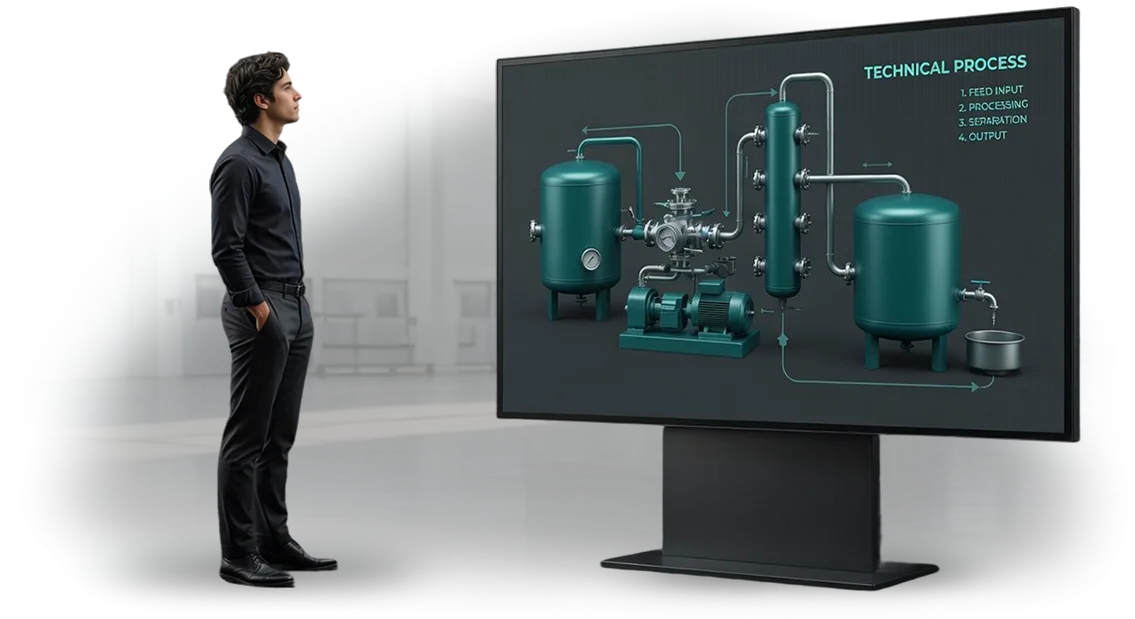
A complex technological process with equipment, pipes, and hidden components is better explained through 3D animation: it provides a three-dimensional understanding of the structure and flow movement that ordinary filming cannot achieve.
This is why CGI instructions are valued in oil and gas wherever production cannot be stopped for training footage or where the real process is dangerous for people.
The second criterion is the audience's skill level. For mass training of new employees, short videos with clear rules, control questions, and repetition of key actions work well.
For engineers, technologists, and maintenance personnel, deeper detail is needed: it is important to show the physics of the process, the sequence of operations, and possible risks.
CGI animation of a technological process in the oil and gas industry shortens the time to competence and reduces the number of errors because the employee sees not an abstract diagram but an accurate three-dimensional model of their actual work object.
Clients note that after such videos, newcomers ask fewer clarifying questions and start working independently sooner.
The third factor is the environment in which the instruction will be used. It could be a distance learning system, a tablet next to the installation, or a short pre-shift briefing, and each case requires its own duration and density of presentation.
The choice is also affected by the number of employees and the frequency of material updates. If the process changes often, it is better to make the video modular so that individual blocks can be replaced without reshooting the entire video. This saves maintenance budget and extends the instruction's lifespan without losing quality.
We help make the choice in a businesslike manner: we analyze the technological process, discuss the target group and usage scenario, and then prepare a short demonstration fragment.
You see the style, level of detail, and timing before full production begins, so the result meets expectations in advance. This approach has already helped oil and gas clients reduce staff training time, lower error rates, and ease the burden on experienced mentors.
A short recommendation: do not start by searching for videos "like competitors have." First, define which error or risk you want to eliminate.
If the answer is to teach personnel a complex operation, choose CGI animation; if it is enough to remind them of a rule, a simple explanation will suffice. For our part, we will suggest the optimal option and show an example tailored to your task.
Frequently Asked Questions About Video Instruction Development
Before starting a project, clients ask similar questions: how quickly will the video be ready, will employees actually watch it, and what happens if something goes wrong.
We have collected answers to the most common questions — so you understand in advance how the work is organized and what result you will get.
How long does it take to develop a video instruction?
The timeline depends on the complexity of the process: for a standard regulation, 2–3 weeks is usually enough; for a multi-stage one with animation, slightly longer. At the start, we set a clear schedule and stick to it.
You do not need to control every step: we plan the stages ourselves, align the script, and show intermediate versions. In the end, you receive a finished video exactly within the agreed timeframe.
Will employees actually watch the video and apply it in practice?
Yes, if the video solves their real task: it shows how to act correctly and removes the fear of making a mistake. We build the story around a specific work situation rather than simply retelling the instruction.
Short videos with clear examples hold attention and are easier to remember. Based on project experience, such video instructions increase personnel engagement and reduce the number of errors when performing operations.
What quality guarantees do you provide, and what if the video is not suitable?
We work under a contract with stage-by-stage acceptance. Until you approve the final version, we make revisions — to the text, visuals, timings, and emphasis.
If after reviewing it becomes clear that a block needs to be reshot or re-voiced, that is also part of our work. We bring the result to a state that solves your task rather than "delivering and forgetting."
Will you support and update the video after launch?
Yes, we do not disappear after project delivery. If regulations, equipment, or processes change, you can order an update of individual scenes or a full reassembly of the video.
For this purpose, we store source files and scripts, so updates take minimal time. You get not a one-time service but a long-term partner for technical documentation.
If you still have questions, ask us directly — we will respond within one business day and provide guidance on timelines and budget for your task.Submit a Request — Get a Plan and Project Cost Estimate
Submit a request — we will call you back within one business day, clarify the tasks, and prepare a plan and cost estimate for the video instructions. This is non-binding: you can calmly compare terms without hidden surcharges or surprises.
So that you make decisions based on facts rather than promises, we put together a complete project plan before the start: script, stages, timelines, and cost. This way, you know the result in advance and protect yourself from the risk of employee errors, downtime, and rework.
After your inquiry, you go through a simple path:
- Request — you leave your contact details, and we reach out to you.
- Consultation — we review your training tasks and production processes.
- Plan — video structure, script, style, and lesson format.
- Cost estimate — a stage-by-stage breakdown: preparation, filming, editing, approval.
- Start — after your approval, we begin the work.
In the plan and cost estimate, you will get everything needed for your decision:
- a script and frame-by-frame plan for each video instruction;
- a list of scenes, formats, and filming solutions;
- production timelines with dates for each stage;
- a cost breakdown for all work;
- examples of oil and gas industry projects;
- recommendations for using videos in training.
Do not postpone staff training — every day without clear instructions increases risks on the production site. Submit a request: within one business day, you will receive the plan and cost estimate; the decision is then yours.