

The food industry loses quality due to ineffective training
The human factor remains the main source of losses in food production. An employee who did not fully understand the process specification or violated the sequence of operations means a defective batch, a line stoppage, and reputational risks.
Personnel training in food production often comes down to passing thick regulations from hand to hand, while comprehension checks come down to a formal signature in a logbook.
The consequences of such savings go far beyond the shop floor. Violation of sanitary standards, improper heat treatment, packaging errors — each of these situations turns into fines from regulatory authorities, claims from retail chains, and loss of consumer trust.
Product quality directly depends on how quickly and accurately an employee absorbs process instructions, and scattered memos and outdated presentations do not solve this task.
The problem is exacerbated by staff turnover. A new employee goes on shift after a couple of days of observing a mentor, who teaches "how we do it here" rather than according to the current standard.
Employee mistakes are repeated because knowledge is not systematized, and it is practically impossible to train frontline staff in uniform rules without clear visual materials.
To break this cycle, it is not enough to simply rewrite the instructions.
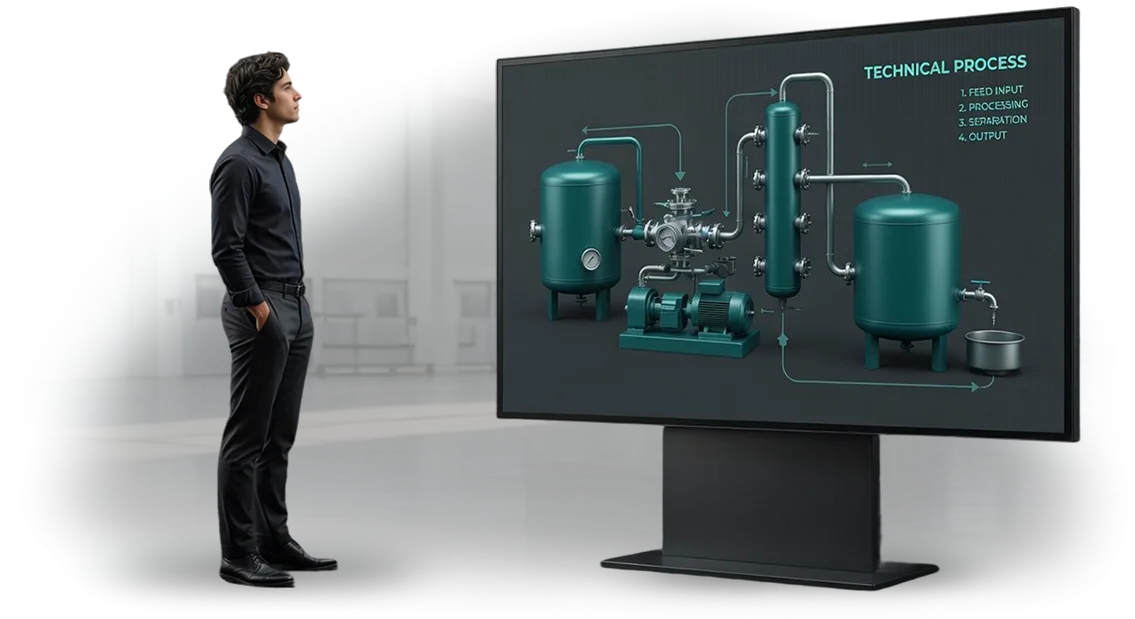
The training process needs to be turned into a visual standard: an employee should see each stage with their own eyes, understand the critical importance of each operation, and be able to return to the material at any time.
We meet this need with corporate video instructions that are understandable even to a beginner and eliminate double interpretation of regulations.
As a result, the number of defects decreases, onboarding time is reduced, and the burden on process engineers decreases, since they no longer need to repeat the same thing endlessly.
A well-designed system of visual instructions works for product quality 24 hours a day — regardless of the experience of a particular shift employee.
What a modern video instruction gives the customer
A modern video instruction is not just a “clip for newcomers,” but a management tool that saves time, money, and nerves.
It replaces dozens of hours of personal training, removes dependence on the “human factor,” and gives the manager a transparent picture: what exactly each employee knows and where the process breaks down.
Reducing onboarding time
A new employee no longer waits for a senior colleague to become available and demonstrate the process.
The video instruction is available immediately, from any device, at any time — and from the very first day the person works according to a unified standard, not from the mentor’s recollections.
The savings amount to hours in the very first weeks. Experienced employees also understand new regulations faster — there is no need to gather a meeting; sending a link to the updated instruction is enough.
Reducing defects and product spoilage
In the food industry, a mistake is costly: a spoiled batch, product recall, reputational risks. The video instruction captures every step — from sanitation to packaging. The employee sees all the details that are hard to convey in words or text.
When eyes see correct execution, the number of errors during reproduction drops severalfold. This is especially noticeable in equipment operations, where the slightest deviation from regulations leads to defects.
Unified standards for all shifts and lines
Even experienced technologists may interpret regulations differently. The video instruction eliminates discrepancies: all employees — on day shift, night shift, on different lines — work the same way. This simplifies control, audits, and interaction between shifts.
The manager no longer finds out “who taught it that way,” but calmly refers to the approved standard. The video becomes a reference standard you can return to at any time.
Monitoring knowledge acquisition
Simply showing a video is not enough — it is important to make sure the person has absorbed it. A modern video instruction includes built-in questions and assessment tasks at the end. The system records who completed training and who did not, and where errors were.
You get objective data: is a specific employee ready for independent work, or do they need additional repetition. This removes “I told you so” arguments and replaces them with facts.
Our team has been developing such video instructions for food production facilities for more than 10 years. We know that in your industry accuracy, hygiene, and speed are important, so every video reflects the real conditions of your production floor and your regulations. The result is predictable processes and fewer losses.
Video Instruction Formats for the Food Industry
Food production employees work under strict regulations and high responsibility for product safety. Video instructions allow fast and uniform training of personnel, but one format does not cover all tasks — from studying theory to practicing practical skills.
We have prepared a compact table so you can choose a suitable format for your task. All formats are adapted to the specifics of your enterprise and production characteristics.
| Format | What it suits | What it gives the enterprise |
|---|---|---|
| 3D animation of technological processes | Demonstration of hidden stages, equipment operation, line diagrams | Visual clarity without stopping production, understandable even to newcomers |
| Filming at the production site | Training in practical actions, compliance with standards and safety regulations | A realistic picture, employees see a familiar environment |
| Combined format | Complete training: from theory to practice in real areas | Maximum engagement, rapid onboarding of a newcomer to a shift |
Which option to choose depends on your specific task. For example, for Yuzhny Meat Processing Plant, we combined animation with video filming to show both internal processes and real actions of personnel — this accelerated employee adaptation by two times.
We help determine the optimal format, develop the script, and fully produce the video instruction. Contact us for a consultation — we will tell you which format is best suited for your production.
How work on a project proceeds: 7 steps
We have structured the process so that at every step you understand what is happening and what result you receive. No “black boxes” — only clear stages, approvals, and checkpoints.
- Video production brief. We define the purpose of the instruction, the employee audience, the specifics of the technological process, and training requirements. You receive a document that takes all requests into account.
- Scenario and storyboard development. Based on the brief, we create a scenario that describes every frame of the future video. Scenario approval is your checkpoint: here we adjust emphasis so the material precisely meets the training objective.
- Scenario approval. You make edits, we take them into account and lock the final version. After that, we launch production — changes at later stages require more resources, so we carefully check everything at this stage.
- Creating 3D animation of the technological process. We model equipment and employee actions so that every step is clear and safe to understand. CGI makes it possible to show internal processes that cannot be filmed with a camera.
- Voiceover and subtitles. We add professional voiceover with clear diction and text support. This improves material retention — employees watch the video even without sound.
- Editing and final assembly. We assemble a single video, check timing, and adjust color and sound. You receive a ready video instruction in the required formats — for LMS, TVs, or mobile devices.
- Launching the training video and support. We hand over the files and help integrate the video into your training system. We then stay in touch: if regulations or equipment change, we will update the video without full re-production.
This approach has already been used for food production facilities, where employees needed to be trained to work with new lines. Transparent stages and clear approvals make it possible to launch the video instruction on time and with the expected result.
What is included in the training video package
We prepare a set tailored to the tasks of the food industry: the scripts take into account sanitary regulations, specifics of line operation, and safety requirements.
Therefore, the package includes not just a single video file, but a full package for launching training without additional modifications.
- Training script — a detailed storyboard and voiceover text for each video. You see the content before editing and can make changes at any stage.
- Set of video instructions — all videos in formats for computer, tablet, and corporate portal. An employee can open the required format from any device.
- Instructions for staff — one-page memos and checklists for each topic. This is a cheat sheet that can be hung near the workplace and refresh knowledge in a minute.
- Access to the learning system — we upload materials to your distance learning system or set up a learning portal with access for each employee and consideration of their position.
- Content rights — you receive exclusive rights to use, edit, and modify the videos without additional approvals from us.
- Methodological recommendations — tips on how to integrate video lessons into the onboarding program for new employees and periodic certification.
This is what the result of video development looks like: you get a working system, not just a link to a recording. All that remains is to assign the course, assign responsible persons, and track progress in your personal account.
Case: implementing video instructions at a poultry factory
A large poultry factory faced a typical industry problem: high staff turnover on the processing line, and each training of a new employee took weeks and required constant involvement of mentors. Errors in sorting, packaging, and sanitation resulted in product losses and additional inspections.
We proposed to the client not text regulations, but ready-made video instructions that show every stage of work — from equipment setup to quality control. In two months, together with the factory's technologists, we created and implemented 20 videos for five key areas.
They were embedded into the training process: a newcomer watches the video, then repeats the actions under the supervision of a mentor.
The result was measurable already in the first quarter. The number of personnel errors decreased by 30%, and reaching an independent shift accelerated from three weeks to one.
Employees stopped "floundering" in non-standard situations — video instructions became their personal cheat sheet, which they can return to at any time.
For the Zarya agroholding, this meant not only reduced losses, but also relieving the burden on experienced employees, who had previously been constantly distracted by training.
Six months later, the client ordered a continuation — another 15 instructions for warehouse and logistics, because the format proved its effectiveness in daily work.
How to choose the optimal format for your production floor?
There is no universal format — and that is good news. Selecting a video instruction always relies on three parameters: the complexity of the technological processes, staff turnover, and the development budget.
For one shop floor, a short smartphone video is enough, while another needs full CGI animation of the line with a breakdown of every unit. That is why we first determine exactly what needs to be taught, and then propose a format that will solve the task without overpaying.
If we are talking about complex equipment — for example, a filling, pasteurization, or packaging line — choose CGI animation. It allows you to show the process from the inside, slow down units, remove excess shop-floor noise, and emphasize critical points.
The employee sees not just a sequence of actions but the physics of the process: why pressure matters, what happens when temperature is violated, how the valve is designed. This sharply reduces the number of errors among newcomers and speeds up onboarding.
For simple operations — sanitation, packaging, labeling — regular video with real equipment is more effective. It can be filmed in one or two days, approved faster, and updated more cheaply when regulations change.
This format also trains without interrupting work: an employee watches the video right on a tablet next to the line and immediately repeats the actions. The main thing is not to skimp on the script, otherwise instead of an instruction you will get a slideshow.
The optimal choice for most manufacturing facilities is a combined format: real footage of the work area plus animation inserts for hidden mechanisms.
It gives the employee the connection “I see the real shop floor — I understand how everything works inside.” At the same time, the budget remains moderate and timelines predictable.
We use this combination in half of our projects for the food industry, and it consistently meets the need for rapid training of new people.
The right selection of a video instruction saves you time and money. We help you choose a format for your type of production, team skill level, and budget — without pushing anything unnecessary.
We come to the site, look at how the processes are structured, and propose a solution that employees actually use rather than one that gathers dust on a server.
Training without interrupting work remains the main criterion: all material is adapted for viewing on the shop floor, from a phone or tablet, at a convenient pace.
Frequently asked questions about developing video instructions
It's unclear how much developing video instructions will cost and how quickly they will appear — these are the main questions before any project.
Add to that the concern that finished videos will become outdated in six months or won't fit into the corporate learning system, and the order risks getting stuck at the approval stage.
We have collected answers to the frequent questions we hear from process engineers, HR and HR directors. Below — briefly and to the point, with a focus on the benefit for your production.
How much does developing a video instruction cost?
The cost depends on the complexity of the process, the number of scenes and the format: from a short 1–2 minute video to a detailed instruction with 3D animation.
We build a transparent estimate before the start — you know the scope of work and don't pay for "surprises" along the way. At the first briefing we will determine the optimal format for your task and budget.
What are the development timelines? A typical project takes from 2 to 4 weeks. The timeline is affected by the complexity of the technological process and the speed of approval with your process engineers.
We firmly fix deadlines in the contract and show the stages: from script to the finished file. If employees need to be trained by a specific date — for example, by the launch of a new line — we allow a time buffer and prioritize the task.
What happens if the process changes? — How to update a video instruction? That is exactly why we keep the project source files: script, graphics, voiceover. If a stage, formula or equipment changes — you send the edits, and we make them in the video without re-shooting.
This is many times cheaper and faster than creating an instruction from scratch. For frequent changes, we can assemble the video from modular blocks — only the necessary fragment is updated.
Does the video integrate with our LMS? Yes. We deliver finished files in standard formats (MP4, SCORM), which are supported by almost all distance learning systems.
Additionally, we can set up a video player with subtitles, chapter breakdown and view tracking — so that you can see which employees have actually completed the training. We test the integration on your LMS before handing over the project.
If you still have a question of your own — write to us, and we will honestly answer whether the format suits your task and budget.
For complex production facilities with frequent process changes, we will suggest a modular scheme; for standard operations — videos with quick returns. The main thing is that in a month you get a clear video instruction, not endless approvals.
Get a consultation on developing video instructions
Getting a consultation on developing video instructions means removing uncertainty: you will learn how a training video can solve the specific challenge of your production.
We have been creating training videos for food industry enterprises for 10 years, so in a 30-minute conversation you will receive not abstract advice, but a concrete plan for your request.
Here is what you get right after contacting us:
- A preliminary estimate of project cost and timeline for your scenario — with no hidden extra charges;
- A review of your task: which employees we are training, which operations we are showing, which result matters;
- Format recommendations: animation, live-action filming, or a combined option — whichever is more effective for your process;
- Examples of our work for the food industry, with an explanation of how the task was solved;
- A checklist of materials needed to start the project;
- Answers to implementation questions: how to use video in training, how to update instructions, how to measure the result.
The consultation does not obligate you to anything. You decide whether to move forward or stop. If the project is a fit, we will lock in the plan and start work at a convenient time; if not, you will still leave with useful recommendations.
Submit a request via the form on the website or message us in a messenger. We will contact you within one business day, clarify the details, and prepare an estimate.
Starting a project is simple: the first step is a consultation, then a brief, script, production, and a finished video for your employees.