

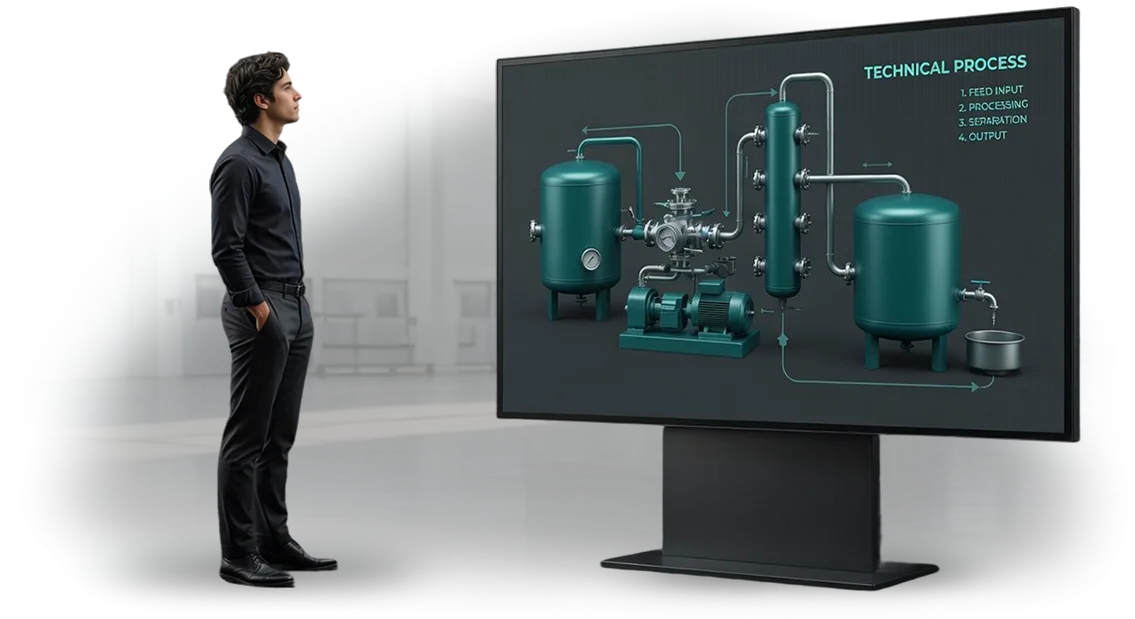
Electric Motor Manufacturing Technology — in Clear Video Instructions
During electric motor assembly, a single mistake at any stage can devalue the work of an entire shift. Reworking a finished winding is difficult and costly, and shipping a substandard batch damages your reputation.
While a newcomer learns from paper instructions, they spend weeks on the job training and still act by guesswork: tension, clearances, commutation order — the details just don't stick.
On an electrical manufacturing floor with high staff turnover, every new worker is a risk to quality. An experienced mentor can't stand next to everyone at the same time, and knowledge passed on verbally loses precision.
Production training becomes a formality: the procedure is signed off, but the hands remember their own way.
Our team solves this problem with a video course built around your technology. We break assembly down into clear blocks and show on screen what text can't explain: the sequence of operations, typical errors, control points.
An employee watches the video at the machine and repeats the steps — video-based staff training becomes faster and more reliable than paper procedures.
Video instructions work like a personal briefing that can't be "forgotten": one standard for every shift, a precise walkthrough before going on site, and a visual knowledge check before granting clearance.
The result: fewer defects, faster onboarding, and less dependence on the human factor. It pays off within the first weeks as a new crew reaches planned productivity. The material is easy to update when your technology changes. Below is how we structure work on your project.
What Corporate Training with Video Instructions Delivers
The benefits of video-based training are clear: new employees are production-line ready within 2–3 days instead of weeks — without pulling experienced specialists away from their own work. Video instructions show every step, from winding placement to final assembly.
Employee onboarding becomes a clear route instead of a chaotic "ask the person next to you."
Learning Speed and Onboarding
Corporate training videos cut introductory training time by 30–40%. A newcomer can review complex sections, pause the frame, and return to the step they need.
The mentor doesn't repeat the same thing ten times — they record the instruction once, and from then on the video works independently.
Unified Standards and Fewer Errors
In electric motor manufacturing, even a minor deviation in an operation leads to defects or rework. Video locks in the single correct sequence of actions.
That's operations standardization: all employees work to the same benchmark, error rates drop, and quality becomes predictable.
Saving Mentors' Time and Scaling
An experienced specialist spends up to 60% of their working time on explanations. Video instructions free them up for actual setup and control. At the same time, training scales instantly: a new workshop or shift gets the same standards — no business trips and no extra meetings.
We record videos on real production lines and inside workshops so employees see a familiar environment. In the end, you receive a library of instructions that you can use both for hiring and for revising procedures.
Video Instruction Formats for Electric Motor Manufacturing
Every operation in electric motor manufacturing has its own level of complexity: one takes a couple of minutes and can be explained by voice-over; another requires understanding the internal structure of an assembly and a sequence of dozens of steps.
The training video format must match these requirements — otherwise employees keep asking mentors, act on guesswork, and create defects.
That's why we match the format to the client's specific goal: from short first-person videos for simple assembly operations to interactive instructions with knowledge checks for multi-stage manufacturing processes. Below are the basic formats we use most often in production.
| Format | Target Audience | What It Delivers to the Client |
|---|---|---|
| First-person video | New employees, operators of simple operations | Fast integration into the workflow without pulling mentors away, reduced load on experienced workers |
| 3D animation of processes | Process engineers, maintenance personnel | Clear understanding of the internal structure of an assembly and assembly logic, fewer errors during maintenance |
| Interactive instructions | All personnel categories, especially under high turnover | Knowledge checks at every stage, automatic recording of assessment results |
| Combined courses | Section managers, quality department | Unified training standard, knowledge control, and rapid adaptation of new employees |
If the process is already documented in your procedures, or you have recordings of your best specialists in action, we convert them into the right format and strengthen them with visualization.
For complex operations, we show each step and tool movement in 3D animation so the employee understands not just "how" but "why."
The main selection criterion is not how the video looks, but how quickly the material is mastered and how many line errors are eliminated. The right format cuts training time by two to three times and delivers consistent results regardless of the employee's experience.
How We Develop Training Videos: Work Stages
Developing video instructions for electric motor manufacturing is a sequence of stages we go through together with you: from the brief and operations analysis to script approval and training implementation. You personally control every step, so the result precisely matches your requirements.
-
Brief and task analysis. We collect information about your production, target operations, and employee skill levels. You receive a clear project plan and timeline.
-
Study of technological operations. Together with your process engineers, we examine every stage of electric motor manufacturing — from parts preparation to finished assembly inspection. This eliminates inaccuracies in the video.
-
Script and storyboard. We create a step-by-step script and approve it with you before animation begins. You see the video's structure and can make changes without redoing the work.
-
CGI animation. We visualize the process with a level of detail that real equipment can't show: internal assemblies, tool movement, the sequence of actions. This makes complex operations easier to understand.
-
Approval and refinement. You receive a draft version and collect feedback from process engineers and operators. We make revisions until you fully approve.
-
Implementation into training. We help integrate the videos into briefings, courses, or your learning management system. Employees can access the materials at any time.
-
Support and updates. We update the videos when technologies and procedures change, so instructions remain current and safe.
What's Included in the Video Instructions Package
Every project ends not just with file delivery, but with a working training system in place. We assemble the package so your mentors and shop floor managers can use the video instructions immediately — without involving a contractor or technical specialists.
- Ready-made video instructions — a series of videos covering the key production operations for electric motors: from stator assembly to testing finished products. The videos follow your procedures and accurately reflect the real process.
- Scripts and frame-by-frame plans — approved documentation for each video. You always see exactly what appears in each frame and can make quick changes without reshooting.
- Training support materials — tests, checklists, and quick-reference cards for knowledge checks after viewing. They help the mentor objectively assess whether an employee is ready to work independently.
- Access to the video instruction library — an internal portal with clear navigation by workshop and operation. Access rights are configured so each employee sees only their own instructions.
- Mentor training — a short hands-on workshop for your specialists: how to build videos into the newcomer onboarding process, how to use the support materials, and how to monitor knowledge retention.
- Updates and support — when a technology or procedure changes, we update the videos and support the system for an agreed period. The instructions don't go stale as your production evolves.
This package covers the entire training cycle: from the first video viewing to on-the-job skill verification. You don't get scattered files — you get a complete system that reduces the load on mentors and helps new employees reach full productivity faster.
Case Study: How Video Instructions Cut Defects in Production
In electric motor manufacturing, stator assembly defects had long been a "blind spot": operators work with their hands, and paper instructions fail to show the critical moments.
A newcomer gets the order of operations wrong, fails to seat the winding properly, or installs it on the wrong side — and the defect moves on down the line. Each such case means rework, line downtime, and unnecessary costs.
We solved this problem with interactive 3D instructions for stator assembly. Instead of static drawings, the employee sees every step on screen: which assembly to take, how to orient it, and how much force to apply.
The system automatically highlights the control zone — the biggest source of errors, human inattention, is eliminated.
Result
Four months after launch, defects in that section dropped by 35%. New employees reach the planned speed a week earlier, and mentors spend 40% less time re-explaining the same things.
"We used to rely on the experience and memory of our operators. Now everyone has the exact sequence of actions in front of them — it's almost impossible to make a mistake.
For us, this isn't just about cutting losses; it's consistent quality in every motor," says the chief process engineer at NPO Privod.
The case shows that video instructions pay off not over months, but within the first two batches. You don't need to reorganize the production cycle — just replace outdated instructions with a clear 3D picture, and the effect shows up in the next QC report.
What If We Have Specific Requirements?
Specific requirements aren't the exception — they're the norm for facilities with unique manufacturing processes. Every plant assembles electric motors differently: some have special winding operations, others have non-standard tolerances or quality control procedures.
That's why we build an individual approach into every project from the start — no off-the-shelf solutions with someone else's standards.
Adapting video instructions begins with deep immersion in your process. We study process charts, talk with process engineers and section supervisors, and break down every stage in detail.
If needed, we use your documentation, terminology, and internal standard requirements so the video speaks to employees in their familiar language — without ambiguity.
This is exactly where CGI animation comes in: it shows operations that can't be captured on camera — what happens inside a motor housing, at high speeds, or in closed assemblies. Non-standard requirements don't limit it; on the contrary, they unlock its full potential.
Complex geometry, uncommon materials, special assembly conditions — all of it comes to life in an animated video with the level of detail you need.
As a result, you get videos that accurately reflect your procedures, not an abstract "industry average" instruction. Employees remember the correct sequence faster, make fewer mistakes on complex operations, and newcomers settle into the work rhythm much more quickly.
The videos are easy to update when standards change — no full reshoot required, just edit the model and rebuild the scene.
If you're unsure whether animation is right for your process, we first analyze your case and suggest a suitable format. Send a description of the operation or process, and we'll show you how we'd solve your specific task.
Common Client Concerns and Our Answers
Any new training system raises questions — that's normal. In electric motor manufacturing, the cost of a mistake is especially high, so doubts about video instructions are understandable. Let's address the main ones.
What does development cost, and wouldn't it be cheaper to keep training as is?
Investment in video instructions pays off through faster newcomer adaptation and fewer defective operations. An employee stops depending on the mentor within just a few shifts, and assembly errors start dropping from the first weeks.
Won't implementation drag on for six months?
Timelines depend on the complexity of your manufacturing operations, but we always work in stages. Within a couple of weeks, you see the first scenes, and you receive the final video with time to spare before training launches.
What happens when the procedure changes? Will we have to reshoot the video?
The videos don't become outdated after a single shoot. We design them in a modular way: replacing one assembly or procedure doesn't require recreating the entire video — just update one block and rebuild the video.
Won't employees get bored with yet another instruction video?
Short videos with real operations and emphasis on key moments hold attention better than text instructions. Employees return to the difficult fragments on their own, and knowledge checks are built right into the training.
How can we tell that video training has truly paid off?
We measure payback not in abstract percentages, but in how fast a newcomer reaches planned productivity and how much defect-related loss drops. As a rule, the effect is visible after the first group of trained employees.
Order Video Instruction Development — Get the Package
Training new employees in electric motor manufacturing takes time from experienced mentors and slows down line launches. Ordering video instructions means getting a ready-made tool that explains every process consistently: from assembly to quality control.
You shorten the adaptation period, reduce the risk of defects, and free up supervisors for actual work.
We'll prepare a custom package for you: assess the scope of work, propose a script for your operations, and show you what the result will look like. After you get in touch, you'll receive:
- Cost estimate based on your list of processes and number of employees — no hidden fees or unnecessary options;
- Preliminary work plan with stages, timelines, and areas of responsibility;
- Format consultation — which videos you need for training, briefings, or mentorship;
- Examples of our video instructions for facilities with similar manufacturing cycles;
- Commercial proposal with fixed terms and delivery timeline;
- A personal manager who supports the project from brief to implementation in the training process.
Submit a request for a cost estimate, and by the next day you'll understand how to move your training to clear video-based procedures.
We'll respond within one business day, show relevant examples, and offer a solution that pays off quickly through faster employee achievement of target metrics and fewer errors on the line.