

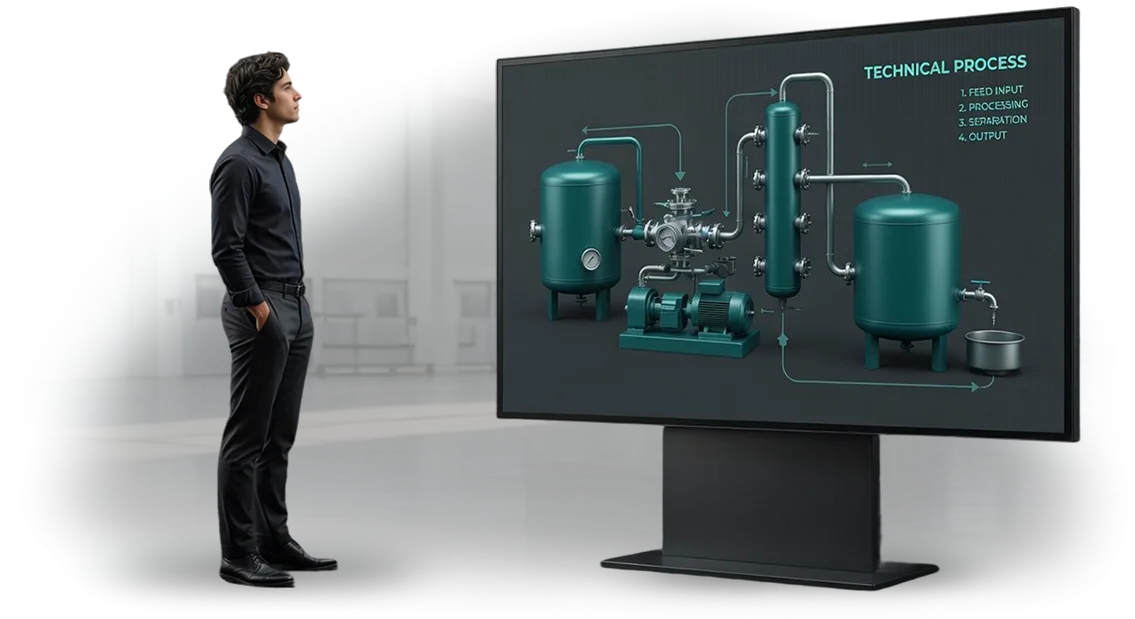
Reducing Defects and Downtime in Cable Production
In cable production, defects and downtime most often occur not because of equipment, but because of the human factor.
An operator skips a setup step, mixes up the order of operations, or reacts incorrectly to an abnormal situation — and now a batch is rejected and the line is stopped. Every such mistake hits the cost of production, disrupts shipping schedules, and creates tension between shifts.
The cause is systemic: processes are complex, and personnel training often comes down to a brief orientation or the transfer of experience “from senior to newcomer.” The employee is left alone with a multi-meter machine, risk zones, and procedures they only partially remember.
The result is that employee errors repeat, defects become a familiar backdrop, and downtime becomes routine that everyone turns a blind eye to.
For the business, this means direct losses: reworking raw materials, extra time spent on diagnostics, lost output, and the risk of not meeting a contract on time.
Plus hidden costs: turnover due to stress, conflicts between departments, and expenses for sending technologists to investigate failures. The longer training remains formal, the more expensive each shift becomes.
We solve this problem — we develop corporate video instructions that turn technological processes into clear step-by-step scenarios. The employee sees every component, every action, and typical mistakes before ever touching the equipment.
As a result, defects decrease, downtime is reduced, and staff training no longer depends on the personality of a mentor. You get stable quality across all lines without constant oversight from above.
How Video Instructions Speed Up Onboarding and Reduce Errors
New employees in cable production often learn by trial and error: a senior mentor shows, the newcomer remembers, and a month later it turns out everyone works differently. This costs time, defects, and nerves.
A proven way to accelerate onboarding and reduce errors is video instructions that set a single standard for performing operations. our team develops such materials — here is what changes after implementation.
- Learning speed increases many times over. Instead of spending a week observing a mentor, an employee watches a 10–15 minute video and immediately moves to practice. They can review difficult moments again without distracting colleagues.
- Errors in production decrease. The video shows every step accurately and clearly: how to properly strip insulation, clean a wire, and set up equipment. The employee acts according to a reference standard, not from memory.
- Newcomer onboarding goes more smoothly. A person is not afraid of forgetting the sequence of operations — the instruction is always at hand. Less stress, confidence comes faster, and turnover during the probationary period decreases.
- Process standardization reaches a new level. All employees are trained with the same video, so they perform their work at the same quality level. This simplifies control, audits, and the transfer of experience between shifts.
- Training does not depend on the experience of mentors. Even if a key specialist goes on vacation or leaves, the knowledge stays in the company. The video archive becomes the basis for training the entire staff lineup — from operator to shift supervisor.
- Retraining and skills improvement happen without stopping work. You simply open the video you need, and the employee refreshes their knowledge in a couple of minutes. This is faster and cheaper than gathering a group for an in-person training session.
No paper instruction or presentation will produce the same effect — video conveys actions, details, and nuances that cannot be described in text. This is especially important for cable production: every incorrect step can turn into a rejected batch or line downtime.
Our filming and editing technology has been refined across dozens of projects, so you get instructions that actually work — they are watched to the end and applied in practice.
Formats of Video Instructions for Cable Production
“Training videos for cable production” sounds like one task, but inside it there are dozens of scenarios: getting familiar with the technological process, working on a specific machine, safety procedures during setup and repair.
Each task has its own specifics, and the video format must match them. If this is not taken into account, employees will watch the video formally, but the necessary skills will not appear — instead, errors, defects, and downtime will appear.
The choice of format directly affects how quickly a newcomer gets up to speed and how many errors experienced personnel make. That is why we do not assign a “default” format, but choose one to fit the specific operation and audience level. Below is a guide to how this looks in practice for cable manufacturers.
| Format | When It Fits | What It Gives Production |
|---|---|---|
| Scenario | The process is complex, with many hidden steps and control points | A clear sequence of actions that is easy to put into any visual format |
| 2D animation | You need to show the general line layout, core movement, material flows | A simple and quick explanation of the entire production logic without overloading with details |
| 3D visualization | You need to look inside a machine or understand how the cable behaves during winding, twisting, insulation | A complete understanding of the physics of the process before going to the equipment — this reduces fear and the risk of errors |
| Video filming | You need to show real actions at the machine and typical mistakes made by experienced employees | A realistic “how we do it here” picture, more quickly forming the right habits |
A scenario is the foundation of any format.
We define the learning goals, audience, timing, and narrative logic, and only then decide what will be more effective: 2D animation for clarity of the diagram, 3D visualization for hidden processes, or video filming for a real workplace.
Often one scenario becomes a combination: the general line layout in 2D, the operating principle of a unit in 3D, and the correct operator actions in video.
This approach gives you not just “another video,” but a working tool that employees actually watch to the end and use on the shop floor. We will help you decide on a format for each of your processes — we will handle this together with scenario development.
How the Project Development Works Step by Step
To ensure you get a predictable result, we follow a transparent process. Each stage ends with a control review point — you see the interim result and approve it before moving to the next step. This approach eliminates surprises at final delivery and helps meet deadlines.
- Brief and audit. We gather the objectives, study the target audience, and analyze the technological processes of cable production. We fix the deadlines, format, and acceptance criteria.
- Scenario and storyboard. We turn production steps into a clear visual sequence. We agree on the text, narrative logic, and key training emphasis.
- Concept approval. We show the visual style and examples of equipment visualization. You approve the overall style — then we move forward without unnecessary revisions.
- CGI scene production. We create accurate 3D models of the cable line and adjust camera movements so that important components and operator actions are visible.
- Editing and voiceover. We assemble the video, add explanatory captions and narrator text. We check that the instruction is understandable even to a new employee.
- Final approval and launch. We make edits based on your comments, deliver the final files in the required formats, and upload the video into your training system. We transfer the rights.
At each stage you understand what is happening and what comes next. That is why the final video meets expectations — without lengthy rework or downtime in staff training.
What Is Included in the Deliverable and What Stays with You
After the project is completed, you receive a complete set of materials — not only the final videos, but also everything needed to update, reuse, and integrate them into training. There are no “rented” files: all assets become your property and remain with you forever.
- Final video files — the finished videos in multiple formats: for uploading to an e-learning system, for display on shop-floor screens, and for sending by corporate email. Every employee can access the instruction from any device.
- Source files and working materials — project files, the 3D models used, textures, and animations. If the technological process changes, you can make quick edits with your own team or commission us to update them without recreating the entire scene.
- Content update procedure — a step-by-step guide on how and when to update video instructions: when equipment is replaced, standards change, or new regulations come out. This removes dependence on “the person who remembers” and makes the process systematic.
- Ready-made LMS structure — course settings, check questions, and the assignment sequence for video instructions. You connect the materials to your e-learning system without additional development, and HR immediately sees who has completed training and who has not.
- Instructor guide — recommendations on how to integrate video instructions into in-person training, what assignments to give after viewing, and how to assess material retention. No need to invent a scenario — everything is already thought out and tested.
- Supporting documentation — a list of all files with descriptions of what is located where and how they are interrelated. Even if changes occur in your team, a new specialist will quickly understand the structure and continue working without losing context.
This package turns video instructions from a one-time video into a working training tool: you can scale it to new facilities, replicate it for other processes, and keep it relevant without constantly contacting a contractor.
Case Study: 40% Reduction in Errors After Implementation
A large cable manufacturer faced a typical industry problem: defects on the line were caused by operator errors, especially among newcomers.
Text instructions and mentoring did not provide the required speed — an employee needed several weeks to reach a stable performance level, and every mistake led to reworking expensive raw materials.
We proposed replacing part of the classic training with a series of video instructions using 3D animation of technological processes.
Instead of diagrams and descriptions — a clear visual picture: how to properly thread the filament, set extruder parameters, and perform quality control. This format is understandable for both newcomers and experienced supervisors.
What Changed After Implementation
After two months, the company recorded a 40% reduction in errors. Defects on key operations decreased, and the time needed to onboard new employees was cut in half.
Training no longer depends on the mentor’s experience — now everyone watches equally precise videos and works according to a single standard.
The customer also noted an indirect effect: fewer reworks means lower product costs and therefore higher margins. Operators less often distract senior colleagues over small issues, and the line runs more smoothly.
After the pilot launch, we expanded the project to three facilities and produced a full cycle of instructions — from raw material intake to packaging of the finished product.
Why This Works
Video instructions remove the main objection from production managers: “we don’t have time to train newcomers.” The video lasts 5–7 minutes, can be rewatched at any moment, and 3D animation shows the process even better than a real workshop — without smoke, noise, or rush. Employees memorize the sequence of actions faster and make fewer mistakes.
For us, this case confirmed that properly produced training videos pay off through reduced defects and faster onboarding. If you have a similar task — tell us about your technology, and we will propose a filming format that fits your cost and deadlines.
How to Choose the Right Format for Your Task?
The choice of training format directly depends on three factors: process complexity, equipment accessibility for filming, and planned cost.
For simple operations that are visible to the eye and performed on accessible equipment, ordinary video filming is enough — it is created quickly, easily updated, and does not require large investments.
But as soon as the process is hidden inside a machine, happens at high speed, or involves risk to an employee, filming stops working.
In such cases, 3D graphics and animation come to the rescue. They allow you to show what a camera cannot capture: the internal structure of the cable, the movement of currents, the stages of crimping or insulation melting, and how mechanisms work in cross-section.
The employee sees the full logic of the process, not just the result on a screen. This speeds up understanding and reduces errors when starting work on the line.
Yes, this format costs more, but it pays off through versatility — one model can be used in different instructions and in different areas of production.
The optimal option for most tasks is a combination of real filming and animation. Real footage shows what the workplace looks like and how to properly handle the tooling, while animated inserts explain the physics of the process and hidden components.
Such a hybrid instruction is easier to absorb than “bare” graphics, and it does not require ideal conditions for filming complex equipment.
Sometimes a customer thinks complex 3D animation is essential, even though the process can be shown with ordinary filming and a long shot. And the opposite happens: they try to film something that fundamentally cannot be captured on camera, wasting time on unsuccessful takes.
This is why we always start with an analysis of the task: which operations need to be shown, what can actually be filmed, and what must be modeled. Based on that, we propose a format that solves the training task without unnecessary costs and schedule delays.
Whichever option you choose, it is important to understand: the main thing is not a “pretty picture,” but how quickly a new employee masters the operation and starts working without defects.
Video, animation, and 3D graphics are tools, and we choose the one that delivers maximum results for your task and cost.
Answering Common Doubts Before Placing an Order
Before ordering CGI training for cable production, the same doubts arise: will the videos become outdated, will they fit into current training, and will the investment be justified. We answer these questions directly so that you can make a decision with a clear picture.
Will the instruction become outdated after a technology change?
We build the scenario around typical cable production operations — these rarely change. If procedures or equipment are updated, we reshoot and replace only the changed fragment without redoing the entire video. This removes the main risk that “content becomes outdated.”
Is it difficult to integrate videos into an existing training system?
We deliver the videos in universal formats — they can be uploaded to any e-learning platform, attached to a course on a corporate portal, or used on a workplace screen. All you need to launch is a file or a link; no separate system development is required.
Why CGI rather than ordinary filming?
Live filming does not show what happens inside a cable line: directions of movement, how components interact, hidden mechanisms. CGI makes the invisible visible — the employee understands the logic of the process and forms the correct skill faster.
Complex sections can be slowed down, broken down step by step, and repeated as many times as needed.
How is the cost calculated and what is guaranteed?
The cost is calculated after the brief — it depends on the number of scenes, the level of process detail, and the intended formats of use.
The contract specifies deadlines, stages, and the expected result, so you know what you are paying for and when you will receive the video instructions. We provide support after delivery so the material continues to work in your training.
Get a Cost Calculation for Video Instructions for Your Tasks
Leave a request — and get a cost calculation for your specific tasks, not average numbers from generic proposals. We know the specifics of cable production: non-standard operations, safety requirements, and quality control at every stage.
Therefore, we include in the calculation only what your employees actually need, without unnecessary options.
What you receive after contacting us:
- A cost calculation for a specific list of video instructions — from short algorithms to complete courses on technological processes.
- A consultation with a technologist: they will clarify the scenarios, review the operations, and recommend the optimal video format for training.
- Examples of completed projects for manufacturing and the cable industry — you can evaluate the quality before payment.
- A clear work plan and deadlines: from brief to finished videos, with defined stages and responsible parties.
- Recommendations for using the instructions: for onboarding newcomers, recertification, or skills assessment.
- A guarantee that the video will meet your internal procedures and quality standards.
After the consultation, you will receive not just numbers, but a ready-made plan: which videos are needed, in what volume, and how they will speed up the employee’s transition to full productivity.
Leave a request — we will connect you with a technologist, show examples, and prepare the calculation. There is no obligation, but you will immediately understand the cost and timelines.