

How to Train Employees Without Stopping Beverage Production
Training staff in beverage production always involves a dilemma: stop the line for instruction or let employees into the workshop without proper preparation. Any downtime means lost revenue, disrupted shipments, and a stressed manager.
At the same time, the traditional format—a lecture at a whiteboard or mentor accompaniment—pulls experienced workers away from their duties and gives no guarantee that a newcomer has absorbed all the nuances of the process.
The solution is video instructions created specifically for your production. Employees study the material at a convenient time: before a shift, during a break, or during scheduled equipment maintenance.
Production doesn't stop for a minute: people learn without leaving their work, and comprehension can be checked with built-in tests.
But simply filming the workshop doesn't always solve the problem. Many stages—fermentation, filtration, bottling, sterilization—are hidden from view or dangerous to show.
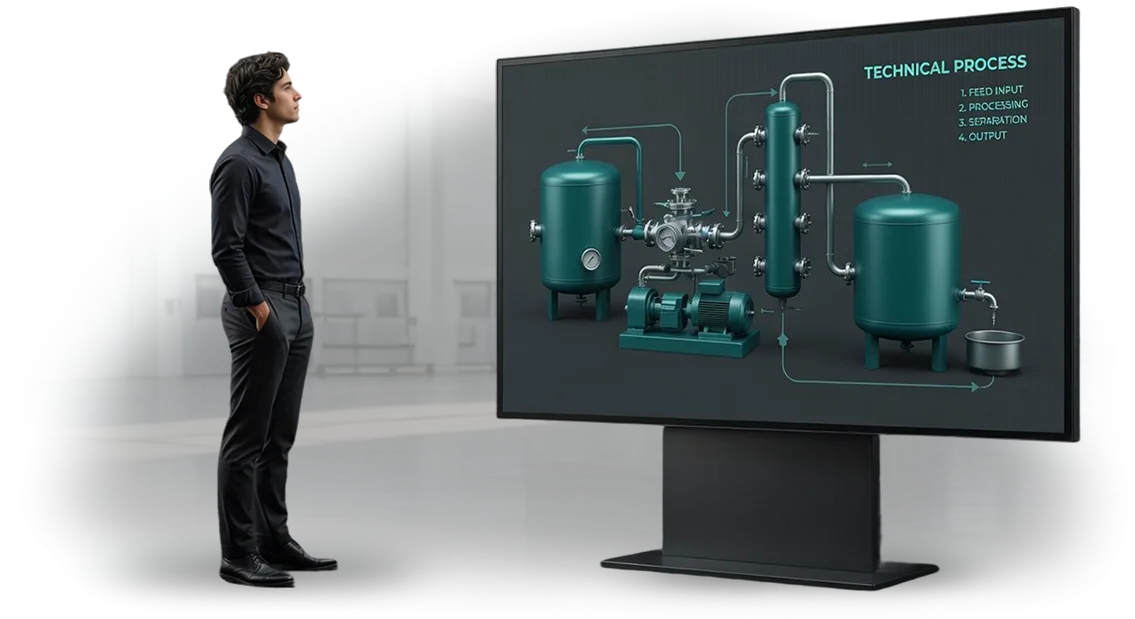
This is where CGI animation of technological processes helps: it clearly demonstrates every stage in detail, allowing employees to understand the essence of the process rather than just memorize a sequence of buttons.
Animation can be paused, reviewed, and slowed down—something that's impossible in a real workshop without losing time.
Video instructions save mentors' time, level out the training of all shifts, and reduce the risk of defects and accidents. For beverage production, this means stable product quality and smooth operations even with high staff turnover.
We develop such video instructions for your actual lines and procedures: from script to final video. Staff training stops being a cause of downtime—you get a ready-made tool that pays off after the very first batch of new employees.
Benefits of Training Videos: Adaptation Speed and Quality
An employee masters new operations faster when they see the whole process rather than reading an abstract instruction. In beverage production, the chain includes dozens of steps, and an error in any of them affects product quality.
Video instructions turn complex material into a clear scenario—this is the main benefit of video training.
Speed of Adaptation for New Employees
Video compresses a week of explanations into a few hours of self-study. The employee watches the stages at their own pace, returns to difficult moments, and gets up to speed faster. Mentors no longer have to repeat the same thing over and over.
Stable Quality of Operations
Beverage production requires precision: timing, temperature, and the sequence of adding ingredients. Video captures the correct execution of each step, and the employee replicates exactly that rather than an approximate version. Fewer mistakes and defects—especially when launching a new line.
Single Standard and Control
Videos set a single standard for all shifts. A manager can see who has absorbed the material and who needs help, making training manageable. There's no need to rely on ad-hoc retelling of experience.
The benefits of video instructions for beverage production are obvious: faster adaptation, stable quality, fewer losses. The investment pays off through predictable staff performance.
Video Instruction Formats for Beverage Production Tasks
Beverage production means continuous lines, strict procedures, and shifts where every employee action affects product quality.
A universal video instruction doesn't always work here: someone needs a short answer to “what to do if a setting is off,” while someone else needs a full breakdown of the technological process from raw material intake to bottling.
We match the format to the specific production scenario: from a single-screen checklist to full CGI animation of the process with a cutaway view of the equipment.
This lets the employee see not only the sequence of actions but also what happens inside a pipe, dispenser, or tank—so errors caused by a lack of understanding of the process physics disappear.
| Format | For Whom | What It Gives the Client |
|---|---|---|
| Full training film | For new workshop employees and line staff | A single standard for working on the line, quick onboarding without pulling experienced mentors away |
| CGI animation of the technological process | For equipment operators and setup technicians | A clear explanation of hidden processes: product flow, valve and dispenser operation—the employee understands why each step matters |
| Short reminder videos | For all shift employees | Quick review of key operations before a shift, fewer errors caused by human factors |
| Interactive video with scenario choice | For bottling and packaging operators | Practice of actions in abnormal situations: line failure, parameter deviation, process stop—the employee learns to make decisions rather than wait for instructions |
| Video checklist for quality control | For technologists and laboratory staff | Clear criteria for checking each batch, fewer discrepancies between shifts, and fewer returns due to non-compliance with standards |
We choose the format after an audit of production tasks: sometimes a three-minute video is enough, and sometimes detailed animation with recipe breakdown is required. The main thing is that the instruction becomes a working tool, not just a recorded lecture.
How Video Instruction Development Works: 7 Steps
We have structured video instruction development as a clear process with no surprises. You know in advance who is responsible for what, when you receive intermediate results, and at which stage you can step in and adjust the script.
- Brief and research. We define the task: which operations need to be explained and to which employees in beverage production. We study your technological process and existing materials so nothing is missed. This takes 2–3 days.
- Script and storyboard. We describe the shots, voiceover text, and action logic. You receive a document for approval and already see at this stage what the future video will look like before rendering begins.
- Approval and revisions. We make changes based on your comments. Usually two rounds are enough to approve the script without delays or unnecessary approvals.
- Animation creation. Our artists and animators bring every stage of the technological process to life—from raw materials to packaging. At intermediate renders, you control the visual style and details.
- Voiceover and sound. We record professional voiceover and add sound cues. You receive a draft of the video and can optionally order dubbing into other languages.
- Final approval. You review the finished video and make final edits. We quickly address comments and deliver the final version—without you needing to dive into technical details.
- Training launch. We provide all necessary formats: for corporate LMS, portal, and offline screens. Plus a short guide for the platform administrator and methodical tips on how to integrate the video into the training program.
What's Included in the Package: Videos, Scripts, Methodological Guides
You receive not scattered files but a systematic package that can be integrated into training immediately after handover. Everything is tailored to your employees' tasks: from short videos to knowledge-check materials.
-
Video instructions — ready-made videos that employees watch on screens, computers, or tablets. The storylines are designed to hold attention: short scenes, voiceover, emphasis on key actions.
-
Scripts for each video — with text transcription and timecodes. This is useful when you need to make edits or reassemble the material for a new production line.
-
Methodological guides for mentors — a step-by-step lesson plan: how to engage the group, what questions to ask, and what to focus on during skill practice.
-
Test assignments and checklists — for knowledge verification after training. They help determine whether an employee truly understood the process or just watched the video.
-
Final files in multiple formats — for a corporate portal, learning management system, or offline display. Upload them wherever your employees find it convenient.
-
Usage rights — a perpetual license for internal needs with no restrictions on reproduction or demonstration.
If you need to adapt the package to your production specifics—for example, add a script for new equipment—this can be done as a separate stage.
Case Study: How We Made a Plant's Training 2x Faster
For the beverage manufacturer Severny Zavod Napitkov, standard training for operators of a new line took two months. The equipment is complex: dozens of modes, frequent transitions between recipes, and high sanitary requirements.
Newcomers had to memorize a lot of information from paper instructions, but in practice they still made mistakes and constantly distracted mentors. As a result, the line sat idle and output dropped in the first weeks of each shift.
We replaced text-based procedures with short video instructions filmed directly on the production floor. The operator sees the real control panel and the exact sequence of actions: line startup, switching to another recipe, and washing.
Each video lasts 2–3 minutes, so an employee can review the required step right before performing it.
Results After Launch
Within a month, newcomer adaptation time was cut in half: from eight weeks to four. The number of errors when switching recipes dropped by a third, and mentors stopped spending their time on repeated explanations—each one returned two shifts per week to production tasks.
The plant manager noted that new operators reach planned speed as early as the second week instead of the usual month.
Six months later, the client came back to us with a request to create similar video instructions for a second site. For us, this is the key indicator: the tool reduces training costs and delivers quick results that show up in production numbers.
How to Choose the Right Video Instruction Format for Your Task?
When choosing a video instruction format, it's important to base the decision not on trendy solutions but on what the employee needs to do after watching.
For simple operations, a short video demonstrating real equipment is enough, while for complex technological processes in beverage production—such as bottling, pasteurization, or line washing—CGI animation is needed to show hidden processes and sequences of actions without risk to people or equipment.
The selection criteria are clear: operation complexity, cost of error, staff turnover, and how often training has to be repeated.
If an employee needs to disassemble an equipment unit or resolve an abnormal situation, a “filmed on a phone” approach won't work—a detailed 3D model with focus on critical points is required.
This is where CGI animation proves its worth: it removes unnecessary noise and focuses the operator's attention on what truly affects product quality and safety.
Another practical criterion is how quickly a newcomer needs to start working independently.
A training video with process animation shortens this period: a person sees in advance how the line works inside, how valves move, and how temperature changes, instead of trying to imagine it from text.
This format is also convenient for cross-training specialists from adjacent areas—it provides a complete picture without stopping production.
When selecting the right option, we always start with the learning goal and check whether we need to show cause-and-effect relationships, dangerous zones, or reactions invisible to the eye. If yes, the obvious choice is detailed CGI animation.
If not, we suggest a lighter format so you don't pay for excessive complexity. This approach eliminates mistakes at the start and produces an instruction that employees actually watch to the end.
Answers to Frequently Asked Questions About Corporate Videos
We understand that deciding to order training video instructions for beverage production employees raises questions—especially about timelines and how it will affect current operations. We answer the most common concerns so you can make a decision without stress.
How long does it take to create a video instruction?
The timeline depends on the complexity of the process, the number of scenes, and approval requirements. On average, one video is ready in two to four weeks. At the brief, we discuss details and set an exact delivery date in the plan—not “sometime”. You know in advance when the video will be available for training and can plan employee onboarding.
Is it difficult to integrate videos into existing training?
No. We deliver videos in standard formats that work in any learning management system and on regular tablets or computers. Nothing needs to be rebuilt.
We include an implementation guide: at what training stage to show the video, how to reinforce knowledge with quizzes, and how to verify material comprehension. Employees simply launch the video and follow the instructions.
What guarantees do you provide and what if I'm not satisfied with the result?
Guarantees are set in the contract: fixed timelines, video composition, and format of the final material. If after watching something does not meet the task, we refine the video at no extra charge. You only accept the work when the instruction truly fulfills the training need. This approach eliminates situations of “you sent the wrong thing”.
Do you stay in touch after the project is delivered?
Yes, we don't disappear after delivery. We support implementation: we consult employees and mentors, and help integrate the videos into the training schedule. If production procedures or equipment change, we update the videos to keep the instructions relevant. You can contact us at any time—support is already included in the cooperation.
Ready to Discuss Your Project? Submit a Request for a Calculation
Submit a request and we'll prepare a preliminary cost and timeline estimate for your task within one business day.
You don't need a ready script or technical specification: we'll break down the process together, clarify which employees need training and which operations need to be shown.
Tell us about your task and we'll suggest a suitable format: video instruction, CGI animation of the technological process, or a combined option.
If it's about beverage production, we'll show how animated diagrams help safely train employees on bottling lines, quality control, and equipment setup.
After you reach out, you'll receive:
- consultation on the format and structure of the video instruction for your specific needs;
- an estimate by volume, complexity, and timeline with no hidden charges;
- examples of our work for production and training programs;
- a step-by-step plan: from process analysis to delivery of the finished videos;
- recommendations on how to use the videos in hiring and employee certification;
- a dedicated project manager who will stay in touch at every stage.
This is without obligation—you'll get a clear estimate and can make a decision. Send a request through the form, and the very next day we'll discuss the details by phone or in writing.