

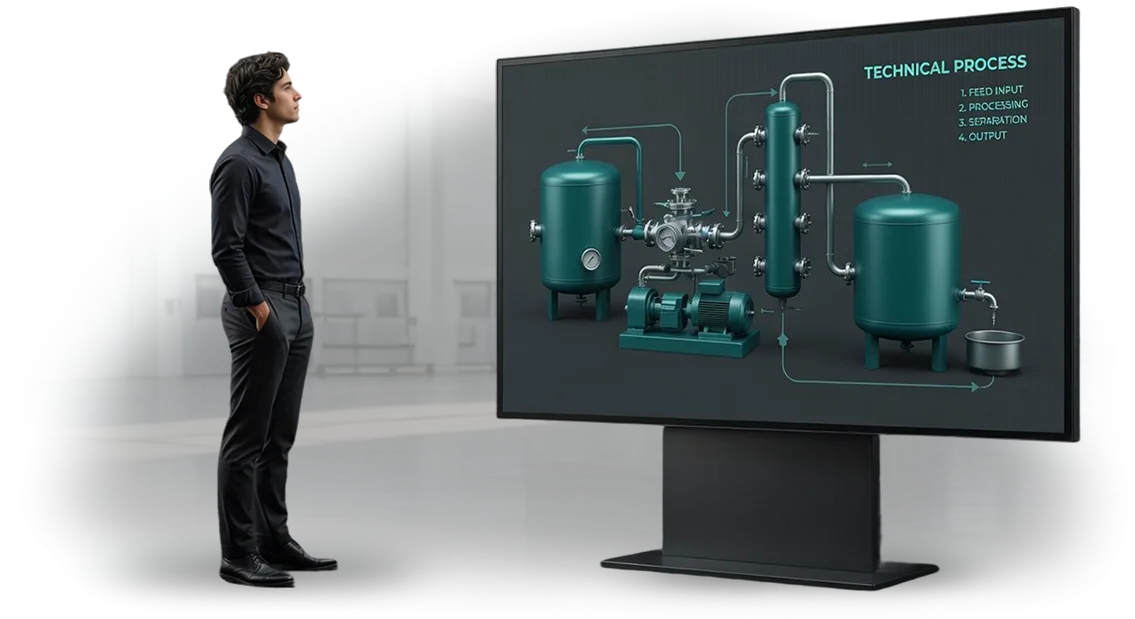
Problems in plastics manufacturing: employee errors and defects
Plastics processing is a technologically complex process where the cost of an employee error is measured not only in a spoiled batch, but also in line downtime and missed deadlines.
An untrained operator acts by guesswork, relying on memory or advice from colleagues — each such case leads to deviation from the procedure, overconsumption of raw materials, and a higher defect rate, which directly hits the product's cost.
Problems often arise not from negligence, but from the lack of a unified work standard. Verbal instructions are perceived differently by each person, and employees read text-based procedures carelessly and quickly forget them.
A newcomer learns through trial and error, spending the time of experienced mentors and creating the risk of producing off-spec products that end up as waste or require costly rework.
Video instructions solve this problem systematically: they capture the benchmark for each step and make knowledge accessible to every employee at any moment. Instead of spending a shift on guesswork, staff can consult a visual reference and work without mistakes.
This is not just training — it's packaging your experience and standards into a format that eliminates ambiguity and delivers consistent quality on every shift.
What a training video package delivers to the client
We know how expensive defects are in plastics manufacturing: rework, equipment downtime, lost orders.
Traditional "word-of-mouth" training dilutes the technology — each operator remembers the process differently, and quality control depends entirely on the mentor's experience.
Video instructions with CGI animation close this gap: the employee sees the benchmark process, not a subjective retelling.
Fewer defects and rework
Process animation shows all key operations: heating, pressure, sequence of actions, control points. The employee checks each stage against the video — and the error rate drops noticeably.
In our projects, clients report defect reductions of up to 30% within the first months after implementing the instructions.
Faster onboarding for new hires
Instead of two weeks with a mentor, a new operator masters the process in 2-3 shifts. The video can be rewatched at any time — no need to wait for an experienced colleague to become free. Production gets a fully capable worker faster, and the workload on line staff decreases.
A unified standard for training and quality control
All employees — from new hires to shift supervisors — work to the same benchmark. This simplifies quality control: the manager knows exactly which points to check. And when expanding the team, there's no need to develop new manuals — just show the video.
We've been creating such packages for plastics manufacturers for over 10 years. Each video is built into the training system: the script is aligned with technologists, and the animation mirrors the real sequence of operations. The result is a tool that works both for hiring and for ongoing skill development.
Video instruction formats for plastics manufacturing
The choice of format directly affects how quickly new operators settle in on the line and how many mistakes they make in their first week. Filming the workshop gives a realistic picture, but doesn't show internal processes.
Three-dimensional animation, on the other hand, lets you look inside the machine and safely break down each stage — from raw material loading to removing the finished part. We match the format to the specific operation rather than using one template for everything.
| Format | For whom | What it gives the client |
|---|---|---|
| 3D process animation | For complex operations, new equipment and hazardous areas | Shows the line's internal structure and allows practicing the sequence of actions without risk to people or equipment. The employee sees the process as it actually happens, with emphasis on key control points |
| Production video filming | For training on specific equipment where real context matters | The employee immediately recognizes their workshop and machine and sees real operator movements. Less adaptation time, higher trust in the instruction |
| Animated diagram | For quick review of procedures, operation sequences and routes | Compresses a long instruction into a short, memorable visual sequence. Helps the operator quickly refresh knowledge before a shift |
Most often we combine formats in a single training system: the overall line logic — animation; specific actions on different equipment models — video filming; quick-reference guides and checklists — animated diagrams.
This approach cuts onboarding time by a third on average and significantly reduces the number of human-factor errors. You get a material package that covers both new hires and experienced staff during retraining.
How we make a video instruction: 6 steps for the client
Each stage of video instruction development has its own value: the right brief determines whether the video actually covers the operations that reduce defects.
In plastics manufacturing, it's especially important that a new employee quickly masters the process and avoids mistakes at high temperatures or when working with molds. That's why we've structured the work so the client sees an intermediate result at every step.
Six stages from brief to finished video
- Video brief. We discuss the purpose of the instruction, the audience, and problem operations. You specify deadlines, placement format, and requirements — we capture them in a short document.
- Process analysis. We visit the production site or meet with your technologists. We break the operation down to the smallest detail: what happens to the material, on which machines, and where employees most often make mistakes. This is the foundation for the script.
- Training script. We write a shot-by-shot plan, the narrator's text, and the instruction logic: from tooling preparation to part quality control. The script is approved before filming, so changes at this stage cost nothing.
- Production filming and computer animation. We film real operations at your site. Hidden processes — melt flow, the work of internal components, changes in material structure — are shown through animation. In this way, the employee understands not only "how" but also "why."
- Draft and video approval. We assemble the video, add voiceover and subtitles. We show the draft, collect feedback, and make edits. Approval is fast — usually two rounds of amendments are already included in the work.
- Launch and material handover. We deliver the final files in the required formats: for a distance learning system, tablets at the machine, or team meetings. If needed, we help upload the instruction to your platform and verify the video opens on all devices.
The result is a ready-made video instruction that shortens the time to full proficiency and reduces the number of errors. We manage the process, and you see the result at every stage.
What's included in the delivery: material package for launch
The video instruction package is not just finished videos. You receive a full set of materials to start training employees in plastics production right away: from scripts and storyboards to files for embedding into a distance learning system.
Everything is packaged so the HR department doesn't waste time on modifications and can use it for skill development immediately.
Here's what's included:
- Finished videos — video instructions in formats for different platforms: from a training portal to a tablet or a screen at the workstation. Employees can review the material at their convenience.
- Script and storyboard — a text description of each frame and the explanatory logic. You can see exactly what is shown and how, and easily make changes before final editing.
- Training files — short versions, diagrams, and checklists for review. They help consolidate the material and work even without access to the system.
- Video rights — you receive full rights to use the materials not only for training, but also for presentations, internal communications, and new-hire onboarding. No restrictions on duration or number of employees.
- Project support — implementation assistance, consultation on organizing training, and, if required, updating the videos for new tasks or production changes.
With this package, launching training takes days, not months. You rely on ready-made materials that already account for the specifics of plastics production and your team's characteristics — all that remains is to set a date and add the videos to the program.
Case study: how 3D animation cut the number of errors on the line
In plastics manufacturing, the cost of an operator error is not only a spoiled batch, but also line downtime, missed deliveries, and extra rework costs.
Text instructions and old video footage don't show the nuances: how to set the temperature, when to remove the part from the mold, what counts as an acceptable deviation. As a result, employees work by guesswork, and defects become a routine loss item.
We solved this problem for a major manufacturer of plastic products. Instead of flat diagrams, we created a series of 3D video instructions: every stage — from press setup to packing the finished part — is shown in motion, with focus on critical points.
New employees no longer need months of being paired with a mentor — the video provides the foundation, and the mentor helps with fine nuances.
Results after implementation
| Metric | Before the project | After implementation |
|---|---|---|
| Defect rate on the line | 4.2% | 2.6% |
| Time to full proficiency for new hires | 3 weeks | 5 days |
| Operator errors during setup | 12 per month | 4 per month |
The production manager summarized the result this way: "Operators have stopped guessing — they see the benchmark process and reproduce exactly that.
Disputable issues are resolved in minutes, not through reviewing each batch." The first block paid for itself in 4 months through reduced losses and shorter downtime.
After that, the client ordered animation for three more areas of the workshop — video instructions became part of the internal standard.
We scale the same approach to other production sites: the important thing is not just to draw the process, but to make it understandable for any new hire.
How to choose the right video instruction format?
The choice of video instruction format should start not with the budget, but with the question: what exactly should the employee see and remember?
If the task is to familiarize a new hire with the area, equipment layout, and actions in a typical situation, filming at the production site is sufficient. It naturally shows the real environment, and such a video is produced faster and at lower cost.
3D animation is justified where the camera is powerless. In plastics manufacturing, many processes are hidden inside the equipment: polymer melt in the injection molding machine barrel, screw movement, mold filling.
The operator doesn't see these stages, yet that's where most errors and defects originate. Animation makes the invisible visible — the employee understands the physics of the process, not just memorizes a sequence of buttons.
The video budget matters, but the specifics of production matter just as much. Live filming may seem cheaper, but site preparation, approvals, and retakes consume time and money.
High-quality 3D animation requires a larger upfront investment and fully pays off when the instruction is used for years and is equally understood in every workshop.
The main selection tool is the technical specification. It records the specific operations, hazardous areas, procedures, and employee skill levels.
Based on that, we propose the optimal combination: live filming in some places, animation in others, and often both formats in a single video. This way you get an instruction that solves the training task, not just "nice video" to fit a budget.
Answering your questions about timelines, cost, and video rights
Before ordering a video instruction, owners and technologists at plastics manufacturing companies ask the same questions: how fast will we get the videos, how much does it cost, and who owns the materials.
We've produced more than 100 training videos for industrial companies and compiled answers to these concerns.
How long does it take to develop a video instruction?
On average — 3-4 weeks. Less for a simple process with a single line, a little longer for a multi-stage production with equipment animation. We commit to a specific date in the contract and deliver on time so you can launch training for new employees on schedule.
How much does a video cost?
The cost depends not on the "video length," but on the scope of work: the number of scenes, the complexity of the 3D animation, and the filming of the real workshop. Before we start, you receive a detailed estimate.
After approval, the price is fixed, and we don't issue additional invoices — you can plan the budget with confidence.
What if the video doesn't fit?
We don't hand over "raw" results. Work proceeds in stages: after the script, draft animation, and editing, you receive versions for feedback. If something doesn't match your process, we make changes within the approved scope — at no extra charge. You approve the final result, and only then do we render the final version.
How do we make edits after launch?
Technologies and equipment change over time, and the video instruction should keep up. We store the source files and can quickly update the video: add a new operation, replace a component, re-record commentary. This costs a fraction of making a new video from scratch and takes just a few days.
Who owns the rights to the video?
After full payment, all rights transfer to you. You can use the materials on an internal training portal, on computers in the workshop, and for new-hire onboarding — without restrictions.
We don't share the videos with third parties and don't show them in a public portfolio without your permission.
Let's discuss your task and prepare a video instruction plan
Plastics manufacturing involves multi-stage processes where even a small inaccuracy leads to defects, downtime, or material overconsumption.
Text instructions and mentor-led sessions don't always deliver consistent results: employees absorb information differently, and experience is passed on unevenly.
Video instructions establish a single standard — every new worker sees the benchmark process and reproduces it without loss of quality.
We invite you to a consultation on developing training video instructions. In half an hour, we'll review your task and suggest the right material format — without obligations or unnecessary technical detail. On the call, we'll discuss specifically:
- Training goals — accelerating new-hire onboarding, reducing errors, monitoring procedure compliance.
- Target audience — operators, setup technicians, warehouse staff, or the entire workshop; their skill level and working conditions.
- Technological processes — from raw material preparation to finished product quality control — that need to be shown as clearly as possible.
- The right video format — short "how-to" videos, full courses for each area, or combined materials with tests.
- Production plan — development stages, timelines, and areas of responsibility for the client and the contractor.
- Implementation at the production site — where employees will watch the videos: on stationary screens in the workshop, on tablets, or through an internal training system.
- Project cost calculation — a transparent estimate with no hidden charges, tied to the volume of materials and process complexity.
Following the consultation, you'll receive a detailed video instruction plan — with the chosen format, video structure, and an approximate budget.
We'll also advise how to embed video training into your current processes so new employees get up to speed faster and current ones make fewer mistakes.
Leave a request on this page — we'll get in touch, clarify the details, and find a convenient time to meet.