

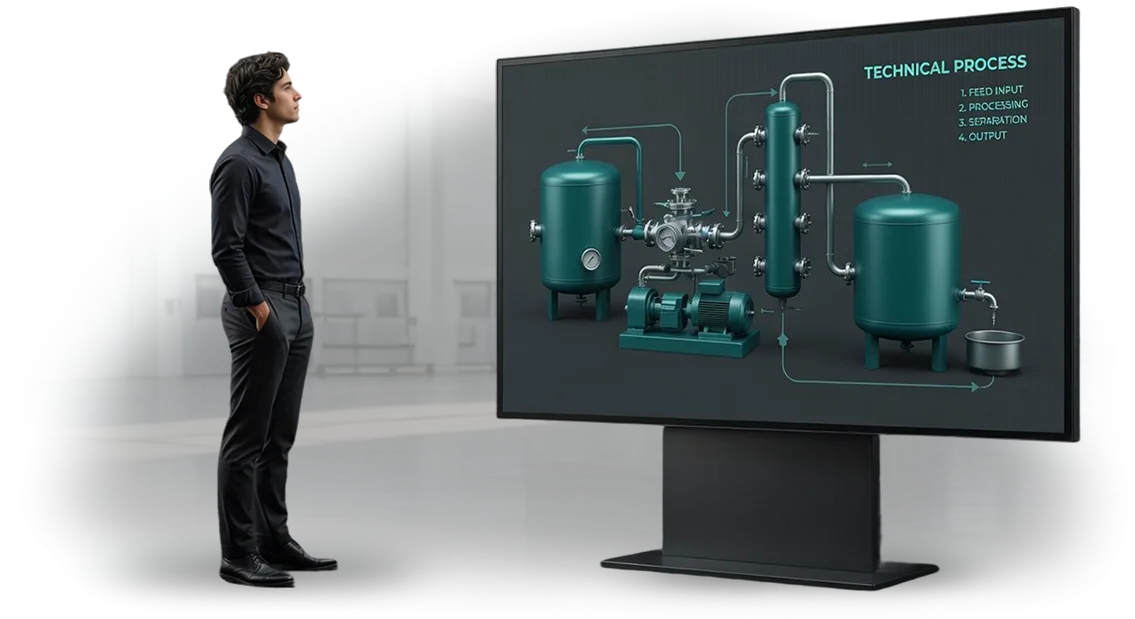
Why Training Videos for Semiconductor Manufacturing Don't Work
Employees at semiconductor manufacturing facilities work with processes that cannot be seen with the naked eye: wafer etching, thin film deposition, lithography.
Regular training videos are shot "as is" — the camera shows the surface of the equipment, but the internal transformation stages remain hidden.
Instructions for employees turn into a set of mechanical movements without understanding why and how the technological operation happens.
This is where the client's main pain point comes from: a newcomer learns slowly, and experienced operators cannot put into words what they are used to feeling intuitively.
Semiconductor manufacturing is a high-responsibility zone where one employee's mistake results in a rejected batch and lost time on equipment restart.
Without a clear explanation of complex technological processes, training stretches out for weeks and relies on the memory of specific people.
What does the business get? Turnover is accompanied by constant risks: an employee leaves — the process knowledge leaves. Two-dimensional drawings and presentations do not show material movement, temperature zones, or the sequence of chemical reactions.
That is why video instructions that do not accurately reproduce the technology do not reduce the load on mentors and do not speed up a newcomer's path to working a shift.
We solve this problem with detailed 3D animation of technological processes. The animation shows the inside of the equipment, reagent flow, and wafer behavior — everything that housings and safety systems hide on real equipment.
This format of training video gives the employee a holistic model that they instantly transfer to real work: less fear of making mistakes, higher operation quality, lower defect rate.
It is important to understand: we are not just making a pretty picture, but a training tool crafted by a senior technologist and production engineers. Every stage is checked against the real sequence of actions.
For the client, this means that training stops being the weak link and starts working for process speed, stability, and predictability.
What CGI Animation Delivers in Corporate Training
For semiconductor manufacturing, the cost of a mistake is especially high: defects at any stage result in lost batches and equipment downtime.
Regular text instructions and static diagrams do not convey the dynamics of the production process, so new employees learn for months and often repeat other people's mistakes.
CGI animation turns a complex production process into an understandable visual story. Instead of abstract descriptions, the operator sees how the material behaves, where the risk of damage arises, and why each operation matters.
We — our team — create such videos based on your technical documentation, so the animation precisely matches the procedures rather than the approximate logic of "how we used to do it."
Such process visualization directly affects three business metrics. Training speed: video material is absorbed many times faster than text, and the trainee reaches independent work sooner.
Error reduction: the employee sees typical violations and their consequences in advance, and therefore makes fewer defects in real work.
Standardization: everyone — from newcomer to experienced technologist — gets a single picture of the process, without personal interpretation of instructions or "shop floor" habits.
The visibility of hidden stages is especially valuable. In semiconductor manufacturing, most operations happen inside equipment, under vacuum, or at the micro level.
CGI animation shows these processes as if the operator had X-ray vision: layers, etching, deposition, thermal treatment. This lowers the entry barrier for newcomers and reduces the flow of questions to mentors.
In the end, a training video pays for itself on the first group of employees: faster adaptation, fewer defects, a unified quality standard. And the animation itself can be reused — when hiring, recertifying, and launching new equipment.
Video Instruction Formats for Different Tasks
The choice of video instruction format directly affects the speed and quality of employee training.
For semiconductor manufacturing, where every stage requires precision, it is important not only to show the sequence of actions, but to explain why this step is needed and what happens if it is skipped.
That is why we separate the tasks: general introduction to the production process, learning hidden mechanisms, and checking the material learned.
We use a different format for each task — so training takes less time, and the employee starts working independently with more confidence.
| Format | For whom | What it gives the client |
|---|---|---|
| 2D animation | New employees getting familiar with the workshop layout and process logic | Clearly explains equipment operating principles without filming in the clean room — faster onboarding |
| 3D animation | Operators and technologists who need to understand the internal structure of equipment and hidden processes | Shows the mechanics and physics of the process "from the inside," reducing the number of errors during setup and operation |
| Interactive modules | Employees before being approved for independent work and during periodic certification | Allow checking knowledge in a safe environment; the system itself hints which step caused difficulty |
In a single project, we often combine formats: a 2D overview module, a detailed 3D breakdown of components, and an interactive exam at the end.
This way you get a training system rather than scattered videos, and each employee goes from "seeing it for the first time" to "working with confidence."
Stages of CGI Animation Development for Semiconductor Manufacturing
Developing animation for semiconductor manufacturing is a process that requires precision and immersion in your technological procedures. We have structured it so that at every stage you understand what is happening and can influence the result. Below are the six steps a project goes through.
-
Brief and production analysis. We study your technological process, equipment, and procedures. We define the goals of the video instruction — what exactly the employee must understand and remember. You receive a document with a clear work plan and timeline.
-
Script and storyboard. Based on the brief, we create the narrative: which stages to show, in what sequence, where close-ups and emphasis are needed. You approve the text script — this is the foundation that protects against rework at later stages.
-
Visual style approval. We show examples of styles and levels of detail — from a simplified diagram to a photorealistic approach. You choose the option that is clear to your employees and matches the corporate standard.
-
Implementation and interim checks. Animators assemble draft versions of key scenes. We send you a video for review, you provide comments — revisions are made before the final assembly, not after.
-
Final assembly and launch. We prepare the final version in the required formats: for the learning management system, video hosting, or offline viewing. We check playback on different devices and package the materials with usage instructions.
-
Support and updates. If the technological process changes later, we quickly make revisions to individual scenes — without rewriting the entire animation. You get a working tool that does not become outdated.
What's Included in the Corporate Training Video Delivery
We deliver a comprehensive training product, not just a video. It includes everything needed for employees to start working to the new standards immediately after publication — from the script to upload into your training system.
- Script. Written based on the real technological processes of your semiconductor manufacturing. Divided into short 2–3 minute modules so training fits easily into the work schedule without pulling employees away from their tasks.
- Animation. Detailed CGI visualization of every production stage — from material preparation to final assembly. Shows nuances that cannot be captured on real equipment.
- Voiceover. A professional narrator with clear diction and Russian subtitles. The material is equally understandable for new employees and experienced technologists.
- LMS integration. We upload the finished videos into your system — Moodle, iSpring, or a corporate LMS. We set up completion tracking, tests, and statistics so you can see who actually studied the instructions.
- Test assignments. Ready-made questions for each module. Employees take the check right in the LMS, and you get an objective picture of the team's readiness.
- Supporting materials. Reference cards, instructions, and presentations for internal training. Can be printed, sent via messenger, or used at meetings.
- Technical support. After delivery, we support the project: we update videos when procedures change, make revisions, and answer your administrators' questions.
This package covers the entire training cycle — from setting the task to monitoring the result. You do not need to hire separate contractors for the script, voiceover, and editing: everything is included in one delivery and one budget.
Case Study: How We Cut Onboarding Time by 30%
We worked with a large semiconductor manufacturer, Kremniy-Tech: the line has more than 500 operators, and every new product requires dozens of precise operations.
Paper procedures did not help — newcomers confused the sequence of actions, made defects, and spent up to two or three months adapting.
Instead of a standard presentation, we created a series of video instructions broken down by process stations. Each video shows the process through the operator's eyes: how to hold the tooling, in what order to tighten the fasteners, where tolerances are acceptable.
The employee watches 10–15 minutes before a shift and repeats the actions on a simulator. Before launch, we ran the scripts past the mentors and refined the details.
Results after two months
Onboarding time decreased by 30%: instead of two months, operators reached planned productivity in six weeks. The number of errors at the assembly stage dropped by almost a fifth — that means fewer defects, less rework, and a steady shipping schedule.
Why it worked
We filmed the video on the real line and edited it with an emphasis on typical errors. Mentors received a ready-made resource for monitoring, and operators got the ability to review the instruction from any device.
This is why the client ordered a second package of videos for the neighboring workshop after the first two months of work.
How to Choose an Animation Format for Your Task?
The animation format should be chosen not "just for show" but for a specific task: who needs to be trained, which operation to show, and what result counts as success.
A simple schematic graphic is suitable for introducing employees to the general layout of the workshop, while training a complex technological operation in semiconductor manufacturing requires detailed volumetric visualization — it shows the sequence of actions without risk to the equipment.
Budget and timelines determine the depth of detail: the more scenes and details, the longer production takes. But this does not mean you have to sacrifice quality with a limited budget.
The optimal option is to split the video into modules: a basic video for the whole team and short in-depth segments for operators of specific equipment. This way you get the right coverage without unnecessary costs.
The specifics of semiconductor manufacturing are high precision and a strict sequence of operations. Animation allows you to show the process step by step, with an emphasis on critical moments that are hard to explain with text or photos.
At the same time, we adapt the level of detail to the employees' skill level: general logic for newcomers, nuances that affect product quality for experienced workers.
We help you decide on the format and scope before the start: we analyze your task, audience, and available budget, then offer two or three options with different levels of detail and timelines.
You choose the optimal one — without overpaying for unnecessary "bells and whistles" and without losing the training effect.
This approach has already proven itself on projects for industrial enterprises: a short module for mass training covers basic needs, and detailed 3D animation of the technological process becomes the basis for certification and professional development. You get exactly the format that solves your task, not just a pretty video.
Frequently Asked Questions About Developing Training Video Instructions
Managers worry that videos will take a long time to approve, cost more than expected, and ultimately sit on a shelf. We answer the main fears right away — without technical details or hidden conditions.
How long does it take to develop video instructions?
Timelines depend on scene complexity and the amount of material. After the brief, we give an exact date and fix it in the contract.
For a typical project of 3–5 instructions, 2–3 weeks is enough, but the key thing is that the schedule is not disrupted: we are responsible for delivering the result by the agreed date.
How much does development cost?
The cost depends on the number of videos, duration, the need for computer animation, and sound quality. After the brief, you receive a detailed estimate where every action is itemized.
The price is fixed in the contract and does not change during the process — you plan your budget without risks.
Is it difficult to integrate video instructions into current training?
No. We deliver ready-made videos in the required formats — they can be uploaded to a corporate portal, a learning management system, or inserted into a presentation. If needed, we help with access setup and navigation so employees can quickly find the video they need.
What guarantees that the videos will deliver the required result?
We guarantee fixed timelines and cost in the contract, as well as several rounds of free revisions. For semiconductor manufacturing, we accurately reproduce every technological step so employees learn the process without distortion. After launch, we stay in touch and promptly update content if processes change.
Order CGI Animation for Your Production
After your request, you receive not just an estimate but a ready-made strategy for implementing CGI animation at your semiconductor manufacturing facility.
We handle all the questions — from calculating the scope of work to showing examples that have already delivered results for other clients.
What the first stage includes:
- Cost and timeline calculation for your technological process — without hidden surcharges or "surprises" during the project.
- An animation usage strategy: where it will reduce training time and where it will replace expensive training equipment.
- A selection of examples from your industry — you can see what animated semiconductor manufacturing operations look like before signing the contract.
- A consultation with a technologist and a producer: we analyze your process and suggest optimal formats — for training portals, offline training, or instruction sessions.
- A clear launch plan with checkpoints and a person responsible for each stage.
Then we move on a transparent schedule: brief and process analysis — two to three working days; script and storyboard creation — another week; animation production and approval — the main stage, which takes from two to four weeks depending on complexity. At every step, you receive interim versions and can make revisions without losing time.
Wehave been creating CGI animation for enterprises for over ten years, so we know how to present a complex production process in a way that is clear to a newcomer and useful to an experienced employee.
Leave a request — within a working day we will send you an estimate, a strategy, and examples relevant to your production.