

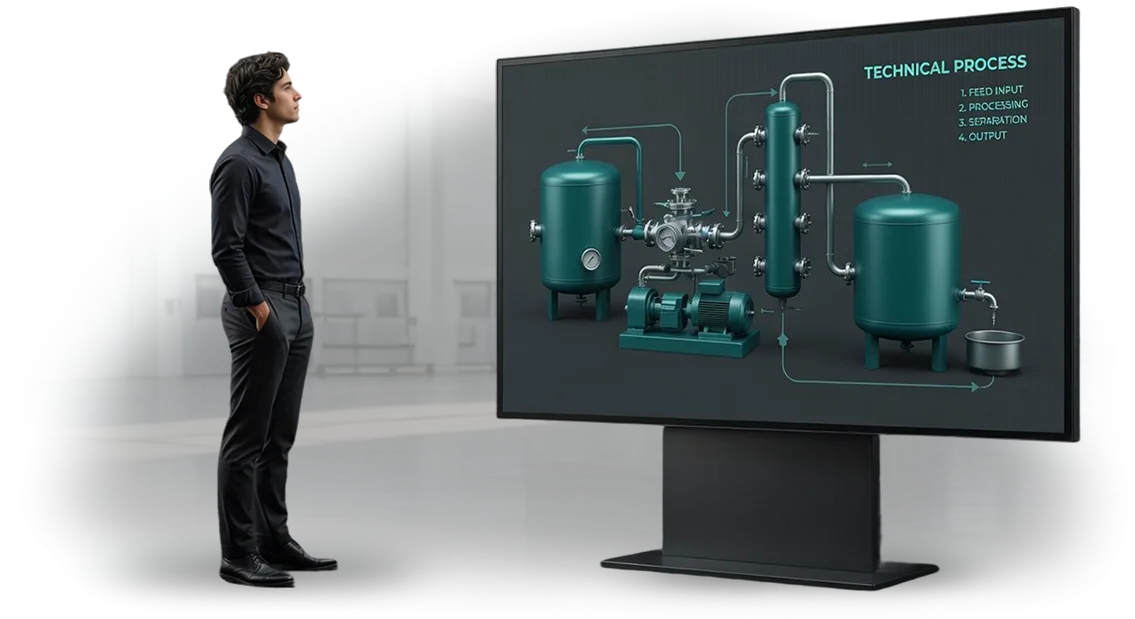
Why Do Telecom Employees Waste Time on Training?
Every day of downtime in a telecom company costs a lot: a new employee spends weeks learning from outdated instructions, while experienced staff spends hours re-explaining the same processes. The result is staff errors on the line, missed connection deadlines, and a growing load on support.
Instead of quickly reaching the required level, a newcomer gets lost in dozens of PDFs and video recordings that don’t match real work scenarios. Such staff training doesn’t provide a complete picture, and knowledge is forgotten within weeks. In the end, the business pays for mistakes twice — first for training, then for their consequences.
We solve this problem with visual instructions that show the technological process clearly, step by step, without unnecessary details. The employee sees how to act correctly in a specific situation and can return to the material at any time.
This reduces onboarding time, lowers the number of errors, and relieves mentors, who can focus on real tasks instead of repeating themselves.
What a Corporate Video Instruction Gives Your Business
A new employee, instead of spending weeks in a mentor’s shadow, gets access to a reference lesson. The video instruction shows every step and eliminates the "broken telephone" effect.
In telecommunications, where processes are complex and multi-stage, this is especially valuable: one mistake while configuring a node can be very costly.
Check yourself against this checklist:
- Process standardization. The whole team performs operations identically, according to the current procedure. The result no longer depends on the memory or mood of an individual employee.
- Fast onboarding. New people become productive in days, not months. The video can be rewatched, and employees can return to difficult moments without asking colleagues for help.
- Reduced mentor load. Experienced specialists stop repeating the same thing — they gain hours for real tasks instead of endless explanations.
- Training quality control. Managers see which scenario employees are learning and can quickly update the instruction after process changes.
- Knowledge retention. Losing a key expert no longer means losing competencies: their experience is captured in clear videos and stays in the company.
We shoot and animate such instructions with professional equipment and server architecture for fast loading. You don’t need to understand the technology — you receive ready-made videos that integrate into corporate training and work for your business.
Formats of Training Videos for Telecommunications: Choose the Right One for Your Task
Each training video format solves its own problem: a screencast helps quickly master an interface, 3D animation explains the structure of complex equipment, and a video with an expert builds trust and context.
This is especially important for telecommunications — employees work with systems, physical infrastructure, and clients alike. The key is to choose the format for the specific situation, not just to “make it look nice.”
| Format | For whom and when | What it gives the client |
|---|---|---|
| Screencast | For operators, client account managers, support staff — when you need to show how to work in CRM, billing, or an internal system. | Quick start: the employee sees exact steps and repeats them without errors. The video is easy to update when the interface changes — no need to reshoot everything from scratch. |
| 3D animation | For technical specialists, installers, engineers — when you need to explain processes inside the network, cable routes, node locations, or how equipment works. | Visibility of hidden processes. The employee understands how the system works as a whole and doesn’t risk equipment during training — everything is shown safely and realistically. |
| Video with an expert | For new employees, managers, and anyone who needs to understand company procedures and standards. | A live explanation from an experienced colleague inspires more trust than a dry instruction. The video engages and reduces the number of questions in the first weeks of work. |
You don’t have to choose just one: a combination of formats usually gives the strongest result. A screencast covers operational routine, 3D animation explains infrastructure, and an expert adds the human factor.
We’ll help you choose a structure that fits your task, timeline, and budget, so employees truly learn rather than just watch videos.
How We Create a Video Instruction: 7 Steps from Brief to Launch
We’ve structured the development of video instructions so that at every stage you understand what is happening and can influence the outcome. No “black boxes”: seven steps, from brief to launch, with approvals at key points. This reduces risks and saves your team time.
-
Brief and task audit. We discuss which operation the instruction should cover: equipment intake, router configuration, maintenance of communication nodes. We record target metrics — time-to-productivity for a new employee, number of errors per shift, ticket handling speed.
-
Script and storyboard. A methodologist turns the technological procedure into a sequence of simple actions. We approve the video script with you and with the relevant engineers, so no production nuance gets lost.
-
Production plan. We determine the format: filming at sites, computer graphics, or a combination. For telecommunications, we often choose CGI animation — it shows processes hidden in cable routes and server racks.
-
Video content production. We shoot at your sites, write the voice-over text, and create animation of technological operations. The finished material clearly demonstrates the sequence of actions instead of dry paper instructions.
-
Intermediate review and edits. We show the draft edit to your working group. We make changes to the logic, emphasis, and titles. You see the project developing before it goes to the final version — this avoids re-approval at the last moment.
-
Final version assembly. We add subtitles, interactive hints, and divide the video into sections by work stages. The finished video is easy to embed in a learning management system or your company’s internal portal.
-
Launch and support. We hand over source files and an administrator guide. If employees have questions about the video, we quickly update the relevant fragments. When the technological process changes, you only need to rework the necessary episode — no need to reshoot everything.
What Is Included in a Video Instruction Package
We deliver not just videos, but a ready-to-implement delivery set. Inside is everything needed to launch a training program: from the videos themselves to files for your learning management system (LMS) and usage recommendations.
- Training videos in high quality, adapted for different devices — from desktop computers to employees’ smartphones.
- Subtitles and additional text versions of the instructions — so the material is accessible in any viewing conditions and for people with different needs.
- Ready-made LMS files: a course in a standard format that is easy to upload into your system and assign to employee groups.
- Implementation recommendations: how to embed the videos into your existing training program, in what order to show modules, and how to check understanding.
- A material update guide — so instructions don’t become outdated and remain relevant when procedures change.
- Promo materials for internal communication: announcements and posts for the corporate portal that help get the team interested in advance.
Thanks to this package, you get not scattered files but a managed solution. Employees train in a single system, and you see progress and results — all in one place.
We take responsibility for making the delivery set complete and ready to use. All you have to do is upload the materials and launch the training — everything else is already thought out for you.
Case Study: Reducing Errors by 40% with Video Instructions for Telecommunications
A large telecom operator, Volna Telecom, faced a typical pain point: new support employees made mistakes when configuring equipment, and training took almost a month.
Experienced mentors were distracted from their work, and employees simply didn’t finish reading some instructions — so mistakes repeated again and again.
We proposed replacing text procedures with a series of short video instructions. We used CGI animation to show internal processes — clearly, without the need to open real equipment. Each video covered one narrow scenario: from connection to diagnostics.
The videos were uploaded to the internal portal so employees could review a needed step in a couple of minutes.
The result after two months: staff error rates dropped by 40%, and onboarding time was cut in half. Attrition in technical support decreased — newcomers reached target metrics faster and were no longer afraid of complex tasks. Service managers stopped spending time re-explaining the same things.
After the first results, the client ordered a second series of video instructions for installation teams and the sales department. Now the videos are used as a base for adaptation in all branches — that’s more than three hundred employees.
How to Choose the Right Training Format for Your Team?
The decision lies in the balance between material complexity, team size, and employees’ working conditions. In telecommunications, instructions are most often needed for sequential operations: equipment setup, installation, diagnostics.
When an action consists of 10–15 steps, a video instruction works better than any text: your eyes are busy with the task, your hands repeat, your brain remembers.
The first selection criterion is how often employees refer to the material. If an instruction is needed once a month, a short video with clear stages, easy to review on a tablet, works well.
If training is large-scale, for example when launching a new service line, you need a format focused on scenarios and process logic so that the whole team shares the same understanding.
The second criterion is the company’s technical environment. Check what devices employees will use to watch the video: desktop, tablet, smartphone.
This affects editing, subtitles, and duration: for a phone screen, it’s better to split the video into 2–3 minute segments, while the training portal can support full-length modules.
The third criterion is employee experience. Beginners need detailed explanations with repetition; experienced specialists need a concise sequence of actions. We combine formats: a main instruction plus a quick-reference card with the key steps. This gives you speed of implementation without losing quality.
We are ready to analyze your processes and suggest a suitable option — from animation of a technological scheme to an instruction with real footage.
We’ll think through the script, timing, and delivery method so your employees start working according to the new standard within the coming weeks.
Frequently Asked Questions About Developing Corporate Video Instructions
Before ordering corporate video instructions, clients most often hesitate about timelines, compatibility with their learning platform, and guarantees. We’ve gathered answers to these questions so you can plan your training without surprises.
If your question isn’t covered here, write to us, and we’ll tell you in detail about your scenario.
How long does it take to create one video instruction?
Usually 5 to 15 business days from the moment the script is approved. The timeline depends on the complexity of the technological process and the chosen format — animation, combined footage, or 3D graphics.
For a series of videos, we adjust the process so that each next video is produced faster. Exact dates are fixed in the contract — you can confidently plan the training launch.
Can we upload the video to our learning management system?
Yes, we deliver files in standard formats supported by all popular platforms. If needed, we add subtitles, chapter breaks, and tests. Your specialist will receive ready-made videos and a short upload guide — the whole process takes no more than an hour.
What if we’re not satisfied with the result? Are there guarantees?
Guarantees are written into the contract: we fix timelines, scope of work, and the number of free revisions. Usually this is two or three iterations to polish the video. If an error is found in the process description, we fix it at no additional charge.
How much will development cost? How is the budget formed?
The budget depends on the format, duration, and complexity of the process. We calculate the cost after the brief and show an estimate in a table — you can see what the price consists of and adjust the scope. We work in two options: a single instruction or a series of videos with a discount.
Order Video Instructions for Telecommunications: Get Results
We create training video instructions for telecommunications companies that reduce the time required to bring new employees up to speed and improve the quality of customer service.
You receive a finished product, not just “videos”: scripts, filming, editing, and adaptation to your internal standards.
After ordering, you receive:
- Video instructions that employees watch without interrupting their work — at a convenient time and from any device.
- A unified training standard: every employee absorbs the material in the same way, with no “broken telephone” effect.
- Up to 40% reduction in training time thanks to visual scenarios instead of text procedures.
- The ability to update videos as processes change — without full reshoots.
- Full support: from brief to integration into your learning management system or internal portal.
- Post-launch support and refinements so the material stays relevant.
We value your time, which is why the launch process is as transparent as possible. Here’s what it looks like:
| Stage | What happens | Your benefit |
|---|---|---|
| Consultation | We discuss tasks, audience, and formats | You understand which video will solve your problem and receive an estimate |
| Brief and plan | We gather material, write the script, and approve the storyboard | You control the content without getting into technical details |
| Production | We shoot and edit the video, approving intermediate versions | You get a finished result that meets your expectations |
Start with a consultation — in 30 minutes we’ll walk through how video instructions can accelerate training in your company. Leave a request on the website, and we’ll propose a solution for your budget and timeline. Our team has already completed more than 200 similar projects, and yours can be next.