

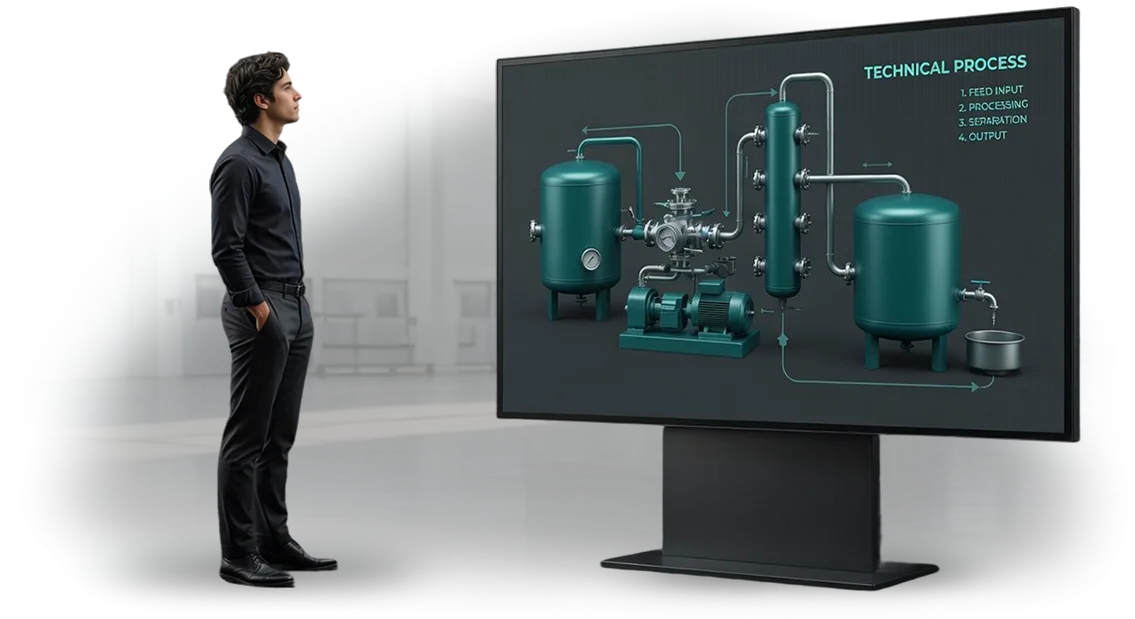
Pipeline transport: how to train personnel without accidents?
Errors by personnel at pipeline transport facilities are one of the main causes of accidents and incidents.
An incorrect operator action, failure to follow regulations, or a misunderstanding of the technological process leads to downtime, leaks, environmental risks, and serious financial losses.
For a business owner, this is not just a failure — it is a blow to the reputation and resilience of the entire company.
Traditional employee training often does not solve the problem. Printed instructions and long lectures overload with information; by the end of the training attention is lost, and crucially, the worker does not form a clear picture of how to act in a real situation.
As a result, the employee knows the rules “in theory” but acts on intuition in a stressful or non-standard situation.
Video instructions change the approach to personnel training. They show the technological process visually, with the exact details that cannot be conveyed in text: the sequence of operations, the arrangement of components, and correct actions in an emergency.
This format allows the employee to see the safe work algorithm on screen and remember it, reducing the risk of errors at a real facility.
Furthermore, video instructions help establish a single training standard for all employees, regardless of experience or shift. The company gets a manageable training process that is easy to reproduce and update. This directly affects pipeline safety and reduces the accident rate at the enterprise.
We develop corporate training video instructions for pipeline transport and know how to turn a technical procedure into an understandable and memorable scenario.
Together with you, we close the main risk — the human factor — making employee training effective and safety manageable.
What a video instruction with CGI animation gives a manufacturing enterprise
Video instruction with CGI animation turns training from a formal obligation into a practical preparation tool.
Instead of text-heavy regulations and occasional lectures, employees see the exact sequence of operations in three-dimensional graphics, where every component and every stage is visible.
For pipeline transport, this is critical: personnel errors here result in downtime, fines, and safety risks.
The first and most important point is reducing the number of errors. When a person sees the correct process with their own eyes, rather than reading about it, they remember the procedure at the level of visual memory.
Practice shows that video instructions with CGI animation increase training effectiveness several times over, so the employee starts working without defects and rework more quickly.
Second advantage: faster onboarding of new employees. Instead of shadowing a mentor for weeks, a beginner studies the video instruction on their own and is already performing basic operations confidently by the end of the first week.
This reduces the burden on experienced workers and speeds up the time to full productivity for a workshop or section.
Third effect: a uniform knowledge standard. Even if different instructors conduct the training, all employees get the same visual representation of the correct process.
This is especially important for enterprises with remote facilities and distributed teams, where it is impossible to gather everyone in one classroom.
Fourth benefit: savings on instructors. One high-quality video replaces dozens of hours of in-person training and can be reused without additional costs.
At the same time, CGI animation shows processes inaccessible to the human eye — the internal structure of the pipeline, the movement of media, actions in emergency situations — making training more visual and safer.
Ultimately, a manufacturing enterprise gets not just a training video, but a measurable effect: fewer errors, faster onboarding, stable knowledge quality, and lower training costs. This is recouped through reduced defects and downtime within the first months after implementation.
CGI animation formats for personnel training at enterprises
The choice of video instruction format directly affects how quickly employees will master the regulations and how precisely they will perform operations. For pipeline transport enterprises, where errors are costly, maximum clarity and detail are essential. Therefore, we select the format for a specific task: from full 3D animation to simple 2D diagrams.
| Format | For whom / what tasks | What it gives the client |
|---|---|---|
| Full 3D animation of technological processes | Complex procedures: component design, media movement, non-standard situations | Full visibility, safe study of emergency scenarios without risk, formation of a clear action algorithm |
| 3D animation with photorealistic inserts | When you need to show real equipment and its details in context | Combination of detail and realism, quick linking of knowledge to specific objects at the production site |
| 2D graphics and diagrams | Simple procedures, safety briefings, frequent regulation updates | Fast creation and updating, low learning curve for new employees |
How to choose a format? If the process is complex and requires an understanding of internal mechanisms, full 3D animation will be the basis of training. When you need to show a real object and its features, a hybrid option is more effective. And for regular briefings and short reminders, 2D graphics are enough.
In any case, the client receives a finished training video that integrates into the distance learning system and can be used repeatedly. We help determine the optimal format at the brief stage, saving the budget and accelerating the launch of training.
Stages of developing a training video instruction: from brief to implementation
An understandable training video instruction for pipeline transport employees is not just a nice video, but a working tool that reduces onboarding time and reduces the number of errors.
We have structured the video production stages so that you control key milestones while we handle the entire technical track. Below is how the creation of a turnkey training video proceeds.
-
Brief and audit. We dive into your specifics: we analyze regulations, technological operations, and typical employee errors. We capture training goals, deadlines, and format — this is the foundation of the entire video instruction development.
-
Script and storyboard. We turn the technical process into an understandable story: step-by-step actions, safety emphasis, narrator text, and visual sequence. We align the script with your experts before production starts.
-
CGI animation production. We render technological processes in 3D, showing the design of components and the sequence of operations in a way that cannot be filmed at a real facility. You get clarity without risks or work stoppages.
-
Voice-over and editing. Professional narrator, synchronization with animation, subtitles, and a clear structure for comprehension. We assemble a draft version so you can see the entire video already at this stage.
-
Approval and revisions. We accept feedback and make changes to timing, text, or graphics. We work according to a clear revision procedure to avoid delaying the video production stages.
-
Implementation and support. We provide the source files and final files in the required formats and help integrate the video into your distance learning system or corporate portal. We remain available for updates and refinements.
What is included in the delivery of a corporate video instruction
The delivery package for a corporate video instruction is not a single file, but a working system for employee training. We provide the materials so that you can organize the viewing in any convenient form and make edits without involving a contractor.
- Ready video in the required formats — for your distance learning system, tablets on site, and projectors in the training classroom. The employee gets access to the instruction without extra steps.
- Project source files — all scenes, layers, and animation elements. If numbers or names change, your team can quickly update the video without ordering a new one.
- Methodological guide for the instructor — script with time stamps, questions to check comprehension, and recommendations for embedding the video into the training program.
- Short reminder versions — 30-second videos for messenger campaigns or the internal portal, so that key safe work rules for pipeline transport are always at hand.
- Content update procedure — if technological processes or requirements change, we promptly release a new version of the video, maintaining a consistent style and quality.
- Technical support at the start — we help set up playback on your equipment and verify that the video works correctly for all employee categories.
Case study: CGI animation of pipeline transport processes
For a pipeline transport operator, the cost of error is hours of downtime and safety risks. Traditional training with paper regulations does not provide the full picture: it is difficult to imagine how the medium in the pipe behaves when pressure or temperature changes. As a result, knowledge remains theoretical and errors repeat.
We solved this problem with CGI animation of the technological process. The client — NefteTrans — received a video instruction in which each stage was shown in motion: from starting the pumping station to emergency shutdown of the transfer. Operators saw internal processes that cannot be observed in real life.
How the animation was built
Together with the client's technologists, we examined three key scenarios: normal startup, scheduled maintenance, and an emergency situation. For each scenario, we created an animated diagram of product movement through the pipe with visualization of pressure and temperature.
The operator sees the consequences of each action and understands the logic of the process, rather than just memorizing the sequence of buttons.
This format of video instruction works better than regular presentations: attention stays on the screen, and complex moments can be replayed and paused.
Result for the business
Three months after introducing the animation into the training program, the number of operator errors decreased by 42%. Onboarding training time was reduced — employees reached working proficiency faster. The shift supervisor noted that new operators act more confidently in emergency situations.
The client's management rolled out this format to all its sites — the animation is now used as core material in personnel training. Video instructions do not become outdated: they can be supplemented when regulations change.
The case showed that CGI animation is not a decoration, but a working tool for reducing risks and personnel training costs.
How to choose the format of a training video instruction for your task?
The choice of training video format starts not with the visuals, but with the task. If you need to explain the sequence of operations to line personnel on a simple section, 2D graphics and diagrams are enough.
If we are talking about a pipeline transport technological process where equipment details, flow directions, and emergency scenarios matter, a full 3D model is essential.
The second criterion is the level of employee training and the complexity of perception. 3D animation shows the process from inside, in cross-section, from any angle, so complex procedures are absorbed faster.
2D graphics are cheaper and faster to produce, but lose in clarity when it comes to internal mechanisms or multi-step operations.
Combined format is the sweet spot: we show key components and hazardous areas in 3D, and the overall layout and routes in 2D. This achieves a balance between budget and training effectiveness.
Based on our projects, combined instructions reduce onboarding time by 20-30% — a newcomer immediately sees the real picture rather than reading abstract descriptions.
To decide, evaluate three factors: the complexity of the technological process, the number of employees who need the instruction, and the frequency of regulation updates. If the process changes once a year, an expensive 3D model is unlikely to pay off.
If it is standard equipment that serves for decades, detailed animation will work for years and become the foundation of the training system.
Come for a consultation — we will analyze your processes and offer a format to suit your task and budget. Over 10 years, we have developed more than 200 video instructions for industrial enterprises, including pipeline transport facilities. We will help you choose and design an instruction that ensures employees truly master the material.
Answers to frequent questions about corporate video instructions
Before ordering a training video, clients ask the same questions: about timelines, cost, filming complexity, and guarantees. We have collected answers to the main objections — without technical details, straight to the point. If your question is not here, just write to us, and we will advise you.
How much does developing a video instruction cost?
The cost depends on the format, duration, and number of scenes. For pipeline transport, CGI animation is often needed to show processes that cannot be captured by a camera, which affects the budget. After the brief, we give the exact figure and fix it in the estimate.
What are the production timelines?
The standard timeline is from two to six weeks. If the video includes complex technological processes, the time may increase for coordination with your experts. We specify the schedule in the contract and adhere to it.
Is it difficult to show pipeline transport technological processes?
No, if you use CGI animation. It shows internal processes that a camera simply cannot see: product movement in the pipe, the operation of shut-off valves, emergency situations. Employees understand the material faster than through flat diagrams.
What about the warranty on the video?
We provide a result guarantee: if the video does not meet the agreed technical specification, we make revisions free of charge. We also provide a warranty on technical quality — resolution, color reproduction, and sound. All conditions are specified in the contract.
What if the video is not suitable after delivery?
The risk is almost eliminated: before filming and animation, you approve the script and storyboard. We show key frames in advance. If revisions are needed after delivery, we agree on a list of adjustments and make them under the warranty.
Order a corporate video instruction for your enterprise
Leave a request for the development of a corporate video instruction — a specialist will contact you at a convenient time, clarify the specifics of your technological processes, and the size of the audience.
After a short conversation, you will receive a preliminary calculation of the video development cost and an implementation plan without needing to dive into production details.
What is included in the response to the request:
- Calculation of cost and timelines according to your budget, the number of employees, and scene complexity
- Video consultation: format selection — on-site filming, CGI animation of technological processes, or a combined option
- Examples of ready-made video instructions for pipeline transport enterprises and related industries
- Work plan: script, storyboard, production, editing, approval with your experts
- Application recommendations: for initial training, professional development, certification, or a distance learning system
- A dedicated project manager at all stages — you always know where the work stands and when the result will be ready
After the request, you will receive not an abstract “price range”, but specific parameters: scene volume, duration, timelines, and the expected result. This allows you to decide on launching the project in one or two days, without spending time on lengthy approvals.
To order a video instruction, fill out the form below or message us in a messenger. The consultation is non-binding — even if you are only considering the possibility, we will advise you on where to start.