

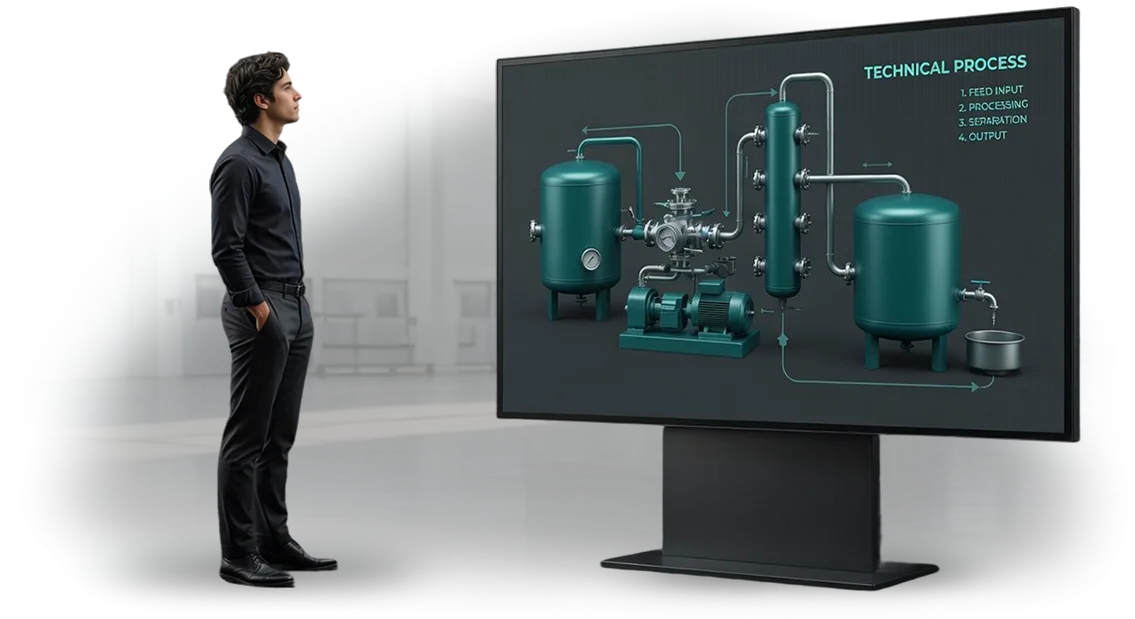
Pulp and paper industry: why training doesn't work
In the pulp and paper industry, staff training is a matter of safety. The cost of an employee error is especially high: stopping a paper machine, violating cooking technology, incorrect equipment setup — each such incident results in downtime, defects, and emergency repairs.
At the same time, most accidents occur not because of equipment complexity, but because an employee did not understand the instructions or could not apply them in time in practice.
Traditional staff training methods — text regulations, PDF diagrams, safety posters — cannot handle this task.
It is impossible to describe the dynamics of a technological process in words: how pressure changes in the digester, how the paper web moves, what happens during a break. Only a few understand this from text; in practice, almost all new employees make mistakes. Training drags on for months, and staff turnover forces you to start over.
CGI-based training video instructions help here. They allow you to show any process from the inside — without risk to people or equipment — and break down every action step by step. The employee sees how to do it correctly and repeats it in reality. Errors and accidents on the production floor stop being the "price of inexperience."
We develop such video instructions for enterprises in the industry and know how to turn a complex technological process into an understandable training scenario.
Immediately after launch, the number of staff errors noticeably decreases, and onboarding of new employees speeds up several times over.
What CGI animation gives for training at your production facility
Training on real risks — without risk to production
Pulp and paper production means expensive equipment, high temperatures, pressure, and chemical reagents. You cannot afford an error here: the cost is a line stoppage, injury, or accident.
That is why ordinary presentations and text instructions stop working: the employee does not see the process, does not feel its logic, and does not remember critical steps.
CGI animation solves this problem. We create an accurate 3D model of your process area — from raw material feed to finished product output. The employee sees the process from the inside, in the correct sequence, with emphasis on dangerous zones.
This makes training visual and safe: an accident can be analyzed on screen rather than on expensive equipment.
Benefit 1. Reduced accident rate
Each animation is built around typical errors and hazardous situations. A new employee knows where risk lies and how to act properly even before going on the line.
Production briefings become real preparation rather than a formality — the number of errors and injuries decreases within the first month.
Benefit 2. Faster onboarding
Instead of a week of reading regulations — a few days of immersive visual videos. The employee understands their area of responsibility faster, starts working independently sooner, and does not bother the mentor over trifles. A newcomer's adaptation time is cut several times over.
Benefit 3. Unified training standard
Everyone reads text instructions in their own way. CGI animation shows one reference scenario: what is right, what is wrong, and how it ends. All shifts and all branches are trained in the same way — and therefore work the same way, without quality loss.
What this looks like in practice
| Format | Target audience | What it gives the client |
|---|---|---|
| Full training film, 5-10 minutes | New employees | Fast onboarding without involving experienced staff |
| Series of short videos, 1-2 minutes each | Current staff | Repetition of critical operations, review of complex components |
| Interactive emergency scenarios | Operators, maintenance services | Practicing actions in abnormal situations without risk |
| E-learning module | HR department | Unified training standard across all departments |
We have worked with industry enterprises for many years
Behind us are projects for pulp and paper mills and related production facilities. We know the specifics of the industry: digesters, washing, bleaching, drying, and packing — and turn these processes into clear visual images.
You get not just a "pretty picture" but a working training tool that pays for itself through reduced defects, accidents, and staff turnover.
CGI animation formats for the pulp and paper industry
Technological processes in the pulp and paper industry are hidden from view: pulp cooking, bleaching, drying — all of this happens inside closed units and pipelines.
It is impossible for a newcomer to understand what exactly happens at each stage, and an operator error leads to downtime or defects. CGI animation solves this problem: it shows the process from the inside, in motion, with the required level of detail.
The animation format is selected for the specific task — from a full training film to a short reference at the workplace. We help you choose the option that will most quickly bring an employee to the required level of training.
| CGI animation format | Target audience | What it provides |
|---|---|---|
| Full animation of the technological process | New employees, trainees | Complete picture of production stages, shorter time to proficiency |
| Interactive simulator | Line operators, maintenance staff | Practicing actions without risk to equipment, fewer emergency shutdowns |
| Animated diagram | Line staff, briefings | Quick understanding of the product route, visual "what comes after what" instructions |
| Animation overlay on real video | Current employees | The combination of "I see the equipment and understand what's inside" — without stopping production |
Animated diagrams and video overlays take minimal time to watch, so they are easy to embed in short briefings. Full animation and simulators are for deep training, when product quality and the safety of the entire line depend on the employee.
This approach pays off quickly: fewer errors in production, less time spent on mentoring, and greater staff preparedness for abnormal situations. Next, we will explain how work proceeds on a format tailored to your task.
Development stages of training video instructions for your enterprise
Developing a training video is a project where sequence matters. We have broken the process into stages so you can control quality at each step and get a predictable result — from the first brief to launching training at your enterprise.
- Brief and task immersion. We identify training goals, the audience, and problem areas in staff performance. This lets us set the right level of detail and video format right away.
- Technological process analysis. We study regulations, equipment, and typical errors of pulp and paper production employees. Based on this, we build the logic of the future video.
- Script development. We create a frame-by-frame description, narrator text, and key emphasis points. Approving the script with your technologists is a mandatory stage to eliminate errors in detail.
- CGI animation creation. We model equipment and technological processes in 3D. This allows us to show what is hidden inside units and safely demonstrate actions that are difficult to repeat in reality.
- Editing and voiceover. We assemble the video, add graphic explanations and subtitles. We prepare versions for different training formats — from a screen on the shop floor to an e-learning system.
- Training launch. We hand over the finished materials and help integrate them into your e-learning system. The launch proceeds without delays or technical difficulties.
- Support and updates. After launch, we stay in touch: we quickly make revisions, update videos when regulations change, or when new equipment appears.
This workflow helps avoid surprises: you see the script and animation in advance, before final editing, and you receive an instruction that genuinely reduces onboarding time and lowers the number of staff errors.
What is included in the delivery of CGI training video materials
Instead of a single "bare" video, you get a complete delivery package you can work with for years.
We plan the material set in advance so that the training department, technical specialists, and marketing can use the result without developer assistance — both in current tasks and future projects.
- Ready video instructions in required formats — videos for LMS systems, embedding in presentations, and display on production screens. The client immediately receives files that can be uploaded to the e-learning system and issued to employees.
- Source projects and scripts — all texts, storyboards, and timings are delivered in editable files. If the technology changes, you can quickly update individual frames or the voiceover text without reshooting the entire material.
- 3D models of equipment and processes — these are not just "pictures" but accurate digital copies of your process lines. They remain at your disposal and can be used to create new diagrams, posters, presentations, and future training videos.
- Usage rights — you receive a perpetual license to all materials without restrictions on the number of employees or internal uses. No additional payments for display, reproduction, or adaptation.
- Technical documentation and regulations — a description of the file structure, update instructions, and recommendations for use in your training system. Everything is structured so a new training department employee can understand it in one day.
- Modular video structure — the video is assembled from separate semantic blocks that can be rearranged and replaced. This is convenient when you need a short version for quick revision or to combine several instructions for a new regulation.
- Post-delivery support — we record the contacts of responsible specialists and remain available for consultations. If questions arise about adapting materials or refinements are needed, you know who to contact without searching for new contractors.
This approach removes the main risk of outsourcing: you do not become hostage to a single contractor, but instead receive an asset that works for the business for years.
Case: how we created training CGI animation for a pulp and paper mill
The key pain point for a pulp and paper mill is the long adaptation of new employees and the high cost of errors in production.
Training staff only with text regulations and diagrams is slow and ineffective: a newcomer remembers only part of the information, and experienced workers do not always perform operations uniformly.
A large pulp and paper mill approached us with a request: reduce the duration of introductory training for process line operators.
The task was non-trivial — we needed to explain a complex multi-stage process that cannot be shown on real equipment without stopping production.
How we solved the problem
We developed a series of training CGI animations that visually reproduce the entire process chain: from raw material feed to quality control of finished products.
Instead of abstract diagrams, the employee sees the clear mechanics of the process — how the mass moves, where risks arise, and how to react correctly in an abnormal situation.
For the client, this meant simple and understandable training: the employee sees the whole process with their own eyes rather than trying to imagine it from instructions. The animation can be reviewed an unlimited number of times, returning to complex parts.
Results we measured
The effect proved measurable. After introducing the videos into the training program, a newcomer's preparation time to independent work decreased by 40%. The number of errors at the initial stage fell by half.
The project evolved — the mill ordered several more scenarios for advanced training of current employees and updating work standards. For us, this is the main indicator of value: when a client returns, it means the result truly works.
How to choose the right animation format for a technological process?
The choice of animation format depends on the specifics of the technological process and training objectives. There is no universal answer: one process requires a detailed view of the equipment's internal structure, while another can be explained with a simplified diagram.
Start with how difficult the process is for a newcomer to grasp and which errors most often occur in practice.
In the pulp and paper industry, multi-stage processes — cooking, bleaching, drying — are best shown with three-dimensional animation. It allows you to "cut open" equipment and show the movement of mass inside closed units.
The employee sees the real process in motion: where defects form, why pressure and temperature change, and how components interact. This reduces training time and lowers errors during startup.
If the process is linear and does not require looking inside equipment, two-dimensional animation or a schematic video will work. It is faster to make and less expensive, and for repetitive operations with safety rules, this form is often clearer.
The main thing is to consider the audience: experienced operators need only a short instruction, while newcomers need a detailed breakdown.
Budget and update frequency also affect format choice. A three-dimensional model pays off with long-term use and allows changing the scenario without production filming. A two-dimensional video is easier to redo after a regulation change.
We will test both approaches on a small section and help you choose a format that fits the specifics of your production and training objectives.
Frequently asked questions from clients about corporate video instructions
Most often, clients in the pulp and paper industry ask the same thing: is it too expensive, too time-consuming, and too complicated to integrate video instructions into an existing training system. We answer four main questions — this will make it easier for you to decide.
How much does development cost and what does the price depend on?
The cost consists of three components: the complexity of the technological process, the number of scenes, and the format of the finished video. The more detail is needed to show equipment or the sequence of operations, the more time is spent on filming and editing.
It is important to understand that the price includes not only video creation but also the script, approval with your technologists, and final adjustments based on the test viewing. We do not charge for revisions if they do not change the original task specification.
How long does it take to create a video instruction?
A typical project takes from two to six weeks, depending on scope and level of detail. A short instruction for one process is ready faster; a comprehensive program for training several shifts requires more time for approval.
We work on a clear schedule: you receive a calendar plan at the start and see intermediate versions at each stage. If deadlines are tight, we will offer a simplified option without quality loss — for example, reduce the number of shooting takes and speed up approvals.
Is it difficult to integrate video instructions into current training?
No, we make implementation simple. The video can be used as a standalone course, embedded in an existing training program, or uploaded to an internal portal — the file format is universal and compatible with all popular e-learning systems.
We also provide methodological recommendations: how to split the video into short modules, how to assign viewing to individual shifts, and how to check that employees have absorbed the material.
You will not have to change your customary regulations — video instructions will become part of them.
Will you take into account the specifics of pulp and paper production?
Yes, this is our core expertise. We understand that employees work with chemical reagents, large equipment, and strict safety requirements — so each instruction is built around the real risks and regulations of your enterprise.
At the script stage, we involve your technologists and experienced operators so that the video does not diverge from the actual sequence of actions. The result is practical material that reduces the number of errors and speeds up newcomer adaptation.
If you still have questions, just write to us — we will send examples of similar projects and calculate timelines for your task.Order development of CGI training videos for your production
It is difficult even for an experienced employee to understand the technological process of pulp and paper production. CGI animation turns complex diagrams into clear video instructions that are understandable from the first viewing.
We have been creating such solutions for industrial enterprises for more than ten years.
Ordering CGI animation from us means getting not just a video, but a ready-made training tool. You save time on introductory courses, reduce the risk of errors, and speed up a newcomer's path to independent work. Moreover, the entire process — from brief to final file — is managed by a personal account manager.
What you get after placing an order:
- Analysis of your technological process and a script understandable to employees at any level.
- CGI video instructions for e-learning systems, tablets, and production facilities.
- Adaptation to corporate standards: brand style, terminology, training logic.
- Source files and rights for full use of the video without restrictions.
- Support after delivery: revisions and consultations on implementation into the training process.
- Deadline guarantee: we fix the delivery date in the contract and take responsibility for delays.
"We ordered a training video on working with the press section. Within a week, employees stopped calling the mentor over trifles, and the time of the introductory briefing was cut in half," — production manager at one of the mills.
Want the same result? Leave a request for a consultation — we will calculate the cost and timelines for your task and show examples of our work. It gives you a precise understanding of what your training video will look like.