

Why do cement plant employees violate the technology?
Every mistake at a cement plant is not just a ruined batch. It means a line stoppage, excess raw material consumption, wear on expensive equipment and, in the worst case, a risk to employee health.
When personnel violate the technology, the causes are almost always the same: instructions are written in complicated language, training is carried out formally, and a new employee has no clear example of correct actions.
Mistakes are especially costly at stages that cannot be seen with the eye: preparation of the raw mix, adjustment of kiln firing parameters, milling control. The operator acts from memory or takes advice from colleagues — and everyone interprets the process in their own way.
The result is unstable clinker quality, increased fuel and electricity consumption, and occupational safety complaints.
Text-based process instructions do not solve this problem. An employee can read the regulation and still understand it incorrectly — there are too many abstract terms and hidden nuances.
And it is impossible to put into words exactly how to turn the damper or at what moment to change the temperature without a visual demonstration.
That is why standard staff training does not deliver the required result: knowledge stays on paper and does not turn into lasting skills.
Mistakes in production repeat again and again, while the safety department and process engineers are forced to spend endless time on post-mortem reviews instead of developing the process.
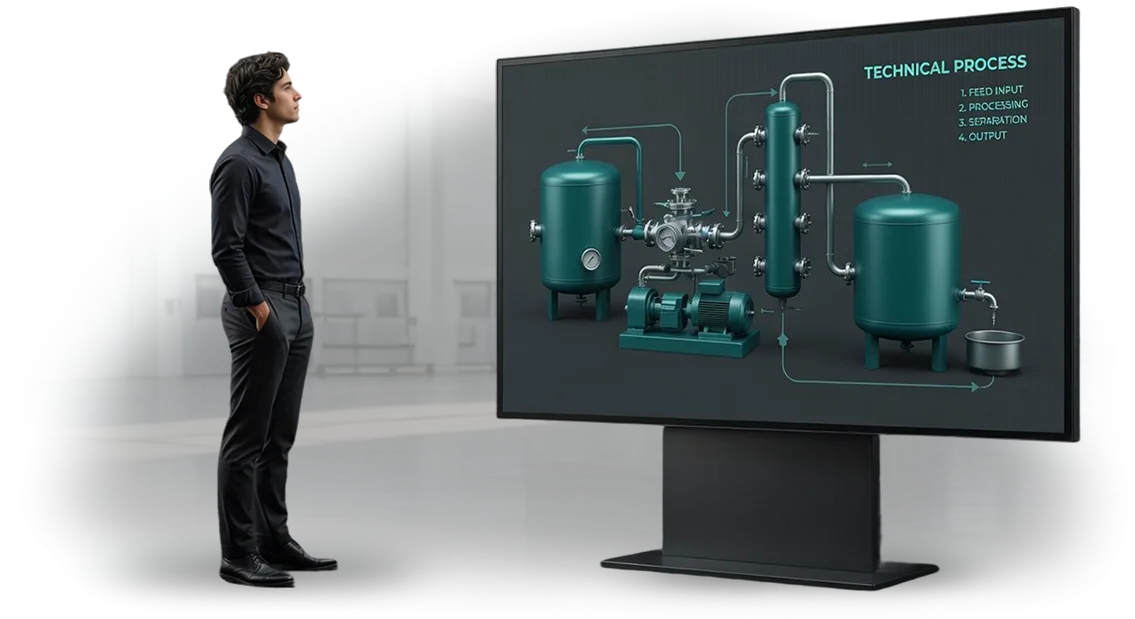
We close this gap — we turn complex process instructions into short, visual video instructions where every step is shown correctly and safely. An employee sees the reference standard of the work down to the smallest detail and memorizes it without rote learning.
This is not just training; it is a reduction in the number of mistakes, stable quality, and peace of mind for occupational safety on the site.
What does training with video instructions deliver?
Every hour of downtime at a cement plant brings losses. When an employee cannot quickly figure out an operation, the line stops, and the risk of errors and injuries grows. Text instructions overwhelm, and there are not always enough mentors.
Video instructions provide a vivid, understandable picture: every step is shown clearly, with emphasis on critical moments. Knowledge is absorbed faster and applied more confidently.
| Problem | Video instruction solution | Business result |
|---|---|---|
| Long onboarding of new employees | Clear demonstration of operations from day one | Faster transition to independent work |
| Downtime due to mistakes | Step-by-step algorithm and troubleshooting of abnormal situations | Fewer stoppages and defects |
| Safety violations | Demonstration of correct actions | Fewer injuries and accidents |
Implementing video instructions brings measurable business results:
- Less downtime — employees find the right information faster.
- Greater safety — fewer mistakes and injuries in production.
- Faster adaptation of new hires — several times quicker entry into the working rhythm.
- A single training standard for all shifts.
- Less strain on mentors.
The company our team creates video instructions based on the customer's real equipment. We animate exactly your technological processes, so employees trust the instruction and apply it without prompts.
Video instruction formats for cement production
There is no one-size-fits-all video instruction for cement production — operators, maintenance staff, and new personnel absorb information differently. The format must match both the task and the employees' skill level, otherwise the training will not deliver the required result.
We help choose the format that gets people up to speed faster and reduces the number of mistakes on real equipment.
Depending on what needs to be shown — a simple sequence of steps, the structure of a machine, or practice in handling an emergency — different video formats are suitable. The table shows the basic scenarios we work with in the cement industry.
| Format | For whom | What it gives the client |
|---|---|---|
| 2D animation | For new employees and basic regulations | Simply and clearly explains the sequence of operations, reduces onboarding training time |
| 3D animation | For complex processes and equipment that cannot be stopped | Shows the internal structure and behavior of machines without risks to production |
| Interactive video | For knowledge checks and practicing the actions of personnel | The employee chooses the scenario themselves and sees the consequences of an error — better retention and safety |
Each format is suitable for corporate training in the cement industry, but the greatest effect comes from combining animation with live footage.
In this way, we show the texture of the production environment and at the same time model processes that cannot be filmed with a camera.
We choose the format at the start of the project: we take into account the skill level of the shifts, the complexity of the equipment, and the skills employees need to consolidate. As a result, training takes less time, and personnel move faster to safe independent work.
How we create video instructions: a step-by-step process
We understand that internal instructions for cement production often remain text on paper — employees do not read them, and newcomers spend months learning by trial and error.
For video instructions to actually work, the creation process must be transparent: you know what is happening at every stage, control the deadlines, and get a result that can be integrated into the training system without rework.
We have structured the process to take the organizational burden off you: you provide the source data, we do all the rest of the work, and we support the project until full launch.
- Brief and immersion in the task. We conduct a short interview with workshop managers and process engineers, and record the goals of the instruction: who it is for, what skill it should build, and what mistakes it should eliminate.
- Analysis of the technological process. We study your documentation, equipment diagrams, and regulations. We produce a storyboard for the future video — a step-by-step script, so that nothing important is missed.
- Script approval. You receive a document describing each frame and the voice-over text in clear language. We make edits before production begins — this saves budget and time.
- Creation of the 3D visualization. We model equipment and work operations in detail, matching your production. Complex assemblies and hazardous areas are shown in close-up — the employee sees the process exactly as it happens in the workshop.
- Interim review. We send a draft version with the key scenes. You check that it matches the real technology, give feedback — and we adjust the animation and text.
- Final editing and voice-over. We assemble the video with narration, subtitles, and emphasis on important steps. We deliver the finished file in the format needed for an LMS or internal portal.
- Launch and support. We help embed the video into the training program and answer employee questions during implementation. For a month after project delivery, we stay in touch and make minor edits free of charge if anything needs to be adjusted.
This approach guarantees that you receive an instruction that is actually used, not gathering dust in an archive. You control quality at every stage, and we handle all the technical and production work — from script to finished video with post-launch support.
What is included in the video instruction work
Developing educational video instructions is not just filming or animation; it is a whole range of work that determines how quickly employees absorb the material. We handle all stages so that you get a ready-made product and do not waste time looking for different contractors.
Our work on video instructions for cement production includes:
- Script — we study the technological processes with your process engineers, highlight the critically important operations, and write clear text.
- CGI animation — we create a clear 3D visualization of the equipment and the sequence of actions, so that complex schemes become obvious.
- Voice-over — a professional narrator with clear diction and a calm pace that is easy to follow by ear.
- Subtitles — a text version that helps with studying material in a noisy workshop or without headphones.
- Editing — we assemble the scenes into a single video, synchronize picture and text, and add accents and captions.
- Final video — we deliver the finished video in the required formats and resolutions for any device.
In the end, you receive a complete package: the script as a document, source materials, and the final video that can be immediately uploaded to a distance learning system or shown during the initial orientation. You do not need to finish anything yourself — just put the material to work.
This way, you save time and money, because all the work is done in one place and coordinated with everything else. And if the instruction needs to be updated in the future for new equipment, we will quickly make changes to the original animation.
Case study: how we helped a cement plant reduce downtime
Downtime at cement plants usually starts with the human factor: a new employee misinterprets a diagram, skips a stage, or overloads a unit. The mistake is expensive — line stoppage, repairs, a missed shipping plan. A plant where this happened regularly contacted us.
We developed a series of video instructions for key technological processes: from raw material preparation to finished product control. Instead of thick regulations — clear animation where every operation and its consequences can be seen.
What the project delivered
Staff training time was cut from two weeks to two days: an employee understands the process faster and makes fewer mistakes. The number of emergency stops caused by incorrect actions fell by more than half, and repeated training cycles are now practically unnecessary.
The production manager also noted an indirect effect: experienced operators began to run the process in a uniform way, and the dependence on "indispensable" specialists decreased.
The customer valued the result so highly that they placed a second project — for equipment maintenance.
That is how, using CGI animation of technological processes for cement production, we solved a problem that for years had only been addressed with fines and safety briefings. Training money stopped being an expense — it became an investment in the stable operation of the line.
How to choose the right format for your task?
There is no direct answer without analyzing the task — and that is normal. We often hear this question from production managers and HR directors: how long should the video be, is animation needed, or is it enough to simply record a master's actions on camera?
In fact, the format is determined by three things: what the process is, who will watch it, and what result you want. If you need to show a sequence of fifty operations in three minutes — that is one format.
If you need to explain the physical and chemical essence of clinker burning — quite another. If you need a short reminder before a shift — a third.
That is why we start with a short consultation. Fifteen to twenty minutes of dialogue and a couple of examples are enough for us to understand your task.
After that, we propose a suitable format: from a schematic animation of the sequence of actions to a full 3D visualization of the technological process with cutaways of the equipment.
It is important that the format choice is not tied one-to-one to the budget. Often a short animated video solves the task better than expensive multi-layered graphics.
We select the minimally sufficient option that delivers a measurable result: fewer mistakes, faster newcomer adaptation, and safer work on the site.
In any case, you do not get a "picture" but a training tool. Instructors use the video in the introductory course, employees review it before carrying out the regulation, and you see how the number of questions to mentors goes down.
If you are unsure which format is right for you, call us — we will help you choose a solution for the task, not sell you "the most expensive video."
We answer questions before you order
Before ordering corporate video instructions, customers have the same doubts: will the project fit the budget, when will the result be ready, what guarantees are there, and how to integrate the video into an already running training system. We review the four most frequent questions.
How much does development cost and what does the price depend on?
The cost depends on the complexity of the technological process, the number of scenes, and the duration of the video. We calculate the exact estimate at the brief stage and fix it in the contract — the final amount does not change during the work.
What are the lead times?
A typical project takes from two to four weeks, but the exact time depends on the scope and density of the script. At the start, we agree on a calendar plan with intermediate milestones and write out deadlines — you always see what stage the work is at.
What guarantees do you provide?
We fix the script, deadlines, and result parameters in the contract. If the final video does not match what was approved, we make edits free of charge until full sign-off. The rights to the materials pass to you after payment — you can use the video freely without restrictions.
How is integration with a distance learning system handled?
We deliver the video in standard formats compatible with most learning platforms. You simply upload the video to your system, and if necessary, we set up integration with your internal platform — so employees immediately get access to the instructions.
Did not find your question? Write to us — we will suggest a solution for your task, script, and budget.What will you get after ordering?
What you get after ordering
You do not get just videos, but a ready-made training system that starts to pay off from the first month.
Instead of taking experienced specialists away from work to repeat the same instruction to newcomers, you create a visual knowledge base once — and every subsequent employee learns faster and with fewer mistakes.
For cement production, where the price of a mistake is a line stoppage or equipment repair, this is especially important.
Our customers report a 1.5–2 times reduction in the time needed to bring a newcomer up to speed and a decrease in the number of incidents caused by the human factor in the first months of work.
What is included in the result
- Script and process breakdown — together with your process engineers, we record every step and eliminate ambiguity.
- Ready-made video instructions for all key operations of your production.
- Adaptation to your formats — from short cards to full training courses for different roles.
- Access to a closed library — all materials are stored on your server or in the LMS.
- Methodological recommendations — how to embed the videos into the training and knowledge assessment process.
our team works remotely across the country, with over 10 years of experience in creating educational content for industry. We fix deadlines and results in the contract and provide a guarantee for all stages.
Payback and guarantee
Calculate the direct benefit: an hour of a mentor's work costs money, but a mentor conducts one video session only once — after that, dozens of employees watch it. On training time reduction alone, the project usually pays back within 1–2 quarters.
We guarantee not the "fact of filming" but the clarity of the instruction for your employee. If, after implementation, you see that a step needs clarification, we make edits free of charge during the warranty period. You are not risking your budget — you are investing in lower accident rates and faster learning.