

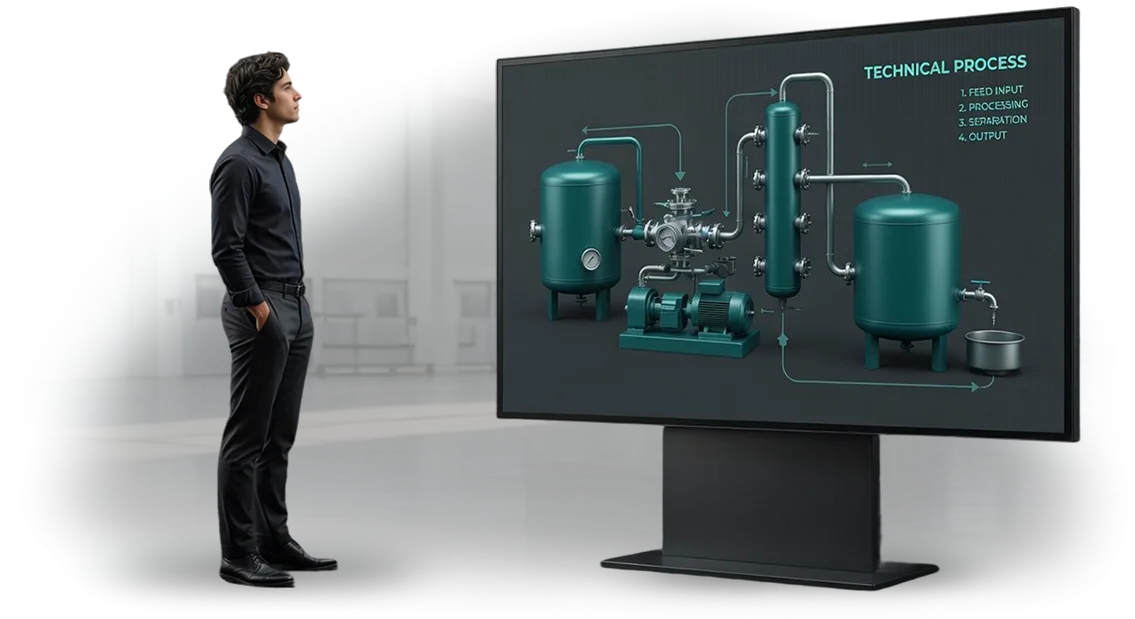
Complex water supply and water treatment processes: how to train personnel
Employees who work with water supply and water treatment systems every day know the technology in words. But in practice, any new or insufficiently experienced specialist can mix up the sequence of actions, misjudge the parameters of the environment, or skip a critical stage.
In such processes, the cost of an error is high: equipment failure, workshop downtime, impaired water quality and risks to consumer health.
Text instructions and static diagrams do not solve the problem — the human brain perceives multi-page descriptions poorly. An employee has to hold a complex picture in mind: the movement of flows, the operation of pumps, the order of reagent dosing and pressure control.
When there is a lot of information and little visual clarity, the number of errors in production increases.
Personnel training becomes effective when the process can be seen with your own eyes, broken down step by step, and the logic of each stage understood.
That is exactly why we create training video instructions: they turn complex water supply and water treatment technology into clear visual algorithms.
The employee sees how to act correctly, what happens inside the pipeline and why each stage matters — instead of simply reading about it.
Such materials are easy to update when regulations change, and training new specialists takes far less time and requires no immersion in technical details.
We address the main pain point of production: we reduce the risk of human error and make employees' knowledge manageable and verifiable.
What video instructions provide for employees and business
When it comes to water supply and water treatment, the cost of an employee error is not just missed deadlines. It is a risk to people's health, emergency equipment shutdowns, and extra costs to eliminate consequences.
Video instructions turn training from "listen to a lecture and try it yourself" into a clear step-by-step process where every step is visible.
An employee remembers the sequence of operations faster because they see real work on screen instead of reading an abstract regulation. As a result, time to onboard into the role is reduced: a newcomer starts working independently in a matter of days rather than weeks.
At the same time, there is no need to distract an experienced mentor each time to explain again — the video takes on the routine part of training, while the mentor deals only with complex non-standard situations.
Video instructions create a unified work standard for the entire organization. Even if specialists work at different sites or in different shifts, everyone performs operations in the same way, according to the approved technology.
This reduces the number of errors related to the human factor and simplifies quality control: the manager always knows exactly how personnel have been trained and what requirements are established in the company.
Savings consist of several components. Fewer errors — lower costs for rework and repairs. Faster training — lower overhead costs for adaptation. A unified standard — easier to scale processes and attract new employees without losing quality.
The main thing business gets is predictability. You stop depending on the experience of individual workers and transfer knowledge in a systematic form that remains in the company forever.
That is why video instructions for water supply and water treatment pay for themselves already in the first months of use and continue to work for every new batch of personnel.
Video instruction formats for water treatment and other industries
The right format of a video instruction directly affects the speed of training and the number of errors made by new employees. This is especially important in water supply and water treatment: processes are often hidden inside pipes and tanks, and a mistake can be costly.
That is why our team selects the format for a specific task — from simple 2D videos to interactive simulators.
| Format | For whom | What it gives the client |
|---|---|---|
| 2D animation | Short briefings, regulations, introductory courses | Quickly explains the sequence of actions, easy to understand even for a beginner |
| 3D modeling | Complex equipment, process units, repair work | Shows the internal structure and operating principle, replaces expensive filming and mockups |
| Combined (2D + 3D) | Complete training programs for different departments | Combine a general scheme with detailed analysis, accelerate understanding of the technological process |
| Interactive instructions | Knowledge testing, practicing actions before being allowed to operate equipment | The employee controls the scenario themselves and receives feedback, reducing the risk of accidents |
For water treatment tasks, we most often use a combination: 2D animation shows the path of water and the treatment stages, while a 3D model allows a detailed breakdown of a specific unit — a pump or a filter. This approach is clear to both the operator and the repair service.
If we need to check how well an employee has mastered the material, we add interactive elements — it is like an exam in a safe mode.
Thanks to this selection of format, the customer receives video instructions that actually work: they are watched to the end, not skimmed through. This means that training costs pay off through fewer errors and faster transition of employees to independent work.
How an instructional video is created: stages
We guide the client from the first brief to delivery of the finished video — you always understand what stage the project is at and what you will get as a result.
Below is a typical process for creating an instructional video for employees of water supply and water treatment enterprises.
- Brief and immersion in the task. We study your process flow, regulations, and target audience: who will watch the video, what level of training the employees have, and exactly what they should learn.
- Script and storyboard development. Together with you, we define the key operations, voice-over script, and visual accents — so that the video fully matches your instructions and work standards.
- Approval of the concept and style. We determine the presentation: dynamic infographics, 3D animation, or a combination with live-action footage. At this stage, we make the main revisions to the content and narrative logic.
- Preparation of materials and 3D models. For clarity, we create animation of process equipment and water supply and water treatment processes — from a pumping station to a treatment unit. We show complex units in cutaway view so that the employee understands the device and principle of operation.
- Rough cut and intermediate review. You receive a working version for review, provide comments on pacing, emphasis placement, and terminology used. We promptly make revisions and show the result again.
- Final editing, voice-over, subtitles. We prepare the final version with a professional voice-over artist and text accompaniment. If necessary, we make subtitled versions for quiet areas or for learning systems.
- Delivery of the finished video and usage instructions. We deliver files in the required formats, help with uploading to your distance learning system, and, if necessary, adapt the video for different departments — from operators to repair crews.
This order makes it possible to control each stage of development and obtain a predictable result. The ordering process is transparent: you see what decisions are made and why, and the final video is fully ready for use after delivery.
What is included in the delivery: video instruction kit
When ordering an instructional video, it is important to know in advance what you will receive as a result. We have assembled the delivery kit so that you do not have to guess or refine anything — every element is ready for use in employee training.
- Script. A detailed description of all scenes and narrator text, agreed with you before work begins. With it, you verify that all technological steps and safety requirements are taken into account.
- Storyboard. A visual plan for the future video: how key frames, transitions and highlights look. You see the style and logic in advance, so edits are made before animation starts — without unnecessary rework.
- Animation of the technological process. Ready CGI graphics that clearly show equipment operation and the sequence of employee actions. Complex water supply and water treatment processes become clear video content.
- Voiceover. Professional recording of narrator text with clear diction and a calm pace. It helps maintain attention and makes the instruction comfortable to perceive.
- Final video file. A ready video in the required format and quality, with subtitles if needed. It can be immediately uploaded to a distance learning system or used in in-person classes.
The entire kit is transferred under an acceptance certificate, and the rights to the materials remain with you. No hidden extra charges for "source files" — you receive a full set of files that can be used for years.
Case study: how 3D animation accelerated training at treatment facilities
A large regional water supply operator approached us when new treatment facilities required retraining 40 operators. The old text-based instructions were not enough: employees confused the reagent dosing order, and mentors spent two months onboarding newcomers. At stake were uninterrupted water supply and personnel safety.
We proposed moving training into a visual format — 3D video instructions that show the technological process from the inside. In 3ds Max, we modeled the entire chain: from raw water intake to treated water discharge.
The operator sees every unit, every valve, and the sequence of actions, as if standing at the real equipment.
Implementation results
| Indicator | Before 3D instructions | After implementation |
|---|---|---|
| Time to train a new operator | 8 weeks | 2 weeks |
| Reagent dosing errors | 4-5 per month | 1-2 per month |
| Unplanned shutdowns due to human factor | 2-3 per quarter | 0 per quarter |
The company's management quickly noticed the difference: new employees were able to work independently four times faster, and target water quality indicators no longer depended on the experience of a specific shift. Training that used to take months now fits into a few days.
This case became the starting point for a long-term cooperation: following the training program, the client ordered five more videos for neighboring facilities and updated internal standards for working with personnel.
The main thing the project confirmed is that clear animation reduces risks and saves resources even before an employee starts a shift.
How to choose the video instruction format for your task?
The choice of format depends on what exactly the employee needs to learn and in what conditions the training takes place.
If we are talking about real work operations with equipment — for example, starting up a pumping station or replacing a filter element — a short video instruction with live footage works better.
The employee sees a familiar environment, memorizes the sequence of operations and transfers the skill into practice faster.
When a process is hidden from view — inside a unit, in pipes, underground — CGI animation of water supply and water treatment technological processes comes to the rescue.
It clearly shows the movement of water, the operation of gate valves, chemical treatment and complex purification schemes. This format is especially valuable when studying equipment that cannot be stopped or dismantled for the sake of a training film.
The employee sees what is inaccessible during an ordinary tour and understands the logic of the system as a whole.
Duration and frequency of review should also be taken into account. For regulations and emergency instructions, short clips of up to two or three minutes with a clear structure are convenient.
For in-depth training of newcomers and certification, a modular format with several blocks and a knowledge check at the end is better suited. In this case, you can combine live footage, animation and diagrams — the main thing is that each element solves a specific task.
There is no universal answer, but there is a simple guideline: the more complex and dangerous the process, the more benefit from visual animation; the more important precise physical actions are, the more appropriate real footage is.
We help you choose a format for your task at the briefing stage — we analyze scenarios of work situations, the level of staff training and the technical specifics of the facility, so that in a month the video instruction really reduces the number of errors and the time it takes to bring an employee up to speed in the position.
Frequently asked questions about developing instructional videos
Any project to create instructional videos for water supply and water treatment starts with questions: will the deadlines slip, will the investment pay off, will the team handle complex technological processes.
Below we have gathered answers to the most common doubts of clients — how we work and what we guarantee.
How long does it take to develop an instructional video?
The timeline depends on the number of scenes, the complexity of the equipment and the level of detail in the animation. An average project takes 3-5 weeks, but we fix exact dates in the contract and meet them — in 10+ years we have never missed a launch.
Is it difficult to show a water treatment process if it is unique? No. We work from your drawings, schematics and photographs — we reproduce the actual equipment and its logic in 3D.
For complex processes we create a script and a storyboard that you approve before animation begins, so the result matches the facility exactly.
What happens if the video doesn't work out after delivery? We protect the client at every stage. First we approve the script, then intermediate versions of the animation, and only after your "approved" do we proceed to final rendering.
If revisions are needed at the approval stage, we make them at no extra charge. The final version is delivered in source formats, and you remain its full owner.
How is the budget for an instructional video formed? The budget is made up of the number of videos, their duration, the level of detail of the 3D models and the urgency.
We prepare a transparent estimate before work begins — with no hidden payments and no "surprises" along the way. You see what you are paying for and can adjust the scope to suit your tasks.
Order a video instruction for staff training
To help employees quickly master water supply and water treatment processes, there is no need to gather them for lectures and pull them away from work.
A single clear video instruction is enough, explaining the sequence of actions in a way that is equally understandable for a newcomer and an experienced specialist.
Order such a video instruction — and already at the briefing stage you will receive a cost calculation and a clear work plan.
You don't need to figure out filming, editing, or animation on your own. Just leave a request — and we will guide you through the steps:
- Consultation: we discuss the task, the video format, and the audience — operators, the repair service, or new employees.
- Analysis of the technological process: your technologists and our scriptwriters record the sequence of actions that needs to be shown.
- Cost calculation: you receive an estimate broken down by stages and timelines, with no hidden extra charges.
- Plan approval: we show the structure of the video, the text, and the storyboard before production starts.
- Production and delivery: we create the video instruction, make revisions after approval, and hand over the finished files in the required formats.
This approach is already used by companies that need every employee to complete training without risk to themselves or the equipment.
All you have to do is order a video instruction — the initial consultation will help formulate the task, and we will propose the optimal format and calculate the cost of work for your technological process.