

Employee mistakes cost money: order a 3D animated video maker
Every day, employees spend working hours studying scattered memos and text-heavy regulations. Through inattention and poor process understanding, they make mistakes that result in damaged materials, missed deadlines, or even industrial accidents.
The losses from such failures easily outweigh the cost of any training, but the problem is not the people — it’s how you deliver knowledge to them.
Dry documents are hard to remember: the human brain perceives 90% of information visually, and static text with pictures loses in speed of comprehension.
Employees don’t need yet another 40-page manual; they need a visual process they can see, understand on the first try, and repeat without mistakes. We propose closing that need with 3D animation and short training video instructions embedded into your corporate training program.
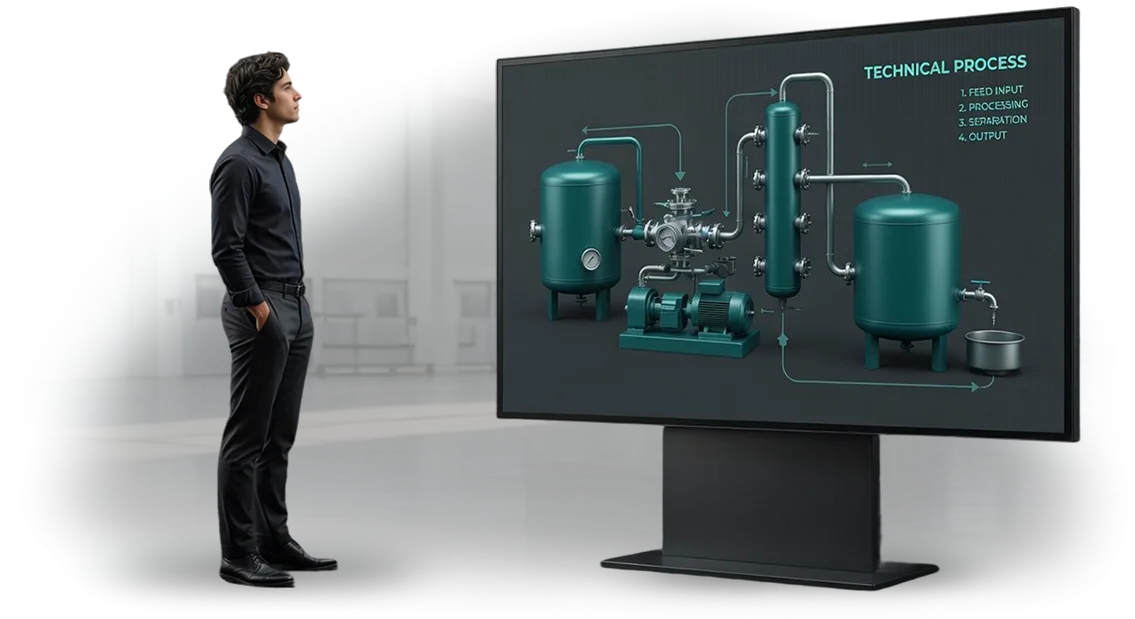
Quality 3D animation shows every stage of the work in detail: from correct equipment setup to safe tool handling. That’s why video instructions from our team become the main training material for new employees — they onboard faster and don’t pester mentors over small things.
Experienced specialists also benefit: clear visual dynamics help them refresh rare regulations without leaving the production floor.
The result is expressed in numbers any manager understands: fewer errors and injuries, faster operations, and shorter personnel adaptation time.
You get a finished digital asset that works for the business around the clock and pays for itself after the first successfully prevented incident.
By ordering 3D animated video development from us, you invest in order and predictability of processes — and therefore in stable profit.
What a quality video instruction provides: 5 key benefits
A quality video instruction is not just a video for beginners; it’s a working tool that directly affects the speed, quality, and cost of operational processes.
When training is built on visual 3D animation, an employee sees every step from the right angle and remembers the sequence of actions without long lectures.
The first benefit is speed of onboarding. A new employee no longer depends on a mentor or scattered memos: the average time to independent work drops from several weeks to several days.
This is especially noticeable in positions with complex operations, where experience used to be passed down over months.
The second is reducing errors and defects. A video instruction demonstrates the correct sequence of actions, highlighting the critical points where failures most often occur.
The employee sees not text but a ready-made reference scenario — the number of reworks and redoings drops noticeably, along with material costs and time spent on corrections.
The third is direct budget savings. The company stops paying for long off-the-job courses, trainer travel, and endless repeat training. One quality video replaces dozens of hours of live classes and pays for itself after the first uses.
The fourth is a unified knowledge standard. A video instruction delivers the material equally to all employees: at the head office, at remote sites, on the night shift.
Instead of “everyone teaches their own way,” the company gets a benchmark execution of the process, independent of a specific instructor’s mood or experience.
The fifth is scalability without loss of quality. The video can be used when opening new locations, growing headcount, or implementing new operations. You invest in production once — and the training material keeps working for the company, saving time for managers and HR.
As a result, professionally made video instructions solve four business challenges at once: faster training, fewer mistakes, a stable standard, and budget savings.
That’s why we invest in professional equipment and refined tools — so the client gets a result measurable in financial terms, not just a pretty sequence of images.
Video instruction formats: from 3D animation to infographics
Standard text instructions often gather dust in chats — they are not read to the end and not applied. A video shot “as is” quickly becomes outdated and doesn’t reflect your actual process.
Employees perceive information differently: some prefer to see the process from the inside, others a five-step diagram, others to click and try themselves. So we don’t offer one format “for everything” but match the presentation to a specific task and audience.
The table below shows the three most requested formats that cover most training tasks — from product familiarization to knowledge checks. Choose what suits your team best, or trust our recommendations — we’ll help you decide in one conversation.
| Format | For whom and for what tasks | What it gives the client |
|---|---|---|
| 3D animation | Complex equipment, technological processes, internal product structure | The employee sees the object in detail without risk or production cost — training up to 3 times faster |
| Animated infographics | Processes, regulations, onboarding, large data volumes | Rules and steps are memorized visually, reducing the number of errors during execution |
| Interactive video instructions | Knowledge testing, practice, onboarding | The learner immediately applies knowledge, and you see the team’s weak spots in a report |
We adapt each format to your brand and communication style. If necessary, we combine them into a series of videos so an employee moves from first familiarization with the topic to confident execution of the operation.
Working on a video instruction: 7 clear steps
We have structured the process so that you always know what stage the project is at and what you’ll get in the end. No “black box”: you approve key decisions at every step, while we handle all the production routine. On average, the cycle takes 3–6 weeks, depending on script scope and animation complexity.
- Brief and expert interviews — We discuss tasks, audience, and expected result. We ask questions to your specialists to capture all the process nuances that need to be reflected in the video instruction.
- Script and storyboard — We turn scattered materials into a clear script with frame-by-frame descriptions. You read the text and see how the story will unfold — edits are made before production starts, when it’s faster and cheaper.
- Style and character approval — We choose a visual language that matches your brand. We show 2–3 design options, you choose, and all objects and characters are then created in a consistent style.
- Animation production — Our artists and animators bring the script to life. We work on professional equipment and refined tools, so results are consistent in time and quality — with no “surprises” at the final stage.
- Intermediate review (animatic) — After the rough cut, we send the video for approval. At this stage it’s easy to adjust pacing, emphasis, and details — changes cost much less than after final rendering.
- Final render and audio — We record professional voice-over, mix sound and music, and assemble the clean picture in the required formats. You receive a finished video in a resolution suitable for your training system — from computer screens to full-length projections.
- Delivery and support — We hand over source files and final files, adapting duration for different formats if needed (short version for phones, full version for the portal). For a month after delivery, we make edits free of charge if you notice inaccuracies.
What’s included in the delivery: a complete training kit
You receive not just finished videos, but a complete package that the training department can use immediately, without extra approvals. Everything needed to launch and support the program is in one order, from source files to adaptation for your channels.
- Finished video instructions — final videos in the required quality and format, ready for placement on the training portal, corporate network, or messengers.
- Source files and materials — working projects, scenes, graphics, and used elements. You are never left without access to content; you can make edits with your own team or order updates from us.
- Adapted versions for different platforms — horizontal for computers, vertical for phones, and short versions for mailings. Each format is calculated around how the employee will watch it.
- Subtitles and text transcripts — for work without sound, for the hearing impaired, and for translating instructions into other languages. The same text description simplifies searching the knowledge base.
- Methodological supporting materials — a short guide for the manager and a list of control questions for knowledge checks after viewing.
- Update package and support — within the agreed period, we make changes when regulations or software change and answer employee questions about rollout.
The whole delivery is tied to your task: you get a single package that doesn’t need to be finalized by your internal training department. This saves launch time and guarantees that training starts on schedule and with the same quality for all employees.
Case study: how we accelerated employee adaptation by 2 times
The management of the manufacturing company Vektor approached us with a typical pain point: new employees reached full capacity only after a month and a half, and the first weeks of work were accompanied by dozens of mistakes.
Mentors physically couldn’t explain the nuances to every newcomer, and no one read the paper regulations to the end.
We proposed replacing the outdated instructions with a series of short 3D animated video instructions. Instead of abstract text — visual scenarios: how to set up equipment correctly, in what sequence to perform operations, how to avoid typical errors.
Animation made it possible to show the process from the inside, impossible with regular footage, and to make training identical for everyone — without distortions caused by the “passing on” mentor.
The numbers tell the result: time to role-readiness dropped from six weeks to three — that is, exactly twice. The number of mistakes among new employees in the first month fell by almost half, and intern turnover ceased to be a headache for the HR department.
Shop floor managers noted that newcomers start working independently faster and bother colleagues with questions less.
After the pilot series, Vektor ordered several more sets of video instructions for other production areas. Now these videos are used not only during hiring but also during periodic skill upgrades — as a baseline against which experienced employees also check their actions. This is not a one-off story but a working tool that continues to deliver value every day.
FAQ and concerns before placing an order
Many clients worry that video instructions are expensive, time-consuming, and hard to integrate into existing training. We operate as your 3D animated video maker: we handle the script, illustration, editing, and packaging for your LMS.
Below are answers to typical concerns; for individual questions, we give a detailed response within one business day.
How much does video instruction development cost?
The cost is calculated individually based on the format and duration of the video. Corporate video instructions cover a full cycle from script to a finished file compatible with your learning platform. The estimate is fixed before work starts, with no hidden payments.
What are the production timelines?
A typical project takes 3–6 weeks depending on scope. If you need it urgently, we can make a pilot video in 10 working days. You see a plan with checkpoints at every stage in advance.
Is it hard to integrate the video with training?
No. We prepare files compatible with most learning management systems (LMS): the video uploads as a course, adds test questions, and can be split into modules. The employee completes the material consistently, and you see viewing and completion statistics.
What if the result doesn’t suit us?
We approve the script and styling of the 3D models before final animation — the risk of mismatch is minimal. Revisions at checkpoints are already included in the price. After delivery, we transfer source materials so you can update the video without new investments.
Order a video instruction that will save your budget
For a manager, every minute an employee is idle is lost money. Training video allows you to bring newcomers up to speed without pulling experienced specialists away from their work. But a video instruction saves the budget only if it is clear and solves real tasks.
We create 3D animated video instructions that employees watch to the end and immediately apply in practice. Order a video instruction — get a ready-made tool for onboarding, safety briefings, or equipment work.
What’s included in the order:
- Consultation — we discuss the task and select a format.
- Cost estimate within one working day — fixed price with no hidden extras.
- Work examples from your industry — we show similar projects.
- Script approval before production — you see the text and storyboard before the final version.
- Finished video instruction in the required formats — for the learning management system, portal, and social media.
- Revisions after delivery — we fine-tune the video to your standards.
Click the request button and fill out the form — we will contact you within one working day. You’ll receive a consultation, a cost estimate, and work examples. Budget savings start with the first video.
How to choose the right format for your task?
The task determines the format, so we never start with “let’s make a pretty video.” First, we analyze where and how employees will train: hiring briefings, working with dangerous equipment, customer service, or internal regulations.
Each of these tasks has its own delivery rhythm, its own emphases, and its own optimal duration. What works perfectly for a short manager onboarding is useless for a two-hour equipment training session.
That’s why, for specific requirements, we don’t force the idea into a ready-made template. If you need to show how to handle an aggressive customer, we create realistic dialogue scenarios.
If the goal is to train staff on new equipment, we choose detailed step-by-step animation with emphasis on safety and error control. Each format has its own logic, and we select it to fit your team and process specifics.
Custom videos are needed more often than it seems. A standard video from a third-party producer describes an “abstract” product, while your employees work with your equipment, in your location, and under your rules.
We adapt the script to your specifics: real operation names, typical beginner mistakes, nuances of your corporate culture. This way the employee sees a familiar context and transfers knowledge to practice faster.
Ultimately, choosing a format is not a question of “animation or live action” but one of training effectiveness. We analyze your task, suggest 2–3 suitable formats with calculation for your target audience and timelines, and then lock the decision into an approved script.
No flights of fancy — only a working structure that solves your problem and won’t gather dust in the library, because we already understand how employees will use these videos.