

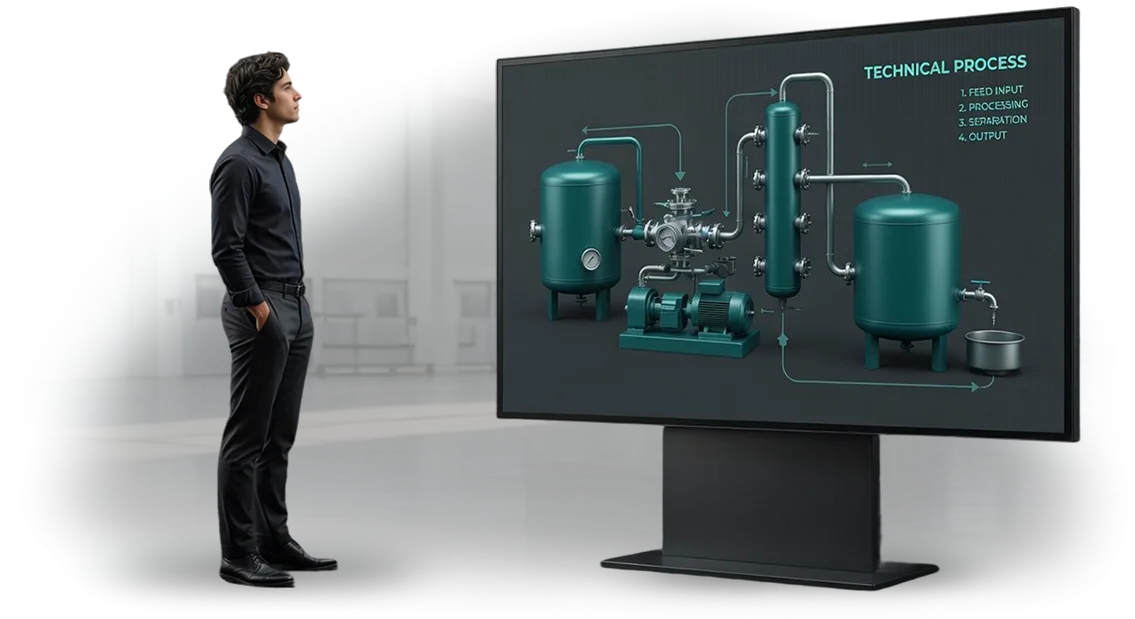
Employees Don’t Follow Instructions — 3d Animated Video Solves the Problem
Employees are increasingly less likely to read long text regulations: they open the document, skim through it, and set it aside — until the next mistake.
As a result, losses from corrections grow, onboarding of new hires drags on, and managers spend time re-explaining the same operations.
The instruction itself exists, but it has almost no practical value — the employee doesn’t remember the sequence of actions because they never see it.
This is exactly where a 3d animated video helps: a training video in 3D format shows every step visually, from the right angle, and in the correct sequence.
It is much easier to see once how to assemble a unit, set up equipment, or place an order than to decipher abstract diagrams. Video instructions are perceived faster and easier — the employee simply follows what’s on screen and immediately gets the right result.
This is especially valuable during onboarding: a new hire reaches full working pace faster and distracts colleagues less often.
We develop video instructions that integrate into a real work process: from short clips for a single operation to a full course for new employees.
You receive a ready-made package that can be placed in the corporate knowledge base, on the internal portal, or in the training system.
An employee opens the desired topic at the moment of the task and finds the answer in half a minute, rather than spending time searching for a forgotten clause in the instruction.
As a result, you invest less in control and explanations, and the team works consistently. Errors are reduced, productivity grows, and new people become independent faster.
A 3d animated video closes the gap between “written” and “done” — the employee actually follows the instruction because they understand it from the first viewing.
What Benefits Animated Video Brings to Staff Training
Employees learn faster when they see a process rather than read about it. Animated video shows each step sequentially and clearly: from equipment startup to working in the system.
This format is understandable to a new hire without experience and doesn’t require a mentor to be nearby.
The key advantage is memorability. A person retains up to 80% of what they see, while after reading text only about 20% remains. This means new employees make fewer mistakes on real tasks, reach planned work speed faster, and bother colleagues with questions less often.
Animation sets a single standard for everyone. The process is shown the same way for every branch, shift, or department — it doesn’t depend on who explains it and how.
An employee learns corporate regulations once and always follows them, and managers don’t need to check whether everyone on the team has the same version of the instruction.
Supervisors and mentors stop spending time on personal explanations. A video instruction covers 80% of typical questions, and experienced employees handle only truly complex cases.
Onboarding of new hires speeds up several times over: the first working day starts not with reading documents but with watching a clear video, after which the person is already ready to perform simple operations.
We create exactly these videos: we capture your company’s real processes and turn them into memorable 3D animation. The result is fast “time-to-productivity” for new hires and fewer errors in the work.
Corporate Video Instruction Formats: From a Single Clip to a Series
There is no one universal instruction: what helps a newcomer get comfortable is not suitable for analyzing a complex production process. A short clip is faster to launch, a series provides depth, and interactivity provides control of knowledge retention.
The choice of format directly affects the budget, deadlines, and how quickly employees start applying knowledge.
We select a format for a specific task: we analyze the audience, the complexity of operations, and the expected result. Below are typical scenarios so you can assess which option is closer to your team.
We make all videos in 3D animation on professional equipment — the result is stable and easy to update.
| Format | Who It’s For | What It Gives the Client |
|---|---|---|
| Short clip (1-3 minutes) | Mass training: simple actions, rules, product introduction | Quick launch, accessible budget, retention after one viewing |
| Video series (5-15 minutes each) | Complex multi-step processes: equipment work, service regulations | Systematic training; employee returns to any step at any time |
| Interactive video instruction | Training with knowledge checks and practice of critical operations | Engagement, retention control, fewer errors on real tasks |
Interactive format is especially valuable where the cost of an error is high: the employee doesn’t just watch, but makes decisions in a safe environment. After completion, you see statistics — which steps are most difficult — and can adjust the training program.
For any task, we’ll propose a format that fits the budget and deadlines — from a single training video to an entire series of 3D modules.
How a Video Instruction Is Created: 7 Turnkey Steps
We structure the work on a turnkey basis: you get the entire process — from brief to support — in one place, with clear approval checkpoints. Each stage ends with a concrete result, so you always know what is happening and what you will get at the end. No “black box”: clear control and a predictable result.
- Brief and objectives — we define goals, audience, and key employee work scenarios. You get a clear technical specification that protects against unnecessary revisions and misunderstandings.
- Script and storyboard — we turn objectives into a frame-by-frame plan with text, logic, and visual style. You see the future video before production starts, make edits without rework or extra costs.
- Estimate and schedule approval — we approve timelines, budget, and scope of work. All agreements are recorded in a document so there are no surprises at the finish.
- Animation creation — our specialists model and animate scenes according to the approved style. You receive intermediate versions of key frames for control.
- Editing and sound — we assemble the video, add voiceover, subtitles, and music. You watch the full draft and understand how the video will look to employees.
- Final approval — we make revisions based on your comments and bring the video to a “ready to launch” state. You get a finished video that doesn’t require further work.
- Launch and support — we deliver all file formats, help with platform placement, and update the video when instructions change if needed.
What’s Included in the Deliverable: 3d Content for Training Videos
Corporate training fails when employees receive dry instructions or long lecture recordings. 3D animation shows processes clearly, but the real benefit comes not from the picture, but from the ability to quickly use the material in work.
We assemble the deliverable as a ready-made solution: you get not just one video, but a system that even a newcomer can work with.
What’s Included in the Package
- Ready-made 3d videos for each scenario — in formats for the training portal, corporate website, internal chats, and offline screens.
- Project source files: scenes, characters, assets, animation files. You own the content, so modifications cost significantly less than creating a video from scratch.
- Series styling: color palettes, fonts, characters, animation techniques. The videos look like a single branded cycle, not scattered pictures.
- Text scripts with timings: each action is broken into steps, the text is approved with your experts and ready for voiceover and subtitles.
- Voiceover and sound design: narrator tracks, music, accents on key moments. The employee doesn’t get distracted and keeps attention to the end.
- Implementation recommendations: when to show the video, how to reinforce the material with tests, and how to measure whether work operations have become faster.
Ultimately, you get 3d content for training videos that immediately integrates into the training program. Employees master the material, return to complex fragments, and you see fewer errors, faster onboarding, and higher quality work.
Case Study: How a Video Instruction Accelerated Onboarding of New Employees
The case study describes a network of plumbing stores AkvaMarket. The company was actively opening new locations — up to 12 per year, but each new sales consultant only reached the required sales level after 8 weeks.
The problem was text regulations: dozens of pages that newcomers couldn’t study in time, so they were afraid to approach a customer.
Task
Management set the goal of reducing onboarding time by one and a half times. We proposed turning key customer-facing scenarios into short 3D videos: assortment consultation, order placement, and handling objections. Each video lasted 2-3 minutes and showed the correct sequence of actions.
Result
After three months, the time to full readiness was reduced by 40% — from 8 to 5 weeks. New employees started selling earlier, and attrition during the probation period dropped: fewer people left because of information overload.
The video instruction also freed up mentors — they no longer needed to repeat the same thing a hundred times.
The client appreciated the result and ordered a similar course for all new branches. The video paid for itself within one quarter; savings on hiring and training were calculated after an audit. This is not a one-off story: almost all clients who try the video format come back with new tasks.
How to Choose the Video Instruction Format for Your Task?
Format should be chosen not because of fashion or the presence of a “pretty picture,” but based on a specific task: what the employee needs to learn and how quickly they must apply it in work. If the process is simple, a short 1–2 minute video is enough.
If it involves complex equipment or a multi-step regulation, you need a modular series where each step is analyzed separately.
Duration directly affects the result: an instruction longer than 5–7 minutes loses attention, while one that is too compressed leaves questions. The optimal approach is to divide the material into semantic blocks of 1–2 minutes.
This way the employee can repeat the needed fragment before performing the task instead of rewatching the whole video.
Budget and deadlines depend on the complexity of filming or animation, but the main guide is savings on training and errors. One quality video replaces several hours of live training and reduces the number of failures in the workplace.
Therefore, we first define the goal, audience, and criticality of the process — and then select the format, duration, and delivery method to match.
We help you choose exactly the option that solves your problem without unnecessary extras: from simple screen recording to dynamic 3D animation.
Our engineers offer the optimal balance of budget and timeline, and you end up with an instruction that employees actually watch and apply.
Answering Questions About Corporate Video Instructions
Managers often postpone video instructions because they fear the unknown: how much it costs, how long it takes, and what happens if the result isn’t satisfactory.
As a result, employees continue to work from scattered texts, and the company spends time on repeated explanations and error control.
We address these questions before the project even starts. Below are direct answers about cost, timelines, revisions, and technical requirements, so you know what you’re getting before signing the contract.
How much do corporate video instructions cost?
The cost depends on the complexity of the scenario and the number of scenes. A base instruction for a standard process has a cost calculated after audit, and a comprehensive program with multiple videos is priced the same way. At the first meeting, we fix the estimate and don’t change it during the project.
What are the development timelines, and what happens if deadlines slip?
Typical cycle is 3 to 6 weeks depending on scope. We build in time for approvals and revisions, so we usually deliver earlier. If you delay feedback, deadlines shift — but this is always visible in advance, down to a week.
How many revisions are included in the cost, and what about the guarantee?
Two approval stages are included in the price: after the script and after the rough cut. At these stages you can change the text, logic, and emphasis. For one month after delivery, we fix any inaccuracies for free if they arise during a test launch.
Are special technical requirements needed to view the videos?
No, it’s all simple. The video works on any computer, tablet, or smartphone, and doesn’t require installing programs or powerful hardware. We provide files in a universal format that opens on any device.
If you still have questions about the process or want to try a scenario for your task — send a request through the form. We’ll reply within one business day and show examples of similar projects.Get a Cost Estimate and Video Instruction Mockup in 3 Days
Paying for an expensive course or onboarding a new hire for weeks is a waste of time and money. A video instruction works instead of a mentor: the employee opens the needed video, repeats the actions, and reaches the result faster.
We’ll help you calculate the benefit before you start — that’s exactly why the estimate and mockup are needed.
In 3 business days, we’ll prepare a commercial proposal with the exact cost and a scenario structure for the future video. You’ll see which scenes will be in the video, how they address your business objectives, and how much time they’ll save employees. No abstractions — only your real processes and a clear plan.
What you get with this package:
- a transparent estimate with no hidden surcharges — you know the project budget in advance;
- a scenario structure: breakdown by scenes and training actions;
- recommendations on duration and format for your team;
- a plan of project stages and launch timelines;
- examples of similar solutions from our practice;
- a clear next step — what we need from your side to start.
Then it’s simple: leave a request on this page, we’ll have a call, clarify the details, and in 3 days send you the estimate with a mockup. No obligations — you make your decision after seeing the plan and cost.
If the project isn’t a fit, you simply don’t start, but you’ll understand exactly how to automate training.
Fill out the form — and within 3 days you’ll know how much the video instruction costs and how it will be structured. Start with an initial consultation: send your request, and we’ll take care of the rest.