

How 3D Educational Videos Solve Employee Training Challenges
Employees don't absorb text-based instructions: lengthy regulations are written in complex language, important steps drown in details, and the result is mistakes, lost time, and stress.
This is especially critical when working with complex equipment, in hazardous production environments, or in processes where the accuracy of every action affects the outcome.
Companies spend hours of mentors' time on repeated explanations, but the problem of material retention remains — training drags on, and new employees make the same mistakes.
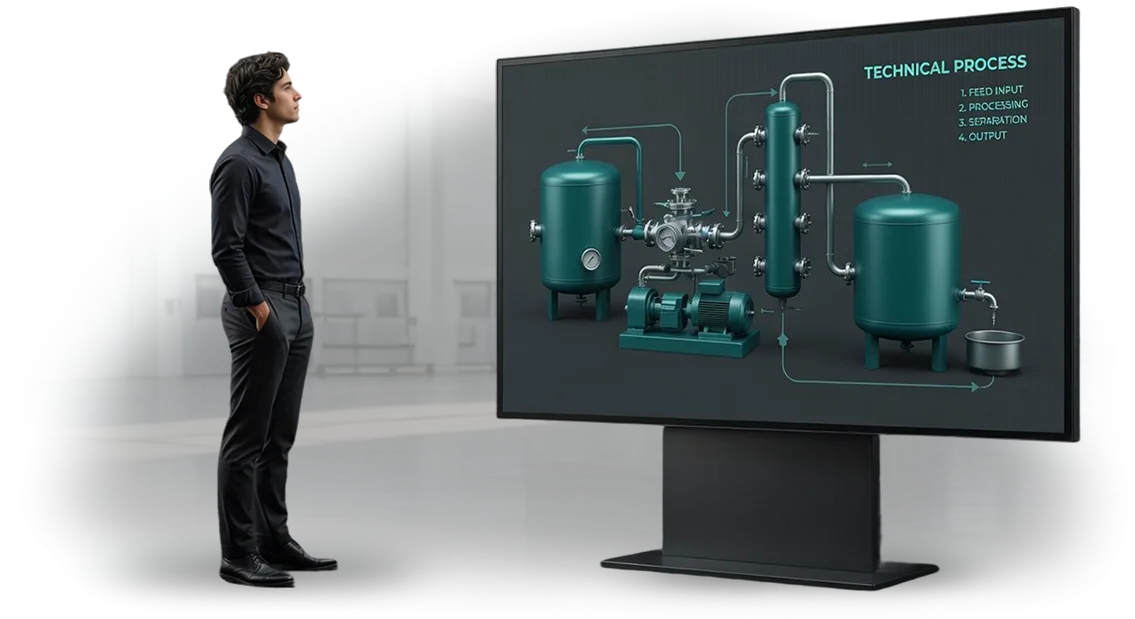
3D educational videos solve this problem systematically. Instead of abstract descriptions, the employee sees a realistic 3D model of the process — from the overall context to the small details that cannot be conveyed in words or photos.
Video instructions engage visual memory, allow safe demonstration of emergency and hazardous situations, and the material is remembered faster and stays in memory for a long time.
Corporate training becomes noticeably more effective: new employees get up to speed faster, experienced ones use the videos as a quick reference, and mentors stop spending time on repetitive explanations.
3D educational videos create a unified knowledge standard for all departments — every employee understands the process the same way, which means fewer errors and faster adaptation.
At the same time, video instructions easily integrate into the existing training system: they open on any device — computer, tablet, or smartphone — without special preparation or setup.
Employees gain knowledge at a convenient time and in a convenient format without being distracted from their current tasks. This reduces the load on the team, cuts downtime, and improves the quality of operations.
Our team develops 3D training videos specifically for your business needs. We analyze current processes, identify problem areas, and create videos that address the real needs of employees.
By contacting us, you get a ready-made tool for fast and effective corporate training — without wasting your team's time and effort.
What Implementing Training Videos Brings to a Business
Every new employee is an investment. While they are getting up to speed, mentors are distracted from their own tasks, and mistakes are costly. Traditional "pass it on to a colleague" training does not scale: knowledge gets distorted and the process drags on.
Video instructions solve this problem systematically. Short videos capture a single standard for performing operations, and every employee learns from the same proven scheme. This is the foundation for fast onboarding and predictable quality.
Implementing training videos gives a business four key benefits. Speed: a new hire reaches working pace in days, not weeks. Consistency: the number of errors decreases because employees can always review the required step. Mentor time savings: no need to repeat the same thing. Standardization: everyone works by the same rules.
Fast onboarding is especially important with high turnover or seasonal hiring. Instead of lengthy supervision, it's enough to show an employee the video and answer questions. Adaptation accelerates and first results appear sooner.
Fewer errors mean direct savings. Every incorrect operation means rework, material losses, or dissatisfied customers. A video instruction is the source of truth: the employee opens the relevant segment at any moment and checks their actions. Defects become the exception.
Mentor time savings return the hours that used to go into repeating the same things. Experienced specialists focus on their own tasks instead of teaching newcomers from scratch. Training quality doesn't suffer.
Standardization creates uniform rules for all branches and shifts. There is no situation where one person does it one way and another does it differently. The company gets predictable results and control over processes.
Implementing video instructions is an investment that pays off quickly. Fast adaptation, fewer errors, freed-up mentors, and a single standard — these are the benefits for the business within the first few months.
3D Content Formats for Different Tasks
The same production process can be shown in different ways: a short video, a detailed breakdown, or an interactive simulator with feedback. How well the format matches the training objective determines whether employees remember the material and can apply it at work.
A poorly chosen format means that even excellent 3D animation does not deliver the desired result — knowledge remains passive viewing.
For clarity, we have compiled the three main 3D content formats into a table — full 3D animation, interactive scenarios, and animation with real-life elements. This will help you choose the right option for your task and budget.
| Format | Who it's for | What it gives the client |
|---|---|---|
| Full 3D animation | Mass training of newcomers, standard processes | Clear video without risk or downtime — employees see the ideal scenario |
| Interactive scenarios | Training for actions in emergency situations | Practicing decisions with consequences, high engagement |
| Animation with real-life elements | Complex equipment, real conditions | Detail accuracy + controlled visuals, faster skill transfer |
If the goal is to quickly introduce newcomers to standard operations, full 3D animation is suitable. Interactive scenarios are needed for practicing decisions in emergency and non-standard situations — employees learn from their mistakes without risk to production.
Animation with real-life elements is chosen when it's important to show the exact structure of equipment and real working conditions.
We help you choose a format for a specific task and, if necessary, combine them in a single training program. This lets you avoid overpaying for unnecessary complexity and get training material that actually changes employee behavior.
How Development Works: Five Steps
A transparent process is what sets us apart from contractors who "draw into the void." You see how the project progresses and make decisions at every stage — without sudden surprises or rework.
Each video production stage is clear in advance, so you know when you'll receive the finished instruction and what it will contain.
How We Organize the Work
- Brief and immersion. We study your tasks, regulations, and audience. We determine which operations need to be shown and set deadlines.
- Script and storyboard. We turn instructions into a clear script: text, logic, emphasis. Script approval takes one or two rounds.
- Creating the 3D visualization. We model scenes and show each step from the right angle. You receive a draft and see what the video will look like.
- Revisions and finalization. We incorporate comments on animation, text, and voiceover. After approval, we deliver the final files in the required format.
- Launch and support. We upload the video to your learning management system and help with access. If regulations change, we'll quickly update the video.
This is what video instruction development looks like without chaos: you control timelines and content, and employees get visual training that is easy to absorb. The training launch happens without your involvement — we handle all the technical work.
What's Included in the Deliverable
So you know what you're paying for, we specify the full scope of the deliverable in the contract before work begins. You get not just video files, but a ready-made tool for training new employees that immediately works toward your onboarding speed and personnel training quality.
Here's what's included:
- Ready-made video instructions — all scenarios for your production processes, rendered in formats suitable for any training portal. Employees can watch them on a computer, tablet, or phone.
- Source project files — all 3D models, scenes, and animations created for your task. You are not dependent on us in the future: your team or another contractor can make edits and release new versions of the instructions.
- Methodological materials — text scripts and reference guides for your operators and mentors. They describe how to integrate the video into the training process and how to verify that employees have actually absorbed the material.
- Library access — a collection of ready-made 3D scenes and standard elements (equipment, tools, actions) that will be useful for creating future videos. This significantly reduces the cost and timeline of future projects.
- Administrator training — a short online course for your specialists: how to upload videos to the portal, update them, track view statistics, and collect employee feedback.
- Post-launch support — for an agreed period, we fix issues for free and help with implementation so you get a working process, not just files.
This scope of delivery covers all needs: you get both the final result and the ability to independently develop a corporate knowledge base without constantly contacting a contractor.
Case Study: How We Cut Training Time in Half
The manufacturing company MetallPro was launching a new packaging line and ran into a typical problem: traditional operator training took 80 hours of theory and hands-on practice with a mentor.
In the first two weeks after starting their shifts, newcomers worked slowly and made errors during changeovers.
We proposed replacing part of the instruction with 3D training video instructions — the employee sees every component of the machine, the sequence of operations, and typical emergency situations in three-dimensional graphics.
Implementation Results
After two months, the company recorded tangible metrics: the time for an operator to reach independent work was cut in half — from 14 to 7 days.
The number of errors during equipment changeovers fell by 40%, and the share of employees who passed certification on the first attempt rose from 68% to 94%.
For these videos, our engineers built accurate 3D models of the production line based on the client's drawings.
This made it possible to show processes that cannot be seen on the shop floor: the internal structure of mechanisms, the movement of parts inside the machine, and the consequences of incorrect actions — without any risk to equipment. The video works at a comfortable pace and is quickly updated when regulations change.
MetallPro's management extended the partnership: a year later, they ordered videos for three more workshops.
In their words, the main effect is not just speed but also consistent training quality: the gap between experienced and new employees narrowed, and onboarding during headcount expansion no longer slowed down production.
How to Choose the Right Format for Your Task?
There is no single "best format" — there is a format that fits your task.
Start with the result the employee needs to achieve: if you need to train working with hazardous or expensive equipment, 3D educational videos work best — they let you show every step without risk or mistakes.
If the task is simple and repetitive, a short screen-recorded video instruction is enough, and for mass personnel training, an interactive scenario where the employee chooses the sequence of actions themselves is a good fit.
The second criterion is the audience. Experienced employees grasp visual animation faster; newcomers need step-by-step logic and the ability to review a difficult moment.
Look at staff turnover and skill levels: the more diverse the team, the more visual and detailed the explanation needs to be.
The third criterion is speed and budget. Full 3D animation requires more production time but pays off when you need to train many people or explain a complex process. Simpler formats are created faster, but they hold attention less effectively and become outdated sooner.
We often recommend a combined approach: a main 3D video shows the complete process, while short video instructions cover individual operations.
The main piece of advice is not to choose a format in advance. First, formulate the training goal, show us examples of your tasks, and we'll propose the optimal option and justify its cost and timeline. This way, you get a video that actually solves the problem rather than one that just looks good.
Frequently Asked Questions and Concerns
Every responsible manager considers the same questions before ordering training videos: will we stay within budget, will deadlines be met, will employees understand the material, and what happens if the result isn't satisfactory.
That's normal — we hear these concerns on every first call. So we've gathered answers to the main ones.
How much does developing a video course cost?
The cost is calculated after audit: it depends on the scope and complexity of the script. For a short instruction up to 5 minutes, the budget is modest; a two-to-three-hour course with 3D animation and voiceover is priced individually based on your specific requirements.
At the first briefing, we lock down the requirements and give you an exact figure that won't change during the process. You always know what you're paying for.
What are the timelines? Will the project drag on for months?
A typical 3-5 minute video is delivered in 2-3 weeks including revisions. A large modular course takes 2-3 months. We show the stage plan and dates in advance, and status is available in a shared chat.
If deadlines are critical, we can speed things up by running scriptwriters and 3D artists in parallel.
How difficult is it to implement video instructions? Do we need to change processes?
Nothing needs to be changed. We deliver ready-made files that can be uploaded to a corporate portal, a learning management system, or simply shared in a work chat. Employees watch videos from any device — no special software or powerful computers needed. For convenience, we add subtitles and chapter segmentation.
What if we don't like the result? Do you refund the money?
Yes, we provide an official guarantee on the result. At the briefing stage, we record the goals and acceptance criteria. If the final video doesn't meet them — after two rounds of revisions, we return the prepayment or redo the production at our own expense. This rarely happens, but this safeguard protects your budget.
These are just some of the questions. If you still have doubts — ask us directly, we'll answer without any fluff and help you calculate a project for your task. Write to us, and by tomorrow you'll have a clear plan.Order Development and Get Results
Ordering development is simple — write to us, and we'll handle the entire process: from script to final video. You'll get a clear plan, timelines, and a single point of contact.
From there, everything follows a transparent scenario:
- You submit a request — we clarify the task and answer questions within one business day.
- We approve the script: we show which operations and emphasis points will be built into the videos.
- We prepare 3D scenes and draft frames — you see the result before final assembly.
- We assemble the videos and adapt them to your formats and platforms.
- We deliver the source files, documentation, and instructions for working with the video.
What you get immediately after reaching out:
- Ready-made video instructions in corporate style — employees get up to speed faster.
- 3D animation shows processes visually, without long texts.
- Adaptation for the training portal, presentations, and email campaigns.
- Approvals at every stage — you make revisions before the final version.
- Support after delivery: we'll update videos if the process changes.
- Source files and usage rights — work with the videos without us.
Submit a request through the form or email us — we'll select the format, show examples, and give you a completion date on the first call.