

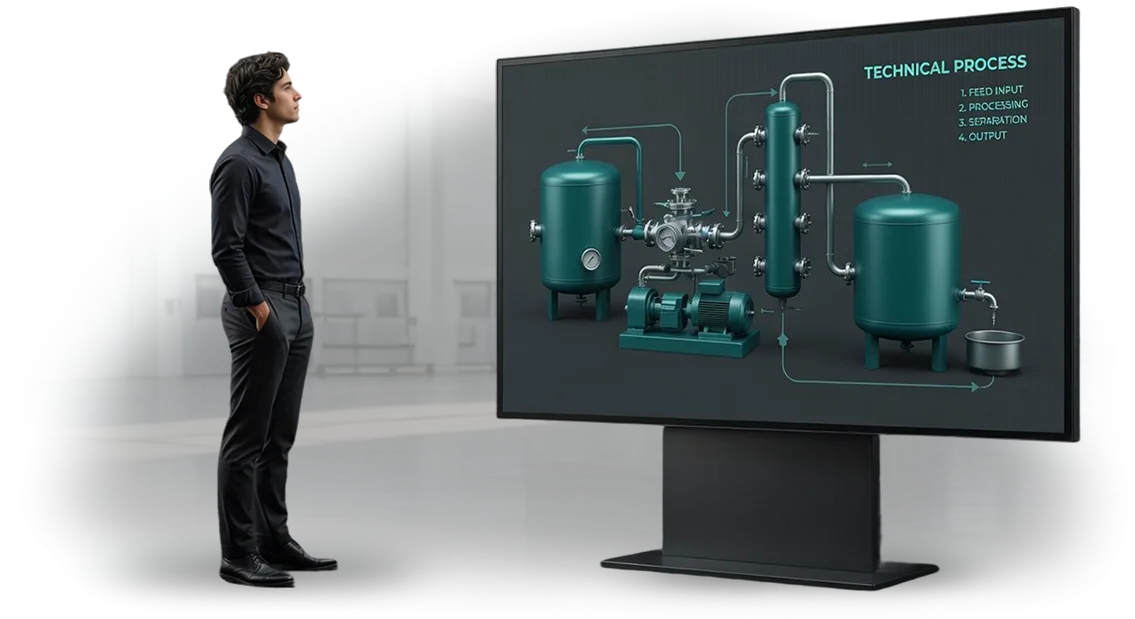
Why industrial 3D printers suffer without video instructions
Industrial 3D printers are expensive and technologically sophisticated equipment, and order fulfillment depends on their operation. Employee errors during assembly, setup, or maintenance lead to defects, downtime, and costly repairs. Every hour of downtime translates into lost production and missed deadlines.
Problems most often arise in small details: improper bed calibration, axis misalignment, untimely lubrication of guides. An operator may ignore a slight deviation, and after a few hours of work the printer breaks down.
As a result, the cost of equipment ownership grows, and the production plan falls apart at the seams.
Text instructions do not solve the problem: each employee reads them in their own way, skips steps, or misinterprets requirements. Beginners have to learn from their own mistakes, while experienced operators spend time explaining instead of doing their jobs.
Video instructions show each step visually: the correct tool, operation sequence, and checkpoints. The employee repeats actions at a comfortable pace, and complex assemblies are shown in close-up. This reduces assembly errors, shortens training time, and reduces equipment downtime.
For business, this means a predictable production cycle and lower repair costs. A video instruction becomes a single standard for all operators.
We create such video instructions for your type of industrial 3D printers, taking into account production specifics and maintenance regulations.
What corporate video training gives a company
The most common problem when launching new equipment or hiring staff is a skills gap. One employee remembers the instructions inaccurately, another learned from “old hands” and repeats their mistakes, a third lacks time with a mentor.
Corporate video training closes all these gaps systematically: each employee sees the same reference process and follows it.
New employees get up to speed 1.5–2 times faster. Instead of spending a week observing a colleague and trial-and-error, the employee spends a couple of hours reviewing work scenarios on an industrial 3D printer and immediately gets down to business.
A video instruction does not get tired, does not get distracted, and does not “forget” to show an important assembly—this is especially valuable when onboarding line staff and operators.
The company gets unified work standards across all areas. There is no longer a need to rely on mentors’ personal experience and verbal agreements. Corporate video captures the best sequence of actions: from printer preparation to final part inspection.
As a result, product quality becomes more stable, and “how it’s done right” disputes disappear by themselves.
The number of errors, defects, and emergency shutdowns decreases. Most failures of industrial equipment occur due to improper operation: axis misalignment, incorrect calibration, untimely lubrication.
The video instruction clearly shows critical points and typical mistakes, so the employee consciously avoids them. For business, this is direct savings on repairs, spare parts, and downtime of expensive equipment.
Skills are retained for a long time, and knowledge remains in the company. People absorb visual information far better than text, and the ability to rewatch a video a month later refreshes memory without retraining.
Even if an experienced specialist leaves, their knowledge does not leave with them—it stays in the video archive forever and works for the company. This approach pays off with every new employee and every prevented accident.
Video instruction formats for industrial 3D printers
An industrial 3D printer is complex equipment, and training employees with “one single file” is ineffective. An experienced specialist only needs a short reminder of the procedure; a beginner needs a full course; and for complex assemblies, visual 3D animation works best.
The choice of format directly affects equipment startup speed and the number of errors during assembly and maintenance.
We have prepared a table of the main video instruction formats that address different tasks: from daily operations to full onboarding. Choose the appropriate scenario or combine them—this will reduce training costs and increase employee confidence.
| Format | For whom | What it gives the client |
|---|---|---|
| Short video | Experienced employees, quick operations | Quick access to instructions, less downtime |
| Full course | New employees, assembly and maintenance | Faster onboarding, unified work standard |
| 3D animation | Technical specialists, complex assemblies | Deep understanding of the design, fewer repair errors |
All formats are developed on professional equipment and adapted to your company’s internal standards. You receive ready-made video files that can be uploaded to a corporate portal or a distance learning system—employees will access the instructions exactly when they need them.
How we create video instructions: from task to launch
An understandable process is the key to a predictable result. We have broken down video instruction creation into stages so you can see what happens at each step, control timelines, and get exactly the product your employees need.
-
Task setting — record for which group of employees the instruction is created, which operations need to be shown, and what result you expect: reduced errors, faster shift readiness, reduced mentor workload.
-
Analysis of work operations — study the real process at the production site or according to your regulations, identify complex assemblies, typical errors, and safety requirements.
This is the basis of the scenario, so the participation of your process engineer or experienced specialist is important here.
-
Script writing — turn operations into a step-by-step scenario in plain language, with emphasis on critical points and correct actions. You receive the text before shooting and can make edits before production begins.
-
Script and plan approval — we approve with you the script, list of shots, and work schedule. At this stage, all substantive edits are made—after shooting starts, they become more expensive.
-
Shooting and video creation — we shoot on professional equipment or create 3D videos, edit, add subtitles and highlights. The result is a finished video that can be viewed on any device.
-
Training launch — we place the video in your distance learning system or hand over files, and prepare a brief instruction for HR and managers on how to integrate the video into the onboarding program or periodic certification.
-
Support and updates — after the launch, we remain in touch: we update instructions when regulations change, help with organizational issues, and, if necessary, refine materials based on employee feedback.
This approach allows you to launch training without lengthy preparation and guarantees that the video instruction actually solves your business problem, rather than simply becoming a nice file in an archive.
What is included in the delivery: a kit for the training department
You receive not just videos, but a complete kit for the training department—everything needed to launch the program from scratch and not come back to this issue for months. Below is the delivery contents, which we record in the contract.
- Ready-made video instructions for assembly and maintenance of industrial 3D printers. The videos are shot on professional equipment and adapted for different formats: showing in a class, self-study by an employee, embedded in an e-learning course.
- Scripts and frame-by-frame storyboards. Each video is accompanied by a text script with a description of each operation. You see exactly what the video shows and can approve it with process engineers before shooting.
- Methodological materials for instructors. A ready-made guide for the trainer: how to structure the lesson, which assemblies to cover in more detail, and how to check that the employee has mastered the material.
- Source files and access to the project working folder. You are not dependent on the contractor: if necessary, you can make edits with your own team or order a new version of the video from us without going back into the task.
- Instruction update procedure. If the printer model, tooling, or assembly technology changes, you receive updated scenes within the agreed format. Training always relies on current processes.
- Usage rights without restrictions on the number of employees. The videos can be used in internal training, at workstations, and in distance courses—no additional licenses are required.
All documentation is delivered in a single standard: the folder structure, file names, and instructions for working with the materials are clear even to an employee who did not participate in the project. The training department gets a working tool, not a “video archive”.
How we reduced downtime and accelerated ramp-up
Downtime of an industrial 3D printer means hundreds of parts, missed deadlines, and overloaded downstream departments. Until recently, operator training took 10–14 days: first theory, then work with a process engineer, then the first hours at the machine. During this period, the equipment either stands idle or prints test samples—and losses only grow.
It was precisely this problem that a series of video instructions, which we developed for the PromKomplekt plant, solved.
Instead of text regulations, the employee received 3D videos on assembly, setup, and maintenance of industrial printers: all assemblies, fasteners, and modes are shown visually, with explanations from the process engineer. The operator repeats the actions right at the machine—no need to keep dozens of pages in mind.
What changed in production
A new employee enters a full shift already on the fourth day instead of two weeks. This result was achieved without a mentor: the video instruction brings the sequence of operations to automaticity, and a short consultation with the process engineer resolves rare questions.
Over three months, equipment downtime decreased by a third, and defects when printing the first batch dropped by half.
The workshop manager noted another effect—operator confidence. When a person sees the correct algorithm instead of trial and error, they stop the machine less often and respond faster to abnormal situations. After the successful pilot, the plant ordered the same videos for the repair service and new lines.
How to choose the instruction format for your task?
The choice of format depends not on fashion, but on what task employees are solving.
For industrial 3D printers, the same operation may require different materials: mass training of newcomers, analysis of a complex assembly, or safety compliance—each scenario needs its own video instruction.
If you need to quickly bring dozens of employees up to speed, short 2–3 minute videos are suitable: general operating principle, typical mistakes, sequence of actions. They do not replace practice, but they remove fear of the equipment and give a common language.
This format is convenient for hiring and the first days on the job, when it is important to show, not tell.
For complex operations—for example, bed calibration, nozzle replacement, print parameter setup—step-by-step instructions with clear detail work better. Here the key is not speed, but accuracy: an employee can pause, return to the desired step, and check against the screen.
A good video instruction for the task eliminates questions to the master and reduces the risk of defects.
Safety is a separate story. This is not a training video, but a mandatory standard: what can and cannot be done, how to behave in an emergency. Such material should reasonably be short, with an emphasis on consequences, and used for regular repeated briefings. It protects employees and reduces company liability.
The main principle of choice is: do not try to fit everything into one video. Split the tasks—and produce a separate format for each. This is faster to produce, easier to update, and clearer for people.
And if you are not sure where to start, start with the operations where mistakes cost the most: usually these are safety and complex setup. Everything else will build around them.
Frequently asked questions: timeline, cost, and adaptation to your workshop
Before ordering video instructions for industrial 3D printers, clients ask about timeline, cost, and compatibility with their equipment. Let’s answer the main questions.
How long does development take and how is the cost determined?
A typical cycle is 3–6 weeks depending on the number of operations. We set the cost after the script and storyboard are approved; it does not change after that. If necessary, we speed things up by working on scenes in parallel.
What if the printer design changes?
We shoot with a margin so that if something changes, only the affected block needs to be refilmed. Source files are kept in editable form—updating a fragment takes 2–3 days. You pay only for updating the required part.
Will the video fit my printer model?
We adapt the script to your modification: exact names of assemblies, operation sequence, and checkpoints for your workshop. Before shooting, we send a questionnaire; the storyboard shows all discrepancies. The employee learns on their own printer, not on an abstract machine.
What guarantees are there for timeline and quality?
We fix the timeline, scope, and cost in the contract and show intermediate versions at each stage. If you find an actual error in the sequence of operations, we will fix it free of charge within a week.
Send us your printer model and the list of operations—we will prepare a plan, timeline, and cost estimate for your workshop.Leave a request, get a sample video for your printer
Leave a request and we will prepare a sample video for your industrial 3D printer. You will see what instructions will look like for your employees: where assembly begins, where the emphasis is placed, how complex assemblies are presented.
This is not a “catalog example” but a sketch of your exact future video instruction, so you can make a decision before full-scale serial production begins.
Then your personal manager will put everything into one clear package. It includes the cost estimate, timeline, commercial proposal, and implementation plan.
You immediately understand who is responsible for what, how much time each stage takes, and how we will integrate employee training into the work schedule without stopping production.
What you get after submitting a request:
- A sample video for your specific 3D printer—no abstract examples.
- Cost and timeline estimate for the required volume of instructions.
- A commercial proposal with a clear scope of work.
- An implementation plan: from filming to distributing instructions to the workshop.
- Employee training: we show how to work with the new format.
- A personal manager available—answers questions within the business day.
This is enough to order a video instruction consciously, without risks. You know the result, budget, and schedule in advance—all that remains is to approve the start and receive a ready-made kit for training the team in a few weeks.