

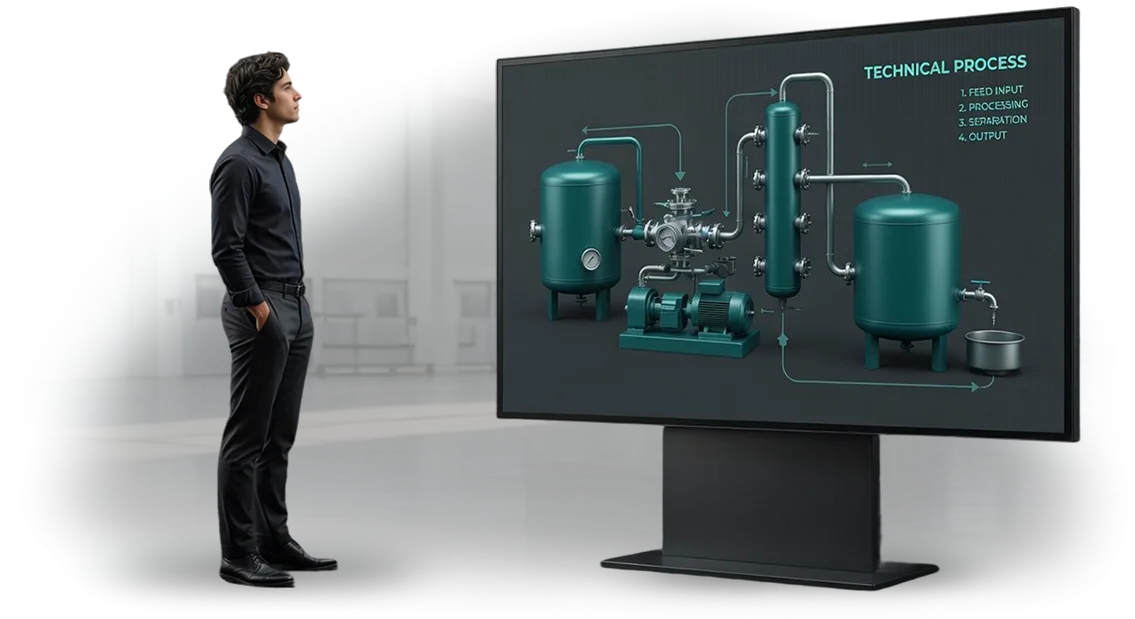
Why Bulldozer Assembly Errors Occur and How to Avoid Them
Bulldozer assembly and maintenance is a process where the cost of a mistake is measured not only in time but also in money.
An incorrectly installed component, a missed routine maintenance step, or an incorrect sequence of actions leads to equipment downtime, defects, and additional costs for rework.
For manufacturing, these are direct losses: missed deadlines, equipment wear, and customer dissatisfaction.
Most often, errors arise not from low employee qualifications but from poor knowledge transfer. Multi-page text instructions and complex drawings take time to study, and in real work, bulldozer parts and components look different than they do in diagrams.
Human factors and training gaps cause up to 70% of production defects — and these are losses that can be avoided.
Video instructions for personnel help solve this problem by showing every step of bulldozer assembly or maintenance visually, in the correct sequence, and with explanations of typical mistakes.
An employee sees not an abstract drawing but a real operation — this way, material is absorbed faster, and the likelihood of error decreases significantly. Videos can be reviewed at any time, used for training newcomers, and for staff certification.
Wehave been developing such video instructions for over 10 years and know how to turn technical complexity into a clear process.
Our clients reduce the number of errors during bulldozer assembly, accelerate the onboarding of new employees, and save on defect correction. In the next section, we'll explain exactly how we structure our work and what results you will get.
What Benefits Manufacturing Gains from Video Instructions
Training for bulldozer work is always a compromise: either a long internship with a mentor or beginner mistakes and equipment downtime. Paper instructions and diagrams do not provide a complete understanding, and text regulations are difficult to apply in real work.
Visual 3D video instructions accurately show every stage of assembly and maintenance — this solves the problem.
Fewer Defects and Errors
When an employee sees a component in three dimensions, they understand the sequence of operations and typical mistakes. At manufacturing facilities after implementing video instructions, the number of defects during assembly drops by up to 30%, and rework costs are halved.
Faster Training for New Employees
A video instruction replaces hours of theory: a newcomer masters the material at their own pace and immediately applies it in practice. Operator onboarding time is reduced from two weeks to four days — while work quality remains high.
Improved Safety
In 3D instructions, hazardous operations are highlighted separately: rigging, working with hydraulics, lifting loads. An employee remembers the safe sequence and takes fewer risks. The number of accidents with this approach decreases by an average of 40%.
Savings on Mentors
Experienced specialists spend up to half their working time training newcomers. Video instructions remove this burden: content is created once and used by all employees without restrictions. You save on mentors and accelerate adaptation.
| Format | For Whom | What It Gives Production |
|---|---|---|
| Step-by-step 3D component assembly | Assemblers, repair technicians | Reduced defects, shorter repair time |
| Occupational safety video | New employees | Fewer injuries, regulatory compliance |
| Self-study library | All personnel | Quick access to knowledge, training standardization |
All instructions are developed based on official documentation and drawings, including data from manufacturers such as Caterpillar. This guarantees accuracy of details and applicability specifically to your equipment.
Formats of Video Instructions for Bulldozer Assembly and Maintenance
The video instruction format determines how quickly an employee masters the operation and how confidently they can repeat it without prompts.
For bulldozers — equipment where an assembly or maintenance error results in downtime — it is important to choose a format for the specific task: from initial familiarization with a component to compliance control of the maintenance schedule. A properly chosen format saves time both in training and in the work itself.
Here is how video instruction types relate to client tasks:
| Format | For Whom | What It Gives the Client |
|---|---|---|
| Full 3D assembly animation | New employees, service engineers | Shows the entire sequence of operations visually, without needing to read drawings. The employee starts working independently faster. |
| Maintenance video regulation | Technicians working on a scheduled maintenance plan | Records the order of inspections and component replacements. Reduces the risk of missing critical operations and increases the regularity of fleet maintenance. |
| Short video reminders on a component | Field mechanics, operators | Solve a specific task: filter replacement, track tensioning, hydraulic checks. The employee gets an answer in a couple of minutes without leaving the work. |
| Interactive error analysis | Training center, quality department | Analyzes typical failures and their causes. Helps employees understand the consequences of incorrect actions and prevent recurring failures. |
From a business perspective, the difference is noticeable immediately. A video instruction reduces the training time of a new mechanic from weeks to several days — a mentor stops being a bottleneck, and work quality stops depending on the "human factor."
You do not have to choose just one thing. Often clients start with full 3D animation for a complex component and then scale it to related operations, turning it into a system of video regulations.
This approach pays off with every next bulldozer that comes off the line or enters service — the instruction is already ready and does not require developer involvement.
How Video Instruction Development Works: From Brief to Launch
We have structured the process so that you can see every key development stage and understand what you get as a result. We have been through dozens of projects, so we handle all approvals, never miss deadlines, and always leave you a control point.
Below are the main stages of creating video instructions, from the first discussion to the finished video.
-
Development brief. Together with you, we define the task: what operation of bulldozer assembly the instruction will show, who it is for, and where it will be used.
The output is a technical specification and a cost estimate where everything is transparent and there are no hidden additions.
-
Analysis and script. We study the documentation, diagrams, and actual videos of equipment operation. We break the operation into logical steps, identify the main components, and the moments worth showing in close-up. You receive a text script before we start animation.
-
Layout approval. We prepare a storyboard of key frames — what the video instruction will look like. This allows you to approve the style, viewing angles, and details in advance, rather than redoing the finished animation. Revisions at this stage are made quickly and without unnecessary costs.
-
Production. We create 3D scenes and animation, and add voiceover narration and subtitles. On intermediate versions, you can see how the project is progressing and provide comments along the way.
-
Final approval. We compile all revisions, check compliance with documentation and the approved storyboard. You watch the draft version in full and confirm everything is correct.
-
Launch and delivery. We provide the finished files in the required formats: with and without subtitles, for the training system or external use. If necessary, we help with publishing and updating videos in the future.
This sequence gives you full control and eliminates surprises. You always know at what stage the video instruction creation is and when to expect the final result.
What Is Included in the Video Instruction Delivery Package
When ordering the development of 3D video instructions for bulldozer assembly and maintenance, you receive not individual videos but a complete training system.
All package elements are designed so that you can launch the program without outside contractors and additional investments.
- A complete set of video instructions: a main course, short lessons on each operation, and separate videos on complex components. Formats are selected for the distance learning system, corporate portal, and tablets in the workshop.
- Methodical materials for instructors: lesson scenarios, skill checklists, and test questions. Your specialists do not need to develop anything from scratch.
- Perpetual video license: use across all company divisions without additional payments as the number of employees grows.
- Access to the training platform: a personal account, assignment of courses to specific workers, progress tracking, and automatic reporting for management.
- Video instruction passports: a description of all operations and bulldozer components shown — the quality department can easily compare the video with current regulations.
- Launch support: we help connect the content to your system, configure access rights, and train administrators.
Such a package allows you to start training within the first week after project delivery. Employees receive a unified training standard, and you get qualification control and a reduction in errors during assembly and equipment maintenance.
Case Study: How a Factory Reduced Defects by 40% After Implementing Instructions
At one machine-building plant producing bulldozers, defect figures did not add up: 15 to 20% of products went to rework at the assembly stage.
The cause was not poor tools but the human factor: experienced mentors were leaving, newcomers worked from old charts, and complex components were assembled from memory. Classic paper instructions did not help — they were rarely read and understood differently.
We proposed converting key bulldozer assembly and maintenance operations into 3D video instructions. Instead of dry diagrams, an employee sees every step on screen: how to tighten a component, in what sequence to connect parts, and what must be checked.
The project's technology base became iSpring — a partner solution that made it possible to quickly compile training videos and update them when the design changed.
The effect was measured after two months: the defect rate in the assembly shop dropped by 40%, and the speed at which new employees reached independent work doubled.
Previously, adaptation took up to three weeks — now an assembler completes training and meets the quota after a week and a half.
According to the plant's chief technologist, "for the first time in several years, shifts work according to the same technology, not by habit."
After the first shop, the client expanded the project to all production lines and requested bulldozer maintenance modules for field operation sites.
The repeat contract confirms the main point: investments in video instructions pay off through reduced defects and downtime, and employees get a clear tool that is easy to use every day.
How to Choose the Right Video Instruction Format for Your Production Tasks?
Choosing a video instruction format is not a matter of taste but a matter of training effectiveness. There is no universal solution: for one task, a simple video is enough; for another, a detailed 3D model is needed.
It all comes down to three factors: the complexity of operations, the skill level of employees, and the conditions in which they will watch the instruction.
For bulldozers, it is especially important to show not only the external appearance of parts but also their internal structure, the interaction order of components, and the correct sequence.
A mistake here is expensive: an incorrectly assembled mechanism can disable the equipment or create a hazard for the operator. Therefore, the requirements for video are high: clear detail, an understandable pace, and the ability to pause and examine any fragment.
The most common and practical option is a combined approach. When a process requires physical interaction with the equipment, it is better to use video recording with a professional operator.
And when you need to show hidden mechanisms or disassemble a complex component without actually taking the machine apart, 3D animation is indispensable.
It allows you to look inside the bulldozer, rotate a part, show the direction of force — things impossible to capture with a camera.
When choosing a format, ask yourself simple questions: who exactly will be trained, how critical is the mistake, and how often will the instruction be used. If experienced mechanics — accents on nuances are sufficient.
If beginners — a step-by-step format with pauses and repetitions is needed. If the instruction is needed as a permanent reference — short videos on a single component are better so that an employee can quickly find the right segment.
We help clients not just shoot video but choose the right format for their production tasks. We analyze typical errors, personnel skill levels, and equipment specifics, then propose a solution that genuinely reduces training time and decreases the number of defects.
This way, you get not an abstract video but a working tool integrated into your workforce training process.
Frequently Asked Questions About Developing Video Instructions for Employees
Before ordering video instructions, many clients have the same doubts: timelines, employee reactions, and guarantees. We answer directly, as in negotiations.
Behind each video is a team with dozens of training programs for industrial enterprises. So we don't say "maybe" — we give specific terms and timelines.
What guarantees do you provide on video instructions?
We work under a contract with a fixed technical specification and stages. If the result does not match the approved script, we make revisions free of charge until full compliance is achieved. The guarantee covers the entire package, including source files.
What are the production timelines for video instructions?
The standard cycle is 2-4 weeks. The exact timeline depends on the complexity of the operations and the number of components. We provide the date after the brief and fix it in the contract. If you need to meet a specific date, we can arrange an accelerated schedule.
What should be done when an instruction needs to be updated?
We build videos from individual scenes and store the source files, so an update takes only a few days. You pay only for the replacement of changed segments and re-voicing.
What if employees resist the video format?
The video format removes the need to reread long texts. An employee sees every step on a 3D model, can pause the video, and return to a difficult moment.
Based on our experience with manufacturing projects, training goes faster and there are fewer mistakes, so employees quickly get used to the new format.
Order Video Instruction Development and Get a Complete Package
Leave a request for the development of corporate video instructions — and we will contact you within one business day. We will clarify what equipment and tasks the materials are needed for, assess the scope of work, and propose a solution that fits your budget and timeline.
You will receive a transparent plan: development cost, stages, and completion date — without hidden conditions or technical details you don't need.
If you require a consultation on video instructions, our specialists will advise which format best suits your employees and how to implement the materials into training faster.
After a short brief, we will prepare and send you a commercial proposal. It will list everything you receive:
- a complete set of video instructions for your bulldozer model — from disassembly of typical components to routine maintenance;
- scripts and texts written for your specialists, without excessive technical jargon;
- video with 3D graphics where every component and action is shown clearly — even complex operations become understandable;
- final files in the format you need — for uploading to a corporate portal or use on tablets in the field;
- methodological recommendations on how to integrate videos into the training and certification program for new employees;
- post-delivery support — if necessary, we promptly make revisions so the materials comply with your regulations.
Fill out the form or write to us — the consultation is non-binding, but you will get a clear understanding of how to accelerate training and reduce equipment downtime. Take the first step — and in a few days you will have a ready solution in hand.