

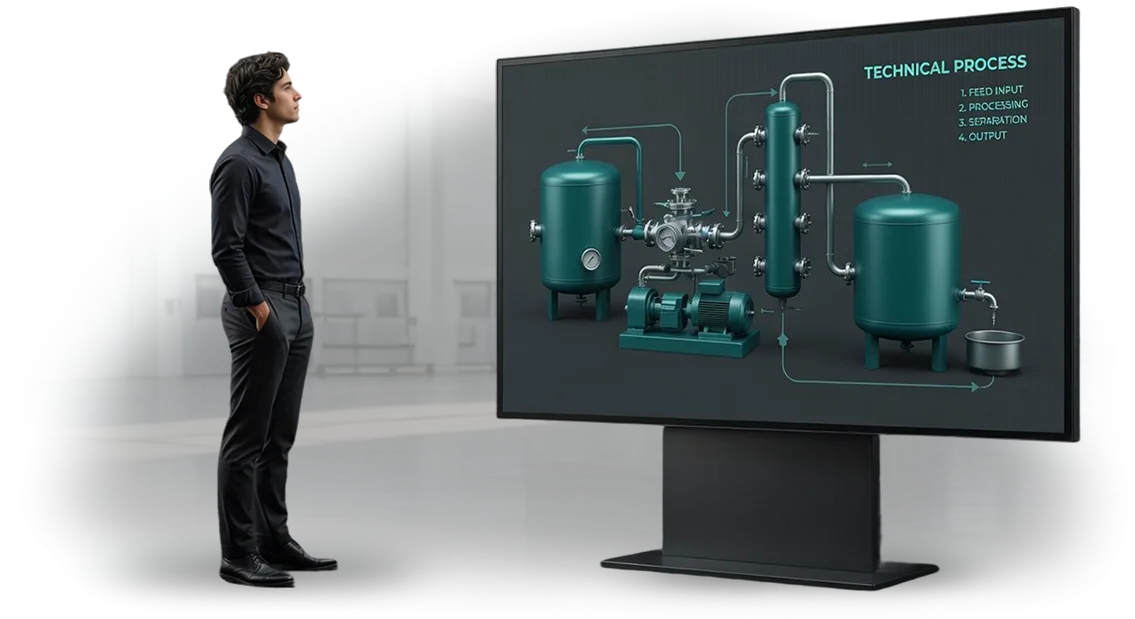
Errors in assembling drilling rigs: how to avoid them?
Assembling a drilling rig is a process where the cost of a mistake is measured not in minutes, but in downtime, repairs, and risk to life. Every hour of emergency shutdown disrupts the drilling schedule, dragging along shifts, logistics, and contractual obligations.
Even experienced personnel make inaccuracies when the instructions are written in a complicated way or do not match real operations. Incorrect assembly sequence, missed locking of a component, safety violations—all of this leads to accidents and costly consequences.
Personnel training at such facilities cannot be formal. An employee must understand not only the sequence of actions, but also the consequences of each step.
This is why standard text-based regulations often do not work: they are skimmed diagonally, interpreted in one's own way, and forgotten in a stressful situation.
We solve this problem with interactive 3D video instructions that accurately replicate assembly operations. The employee sees every component, every fastener, and the correct sequence of actions from any angle, at a comfortable pace, and without risk.
This format eliminates ambiguity, reduces installation errors at an early stage, and makes training visual.
Proven in practice: companies that implement video training reduce the number of safety violations and downtime associated with incorrect assembly. New employees get up to speed faster, rely less on “senior comrades,” and act more confidently in emergency situations. And a manager gets a tool that works equally effectively in the classroom and directly on site.
If you want your drilling rig to operate safely and without stoppages, start with how exactly you train your people. We will help you create instructions that eliminate errors before they even happen.
3D video instructions: a clear language for complex equipment
Complex equipment always places high demands on qualifications. A drilling rig has hundreds of components, and an error in the sequence of actions leads to downtime, breakdowns, or injuries.
Paper instructions and drawings force an employee to mentally assemble a three-dimensional picture from flat diagrams—this takes time and is fraught with errors.
3D animation removes uncertainty. A video instruction shows the internal structure of components, the movement of parts, and the correct order of operations visually, like in a movie. The employee sees each step with their own eyes instead of guessing from a description.
Visual training shortens onboarding and reduces the number of errors during assembly and maintenance.
The multimedia format is now recognized as the benchmark in industrial training. According to the cognitive theory of multimedia learning, a combination of visual and verbal channels is absorbed better than text or speech alone.
We build our videos on this principle: 3D animation is supplemented with short explanations in your employees' language and aligns with your industry standards.
What does this give the business? Fast training for beginners, equally correct actions from all specialists, fewer downtime and breakdowns. Video instructions can be opened on a tablet right next to the drilling rig and are easy to review before a shift.
You get not a one-off video, but a systematic quality control tool for operations that pays off from the very first site.
Video instruction formats for drilling rigs
When new equipment appears on a drilling rig or the maintenance procedure changes, employees need to quickly master the new sequence of actions. The cost of a mistake here is high—downtime, risk of injury, and expensive repairs.
Therefore, the video instruction format must match the specific task: in some cases an overview video is enough, in others step-by-step skill practice is required.
We have prepared a range of formats—from visual assembly animation to interactive instructions with knowledge checks.
Each one covers its own training task: reduce onboarding time, lower the number of errors when servicing drilling rigs, and reinforce the correct sequence of actions.
| Format | For whom and for which tasks | What it gives the customer |
|---|---|---|
| 2D animation | For new employees during initial familiarization with drilling rig components | Quick immersion without risks: a person sees the overall operating logic and structure of the component |
| 3D assembly animation | For training on equipment assembly and disassembly sequences | Visual demonstration of each step from the required angle—fewer errors on the real site |
| Interactive instruction | For practical practice of drilling rig maintenance skills | The employee chooses steps themselves and receives feedback; the skill is reinforced on a simulator |
| Video with knowledge control | For assessing personnel readiness and permitting them to work | Verification of understanding of the procedure before going to the site, clear analytics for each employee |
Formats can be easily combined in a single course: from animation to interactive, so training proceeds in stages.
We select the combination according to your tasks and budget, and the client receives a ready-made system that reduces the burden on mentors and speeds up staff training.
How we create a video instruction: project stages
We have structured the process so that you always understand what is happening with the project and when you will receive the finished result. Each stage ends with your approval—no sudden surprises or rework at your expense.
The project typically takes from three weeks, but the timeline is fixed individually after the brief.
- Brief and task audit. We gather requirements: which operations to show, who will watch, on what devices. We clarify details that affect the scenario and set the deadlines.
- Video scenario. Based on your regulations and instructions, we create a shot-by-shot scenario: what happens on screen, what employee actions are shown, what comments are voiced. You approve the scenario before 3D work begins.
- Creation of 3D models and animations. We model the drilling rig and required components and configure movements in accordance with your instructions. At this stage, you see draft previews and make adjustments.
- Voiceover and editing. We add professional voiceover, subtitles, and emphasis on important details. We produce the final videos in the required resolutions and formats.
- Launch and support. We deliver the finished videos and, if necessary, help integrate them into your training system—along with the platform where employees will complete the material.
Throughout the project, you have a personal manager and a clear calendar with milestones. Revisions at the approval stage are included in the cost—you don't risk your budget because of our internal refinements.
In the end, you get not just a video, but a ready-made training product that employees actually watch and apply in practice. Leave a request, and we will prepare a plan and an estimate for your task.
What is included in the video instruction delivery package
A single video file is rarely enough for training production. The customer needs a package that can be used by the HR department, the technical director, and the employees themselves.
We deliver everything we created and approved on the project in three blocks: training materials, source files, and technical integration.
The delivery package includes:
- Scenario plan and storyboard. A document that describes employee actions step by step: which side to approach the equipment from, which tool to take, and in what sequence to perform operations.
- Accurate 3D model of the drilling rig. A digital copy of the equipment with sufficient detail to study components and the assembly or maintenance sequence.
- Ready-made video instructions in multiple formats—for the corporate learning platform, for tablets, and for in-person training in the classroom.
- Integration with your e-learning platform. Completion results automatically appear in reporting—you see who studied the material and when.
- A methodological package for the mentor. Knowledge check questions, tests, checklists, and recommendations for conducting a hands-on session.
- Project source files. If the design changes, you will be able to update the materials—we will agree in advance on the transfer format and the list of rights.
All elements go through approval with your team before launch. You get not an abstract service, but a clear set of tools for monitoring, implementing, and further developing your training program.
Case study: how to train 500 workers in six weeks
When you need to urgently train 500 workers to operate complex equipment, classic lectures and paper regulations don't help. Employees are scattered across sites, there aren't enough instructors, and an error in assembling a drilling rig threatens downtime. The speed of preparation directly affects revenue.
For the oilfield services holding company BurTech, we created a series of 3D video instructions for assembling and servicing drilling rigs. The visual videos replaced live demonstrations: every component, stages, typical errors, and correct techniques.
We analyzed real cases of defects and structured the scenarios so that employees immediately understood what to pay attention to.
Project results
- 500 workers completed training in six weeks—without stopping production shifts.
- Onboarding time was reduced from two months to five weeks—a 40% decrease.
- Assembly and maintenance errors dropped by almost a third: less downtime and lower repair costs.
The head of the training department shared the results: “For the first time, we met the training need this quickly. Previously, training a single shift took months; now everything happens in parallel across all sites.
Video instructions have become the backbone of the program—they are clear for beginners and convenient for recertification.” After the pilot launch, the customer expanded the project to other types of equipment.
This project shows that properly packaged training saves time, reduces risks, and conserves resources. If you have a similar task—tell us about it, and we will offer a solution with measurable results.
How to choose the right video instruction format for your task?
The video instruction format cannot be chosen “from a catalog”: what works perfectly for one type of equipment completely fails for another.
Drilling rigs differ in assembly complexity, number of components, operating conditions, and even in who will review the instruction—a new employee or an experienced mechanic.
Before proposing a solution, we study these parameters and determine what exactly should happen on screen: a general overview, a detailed breakdown of a component, typical errors, or a maintenance procedure.
The specifics of the equipment directly influence the format choice. If employees need to understand a large-scale installation with many parts, three-dimensional diagrams that can show any angle work better.
For operations requiring a precise sequence of actions—step-by-step videos emphasizing the correct order. And for routine maintenance, short modules that can be reviewed on a tablet right at the rig are more convenient.
Each customer has their own individual requirements: corporate style, employee access levels, and the need to update instructions when regulations change. We gather these requirements at the start and design a format that is easy to adapt and use in daily operations.
It is important that the video instruction does not become just a “pretty video,” but actually reduces training time and the number of errors.
That is why we do not offer a single universal option. We select a solution for a specific task: we determine the duration, level of detail, presentation style, and method of delivery to employees.
This approach guarantees that the instruction will work in your specific conditions—on your specific drilling rig model.
Frequently asked questions about video instruction development
Customers most often ask about timelines, budget, and guarantees of results. We answer directly—this helps avoid misunderstandings at the start and plan a project with an accurate budget.
Below we have gathered answers to the questions that come up in every brief for developing 3D video instructions for assembly and maintenance of drilling rigs. If your question is not here—ask it in the comments, and we will consult with you.
How long does it take to create a video instruction?
A standard project takes from three to six weeks, depending on the number of components and the level of detail of assembly operations. We fix the timeline in the contract and stick to it.
If you need a launch by a specific date, an expedited format with accelerated approval is available.
How is the development cost calculated?
The cost is affected by the scope of the scenario, the number of complex operations, and the format of the finished video. We assess your case, and after the brief we give you an exact quote—it does not change during the process.
The project usually pays for itself through faster onboarding of new employees and a reduced burden on mentors.
What guarantees do we have that the video will be clear and accurate?
We don't just draw 3D—we verify every operation against technical documentation and working engineers. We test the finished video on a group of employees and make corrections until the material is understood without follow-up questions. If you find a factual inaccuracy after delivery, we will fix it for free.
Why is 3D animation better than regular filming for drilling rigs?
In 3D, you can show internal mechanisms, cross-sections, and hidden components that cannot be seen on real equipment. The employee understands how it works before even approaching the rig—this reduces the risk of errors and injuries. The video instruction works on any device and remains relevant when equipment is updated.
Next steps: launch your project right now
Launching a project is easier than it seems. Leave a request for a consultation—we will analyze your task and propose a solution that fits your budget and timeline. No obligations: you get a clear action plan, not abstract promises.
After your request, we follow a proven process. Here are the next steps:
- We will contact you within one business day, clarify details, and answer questions.
- We will conduct a consultation: we will analyze the training scenario, target audience, and the format of video instructions.
- We will prepare a commercial proposal with a fixed cost and timeline—no hidden fees.
- We will agree on the scenario of the future instruction: which drilling rig operations to show and which components to emphasize.
- We will carry out production: 3D models, animation, voiceover, editing—with intermediate previews at each stage.
- We will deliver the finished material and help integrate it into your training system. If necessary, we will adapt it for remote learning.
You get not just a video, but a working tool for staff training. Employees master complex components and procedures faster, there are fewer assembly and maintenance errors, and safety on site improves. We guarantee that the final video matches the scenario and your company's standards.
To order a video instruction, leave a request on this page or call us. Launch the project right now, and within a few weeks your employees will be learning faster and more effectively.