

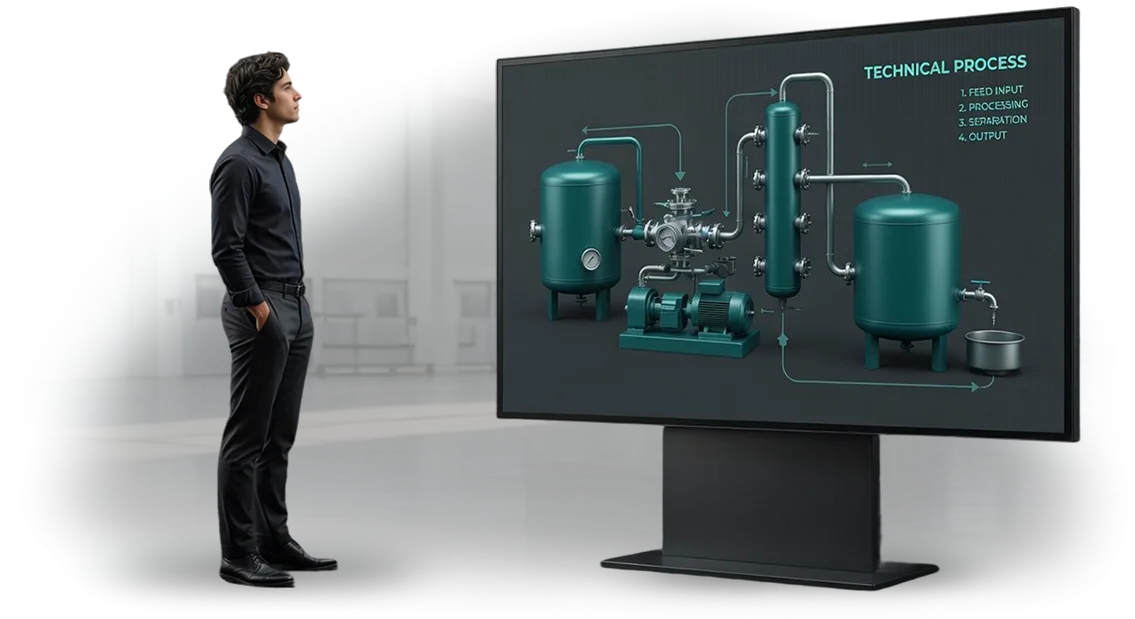
Why Errors in Assembling Electrical Distribution Panels Lead to Losses
Assembling electrical distribution panels is a process where the cost of a mistake is measured not only by a damaged part.
Incorrect wiring, contact tightening, or cable labeling leads to short circuits, overheating, and fire, threatening the safety of people and the integrity of equipment.
For business, these are direct losses: production shutdowns, missed deadlines, unscheduled repairs, and claim payouts. Every workplace accident undermines a company's reputation and customer trust, and also attracts the attention of regulatory authorities.
The root of the problem lies in the training system for assembly technicians. Experienced specialists know the nuances but pass on knowledge "by word of mouth," while newcomers learn from paper schematics or general-purpose videos. This leads to inconsistencies in practice and increases the risk of assembly errors.
Video instructions solve this problem systematically. They show every stage — from unpacking to inspection — in a single standard, with an emphasis on distribution panel safety.
An employee sees the correct movements, tools, and control points, reducing dependence on the experience of an individual master technician.
We create corporate training video instructions that integrate into the assembly technician training process. This reduces onboarding time, decreases the number of accidents and downtimes, and gives management a transparent quality control system for assembly.
What Benefits Does Business Get from Video Instructions for Employee Training
Training employees to work with electrical distribution panels is a task where the cost of a mistake is measured not only in time but also in safety.
Traditional briefings and text-based regulations leave room for misinterpretation, so a new employee takes a long time to reach the required pace and often acts on the principle of "do it the way the mentor taught me."
We create video instructions that turn scattered knowledge into a single, clear standard. Here's what this gives your business:
- Faster training. An employee stops searching for answers in documentation — they see the correct sequence of actions on screen. Onboarding time is reduced many times over, a newcomer starts working independently sooner and doesn't distract experienced colleagues.
- Fewer errors. A clear visual demonstration of panel assembly and maintenance eliminates typical mistakes: incorrect operation order, improper connections, skipped checks. Defective work, rework, and emergency callouts become a thing of the past — along with the costs of fixing them.
- Standardized training. Every employee learns from the same benchmark, regardless of who their mentor is. All actions are performed identically on any shift and at any site, and quality control becomes predictable.
- Rapid knowledge updates. Video instructions can be reviewed right at the workstation or from a tablet. When a regulation changes, it's enough to update one video — and the whole team is back to working according to a single standard, without repeated briefings.
This checklist is not just a list of advantages but a practical tool that is already used in production environments. Video instructions solve staffing issues, reduce operational risks, and make training a managed process rather than a lottery.
3D Instruction Formats: From Animation to Interactive Simulators
The choice of training video format depends on the specific task: introducing a newcomer to the assembly sequence, verifying skills before granting work authorization, or refreshing the knowledge of experienced personnel.
The format determines the speed of onboarding, the number of errors on the production floor, and employee safety — so the choice should be made deliberately.
| Format | Target audience | What it gives the client |
|---|---|---|
| 3D assembly animation | New employees, workers dealing with complex assemblies | Clearly shows every step and sequence of operations, reduces training time and decreases the number of assembly errors |
| Interactive simulator | Personnel before work authorization, certification | Allows practicing actions without risk and at a comfortable pace, automatically verifies employee readiness |
| Video with real operations | Experienced specialists, reference library | Demonstrates real tools, force application, and installation nuances, helps quickly refresh knowledge for rare operations |
The best results often come from combining formats: animation for initial training, a simulator for knowledge verification, and real-life footage as an ongoing reference.
We'll select the optimal set for your tasks and the specifics of your distribution panels — from standard series to unique projects.
Stages of Video Instruction Development: From Brief to Implementation
Developing video instructions for electrical distribution panels is a process where the client is never left alone with a technical specification.
We guide you from the first brief to the implementation of finished videos into employee training: at every stage you see what's happening and make the key decisions.
The entire journey takes from two weeks to a month and a half depending on equipment complexity — we set the deadlines at the start and adhere to them.
-
Brief and material audit. We study the documentation, schematics, and specifics of your equipment. We clarify what tasks the video instructions are needed for: initial training, recertification, dealing with emergency situations. We arrive at a clear technical specification that we agree with you.
-
Video instruction scenario development. We detail every step: from tool preparation to panel setup and inspection. We take into account safety regulations and corporate standards. You receive a script that can be approved before production even starts.
-
3D content creation. We build electrical distribution panel components in a digital model to show the construction from any angle. The employee sees all elements, connections, and actions unambiguously — without the "gray areas" that arise when filming real equipment.
-
Draft versions and client approval. We show a rough cut, you provide edits on wording and logic, and we adjust the 3D scenes and editing. We repeat iterations until the result meets your expectations.
-
Final video release. Finished video instructions with voiceover, subtitles, and interactive emphasis on key actions. We deliver files in the formats you need — for LMS, video hosting, or offline viewing.
-
Implementation and support. We help upload the materials into your training system, set up the optimal viewing scenario, and collect initial results. If processes change — we'll update the digital content without redeveloping everything from scratch.
This approach to the stages of video instruction development turns 3D content creation into a manageable project: you know the timeline, cost, and scope of revisions in advance.
The result is faster employee readiness and a single standard for performing operations across all sites.
What Is Included in the Delivery Package of Video Instructions for Employees
The entire delivery is structured so that you get a working tool from day one, not a set of "raw" files.
We hand over the package in stages — from final videos to regulations and employee access — so that HR staff and technical specialists can launch training without delays.
What's included in the package:
- Final video instructions in multiple formats — for LMS, corporate portal, and offline viewing on devices without internet access.
- Modular video structure — each scenario is split into short steps. An employee can review only the needed segment rather than the whole film.
- Version with subtitles and text transcript — for employees with hearing impairments and for those working in noisy workshops.
- Implementation guide — a step-by-step document: how to upload the materials into your training system, assign a course, and track progress.
- Employee reference card — a short instruction on where to find the videos and what to do if questions arise.
- Personal account access — all files, versions, and updates are stored in one place, and you retain permanent access to the final materials.
After handing over the package, we don't disappear: for a month we support the launch, answer your employees' questions, and promptly make edits to the videos when needed.
If the assembly schematic or regulation changes — you can order an update to a specific episode without reshooting the entire course. This way training stays relevant, and your specialists always work according to the latest instructions.
Case Study: How We Reduced Distribution Panel Assembly Errors by 40%
The client — a distribution panel manufacturer — faced a pain typical of the industry: assembly errors resulted in rework, missed deadlines, and tension among crews.
Experienced assemblers knew how to work correctly, but new employees learned through trial and error, and few people read text-based instructions. As a result, up to 15% of finished panels required rework, and newcomer onboarding stretched over months.
We proposed replacing dry regulations with a series of 3D video instructions: every panel component is shown in volume, with the correct sequence of operations and an analysis of common errors.
The videos can be watched on a tablet right at the workstation, and key steps are divided into pauses with a checklist. For the pilot, the client chose their most problematic panel line — one with a non-standard layout where disputes between assemblers arose most often.
Three months after implementing the training, we measured the results together with the client's process engineers. The number of assembly errors dropped by 40% — confirmed by quality control department reports.
New employee adaptation time also decreased: instead of a month and a half, it took three weeks to reach independent work. The production manager noted that crews stopped redoing work after weekends — previously, this had been the main source of defects.
Significantly, six months later the client ordered a second series of instructions — this time for panel maintenance at end-user sites. By their estimates, every hour of video paid for itself through reduced warranty callouts.
Today these videos are used not only by the assembly shop but also by the service department — as a reference for non-standard situations.
For us, this case confirmed a rule: 3D instructions work not because they are "nice graphics," but because they remove ambiguity. An assembler sees the ideal example in front of them — and replicates it instead of searching for answers in blueprints.
If you need to reduce defects in panel assembly or maintenance, a similar result is achievable — start with one complex operation and measure the effect over two or three months. We'll help design the video so that it solves precisely your task.
Frequently Asked Questions About Creating Corporate Video Instructions
Before ordering a video instruction, almost all clients ask the same things. How long will development take, will it be easy to update the video if the process changes, and what about quality if something goes wrong. They ask because training timelines and employee safety depend on the answers.
In our ten years of work, we've developed clear rules for each of these questions. Below are brief answers to the ones we hear most often.
How long does it take to create a video instruction?
A standard scenario takes 2–4 weeks from task approval to the finished video. The timeline is set in the contract and agreed at every stage: you always understand what stage the work is at and when to expect the result. This allows you to plan employee training without downtime or missed deadlines.
What if the instruction becomes outdated — equipment or processes change?
No problem: a video instruction is not a static document. We make it modular, so when one operation changes, only that segment needs to be replaced. The update takes a few days rather than requiring a full reshoot. You get up-to-date material that doesn't lose value after changes on the production floor.
What guarantees do we have that quality and deadlines will be met?
We work on professional equipment and show draft versions at all key milestones. Acceptance is based on an agreed list of requirements: if something doesn't meet expectations, we refine it.
The contract fixes the requirements for the result and the deadlines — you're protected rather than relying on promises.
Didn't find your question — write to us, we'll review your situation within one day.Get a Cost Estimate for Developing Video Instructions for Your Equipment
Leave a request, and we'll prepare a cost estimate for video instructions tailored to your task.
Tell us what equipment your employees need to be shown — and we'll propose the optimal format: from short training videos to a full course on assembling and maintaining electrical distribution panels.
We'll also answer your questions, give you a sense of the timeline, and advise on which materials will deliver quick results.
We work remotely, so it doesn't matter where your production sites are located. We don't quote a price out of thin air — we calculate the number of scenes, model complexity, and the quantity of finished instructions.
That's why you'll receive a transparent estimate rather than an abstract proposal. The consultation on development comes with no obligation.
What you'll learn after reaching out:
- which types of video instructions suit your personnel — from newcomers to experienced assemblers;
- how 3D visualization accelerates training and reduces the number of assembly errors;
- what scope of work is needed to cover all assembly and maintenance regulations;
- how long material creation will take and how we refine the process;
- how to transfer knowledge if some employees work remotely or on different shifts;
- what's included in the delivery package and which formats you'll be able to use in your distance learning system.
To order video instructions or simply get an estimate, fill out the form. Leave your contact details and a few words about your equipment — we'll ask clarifying questions, prepare a proposal, and send it within one business day.
How to Choose the Format of Video Instructions for Your Production Tasks?
The choice of video instruction format always starts from two parameters: the complexity of the operation and how often it's repeated.
For assembling an electrical distribution panel — with installation of busbars, circuit breakers, and control units — you need full 3D animation that shows the internal construction and sequence of actions without the risk of error.
For periodic maintenance or module replacement, short step-by-step videos with an emphasis on control points are enough.
If the operation is performed rarely but requires high precision, choose an in-depth format with pauses and interactive hints. If the process is standard and repeated daily, a two-to-three-minute video that's convenient to watch at the workstation from a tablet will suffice.
The key principle: an instruction should answer the question "what am I doing right now and how do I check the result," not just repeat a technical manual.
For electrical distribution panels, it's important to show not only the mechanical assembly but also the wiring logic: phasing, grounding, and the order of circuit verification.
That's why the scenario is divided into levels: a general overview of the construction, detailed operations, common errors, and ways to prevent them.
This approach reduces onboarding time and noticeably cuts the number of defects at the site — the employee sees the entire process through the eyes of an experienced commissioning engineer.
Before ordering production, determine who will watch the videos: commissioning engineers, assemblers, or maintenance operators. Each group has its own optimal depth of detail and pace of presentation.
If you're unsure which format fits your task, start with a pilot video on one complex component. We'll prepare a scenario plan and show an example on your equipment — so you can evaluate how easy it is to follow before a full-scale production run.