

Are clients losing employees due to errors in grain elevator assembly?
Grain elevator assembly is a process where a mistake costs dearly: damaged equipment, missed deadlines, and in the worst case, employee injury. And the cause is usually not negligence, but the fact that a new worker is left alone with a complex paper instruction.
He doesn't see how one unit connects to another, doesn't feel the sequence of operations, and makes decisions at random.
High staff turnover in grain industry enterprises makes the situation worse. Employee training takes weeks, and experienced mentors cannot physically be next to every newcomer.
The human factor becomes the main source of risk: errors in grain elevator assembly repeat from shift to shift, and work safety depends on the employee's random knowledge. One serious incident cancels out all the savings on training and undermines trust in the regulations.
The problem is also that traditional instructions are based on text and flat diagrams. This format requires well-developed spatial thinking, and under high stress and fatigue, even an experienced assembler misses details.
A newcomer who has never seen a real grain elevator assembly tries to recreate it from scattered fragments — hence missed steps, wrong sequences, and rework.
We eliminate this pain at the level of information perception. Instead of abstract materials, the worker gets a visual scenario in which he sees every action, from preparing the workplace to the final check of the unit.
This makes employee training faster, correct actions are reinforced from the first shift, and work safety no longer depends on the "golden hands" of individual employees.
What does a 3D video instruction give your production?
Text instructions and flat drawings do not prevent mistakes: a new employee spends weeks figuring out how the elevator works, and each mentor explains things differently.
The result is a slow start to the shift, risk of injuries and equipment damage due to the human factor, especially during grain reception season.
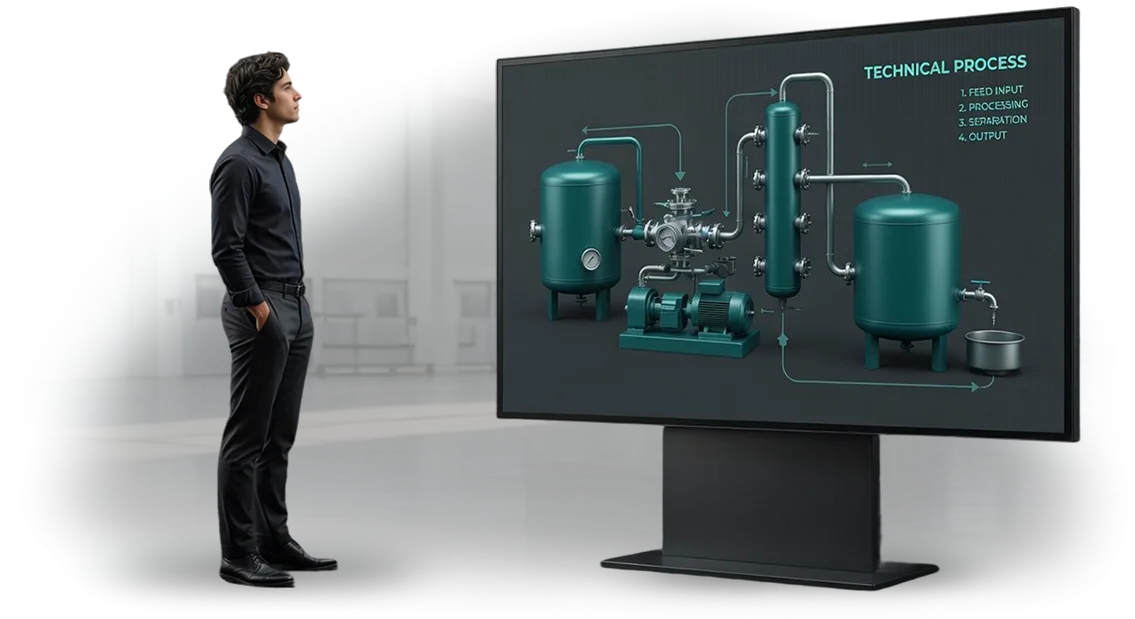
A 3D video instruction shows every grain elevator unit in volume: how assembly is done, how to maintain mechanisms, which movements are dangerous. The employee sees not an abstract diagram but an accurate model of his equipment with real risk zones.
We create videos based on your technical documentation and professional 3D modeling, so the image fully matches the production environment.
This directly speeds up onboarding: in 10–15 minutes of viewing, a person gets what previously took weeks of practice.
Dangerous areas shown in 3D are remembered visually and work better than any safety briefing — injuries decrease, there are fewer downtimes and unscheduled repairs.
We add knowledge control: after the video, the employee takes a short test, and you see who is truly ready to work and who needs more training. All videos follow a single standard based on your regulations — training no longer depends on the mentor's personality.
According to our team experience, companies shorten onboarding time and noticeably reduce the number of accidents already in the first season of use.
Formats of 3D instructions for grain elevator assembly
Grain elevator assembly and maintenance involve dozens of units, strict sequence of operations, and high safety requirements. A newcomer reads text regulations for hours, while an experienced mechanic wastes time searching for the right clause.
A 3D video instruction solves both problems: it shows the entire process and allows you to pause at the required operation.
Different tasks require different formats. We match the format to the scale of production and the team's skill level so that the video instruction works toward a specific result — reducing downtime, fewer errors, and a quick path to normal productivity for the employee.
| Format | For whom | What it gives the client |
|---|---|---|
| 3D assembly animation | New employees, assembly crews | Clear operation sequence without reading drawings, fewer errors during grain elevator unit assembly |
| Interactive video | Operators and mechanics | Practicing actions in a safe environment, knowledge control before going to the site |
| Modular videos | Service departments and repair crews | Quick access to the needed unit, time savings on elevator maintenance |
| Full video course | Training centers and large holdings | A single training standard for all branches, reduced mentor costs |
The choice of format depends on what you want to achieve: fast onboarding, improved safety, or faster repairs.
We combine 3D animation, interactive video, and modular videos into a single training system so that every employee receives knowledge exactly when and in the form needed for the job. This turns a one-time purchase of videos into a working personnel management tool.
How work on your video instruction proceeds
Work on a video instruction for employees is a transparent process in which we handle all technical issues and you receive a finished result. We start with a brief and support the project until the video is actually used in training at your enterprise.
- Briefing. We discuss the task: which operations to show, who the audience is, and which mistakes employees make most often. This helps define quality criteria and deadlines.
- Production analysis. We study real workplaces, equipment, and regulations. The video instruction must match how the work is actually done — otherwise employees will not trust it.
- Script plan. We develop a step-by-step script: which actions to show, how much time to allocate for each step, and which accents and warnings to include. We approve it with you before production starts.
- Approval. You receive the plan and storyboard and make edits. We take your comments into account and only move to 3D visualization after your approval.
- Visualization. We create models and animations that accurately replicate your equipment. The employee sees every unit from the right angle — this makes information easier to remember and apply in practice.
- Voiceover and editing. We add a narrator's voice, text captions, and highlight dangerous moments. The finished video is assembled into a complete training program.
- Implementation. We deliver files in the required format and help integrate the video instruction into your training system. If necessary, we adapt it for different device types.
At every stage you stay informed: we have no "black box"; all decisions are approved together. Therefore, the result is an instruction that actually works and reduces the time needed to bring new employees up to speed.
What is included in the video instruction delivery package
When a company invests in training materials, the question of delivery scope is not a formality. It determines whether you can update instructions when equipment changes or use the videos for other tasks.
We specify the full package in the contract so that after project delivery you receive a working asset, not just files.
Here is what the standard delivery includes:
- Final videos in the quality and format you need — ready for upload to your corporate portal, LMS, or for display on tablets and in the workshop.
- Project source files — scripts, frame-by-frame storyboards, and editable files. These are your safety net: if necessary, you can make changes with your own team or another contractor without losing quality.
- User guide — a clear instruction for launching, using, and embedding the videos into the training system. No "figure it out yourself" — everything is laid out step by step.
- Update procedure — the process for making changes when equipment is modernized or the technological process changes. You know exactly how long an update will take and what cost to plan for.
- Technical support — after project delivery, we stay in touch. If you have questions about playback, integration, or configuration, we respond within one business day.
For grain elevators, this is especially important: equipment is modernized and regulations change.
A full package of documentation and source files guarantees that your video instruction will not become outdated in six months and will work as part of the training system, not as a one-time file. Leave a request — we will send a detailed delivery list for your task.
Real case: efficiency growth in production
Before implementing 3D video instructions, a new grain elevator employee studied paper regulations and spent months watching a partner. Double training took weeks, and errors in equipment assembly and maintenance led to downtime and emergency work.
For the agricultural holding «ЗерноТрейд», we converted the training program into a visual digital format — a series of instructions for all key operations, from grain reception to scheduled repairs.
Instead of PDF documents, detailed 3D videos appeared for each grain elevator unit: from the receiving device to conveyor lines. The employee sees the mechanic, his actions, and the correct tool, and can review a step before going on shift.
This format is understandable even to a trainee without a technical background and is equally useful for a beginner and an experienced master dealing with a rare fault.
Figures the client saw
- Onboarding time for a new employee dropped from 14 days to 4 days.
- The number of errors during assembly and repair fell by 45%, and equipment downtime was cut in half.
- Repair crew productivity increased by 30%: less rework, more planned tasks.
- The mentor freed up about a third of his time — instead of repeated explanations, he focuses on team development.
The production manager commented on the result: «Previously, we spent weeks training people and then spent time fixing defects. Now the crew opens the video before the shift starts and gets everything right the first time; the mentor is barely distracted. For us, this is growth in useful work without hiring new employees».
The success of the project allowed the client to scale the format to all five sites and order additional instruction series — for seasonal maintenance and introductory training.
This result is not a coincidence but a consequence of a properly built knowledge transfer system: we design videos so that every employee quickly finds the answer and immediately applies it in practice.
How to choose a video instruction format for your task?
No video instruction format is universal: what works perfectly for one task may be useless for another. The choice comes down to three key criteria — the training goal, the employees' skill level, and project cost.
Your answers determine which option you get: a simple overview of key operations or a detailed 3D scheme of a grain elevator unit assembly with component-by-component breakdown.
The first criterion is the technological complexity of the operation. If we are talking about regular maintenance of a grain dryer or replacing a bucket elevator bucket, a step-by-step instruction with an emphasis on sequence and safety is enough.
If the task is more complex — training for repairing a unit where every detail matters — it is worth investing in 3D animation. This format shows the mechanism from the inside, allows viewing it from any angle, and does not require stopping equipment for filming.
The second criterion is the target audience. New employees need maximally detailed materials with explanations of basic concepts, while experienced mechanics process the same information faster.
They need not explanations but control points, common mistakes, and non-standard situations. One format rarely covers both needs, so we often prepare an instruction with depth levels or two different versions of the same operation.
Finally, budget and deadlines. A full 3D scene requires more resources than filming a real object, but it pays off when the equipment is unavailable for filming or the instruction must be updated when the design changes.
Practice shows that clients most often choose a hybrid format: filming real actions plus 3D inserts for hidden grain elevator units. This is the optimal combination of cost and effectiveness.
You do not need to figure out formats yourself — that is our job. We analyze your task: you describe the operation, the number of employees, and desired deadlines, and we propose a format that solves the problem without overpaying. You receive a clear justification for why this option was chosen and a precise implementation plan.
Frequently asked questions about video instruction development
Most often, before ordering, people ask about deadlines, guarantees, and revisions. These are the right questions: a 3D video instruction for grain elevators must fit into the training process and not become outdated after design changes. We answer briefly and to the point, without fine print.
This approach has already been proven on dozens of projects. We state our obligations in the contract, show intermediate versions, and refine the material until full approval from your side.
How long does video instruction development take?
A standard project takes 2–4 weeks depending on the complexity of assembly units and the number of scenes. We set deadlines in the contract and show intermediate versions at every stage — you see the progress rather than receiving a "lump" at the end.
What happens if revisions are needed after delivery?
After the rough cut, you send your comments — edits within the scope of the technical specification are free and made until full approval.
If equipment design changes later, we will make an update as a separate iteration: the source materials are saved, so releasing a new version takes days, not months.
What guarantees do you provide?
We work under a contract with acceptance stages. At each stage, you approve the result, and we do not release the final version without your "go-ahead".
If technologists find an error during review, we fix it at our own expense — responsibility for the result remains with us.
Will the video instructions be compatible with our training system?
Yes. We deliver in universal video formats — suitable for corporate portals, any learning management platform, and regular video hosting. Employees can watch the instruction on a computer, tablet, or smartphone without installing additional software. If needed, we will help configure publishing inside your platform.
Start your video instruction project today
Starting does not require technical preparation from you: we manage the project ourselves, from the first request to finished video instructions.
our team works remotely, so the launch process takes minimal time from you — you get the result without diving into production details.
Here is what the path to ready-made employee video instructions looks like:
- You leave a request on the website or by phone — we contact you within one business day.
- We conduct a consultation: we clarify tasks, audience, scenarios, and the format of the video instructions.
- We prepare a project cost calculation — deadlines, scope of work, and cost are fixed in the contract.
- We approve the production plan: script, filming schedule, or 3D visualizations.
- We start development. At all stages, you see intermediate versions and make edits.
- After delivering the video instructions, we stay in touch: we make changes if regulations are updated.
For typical grain elevator assembly and maintenance projects, we already have proven scenarios, so the calculation and initial drafts take minimal time. In most cases, no more than a week passes before development starts — you quickly get a working tool for employee training.
You can leave a request right now — from there, we handle all organizational matters.