

Errors in Escalator Assembly and Maintenance: What It Costs
Any error during escalator assembly or maintenance is not just an omission in an inspection log. It is a potential accident, with possible injuries, a facility shutdown for days, and proceedings with regulatory authorities.
The cost of such an error is measured not by repair time but by a company’s reputation and the trust of passengers.
Escalator accidents and incidents always become public stories: the media picks them up, passengers write about them on social media. Then come orders, heavy fines, and unscheduled inspections.
But the biggest blow is to the safety of employees and customers, as well as to the uninterrupted operation of the entire facility: every hour of escalator downtime disrupts schedules and upsets visitors.
Why do errors happen? Most often, the cause is human error. An employee skipped an important step, forgot a point that had not come up in their practice, or followed an outdated instruction.
An escalator is a complex system where even a slight deviation from the procedure can lead to serious consequences.
Ordinary text reminders and seminars do not provide the required level of training: they do not show the mechanism in detail and do not allow practicing the sequence until it becomes automatic.
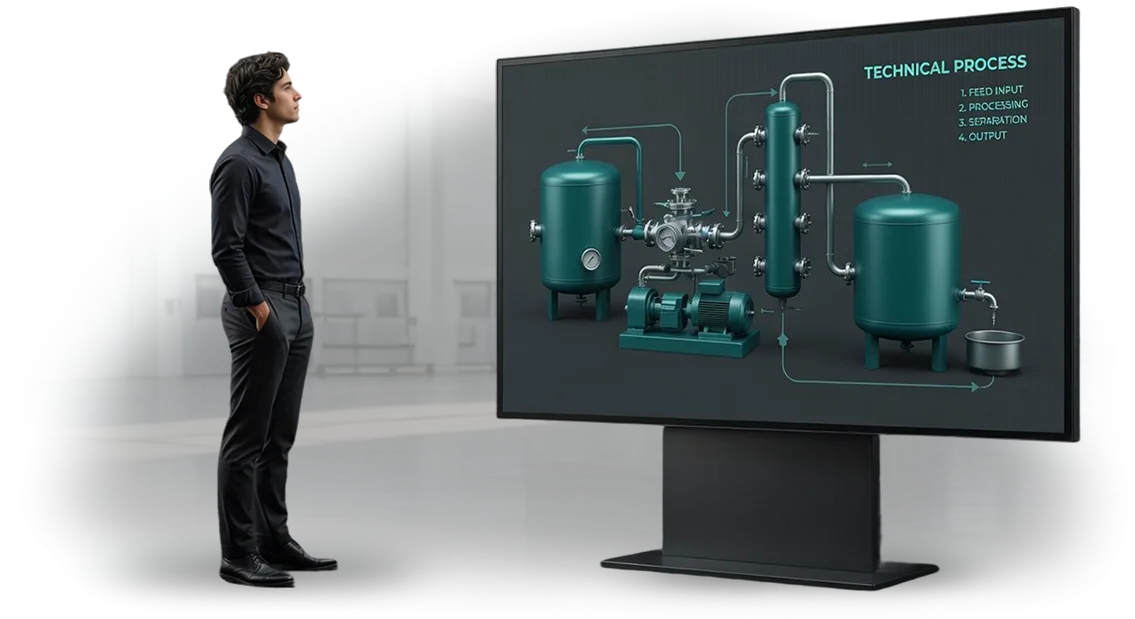
That’s where a modern training approach helps: 3D video instructions that visually demonstrate every stage of assembly and maintenance. The employee sees the inner structure, the correct sequence of operations, and typical mistakes before even picking up a tool.
This kind of training reduces the risk of errors, shortens onboarding time, and ensures uniform safety standards across all departments. Investment in quality training is always smaller than the losses from an accident or downtime.
What Benefits Does a Company Get from Video Training for Employees
Traditional training of new employees means long weeks with a mentor, thick instruction manuals, and inevitable mistakes on real equipment. As a result, the company loses time and money, and work quality depends on the experience of a single specialist.
Video training based on 3D models solves this problem: the employee sees each escalator component in cross-section and the sequence of operations from any angle. This is especially important during seasonal hiring, when a team needs to be prepared quickly.
Learning speed increases many times over—a newcomer masters the process in 2–3 viewings instead of weeks of practice. At the same time, knowledge does not depend on the mentor’s availability: the video instruction can be rewatched at any time on any device.
Standardization is another key advantage. All employees are trained to a single reference standard that captures the best experience of your engineers. There is no inconsistency in methods on site, which means fewer errors during escalator assembly and maintenance.
Safety reaches a new level: dangerous operations are studied virtually, without any risk to people or equipment. The employee arrives on site already prepared, which reduces injuries and the likelihood of emergency downtime.
Savings come from reduced training time, fewer defects, and lower mentoring costs. Moreover, training becomes independent of staff turnover—even with high rotation, you maintain preparation quality.
We build models from your documentation and create instructions that pay off after the first use with a group of employees.
Formats of Training Video Instructions for Different Tasks
Training for working with escalators requires different formats. Some need only to refresh their knowledge, others need to practice an emergency situation without risking equipment. That is why we’ve selected three basic formats: video, interactive course, and simulator. Below is a comparison and guidance on what to choose.
Video is suitable for initial introduction, interactive for checking understanding, simulator for practicing complex operations. We design the formats so that you can see the result: time to proficiency, maintenance errors, readiness for abnormal situations.
| Format | For whom | What it gives the client |
|---|---|---|
| Video | New employees, initial safety briefing | Fast rollout and mass training: short 3D videos clearly show operations, reducing mentor time and time to proficiency. |
| Interactive course | Current staff, professional development | The employee goes through the material at their own pace, answers quiz questions, and you see each person’s progress and weak points. |
| Simulator | Rare operations, emergency situations, certification | Practice dangerous actions without stopping equipment. The employee gains hands-on experience not available in real work and passes an exam in a realistic environment. |
Stages of Developing a Video Instruction for Employees
Developing a video instruction is not a one-off task but a structured process where each stage is clear and controlled. We break the work into steps so that you get the desired result without surprises and can make edits at early stages—when it costs the least.
-
Brief and immersion. We study your procedures, equipment, and employee audience. As a result, you receive a clear technical specification that the entire project is built on.
-
Script and storyboard. We turn complex operations into an understandable frame-by-frame language. You see the future video before production—this saves time and money on rework.
-
Review and revisions. You provide feedback, and we quickly adjust the script and visual solutions. All open questions are closed before launch, not after.
-
Production. We create the video: professional filming or 3D animation. For escalators, accuracy of details matters—we use proven tools so the employee sees every operation.
-
Voiceover and subtitles. We add narrator voice-over and text prompts. The video is comfortable to watch even without sound—for example, in a noisy technical room.
-
Launch and handover. We deliver the finished instruction in the required format and integrate it into your training system. Employees get access right away, without extra effort on your part.
-
Support. If procedures or work sequences change, we quickly update the video. You can always be sure that training follows the current version, not outdated materials.
What You Get in the Package with a Video Instruction
You order a video instruction not for the sake of a file but for a training outcome. That is why the delivery includes not just a video but a complete set of materials—so you can launch training within days and independently develop the training system based on this content. All rights remain with you, with no restrictions on time or number of employees.
Here is exactly what you receive after the project is completed:
- Finished video instruction on escalator assembly and maintenance—for LMS platforms, in-person classes, and safety briefings. The video plays on any device, including tablets and phones for field teams.
- Video script—a detailed storyboard with text and timing. It is needed to approve the content with engineers and use it as the basis for reshoots of new versions.
- Instructor’s guide—a step-by-step manual for conducting training: how to show the video, what to emphasize, how to answer employee questions. With it, any mentor can run a session without prior preparation.
- Project source files—graphics, animation, audio, and the editing project. You can make changes when procedures change or new escalator models appear—without ordering the work from scratch.
- Usage rights—full rights to the video and individual frames for internal procedures, presentations, and training courses. Perpetual access with no extra fees per trained employee.
Each package item is documented in a delivery acceptance certificate. Along with the video, you get a tool that can be scaled: updated, re-voiced, and adapted for branches—this protects your investment for years to come.
Real Case: Implementing Video Instructions in Production
Many escalator manufacturers face the same pain: high staff turnover, long onboarding, and errors that lead to downtime and injuries. Traditional on-the-job training with a mentor takes weeks, and the result heavily depends on the experience of a particular employee.
We decided to solve this problem systematically—we developed a series of 3D video instructions for a production facility.
Instead of abstract drawings and text procedures, we created visual videos showing every assembly and maintenance operation: component by component, with emphasis on typical mistakes.
An employee can review the instruction on a tablet right at the escalator instead of looking for a mentor.
Numbers the Client Saw
The effect was measured six months after implementation. Training time for a new installer decreased by 40%—five weeks instead of two months. Assembly errors fell by 65%, and the share of repeat service callouts was cut in half.
Safety was also tracked separately: over the course of a year, not a single accident occurred at the site working with video instructions.
For the production manager, this means predictability: fewer defects, less downtime, and new employees become productive faster. For HR, it is a clear onboarding program. For the occupational safety department, it is reduced risks and injuries.
What the Production Manager Said
“Training used to take months, and still someone would miss something. With video instructions, beginners assemble components correctly from the start, and experienced technicians no longer argue about the sequence of operations. Safety has improved—that’s priceless.”
After the first stage, the client expanded the project: they ordered videos for service maintenance and procedures for work in confined spaces.
The instructions are now used across three production sites of the company, and this is not the limit—the videos are easily adapted to new equipment and types of escalators.
How to Choose a Format for Escalator Assembly and Maintenance?
The right format is determined by the tasks, staff skill level, and budget—not by fashion or a desire to make it “prettier.” For escalator assembly and maintenance, where a mistake is costly, a regular text instruction or a set of photos does not work: a newcomer cannot see the internal mechanisms, and an experienced specialist wastes time rereading.
That is exactly why the choice of format directly affects training speed and the number of errors on site.
When the question “which format to order” comes up, it is important to look at three things: the complexity of operations, the current skill level of the team, and the development budget. Our experience shows that for routine work, a 2D video with focus on components is enough.
But for non-standard assembly or maintenance of complex escalator series, you need a full 3D model that shows the process from any angle and allows you to look inside the component. Below is a guideline we use when consulting clients.
| Format | For whom | What it gives the decision maker |
|---|---|---|
| Text + static photos | Budget option for simple operations | Cheap and fast, but the employee has to fill in the details themselves—the risk of error remains |
| 2D video with animation | Basic training for new employees | Clearly shows the sequence but does not reveal the internal structure of components |
| 3D video instruction | Assembly and maintenance of complex escalator designs | Full immersion in the process: every component is visible, and you can pause, zoom, and repeat—errors are minimized |
We recommend not chasing the most expensive format but choosing the one that solves your specific problem. If you have staff turnover and need a standard for fast onboarding, look at 3D, but with basic detail.
If training is selective and employees are already experienced, 2D with emphasis on difficult places is enough. In any case, we first audit your operations and budget and only then propose a solution—we do not sell the same template to everyone.
You will not have to overpay for unnecessary complexity or save money and then struggle with equipment failures.
Order a 3D video instruction—and your employees will work to a single standard, while quality control becomes easier. We will prepare a format for your task and budget, show examples of similar projects, and make a pilot fragment before full payment.
Your time and money go into a training system that pays off by reducing escalator accidents and downtime.
Frequently Asked Questions About Developing Video Instructions
Clients come to us with the same doubts: will deadlines be missed, will it be too expensive, will the instruction become outdated after the next escalator upgrade. We address these questions—briefly and without technical details.
How long does it take to develop a video instruction?
A typical project takes two to four weeks, including filming, editing, and approvals. The timeframe directly depends on the number of components and scenarios: one operation is faster, a full maintenance procedure takes longer.
We set a schedule in the brief and stick to it. If revisions arise, we incorporate them within the agreed time, so the launch is not delayed.
Why is this better than a regular text instruction?
Text has to be read, while video shows the movements of hands and tools. A new employee watches the video once or twice and repeats the actions without mistakes instead of rereading pages.
This reduces the number of errors during assembly and maintenance, and time to proficiency is cut by two to three times. For a business, this means a fast return on investment.
What happens when the escalator design changes?
Video instructions do not become outdated if they are built on a modular principle from the start. We shoot individual components and operations so that when one block is replaced, you do not have to reshoot everything.
If the procedure changes, you only need to update the affected module—this takes days, not months. You get up-to-date material without a large additional budget.
Is it difficult to integrate such instructions into training?
No, employees will not need to learn new programs. The video is uploaded to the corporate system or shared via a link—it can be opened from any device with one click.
For a manager, this is a ready-made control tool: you can see who has watched the material and quickly check knowledge. Training stops being a “paper formality.”
For example, for a client, we filmed a series of maintenance instructions—within two months, employees completed training four times faster, and the number of errors during routine work fell by a third. The client confirmed that the investment paid off in the very first quarter.Order the Development of a Video Instruction for Your Production
Leave a request on this page, and within the next business days you will receive a ready solution for your task. We know how costly equipment downtime is, so we get straight to the point: we clarify details, show examples, and calculate the cost.
What you get after submitting a request:
- Personal consultation—we will review which video instruction format suits your production and team.
- Cost and timeline estimate—a transparent quote with no hidden fees, taking into account the number of employees and the complexity of operations.
- Examples of our work on escalator assembly and maintenance—you see the level of detail and presentation style before the project starts.
- Step-by-step development plan—you understand at which stage each part of the instruction will be ready.
- Technical specification with a description of all scenes—we approve the script so the video exactly covers your procedures.
- Direct contacts of a manager or project lead—no bots and no long waiting.
It all starts with one request—we take care of the rest. Describe in a few words what equipment needs to be shown, and we will propose a solution that will reduce training time for new employees and lower the risk of maintenance errors.