

Gas Turbine Maintenance Mistakes: Cost and Solution
Mistakes in turbine maintenance are not just an oversight — they are a direct risk to production. The wrong order of operations, a missed component, or incorrect tightening torque leads to accidents, equipment shutdowns, and unplanned repairs.
According to industry statistics, a significant share of such incidents occurs not because the equipment is complex, but because an employee misread a paper manual: diagrams, terms, and action sequences in text form require a high level of skill that new personnel simply do not have.
Accidents in production are especially costly when a turbine fails during the busiest period. Every hour of downtime means unmet contracts, missed deadlines, and lost revenue. Meanwhile, gas turbine repairs can take weeks, and hiring and training new specialists can take months.
The result is that a company pays twice: first for the mistake itself, then for restoring the process and reputation. The cause is not employee negligence, but the fact that traditional training does not help a person form a clear mental model of the operation.
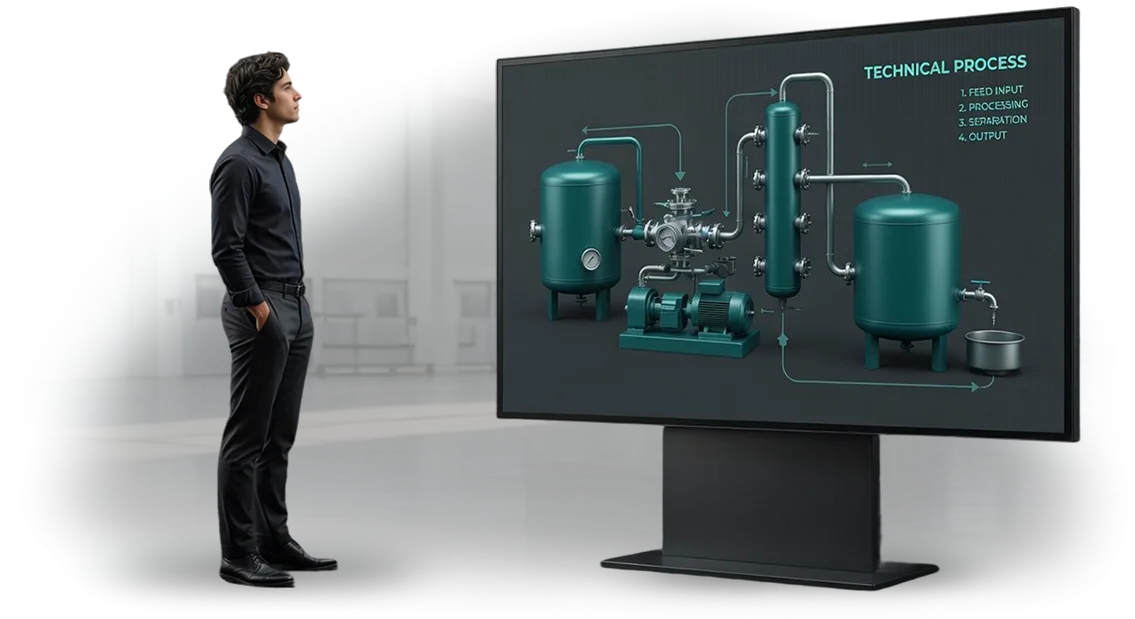
The solution is 3D video instructions for gas turbine assembly and maintenance. An employee sees every component, every motion, and the sequence of actions as if they were doing the job themselves.
This is not an abstract diagram, but a visual trainer that removes the main pain point — the gap between “read” and “understood.” Training according to the procedure becomes fast, predictable, and equally effective for a newcomer and an experienced mechanic.
We solve this problem: we turn procedures into video format that is clear without decoding, and we reduce the risk of human error before the employee even reaches the equipment.
Instead of expensive accidents and long downtime, the client gets a stable process — everyone performs operations to a single standard, and quality control does not depend on the experience of an individual specialist. This is exactly what lowers repair costs and increases the predictability of production as a whole.
Benefits of Video Instructions for Personnel Training and Safety
Video instructions from our team turn the scattered knowledge of experienced adjusters into a clear standard for the entire team.
Instead of thick manuals and word-of-mouth handovers, an employee receives a step-by-step video course where every component and every action is visible. The enterprise gains measurable benefits — from training speed to reduced accident rates.
Fast Onboarding of New Employees
A newcomer no longer depends on a mentor’s availability: they watch the video instruction, repeat what they see on the screen, and practice the skill until it becomes automatic.
Time to full readiness is reduced by 30–40%, and the number of questions to supervisors drops dramatically. A standardized process allows hiring people without extensive experience and quickly bringing them up to line-level performance.
Reduced Risks and Errors in Maintenance
Gas turbines are equipment where the cost of a wrong action is measured not only in money but also in human safety. Video instructions set a single order of operations, eliminating improvisation and skipped critical steps.
Fixed safe working methods with tools and components reduce the likelihood of breakdowns and injuries — and therefore reduce downtime and unplanned repairs.
Internship and Certification Control
A manager sees which employees have actually completed training and which are only listed as completed: video instructions come with tests and viewing confirmations. This makes the internship process transparent and protects the company during inspections.
All access documents are collected automatically, saving hours of work for HR and technical supervision departments.
Easy Updates to Training Materials
Procedures change — you only need to reshoot one segment rather than reprint hundreds of pages of instructions. Current video versions are always at hand: employees work according to fresh standards, not outdated memos.
This reduces documentation maintenance costs and eliminates confusion between different versions of procedures.
Video Instruction Formats for Gas Turbines: Which One to Choose
The format of a video instruction directly affects how quickly an employee learns. There is no universal solution for gas turbines: sometimes detailed 3D animation is needed, sometimes interactivity, and sometimes a short breakdown.
Most often, difficulties arise from choosing the wrong format: a video that is too long gets abandoned, while one that is too short lacks the necessary detail. Let’s look at three options we use in projects and suggest which one to choose.
| Format | Target audience | What it gives the client |
|---|---|---|
| Full 3D animation | New employees, engineers, operations | Shows the turbine structure and operation sequence in detail. Speeds up onboarding and reduces errors during independent work. |
| Interactive video | Experienced specialists, authorization for complex operations | Allows pausing, returning to steps, and testing knowledge. The employee controls the pace — learning is deeper. |
| Short video tutorial | Line personnel, standard operations | Covers one action in 1–2 minutes. Easy to review in the field, saves time, and reduces dependence on a mentor. |
Which format is best depends on the frequency of the operation and the experience of the employees. We help determine this during the brief: we analyze the process, the audience, and typical errors.
As a result, you get not just a video, but a ready-made training tool that fits into your mentoring system.
How the Work Proceeds: From Brief to Implementation and Support
To help employees master complex gas turbine operations faster, they need clear instructions that everyone can understand.
At our team, the process is built like a well-oiled conveyor — you know in advance what happens at each step and when you will receive the finished result. This approach eliminates surprises and allows you to control timelines.
-
Brief and task analysis. We discuss your specifics: which operations need to be shown, who will be trained, and what standards the company uses. The output is a technical specification with goals and scope fixed in writing.
-
Script development. We write a detailed script with a shot-by-shot description of actions, narrator text, and emphasis on important components. You review it with technologists and experts, make edits — this removes objections at the final stage.
-
Creation of 3D models and environment. Based on your drawings and documentation, we model gas turbines, tools, and work areas. The equipment looks realistic — employees easily transfer knowledge to real objects.
-
Video rendering and editing. We turn the prepared scenes into finished video instructions with narrator voice, subtitles, and pop-up hints. The videos are consistent and suitable for different types of training — from in-person to remote.
-
Testing and revisions. We show a preliminary version, collect feedback, and refine: change camera angles, pacing, and add additional emphasis. You see the final product before delivery.
-
Delivery and implementation. We provide files in the format you need or embed the videos into the company’s LMS. We perform a quick access setup so employees can start training without a long preparation phase.
-
Support and updates. If procedures change or a new equipment modification is released, we quickly make edits to the videos. Updates are approved through a simplified process — there is no need to go through the entire cycle again.
In the end, you get not just a set of videos, but a working tool that reduces employee onboarding time and lowers the number of errors during turbine assembly and maintenance.
What Is Included in the Delivery: A Package for the Training Department
You receive not just a set of files, but a ready-made system for the training department. The delivery includes everything needed to launch a training program for gas turbine work, verify material comprehension, and keep the videos up to date without unnecessary costs.
- Ready-made video instructions for gas turbine assembly, maintenance, and repair in multiple resolutions — for desktop computers, tablets, and smartphones. Employees train on any device, even in the field, without losing image quality or detail.
- Scripts and shot-by-shot comments for each video. Training department methodologists can quickly adapt the material to internal procedures instead of creating supporting documentation from scratch.
- Methodological materials and control questions for knowledge checks after viewing. Ready-made tests save weeks of instructor time and allow objective assessment of how well an employee has learned the operation sequence.
- Source 3D models and project files. If your team wants to make edits using its own specialists, the source files are already in your hands. Alternatively, we quickly refine a detail upon your request.
- Video update procedure. When a turbine design changes or a new maintenance procedure is released, we update only the necessary episodes rather than reshooting the entire course. This is many times cheaper and faster than ordering a video from scratch.
- Implementation guide for the distance learning system. We help upload courses, configure assignments, and track results — so the training department immediately sees each employee’s progress.
- Technical support and material warranty. After project handover, we remain in touch: we answer questions, advise on usage, and support the first training launches.
This package covers the full cycle: from the first viewing to knowledge control and regular updates. The training department gets a tool that works right away, not one that requires lengthy in-house refinement.
Case Study: How We Reduced Repair Crew Errors
A repair crew from the Northern Energy Holding went to the site with paper manuals and relied on the experience of senior colleagues. During gas turbine assembly, any mistake meant extra hours of downtime and a risk to expensive equipment.
We prepared a series of 3D video instructions for the client, where each component is shown step by step and complex operations are accompanied by explanations.
Results After Three Months
After implementing the instructions, assembly errors decreased by 60%, and average repair downtime fell by 30%. The crew distracts senior mentors less often, new employees reach working speed faster, and the service manager sees where the team most often stumbles.
This effect was achieved not only through clear visuals. We analyzed typical errors from past repairs and placed emphasis precisely on the components where they occurred.
The videos are available on tablets and phones, so workers check the instructions right at the turbine instead of returning to the break room.
Why This Result Is Repeatable
Six months later, the client ordered a second set of instructions — for planned maintenance in a neighboring workshop.
This confirms that digital instructions work not as a one-off measure, but as a systematic solution that pays off through fewer emergency shutdowns and stable repair quality.
If your crew also spends hours fixing the consequences of mistakes, we will start with an audit of typical operations. We will show you at which stages video instructions will deliver the greatest effect in your specific process.
Frequently Asked Questions About Implementing Video Instructions
The most common questions are about cost, timelines, adaptation to non-standard components, and updates. We answer directly — without fine print or asterisks.
How much does development cost and what makes up the cost?
The cost depends on the complexity of the equipment and the number of operations to be shown. You are not paying for a “video” but for a clear instruction that reduces personnel errors and training time — the exact figure is fixed in the contract after the brief.
What are the timelines? When will the first materials be ready?
The typical timeline is two to six weeks for a set covering one turbine model. We provide a draft version as early as the second or third week so you have time to make edits.
If you need it before a planned overhaul or the hiring of a new shift, we build in a buffer and deliver ahead of schedule.
We have specific turbines and internal procedures — can you adapt?
Yes, this is our core work. We study your drawings, process charts, and procedures, and clarify details with your technologists. The result is a video that exactly matches your assembly or maintenance route sheet and is still clear to every employee.
What happens when an operation or design changes? This isn’t forever, right?
Instructions can be updated: if a component, tool, or action sequence changes, we make edits to the existing project and upload a new version to your internal portal or learning system. This is faster and cheaper than creating a video from scratch.
Still have questions — write to us: we will send work samples and calculate the cost for your task.Order a Project Estimate and Get a Demonstration Video
To understand how video instructions will fit into employee training, it is important to see the result in advance.
That is why we prepare a demonstration video based on your component, and we make the project estimate before discussing details — so you can make decisions based on facts, not promises.
Send a consultation request — we will study your task, suggest the optimal format, and send a commercial proposal. No obligations: you get the full picture of timelines, scope, and cost, and then calmly decide whether to move forward.
What is included in the estimate and demonstration:
- Project estimate for your part or component: script, complexity, number of videos.
- Demo video in your style — so you can assess how the instruction will look for your employees.
- Commercial proposal with specific stages, timelines, and terms.
- Consultation — on how to integrate video instructions into your training and certification program.
- Adaptation plan for different workshops and employee skill levels.
- Answers to questions: video updates, formats, integration with your learning system.
After the estimate, you understand how the instructions will reduce newcomer onboarding time and lower the risk of errors during gas turbine assembly and maintenance. The demo video shows the quality level, and the commercial proposal lets you justify the decision to management.
Send a consultation request — we will respond within one business day, prepare the estimate and demo. Start with a short message, and we will handle the rest.
How to Choose a Video Instruction Format for Your Budget and Timelines?
To choose a video instruction format that fits your budget and deadlines, you need to base the decision not on trends but on specific tasks. For simple operations — for example, filling out work orders or working with documentation — standard screen recording is enough.
For complex gas turbine components, it is a different matter: detail and the ability to show internal structure without disassembling the equipment are important here. For such tasks, 3D animation is justified and pays off through clarity and fewer personnel errors.
The main criteria for choosing a format are the turbine type and the skill level of the employees.
If you have several turbine models and a team with varying experience, a universal video will not work: a newcomer needs more explanation, while an experienced specialist only needs control points.
We take this into account and offer a modular structure where basic blocks are produced using simpler methods, and complex components are covered in 3D inserts. This hybrid approach can reduce the budget by up to 40% compared with fully animated video, without losing value.
Production timelines also depend directly on the format. Full 3D animation of a complex component can take weeks, while a realistic assembly from existing materials can take several days.
We always give realistic timelines up front and offer phased delivery: first we agree on the script, then we show draft animation, and only after your confirmation do we deliver the final version. This allows you to control the process and adjust the budget at early stages.
Our task is not just to produce a video, but to choose a format that solves the problem with minimal cost. That is why, during the brief meeting, we analyze the specifics of your turbine, employee skill levels, and target implementation timelines.
Only after that do we propose an estimate and schedule — without hidden extras or surprises. The result is a video instruction that is clear to your team, fits the budget, and is ready for use exactly on time.