

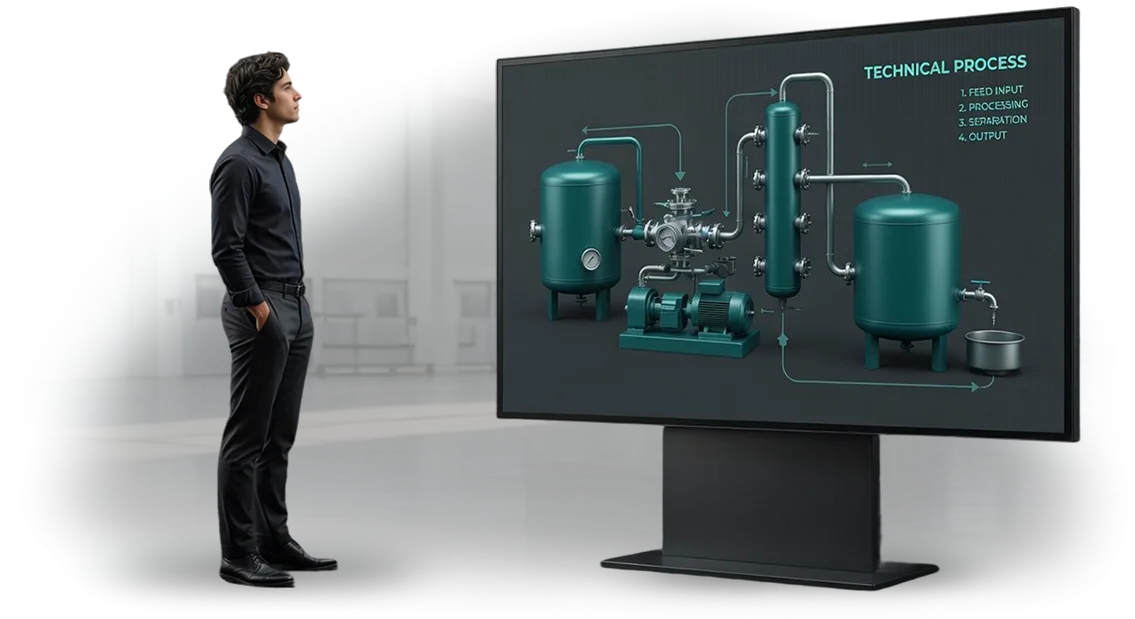
Why Conveyor System Assembly Turns into Chaos
Conveyor system assembly turns into chaos when employees are forced to learn from text instructions and diagrams. Assemblers interpret the same points differently, skip important steps, and waste time searching for the correct order of operations.
As a result, assembly errors backfire: the conveyor starts with delays, rework is required, and sometimes entire units must be reassembled.
Production loses money in the process: line downtime means unfulfilled orders, missed deadlines, and frustrated clients. Every assembly mistake leads to repeated personnel callouts, purchases of new fasteners and seals, and adjustment of operating modes.
The worst part is when the problem surfaces not during assembly but during operation, and it has to be traced across the entire line.
Training staff based on dry documents is especially hard for beginners: they cannot see what a correct unit should look like, what forces to apply, or how to control quality.
Experienced technicians are not ideal either — over time, each one develops their own "convenient" methods that do not always match the regulations. This is how discrepancies arise between different crews and hidden defects accumulate.
The solution is video instructions for employees that clearly show every stage of conveyor assembly: from laying out components to checking belt tension. Short videos remove uncertainty, set a unified standard, and get newcomers up to speed quickly. Such training takes less time, reduces the number of errors, and makes the process predictable.
We create exactly these video instructions: we examine real conveyor system components, capture working techniques, and turn them into clear training videos. You get a tool that shortens assembly time, reduces correction costs, and makes your employees more confident.
What Video Instructions Provide: Speed, Accuracy, and Control
Every new employee in production is a risk of error: while they learn, they assemble conveyor systems slowly and with flaws, and experienced specialists are distracted from their tasks by mentoring.
Video instructions make training predictable — it no longer depends on the shift, free time, or mood of a particular mentor.
Fast onboarding is the first thing you notice after implementation.
Instead of weeks of reading regulations and accompanying a newcomer with an experienced employee, a person watches short videos on assembly and maintenance, immediately sees the correct sequence of actions, and begins independent work much faster. Employee adaptation stops being chaos and becomes a well-tuned process.
The second advantage is reducing errors and defects. When everyone performs operations according to a single video standard, "personal" methods and guesswork disappear.
Every conveyor system installation, every unit replacement, or adjustment is done equally correctly — which means fewer reworks, less downtime, and fewer client complaints.
Third is control and standardization of work.
You gain confidence that all employees are trained according to the same rules, recorded in video rather than oral stories of "how we used to do it." A supervisor can reuse the videos for retraining, onboard seasonal staff faster, and verify that standards are upheld across all shifts.
This works like a checklist without the human factor: speed of immersion, accuracy of actions, and quality control. You get these results from the very first training video.
Video Instruction Formats for Conveyor Systems
Formats are selected for the specific training task. Some need a quick reference right at the conveyor line; others need a full course for a beginner.
So we divide video instructions into two types: quick videos for on-the-job reference and extended modules for systematic operator training.
Both formats are filmed on professional equipment and adapted to your technological instruction. As a result, the employee gets visual material that reduces errors and accelerates reaching the required productivity.
Format Comparison
| Format | For Whom | What It Gives the Client |
|---|---|---|
| Short video (1–2 minutes) | Operator at the conveyor line | Quick reference for a single operation — without stopping work or wasting time |
| Training module (10–15 minutes) | New employee | Full understanding of the assembly or maintenance process from day one |
| Step-by-step technological instruction | Maintenance and commissioning staff | Clear sequence of actions for unit replacement and preventive maintenance |
| Full course with knowledge check | Entire staff | Assessment of material comprehension and authorization of the employee for independent work |
This structure covers all scenarios: quick help in the workshop, newcomer onboarding, and training quality control. You get a video set that works at different stages — from instruction to certification.
If needed, we combine formats: we produce short videos from a full module so you do not pay for filming twice. Budget savings and a logical training system — without extra costs for reshoots.
How We Structure the Project: From Brief to Production Launch
How We Structure the Project: From Brief to Production Launch
The development process is designed so you can see timelines, responsible parties, and control points in advance. No surprises: each stage closes with a specific result that you approve before moving to the next.
- Brief and task audit. At the start, we clarify the scope of operations, the number of employees, their skill level, and technical conditions at the production site. This allows us to set the right video format before filming — without unnecessary edits mid-project.
- Script and storyboard. We turn technological instructions into clear scripts broken into short steps. You receive a text document describing each frame and visual sequence — easy to approve with technologists and safety specialists.
- Concept approval. We present the style and filming or 3D-scene plan, as well as the material presentation logic. All substantive edits are made at this stage — before budget is committed to production.
- Filming or 3D visualization. We work with professional equipment — for conveyor systems we often use a combination of live-action filming and detailed 3D graphics to show internal mechanisms without disassembling equipment.
- Editing and rough cut review. We assemble the video with voiceover, subtitles, and emphasis on critical operations. You receive the draft for preliminary review — you evaluate the pace, completeness of instructions, and ease of comprehension.
- Final approval and quality control. We address comments, verify each operation against your regulations and safety requirements. After your "yes," the project is considered ready for delivery.
- Implementation and support. We hand over the final files in the required formats and help upload them to your training system. If regulations change during operation, we promptly reshoot or adjust specific blocks.
Thanks to this algorithm, you know exactly when you can intervene in the process and understand what portion of the budget and time has already been committed.
This removes the risk of "endless approvals" and guarantees that the result is approved by you, not by an abstract technical specification.
What Is Included in the Delivery: A Complete Set of Documents and Videos
We prepare a set that lets you launch employee training without getting involved in technical details. The delivery includes not just individual files but a system: videos, documentation, and practical materials for working with personnel.
Everything is tailored to your actual process — from the first assembly to scheduled maintenance of conveyor systems.
Here is what you receive:
- Ready-made training videos for each operation: assembly, setup, maintenance, common faults. The format is clear to a beginner; no engineer is needed at every session.
- Text explanations: short instructions for mentors and reference sheets for employees that can be printed.
- Implementation recommendations: training launch scenario, breakdown by personnel groups, and checkpoints for knowledge verification.
- Personnel assessment documents: checklists and templates that let a supervisor see who has mastered the material.
- Launch support: we stay in touch and help adapt the materials to your regulations.
- Material updates: when the design or work technology changes, we adjust the videos and documentation without charging for a full cycle again.
This set fully solves the task of "training employees." After delivery, you get a tool that keeps working at the enterprise: instruction, self-study, knowledge control. All materials remain your property, and they can be reviewed and reused when hiring new employees.
Case Study: How a Factory Cut Assembly Time by Three Times
Production experience shows: the more visual the instruction, the faster an employee masters the operation and the fewer errors occur. When a line idles because a newcomer cannot quickly assemble a unit, it hits revenue.
Ordinary regulations and photo instructions overload attention — a beginner spends weeks memorizing the sequence.
A factory producing conveyor systems came to us with this request. We developed a series of 3D video instructions for three operations: drive unit assembly, belt installation, and scheduled maintenance.
Instead of paper diagrams, the employee sees exact movements, part order, and checkpoints — this is a clear example of video instructions for real production.
After two months, the average drive unit assembly time dropped threefold — from 45 to 15 minutes. During a control assembly, new employees made zero errors instead of 2–3.
Training two groups of ten people took three days instead of two weeks — such training results quickly pay off the investment.
Promline factory extended the project for another six months: instructions for the repair crew were added, and the internal knowledge base was updated. Engineers note that video instructions are now the foundation of the induction program for all mechanics.
If you also need assembly speed without sacrificing quality, we are ready to make a pilot video on your unit and show the effect before launching the full cycle.
Common Concerns: Will Production Break Down During Implementation?
Any innovation in production raises questions: will the conveyor stop, will the schedule need to be rearranged, will employees understand video instructions. This is normal — we hear such concerns from nearly every client.
So let us briefly explain how the work is structured so you can make a decision without unnecessary stress.
Implementing video instructions does not require stopping the production line. We develop scripts in advance, approve them with your technologists, and edit the videos without interfering with the workflow.
On site, we only conduct short filming sessions in agreed windows — for example, during shift changes or scheduled maintenance.
Employees master video faster than text: visual information is perceived many times faster than pages of regulations. Short videos of 2–4 minutes can be rewatched as many times as needed — this reduces the load on mentors and accelerates newcomer onboarding.
Will production have to be stopped during filming?
No. We plan filming so as not to disrupt the line rhythm: we capture units and operations in their natural mode, and communicate complex processes using 3D models and slow motion. In years of practice, no project has required stopping the conveyor.
What if employees refuse to watch the video instructions?
Video is easier to perceive than text, and our videos are built on the "watch and repeat" principle — with minimal text and clear emphasis on key actions. Additionally, you get view tracking so you can see which employees actually completed the training.
What if the instruction does not fit our process?
Before development, we conduct an audit of your equipment and technological processes, and the scripts are approved by your technologists. After editing, you receive test access — if something does not match, we make corrections before the final release. The risk that the videos will not fit your specifics is practically eliminated.
Let's Start with a Short Audit: We'll Understand What You Need
Every company has its own conveyor systems, regulations, and employee skill levels. Ready-made templates do not work here: a video instruction is useful only if it accounts for your specifics.
That is why we start with a short audit — we analyze what to teach people so they can immediately apply the knowledge in practice.
In 30–40 minutes, you gain an understanding of how to build training without downtime and unnecessary costs. Here is what our process looks like:
- Development request — you submit a request, we contact you within one business day and clarify what tasks the video instructions will solve.
- Training audit — we analyze current materials, regulations, and typical employee errors: what already exists and where the main gaps are.
- Consultation — we discuss which assembly operations and conveyor system components should be shown first to reduce breakdowns and accelerate onboarding of new people.
- Implementation plan — we fix the stages of video creation: script, filming/3D animation, editing, approval. We show timelines and the format of each step.
- Pilot fragment — we make a short video on one of the complex units. You see the style and depth of detail before launching the full cycle.
- Launch and support — we deliver the complete set, help integrate it into your training system, and update videos when equipment changes.
After the audit, you understand which video instructions are needed, in what order, and how they will affect staff performance. The result is predictable and measurable.