

Why do employees make mistakes during sprayer assembly?
Sprayer assembly is not a conveyor operation where a mistake can be corrected in seconds. Here, every incorrectly installed component is a risk of leaks, equipment failure in the field, and unplanned downtime.
When employees learn "on the job" through verbal instructions or old drawings, knowledge gaps are reproduced month after month. The result is the same assembly errors that cost money and time every season.
The flip side of poor training is safety.
Complex units require a precise sequence of actions: an undertightened mounting, mixed-up hoses, an improperly secured protective guard — and this is no longer just a defect but a potential injury to the employee or damage to the equipment.
Industrial safety at an enterprise begins not with a briefing but with how well a person understands every component before starting work.
Classic training methods lag behind real needs. Text-based regulations are hard to absorb, and a mentor physically cannot devote time to every newcomer.
As a result, new employees make mistakes where everything could have been anticipated in advance — by visually showing each step, each part, and its correct position.
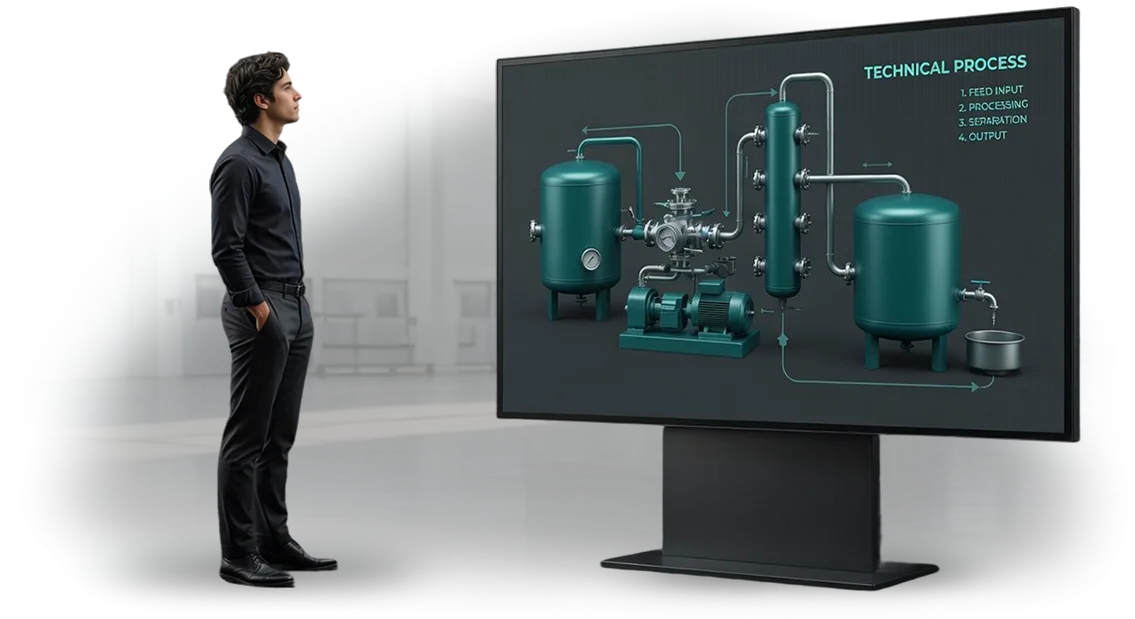
That is why companies are switching to 3D video instructions that show the assembly process without losing time on explanations. We address this pain point: we develop training video instructions that demonstrate the correct sequence of actions in detail and eliminate ambiguity.
The employee sees not an abstract diagram but an exact model of the sprayer where every component falls into place.
What benefits does business get from 3D instructions?
3D video instructions for sprayer assembly and maintenance are not just a replacement for paper regulations.
They deliver measurable results that are visible within the first weeks after implementation: fewer errors, faster onboarding of new employees, and noticeable budget savings on training.
The first benefit is a reduction in assembly and maintenance errors. The employee sees every sprayer component in volume, understands the sequence of actions, and knows typical trouble spots.
The result is fewer reworks, defects, and unplanned equipment downtime — and therefore lower direct costs for fixing mistakes.
Second — training cost savings. Instead of assigning a newcomer to an experienced mentor for months, the company gives them access to a clear video instruction.
Mastering basic operations takes significantly less time, experienced employees are less distracted from their tasks, and onboarding costs decrease.
Third — rapid adaptation of new employees. Short, visual videos help a person work confidently from the first days. They don't need to feel embarrassed about asking questions, and the supervisor doesn't need to monitor every step. This reduces turnover during the probation period and accelerates reaching planned productivity.
Ultimately, the business gets a team that works more consistently and requires fewer training resources.
These are exactly the results we record with our clients after implementing 3D instructions for sprayers — from reduced error counts to measurable budget savings on personnel training.
Formats of video instructions for sprayer assembly and maintenance
Employees perceive information differently, so the same sprayer assembly instruction works in three formats. The client chooses based on the task: fast onboarding, skills advancement, or practicing complex operations.
We prepare all three options based on a single 3D scenario so that training is consistent and non-contradictory.
Format matching the task
| Format | Who it's for | What it gives the client |
|---|---|---|
| 3D animation | New employees who need to understand the sprayer design from scratch | Visual breakdown of components and assembly sequence — reduces training time and the number of errors in practice |
| Interactive instruction | Line personnel preparing for the season or after a model update | Step-by-step scenario with action verification: the employee goes through the stages, and the system prompts if something is missed |
| VR training | Operators and service teams before going into the field | Practice on a virtual copy of the sprayer without the risk of damaging equipment — the skill is reinforced before working with the real unit |
Animation is good for a general overview, interactive for self-checking, and VR for bringing operations to automaticity. In one project, formats are easily combined: a short video for all employees, and a VR simulator only for service engineers.
This way you don't overpay for extra functionality and get exactly the level of immersion your team needs.
We build all formats on proven visualization tools, so the image remains realistic both on work laptops and in virtual reality headsets.
The training doesn't look like a diagram from a paper manual — employees see parts, fasteners, and mechanism movements, and after a short session easily repeat operations on a real sprayer.
How does the project progress from brief to launch?
We structured the process so that you understand what's happening and what you're paying for at every stage. No "black boxes": from brief to implementation, you see intermediate results and make edits before the work goes into production. Below is a typical 7-step project path, each step ending with a clear deliverable.
-
Brief and audit. We gather requirements: who will watch the instruction, which sprayer models, which operations are critical. We study your regulations so that the video matches internal standards.
-
Script and storyboard. We write the text — short and unambiguous, without unnecessary terminology. We prepare a visual plan: each instruction step is shown in frames.
-
Script approval. You receive the document, make edits, and approve the final version. This is the point of no return — from here production proceeds without surprises.
-
Production. We create 3D graphics: equipment, components, movements. We record voiceover narration and add subtitles and editing. We work on professional equipment — you get stable visuals and clean sound.
-
Interim review. You watch the draft version and note what to fix — for example, slow down a complex component or change the wording. Edits are made before the final render.
-
Instruction implementation. We deliver the finished files in the required formats — for LMS, YouTube, internal portal, or offline viewing. We help upload the video and verify that it opens for employees.
-
Support and updates. The instruction lives on: if the sprayer design or regulations change, we update the video without a full re-production. You're never left alone with outdated material.
The entire project runs on an agreed schedule — you know the dates in advance and can plan training. The average timeline from brief to finished instruction is 2–4 weeks, depending on the complexity of assembly operations. At every stage, you have a contact person who answers questions during the working day.
What's included in the video instruction delivery?
The complete package starts with the script: we write out every step of working with the sprayer — from preparation for departure to scheduled maintenance.
We account for typical beginner mistakes and safety requirements, so the employee immediately learns the correct sequence of actions.
Here's what you receive in the end
- Training script — step-by-step description of all sprayer operations: tank preparation, nozzle setup, field work, rinsing, and storage.
- Detailed 3D visualization — clear animation of assembly, disassembly, and routine work. The employee sees internal mechanisms and components in a way they couldn't even on real equipment.
- Professional voiceover and subtitles — the material is delivered through two perception channels, so it's absorbed even in a noisy environment or when watching without sound.
- Trainer guide (methodology manual) — a ready-made lesson plan: what to show, which points to emphasize, how to test knowledge after viewing. The trainer doesn't need to prepare from scratch.
- Files for learning management systems — upload the video to your LMS and assign it to employees in minutes, without re-encoding or adaptation.
- Implementation support — we help launch training on a pilot group, collect feedback, and make edits to the materials if needed.
This package saves your specialists' time: they don't need to devise a program on their own or search for visual aids. The video instruction works like a reliable mentor that's always at hand — even if an experienced employee leaves, the knowledge stays with the company.
As a result, you onboard new people faster, reduce the number of errors when working with sprayers, and get a unified training standard for all branches.
Case study: reducing assembly errors by 50% with a 3D instruction
Agricultural machinery is complex equipment: assembly correctness directly determines when the sprayer will go into the field.
The manufacturer who ordered a 3D video instruction from us faced a typical pain point — new employees got confused with paper diagrams, made mistakes, and had to redo some components. AgroTekhnika asked us to turn a complex process into a clear video scenario.
We analyzed the operations where failures occurred and turned them into visual 3D videos. The assembler sees every component, connection, and sequence of actions from the correct angle — no "reading drawings and filling in the gaps."
After implementation, we measured the results on the production floor: assembly errors dropped by 50%. That means fewer reworks and delays, faster ramp-up for newcomers, and predictable equipment release timelines.
For the business owner — stable cost control and confidence that the machinery will reach the customer on time.
We use the same instructions for other sprayer models: once created, the videos are updated, expanded, and continue to serve training and service throughout the entire equipment lifecycle.
Why the client chose us
At the brief stage, we showed a demo version of one component's assembly. The client immediately saw how quickly an operator understands the actions and approved the project.
Since then, we've received repeat orders for new sprayer models — for us, that's the main measure of value.
How to choose the right training format for your task?
Choosing a training format really depends on the task at hand, not on trends or "the most modern" option. There's no universal solution: what works perfectly for one company is overpaying for another.
So the first step is to define your requirements: which operations employees need to master, how complex they are, how often regulations change, and what your training budget is.
When it comes to assembling, configuring, and maintaining sprayers with many components, 3D video instructions work better: they show mechanisms "from the inside" without stopping production or using real equipment.
For simple procedures, like safety briefings, classic video with a live speaker is sufficient. The main thing is not to chase a format but to start from what should change in the employee's behavior after training.
How to avoid overpaying? Transparent task setting at the start. We help capture requirements, break the material into modules, and choose a format that covers the need without unnecessary costs.
For example, you don't need complex 3D animation for a short regulation — quality screen recording or filming will do. But for regular training of new mechanics, it pays for itself through reduced errors and shorter onboarding time.
Ultimately, choosing the right format isn't about "more expensive/cheaper" but about matching the task. If you're unsure which option fits you, our specialists will audit your materials and help select a solution for your budget.
This way you get a working program rather than paying for "extra" technology capabilities.
What if training doesn't produce results?
Collective experience and sound methodology are what distinguish training that works from formal "box-ticking." If an employee watched a video and couldn't apply the knowledge in practice, the problem isn't the person but the approach: the instructions were detached from real work, didn't account for beginner mistakes, and offered no feedback. The business ends up with defects, downtime, and turnover instead of confident specialists.
That's why we structure the development process to eliminate the "trained but no result" situation.
We work on the "made — verified — refined" principle: at every stage, you see intermediate versions, provide feedback, and we adjust the material for your employees. This isn't a one-time delivery but collaborative work until a clear result is achieved.
What's included in the result guarantee:
- Post-launch support. We don't disappear after delivery: for an agreed period, we answer questions, help integrate the instructions into the training process, and advise on how to motivate employees to watch them.
- Free refinements based on pilot results. The first month of use will show which areas need strengthening: adding analysis of common mistakes, speeding up the pace, or splitting a complex component into smaller steps. We make edits at no additional cost.
- Fixed cost and timelines. Before starting, you receive an estimate and a schedule that don't change without your consent. No "we discovered extra work" mid-project.
- Right to make edits at every stage. We approve the script, storyboard, voiceover, and final video sequence. You always control the outcome.
What if the video doesn't suit specific employees — then what?
We don't shelve the material. Before the final edit, we show a draft version to 2–3 employees from the target audience, collect their reactions, and refine it.
If after launch it turns out that some block is still hard to perceive, we'll reshoot or supplement it for free — within the agreed scope.
Leave a request for video instruction development for your equipment
Employees master new operations faster when they see not abstract diagrams but an accurate 3D model of the sprayer. A corporate video instruction reduces training time, lowers the risk of breakdowns, and makes knowledge independent of a specific mentor's experience.
That's why we suggest starting with a pilot project: we'll take one component or operation and show how the instruction will work on your equipment.
Leave a request — and we'll prepare a commercial proposal with pilot terms, timelines, and format.
Before that, we'll hold a consultation: we'll clarify what tasks the instruction solves for your mechanics or operators and select the optimal presentation — 3D animation, a combined format, or video with real component footage.
- Request: you receive a cost and timeline estimate within one business day.
- Consultation: we review your training scenario so the instruction addresses your employees' real errors.
- Pilot project: we create a fragment of the instruction for your sprayer — you see the result before full development.
- Clear stages: brief, script, 3D model, visualization, and editing — you control every step.
- Post-delivery support: we make edits and help integrate the video instructions into your training system.
Take the first step — leave a request on this page. We'll respond within one business day, show examples of similar projects, and offer a pilot that proves the value of video instructions in practice.